
 March 25, 2026 by Editor |
For a global multinational corporation, a high-stakes live streamed event is not merely a communication channel; it is a direct reflection of the organization’s operational excellence and technological prowess. Whether it is a CEO town hall, a global product launch, or a critical investor relations briefing, the expectation is flawless, broadcast-grade execution. However, the complex interplay of on-premise production hardware, enterprise network infrastructure, and cloud-based distribution platforms creates an environment ripe with potential points of failure. In this mission-critical context, standard IT support is insufficient. The differentiating factor that ensures seamless delivery and protects executive confidence is a dedicated, 24/7 broadcast engineering technical support team. This is not a reactive help desk; it is a proactive, integrated component of the production workflow, providing the premium edge required for successful global operations.
This article provides a deep technical analysis of the structure, function, and quantifiable value of specialized 24/7 technical support for B2B event streaming and hybrid production. We will examine the specific engineering skillsets, the infrastructure required for immediate global intervention, and the tangible return on investment that such a service provides to enterprise clients. We will move beyond abstract concepts and detail the specific protocols, hardware, and workflows that define a truly resilient live streaming ecosystem managed by expert engineers, available at any moment.
Deconstructing Mission-Critical Support: Beyond the IT Help Desk
The term ‘technical support’ often evokes images of a tiered ticketing system, where issues are logged, categorized, and escalated through a queue. This model is entirely inadequate for the real-time, high-pressure environment of live event production. A single dropped frame, audio desynchronization, or encoder failure can derail an entire event in seconds. Mission-critical support in this domain is defined by immediate access to broadcast engineers with the authority and capability to diagnose and resolve complex signal flow and network issues in real time.
Real-Time Triage by Broadcast Engineers vs. Escalation Queues
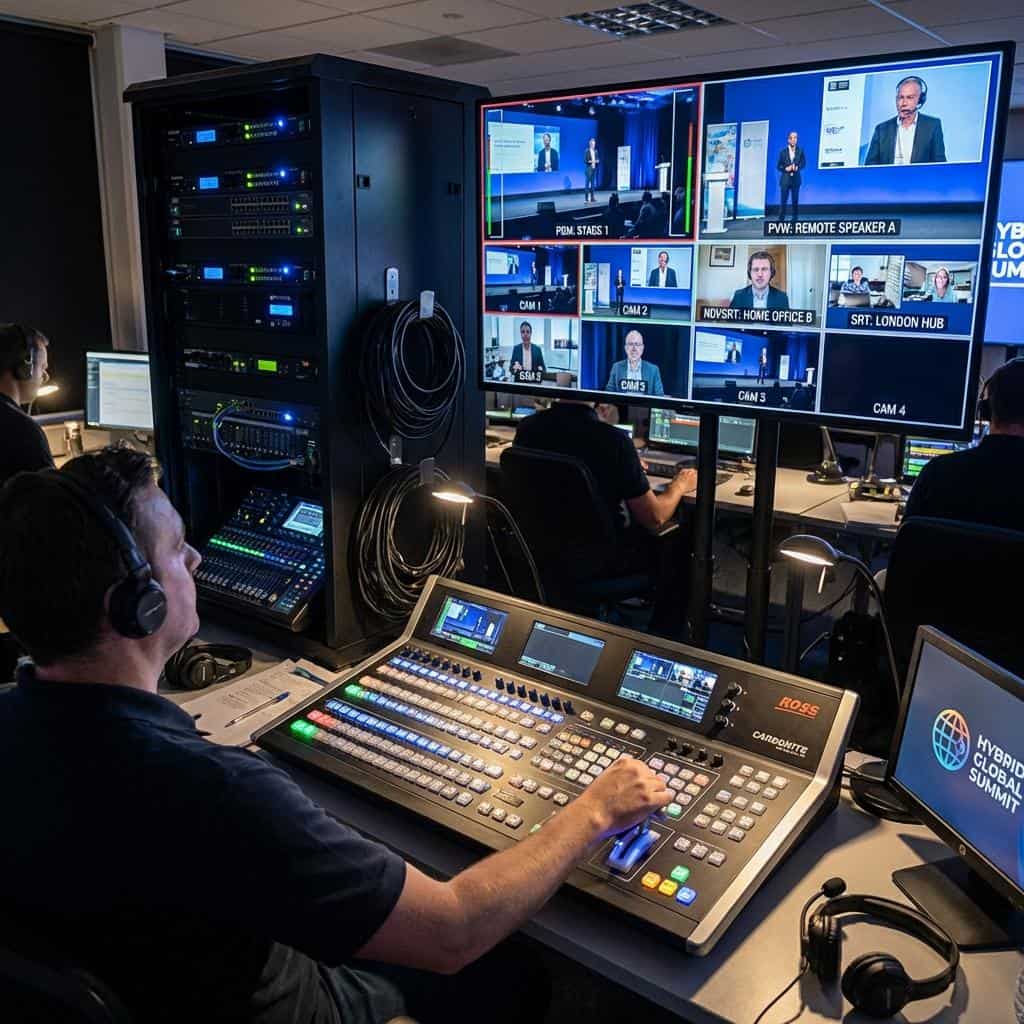
A standard IT help desk is structured to handle a high volume of common software and hardware issues. An AV-related problem, such as a video signal not appearing on a contributor’s return feed, would typically result in a Level 1 ticket. This ticket would then be escalated to Level 2 and potentially Level 3 before reaching a specialist, a process that can take hours. In live production, this latency is unacceptable. A broadcast support engineer, by contrast, operates on a principle of immediate triage. When a call comes in from a production team on-site, they are not logging a ticket; they are joining a live communications channel (e.g., Clear-Com or Riedel over IP) and immediately interrogating the production environment. Their expertise allows them to bypass rudimentary troubleshooting and focus directly on the likely failure points in a professional signal chain. For instance, they can differentiate between a failed 12G-SDI port on a router, a corrupted EDID (Extended Display Identification Data) handshake over an HDMI 2.1 connection, or a network configuration issue preventing an NDI (Network Device Interface) source from being visible on the production switcher.
Proactive System Monitoring and Pre-Event Diagnostics
The most effective support is preventative. A premier 24/7 support service begins its work long before the event goes live. This involves a rigorous pre-flight check of the entire technical ecosystem. Engineers remotely access network monitoring tools to perform path analysis, checking for latency, jitter, and packet loss on the primary and backup data routes. They use specialized software to stress-test streaming encoders, ensuring the hardware can sustain the target bitrate (e.g., 8-10 Mbps for a high-quality 1080p60 H.264 feed) for an extended duration without thermal throttling or performance degradation. Furthermore, they analyze the integrity of video signals using remote waveform monitors and vectorscopes to check for illegal color values or luminance levels that could cause issues on downstream broadcast systems. This proactive diagnostic phase identifies and resolves potential failures hours or even days before the production, transforming the support function from a reactive fix to a core part of the quality assurance process.
The Anatomy of a Global Support Infrastructure
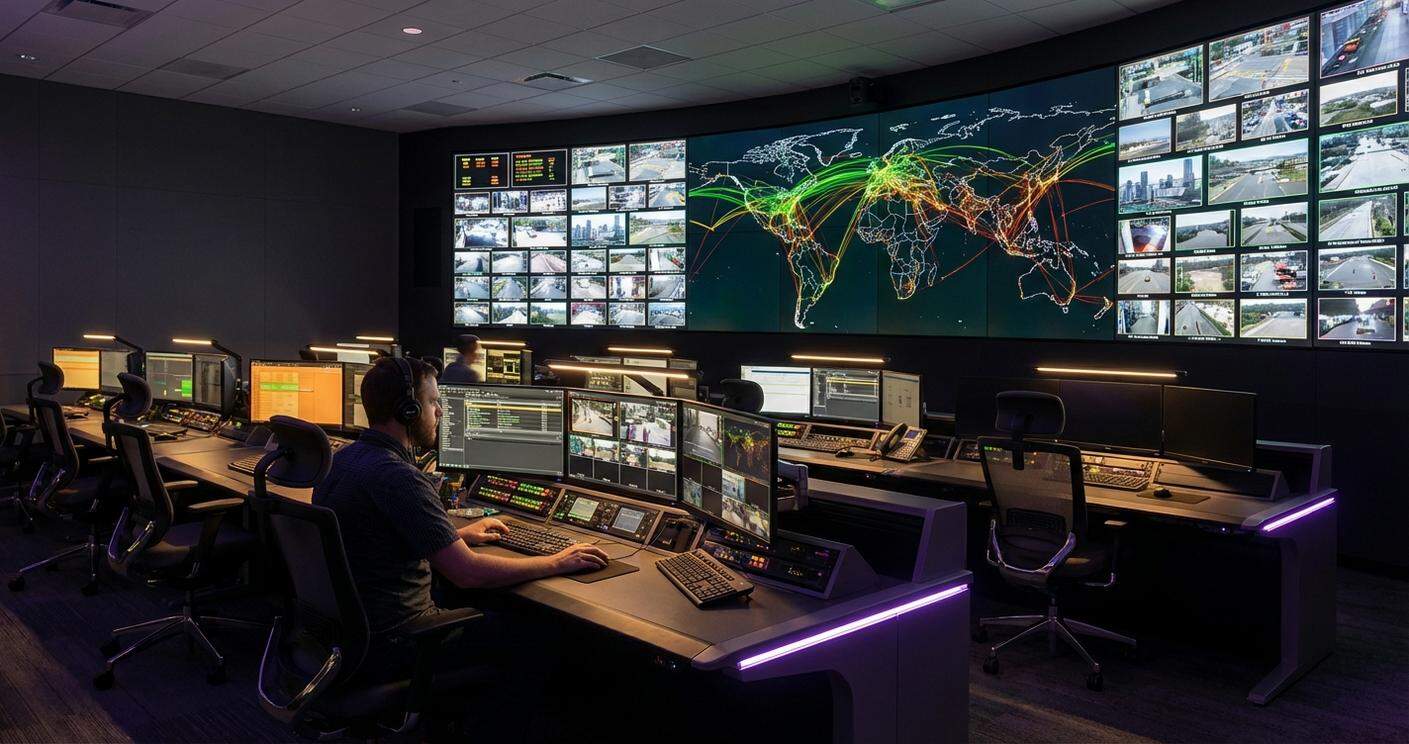
Providing instantaneous, expert-level support to productions occurring in any time zone requires a sophisticated and robust infrastructure. This system is a combination of a global human footprint, secure remote access technologies, and a deep integration with redundant hardware and network architectures. It enables engineers located thousands of miles away to function as if they were physically present in the control room or data center, making critical adjustments to hardware and software configurations with millisecond precision.
Follow-the-Sun Support Model for Geographically Dispersed Operations
True 24/7 coverage is achieved through a ‘follow-the-sun’ model, with engineering teams strategically located in key regions such as North America, EMEA (Europe, Middle East, and Africa), and APAC (Asia-Pacific). As the business day ends in one region, operational command is seamlessly handed over to the team in the next. This ensures that a client in Tokyo at 2:00 PM local time receives the same level of alert, expert support as a client in New York at the same local hour. This model eliminates coverage gaps and the risks associated with on-call engineers who may be fatigued or delayed in their response. The teams are interconnected via a unified communications platform and a shared knowledge base, ensuring that any ongoing issues are transferred with complete context during handovers, providing a consistent support experience regardless of the time of day.
Secure Remote Access and Control Protocols
The core enabler of effective global support is the ability to securely access and control production systems remotely. This is achieved through a multi-layered security and technology stack. A hardened corporate VPN (Virtual Private Network) provides the initial secure tunnel into the client’s production network or the cloud environment. From there, engineers utilize specific protocols to interface with equipment. For IT infrastructure, this may involve SSH (Secure Shell) for command-line access to servers and network switches. For production hardware, it means using manufacturer-specific control protocols, such as Ross Video’s DashBoard for controlling switchers and graphics systems, or Audinate’s Dante Controller for remotely re-routing audio-over-IP flows. When direct hardware control is not possible, secure remote desktop solutions (e.g., TeamViewer, AnyDesk) configured with two-factor authentication provide access to the graphical user interface of on-site control computers. This granular access allows an engineer in London to, for example, re-route a PGM (Program) feed from a failed SDI output to a working one on a video router in a Singapore data center.
Redundancy, Failover, and Real-Time Support Intervention
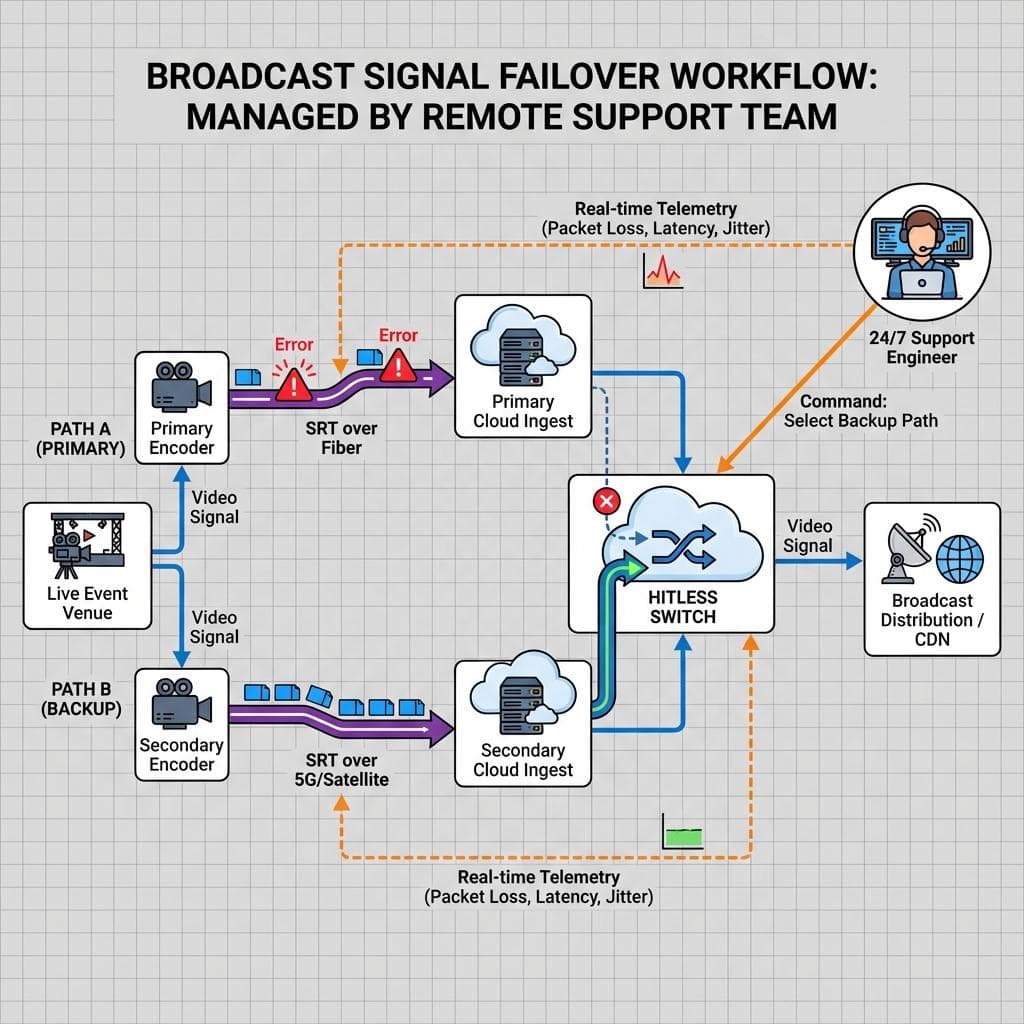
A resilient streaming architecture is built on redundancy, but it is the 24/7 support team that makes this redundancy effective. A common professional setup involves a 1+1 or N+1 redundancy model for critical components like encoders and network paths. For example, a primary video feed might be encoded and transported via SRT (Secure Reliable Transport) over a primary fiber internet connection. A secondary, identical feed is simultaneously sent via a different encoder over a satellite or cellular bonded backup link. The 24/7 support team monitors both feeds in real time. If their monitoring tools detect rising packet loss or latency on the primary SRT stream, they do not wait for a catastrophic failure. They proactively execute a ‘hitless’ switch to the backup stream at the cloud ingest point or master control. This intervention, which can be executed in under a second, is completely transparent to the global audience. The support engineer’s role is to make the intelligent decision to switch, a nuance that automated systems can often miss, preventing a minor degradation from becoming a total broadcast outage.
Quantifying the ROI of Premium Technical Support
Investing in a 24/7 broadcast engineering support service is not an operational expense; it is a strategic investment in risk mitigation and brand protection. The return on investment (ROI) can be measured through direct financial savings, the preservation of brand integrity, and the optimization of global production workflows, delivering value that far exceeds the cost of the service contract.
Mitigating the Financial Impact of Broadcast Downtime
The financial cost of downtime during a major corporate event can be immense. Consider a global all-hands meeting for an MNC with 20,000 employees. If the average fully-loaded cost per employee is $75 per hour, a 30-minute outage due to a technical failure equates to $750,000 in lost productivity and wasted salary expenses. This figure does not even account for the cost of the production itself or the strategic initiatives being delayed. For an external-facing event like a product launch or investor briefing, a failure can directly impact sales and stock price. A 24/7 support team, by preventing even a single major outage per year through proactive monitoring and rapid intervention, can deliver an ROI that is orders of magnitude greater than its cost.
Upholding Brand Integrity and Executive Confidence
Beyond direct financial loss, technical failures in high-profile broadcasts cause significant reputational damage. A glitchy stream during a CEO’s address undermines the perception of the company as a competent, tech-forward organization. It erodes the confidence of employees, investors, and customers. Most importantly, it damages the confidence of the C-suite executives who are the face of the broadcast. When leadership cannot trust the underlying technology, their communication becomes hesitant, and their focus is diverted. A 24/7 support service acts as a guarantee of operational stability. It provides executives and event planners with the peace of mind that a team of expert engineers is dedicated to ensuring their message is delivered flawlessly, preserving both their personal credibility and the company’s brand integrity.
Streamlining Global Production Standards and Workflows
For large MNCs, maintaining consistent technical quality across dozens of regional offices and production teams is a major challenge. A centralized 24/7 support team becomes the guardian of these global standards. By being involved in productions across all regions, they build a comprehensive knowledge base of best practices, equipment configurations, and network conditions specific to the organization. When a team in one region develops an innovative and efficient workflow, the support team can document and disseminate that process to all other regions. This prevents production teams from operating in silos and “reinventing the wheel.” It ensures that whether an event originates in São Paulo or Seoul, it adheres to the same high standards for video quality, audio clarity, and transmission stability, creating a unified and professional global communication strategy.
In conclusion, for global enterprises that rely on live video for critical communications, 24/7 broadcast engineering support is the definitive line between amateur execution and professional excellence. It is the human intelligence layer that governs complex technology, the proactive assurance that prevents failures before they occur, and the immediate expert response that contains and resolves issues in seconds, not hours. By integrating this level of support into their streaming strategy, MNCs are not just buying a service; they are investing in operational resilience, brand protection, and the unwavering confidence that their most important messages will be seen and heard, flawlessly, every single time.