
 March 16, 2026 by Editor |
For premium global brands, the standard for digital communication is absolute control. Off-the-shelf streaming platforms, while functional for general use, present significant limitations in branding, security, and data integration for high-stakes corporate events. When a global town hall, product launch, or investor relations briefing demands a flawless and secure viewing experience, the underlying technology must be as bespoke as the brand itself. This is the domain of the white-label enterprise streaming portal, a custom-built ecosystem that moves beyond a simple embedded player to become a secure, scalable, and fully integrated extension of the corporate brand. It’s an infrastructure decision, shifting the conversation from “which platform to use” to “how we control our own streaming destiny”. For the technical stakeholders, from IT directors to production managers, this involves a deep understanding of the signal chain, from the on-premise production switcher to the global delivery at the end-user’s screen.
The Core Architecture of an Enterprise Streaming Portal
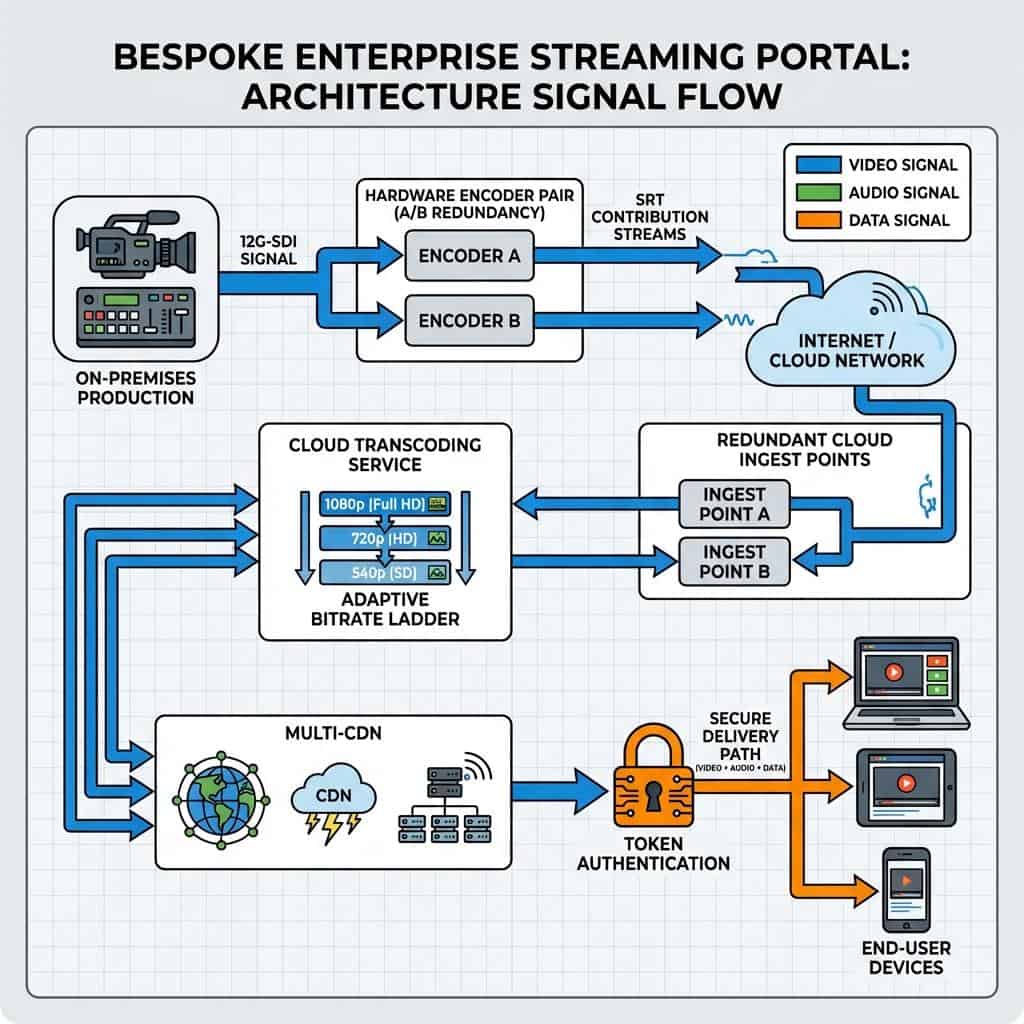
A bespoke streaming portal is not a single product but a carefully architected system of interconnected services. Each component must be engineered for reliability, low latency, and security. The architecture can be broken down into three fundamental stages: ingest and contribution, cloud-based processing and transcoding, and global content delivery. Missteps in any of these areas can compromise the entire event, leading to buffering, security breaches, or a complete signal loss.
Ingest and Contribution: Securing the First Mile
The journey of a live stream begins with contribution, the process of transporting the primary program feed from the production environment to the cloud. The protocol used for this “first mile” is critical. While Real-Time Messaging Protocol (RTMP) and its secure variant RTMPS have been industry mainstays, their reliance on TCP (Transmission Control Protocol) can introduce latency and instability over unreliable networks. For enterprise applications, Secure Reliable Transport (SRT) is the superior choice. SRT, an open-source protocol, provides the reliability of TCP with the low latency of UDP (User Datagram Protocol) by handling packet loss recovery at the application layer. This allows for high-quality, stable contribution streams even over congested public internet connections, with latency typically under 500ms. A typical configuration involves a primary and backup hardware encoder, such as a Haivision Makito X4 or an AJA HELO Plus, each fed by a separate SDI (Serial Digital Interface) output from the master production switcher. These encoders are configured for SRT contribution to geographically diverse cloud ingest points, ensuring physical and network path redundancy.
Transcoding and Encoding Ladders in the Cloud
Once the high-bitrate contribution feed, often a 1920x1080p stream at 10-15 Mbps encoded with H.264, reaches the cloud, it must be transcoded for adaptive bitrate (ABR) delivery. ABR streaming is essential for reaching a global audience with varying network conditions. The process involves creating multiple, lower-bitrate versions of the stream, known as an encoding ladder. A robust ladder for a corporate event might look like this:
- 1920×1080, 59.94 fps, H.264 Main Profile, 6 Mbps
- 1280×720, 29.97 fps, H.264 Main Profile, 3.5 Mbps
- 960×540, 29.97 fps, H.264 Main Profile, 1.8 Mbps
- 640×360, 29.97 fps, H.264 Baseline Profile, 800 Kbps
This transcoding can be handled by cloud services like AWS Elemental MediaLive or Bitmovin, which provide scalable, resilient processing. For content requiring higher efficiency, the H.265 or High Efficiency Video Coding (HEVC) codec can be employed, offering up to a 50% bitrate reduction for the same visual quality compared to H.264. This is particularly valuable for delivering 4K/UHD content or optimizing delivery over mobile networks. The output is packaged into formats like HLS (HTTP Live Streaming) or MPEG-DASH for broad player compatibility.
Global Content Delivery Network (CDN) Integration
The final stage is delivery via a Content Delivery Network (CDN). A CDN caches the HLS or DASH stream segments on servers located around the world, physically closer to the end-users. This dramatically reduces latency and buffering while absorbing the traffic load of a large-scale audience. For a bespoke portal, integrating a multi-CDN strategy with providers like Akamai, Cloudflare, and Amazon CloudFront provides an additional layer of resilience. Security is paramount at this stage. Token authentication ensures that only authorized viewers can access the stream, preventing unauthorized embedding or sharing. The portal’s backend generates a unique, short-lived token for each authenticated user session, which is validated by the CDN at the edge before a video segment is served. This, combined with geofencing to restrict access to specific regions, provides robust control over content distribution.
Beyond the Player: Integrating Data, Security, and Interactivity
A white-label portal’s true power lies in its deep integration with enterprise systems. The video player is merely the front-end interface to a complex backend that manages security, data, and user experience. This level of customization is impossible with public platforms and is a core requirement for brands that view their events as critical business assets.
Enterprise-Grade Security: SSO, DRM, and Access Control
Security for an internal corporate event or a sensitive financial briefing must be absolute. Bespoke portals achieve this by integrating directly with enterprise identity providers using protocols like SAML 2.0 or OpenID Connect. This enables Single Sign-On (SSO), where employees authenticate using their existing corporate credentials from services like Azure Active Directory, Okta, or Ping Identity. This workflow is seamless for the user and provides the organization with centralized, auditable access control. Beyond authentication, encryption is critical. All data in transit must be secured using TLS 1.3. For highly sensitive content, such as pre-release product information or unannounced financial results, Digital Rights Management (DRM) is implemented. DRM technologies like Google Widevine, Apple FairPlay, and Microsoft PlayReady provide device-level content protection, preventing screen recording and unauthorized distribution through robust encryption key exchange systems.
API-Driven Data Integration and Analytics
A bespoke portal functions as a data hub, not just a video platform. Using a robust API (Application Programming Interface), the portal can synchronize with other enterprise systems. Attendee registration data from platforms like Cvent or Bizzabo can be used to automatically provision access and personalize the viewing experience. During the event, engagement metrics, including viewing duration, poll responses, and Q&A submissions, are captured in real-time. This data can be pushed directly into a CRM like Salesforce or a marketing automation platform like Marketo, providing immediate insight into audience engagement and lead qualification. The portal’s analytics dashboard goes far beyond simple view counts, offering Quality of Experience (QoE) metrics such as rebuffering ratios, video startup times, and bitrate distribution across the audience, giving technical teams the data needed to diagnose and optimize stream performance.
The Production Nexus: Bridging On-Premises Control with Portal Delivery
The enterprise portal is the delivery vehicle, but the content originates from a professional production environment. The bridge between the physical and digital worlds must be meticulously planned to maintain signal integrity and provide the seamless experience expected from a premium brand. This is where broadcast engineering principles are applied to corporate event production.
On-Premises Master Control and Signal Routing
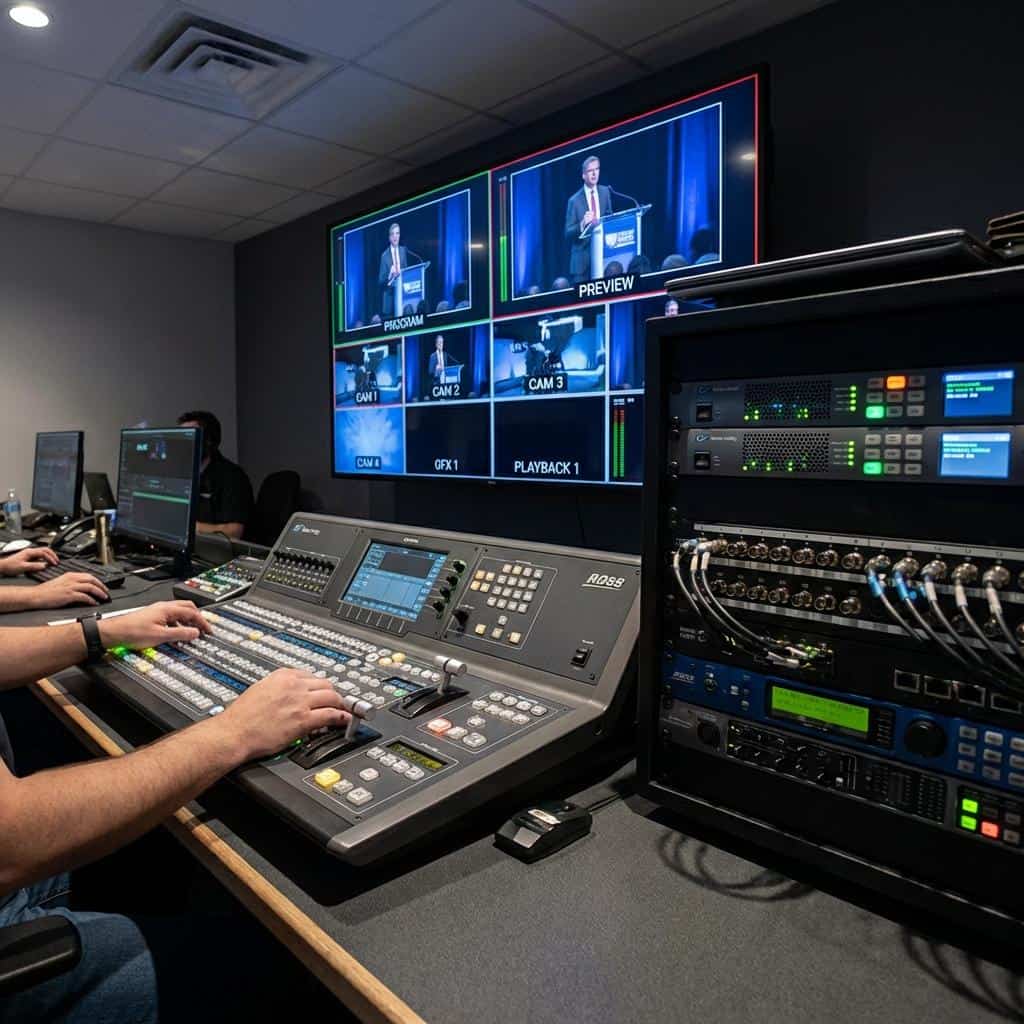
The on-premises production control room serves as the event’s technical heart. The infrastructure is typically built around a 12G-SDI or 3G-SDI signal flow for uncompressed video, supporting resolutions up to 4K/UHD. A production switcher, like a Ross Video Carbonite or Blackmagic Design ATEM Constellation, is the core component for mixing camera sources, graphics, and video playout. All video sources are synchronized to a master reference signal (genlock) to ensure clean switching. Audio is often managed via a Dante or MADI network, allowing for flexible routing from microphones and playback sources to a digital audio console for mixing. The final program feed, along with multiple auxiliary outputs for confidence monitoring and speaker timers, is distributed via an SDI router. ISO (isolated) recordings of each camera feed are often captured directly from the switcher or on dedicated recorders for post-event editing.
Redundancy and Failover Protocols
For any high-stakes B2B event, failure is not an option. Redundancy is engineered into every layer of the production and delivery chain. This starts in the control room with redundant power supplies for all critical equipment. A primary and a backup production switcher may be used in the most demanding scenarios. The program feed is sent to two separate hardware encoders, which are connected to different network switches and ideally, different internet service providers. This A/B path redundancy extends to the cloud, where the two SRT streams arrive at separate ingest points. In the cloud, services like AWS Elemental MediaLink or Zixi can be configured for automatic failover. If the primary contribution stream is lost, the system instantly switches to the secondary stream with no disruption to the end viewer. This level of resilience is a non-negotiable requirement for enterprise-level streaming.
Ultimately, a bespoke enterprise portal is an investment in brand integrity, security, and data ownership. It provides a level of control and customization that is simply unattainable through third-party platforms. For global brands hosting mission-critical events, it is the only way to guarantee that the technical execution matches the premium quality of their content and the expectations of their audience. It transforms live streaming from a simple broadcast into a fully integrated, secure, and data-rich digital experience.