
In the high-stakes realm of B2B event streaming and hybrid production, the ability to seamlessly deliver content beyond internal network perimeters is paramount. Multinational Corporations (MNCs), with their stringent IT security policies and complex network architectures, often present formidable challenges to external live stream deployments. What appears as a simple outbound data stream to a production team can be a significant security concern for an enterprise IT department, leading to blocked transmissions, compromised quality, or outright project failures. This article, authored by the Live Streaming Studio Technical Team, delves into the intricate technical landscape of navigating MNC IT restrictions, providing expert insights and actionable strategies for corporate event planners, AV professionals, and IT directors alike. Our focus is on ensuring secure, reliable, and high-quality external streaming for critical B2B events, leveraging advanced protocols and robust infrastructure designs, distinctly separate from consumer-grade streaming paradigms.
The Labyrinth of Enterprise Network Perimeters: Understanding the Core Challenges
Enterprise networks are engineered for security and data integrity. This inherently creates a challenging environment for outbound live streaming. Firewalls, proxy servers, Deep Packet Inspection (DPI) systems, and stringent egress filtering policies, while crucial for protecting sensitive corporate data, often impede the dynamic and high-bandwidth requirements of professional live video. Understanding the technical mechanisms of these security layers is the first step in formulating an effective streaming strategy.
Deep Packet Inspection and Egress Filtering Impact on Streaming Data
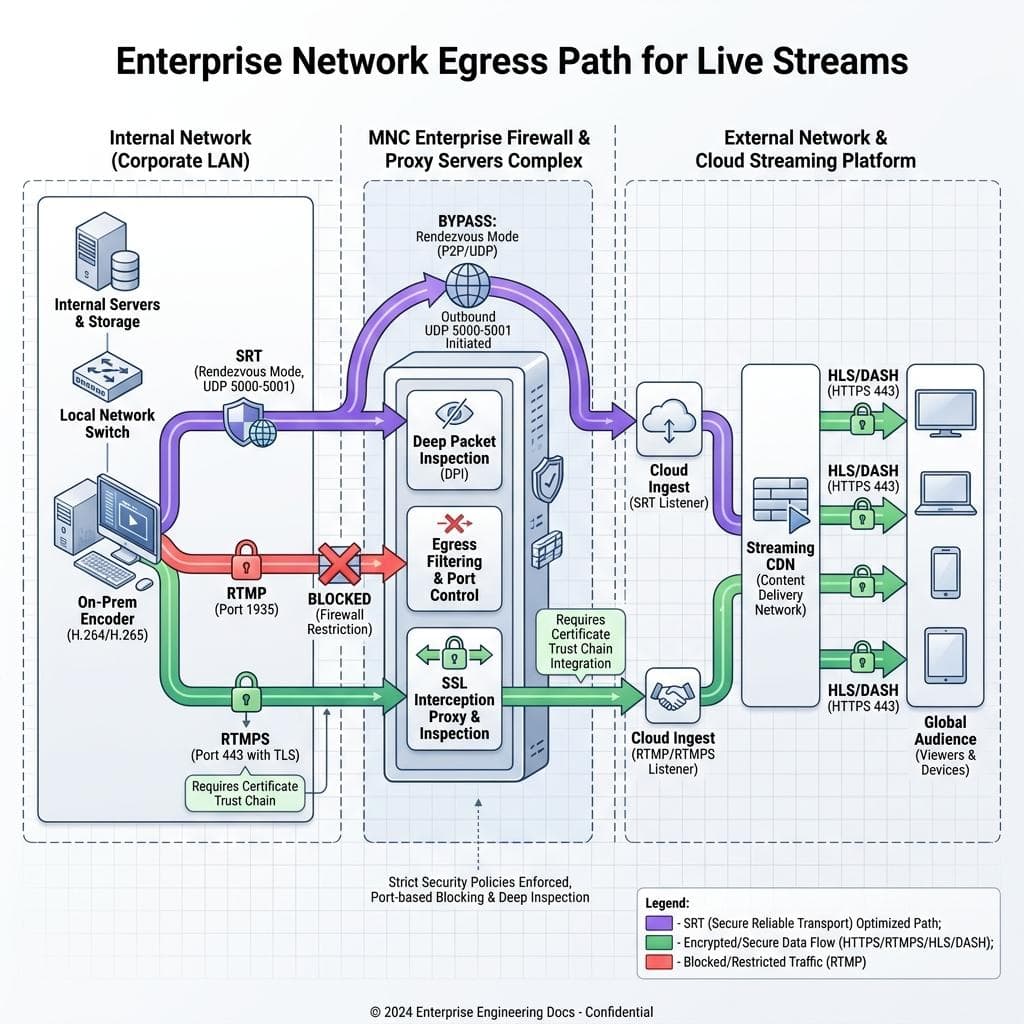
Deep Packet Inspection (DPI) scrutinizes network traffic beyond mere header information, examining the actual payload for policy compliance, malicious content, or unauthorized protocol usage. For live streaming, especially with less common or proprietary protocols, DPI can mistakenly flag legitimate video data as suspicious, leading to packet drops or connection termination. Egress filtering, conversely, controls what traffic can leave the internal network. Most MNCs maintain strict egress rules, allowing only traffic on well-known ports (e.g., TCP 80 for HTTP, TCP 443 for HTTPS) and blocking others. This poses a direct challenge for protocols like Real-Time Messaging Protocol (RTMP), which traditionally operates on TCP port 1935, a port frequently closed in enterprise environments. Even if the port is open, the unpredictable nature of streaming protocols can still trigger DPI alerts.
Proxy Servers, SSL Interception, and Certificate Trust Chains
Proxy servers act as intermediaries for network requests, especially for web traffic. In an MNC, explicit or transparent proxies are often deployed for content filtering, caching, and security auditing. For secure streaming protocols like RTMPS (RTMP over SSL/TLS) or Secure Reliable Transport (SRT) with TLS encryption, proxy servers can introduce significant hurdles. Many enterprise proxies perform SSL/TLS interception (also known as “man-in-the-middle” SSL inspection). In this scenario, the proxy decrypts encrypted traffic, inspects it, re-encrypts it with its own certificate, and then forwards it. For this to work without triggering certificate warnings or connection failures, the proxy’s root Certificate Authority (CA) certificate must be trusted by the streaming encoder or client device. Failure to properly establish this trust chain will result in the encrypted stream being blocked, as the encoder cannot validate the proxy’s presented certificate against its known CAs.
Strategic Protocol Selection for Secure and Reliable External Delivery
The choice of streaming protocol is a foundational decision impacting the feasibility and quality of an external stream. While RTMP has been an industry staple, its limitations within restrictive IT environments necessitate exploration of more advanced, resilient alternatives.
RTMP/RTMPS: Legacy Workhorse and Its Enterprise Limitations
RTMP, leveraging TCP port 1935, has historically been the de-facto standard for live stream ingest due to its widespread support and relative simplicity. However, its TCP-centric design makes it highly susceptible to network congestion and packet loss, leading to visible stuttering or buffering. While RTMPS secures the RTMP payload using SSL/TLS encryption over TCP port 443, making it less prone to basic port blocking, it remains vulnerable to the SSL interception proxies and the underlying TCP inefficiencies in lossy networks. The continuous connection requirement of RTMP also makes it sensitive to transient network disruptions, often requiring full reconnection and re-buffering, which is unacceptable for professional B2B events.
Secure Reliable Transport (SRT): The Enterprise-Grade Solution
Developed by Haivision, Secure Reliable Transport (SRT) stands as a robust, low-latency, and highly reliable video transport protocol specifically designed for challenging network conditions, including traversing firewalls. SRT operates over User Datagram Protocol (UDP), which inherently offers lower latency than TCP by foregoing guaranteed packet delivery at the transport layer. Instead, SRT implements its own sophisticated error recovery mechanisms, including Automatic Repeat Request (ARQ) and advanced jitter buffering, to ensure packet integrity without the retransmission overhead of TCP. This makes it exceptionally resilient to packet loss and network jitter commonly found in corporate WANs and public internet paths. SRT also incorporates robust AES-128 or AES-256 bit encryption, providing broadcast-grade security. Crucially for enterprise environments, SRT offers flexible firewall traversal modes:
- Caller/Listener Mode: One endpoint acts as a “listener” awaiting a connection, while the other acts as a “caller” initiating it. The listener typically needs an open port.
- Rendezvous Mode: Both endpoints initiate the connection simultaneously towards each other, effectively “punching through” NAT and firewalls without requiring specific inbound port forwarding, as long as outbound UDP traffic is permitted. This mode is particularly advantageous for external contributions from within restrictive corporate networks.
For internal network distribution prior to egress, protocols like NDI (Network Device Interface) or its compressed variant NDI|HX can be utilized to move high-quality video between production devices over standard Ethernet, leveraging a dedicated VLAN to minimize network impact. The NDI stream can then be fed into a hardware encoder for SRT egress.
HTTP-Based Streaming (HLS/DASH) for Final Distribution
For the final delivery to a broad external audience, HTTP-based streaming protocols such as HLS (HTTP Live Streaming) and MPEG-DASH are the industry standard. These protocols fragment video into small, indexed segments and deliver them over standard HTTP/HTTPS (ports 80/443). Since these ports are almost universally open for web browsing, HLS and DASH streams are highly compatible with enterprise networks and firewalls for content consumption. They leverage existing Content Delivery Networks (CDNs) for global distribution, caching, and scalability, further reducing the burden on the origin server and the corporate egress point. While HLS/DASH are excellent for delivery, they introduce higher latency (typically 10-30 seconds) and are therefore generally not suitable for low-latency ingest from the corporate source; this is where SRT excels.
Architecting Resilient and Secure Streaming Infrastructure for MNC Environments
Beyond protocol selection, a robust architectural approach is essential. This involves carefully planning on-premise encoding, secure egress points, leveraging cloud platforms, and implementing advanced security measures to form an impenetrable yet flexible streaming pipeline.
On-Premise Encoding and Secure Egress Points
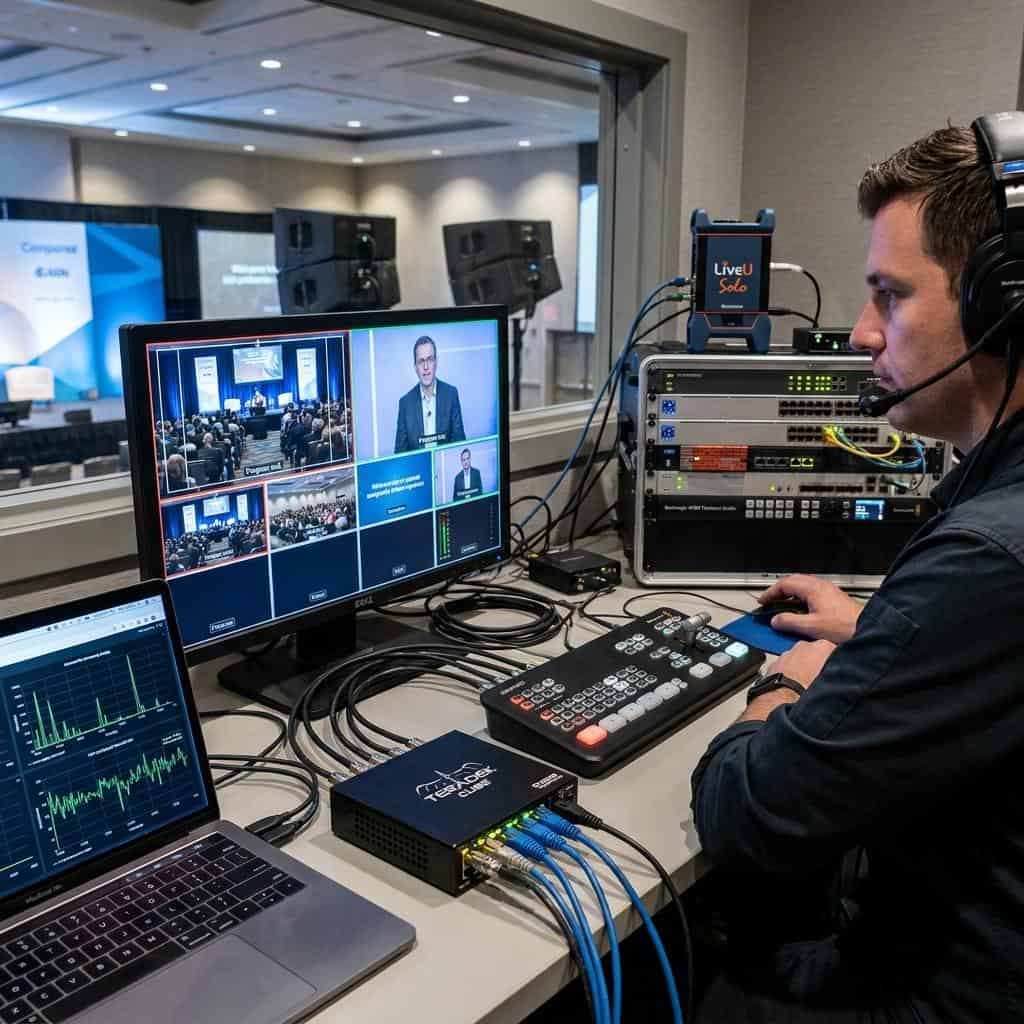
Professional hardware encoders are indispensable for B2B live streaming. Devices such as the AJA HELO Plus, Teradek Cube, or LiveU units provide reliable, high-quality H.264/H.265 encoding with support for SRT, RTMPS, and multiple bitrate outputs (Adaptive Bitrate Streaming – ABR). These encoders should be placed on a dedicated network segment or a Demilitarized Zone (DMZ), logically or physically separated from the main corporate LAN. This DMZ acts as a controlled egress point, minimizing the attack surface and allowing granular firewall rules to be applied specifically to streaming traffic. Crucially, Quality of Service (QoS) configurations must be implemented on enterprise network infrastructure (routers, switches) to prioritize streaming data. By assigning Differentiated Services Code Point (DSCP) values to video packets, network devices can guarantee bandwidth and low latency for the stream, preventing business-critical video from being degraded by other network traffic. For a 1080p60 stream at 8 Mbps, dedicated symmetrical bandwidth of at least 15-20 Mbps is recommended to account for overhead and bursts, along with latency under 100ms and minimal jitter.
Cloud-Based Processing and Distribution Platforms
Leveraging cloud-based ingest and processing platforms is a strategic move to decouple internal corporate infrastructure from external streaming complexities. Services like AWS Elemental MediaLive, Azure Media Services, or Google Cloud Media CDN can act as the secure, external destination for SRT streams exiting the corporate network. These platforms provide scalable transcoding, packaging (to HLS/DASH), and distribution capabilities. By targeting a cloud ingest point as the primary destination, the corporate network only needs to establish a secure, controlled connection to a specific cloud endpoint, offloading the global distribution and scaling challenges to professional cloud providers. This architecture simplifies firewall rules, as only the connection to the cloud ingest IP and port (e.g., UDP 5000-5001 for SRT) needs to be whitelisted.
Advanced Security Measures: VPN Tunnels and TLS Handshakes
For an added layer of security and to potentially bypass some DPI mechanisms, establishing a site-to-site Virtual Private Network (VPN) tunnel between the corporate network’s edge device and the streaming provider’s infrastructure (or a cloud VPN gateway) can create an encrypted, trusted path for streaming traffic. While the VPN connection itself still requires specific port allowances (e.g., UDP 500 for IKEv2), the streaming payload within the tunnel is fully encapsulated and encrypted, making it invisible to deeper inspection by intermediate firewalls. For RTMPS and SRT, strict adherence to TLS/SSL best practices is paramount. This includes using strong cryptographic algorithms (e.g., TLS 1.2 or 1.3), current server certificates issued by trusted CAs, and ensuring proper certificate chain validation on the encoder. This prevents unauthorized interception or tampering with the encrypted stream.
Operational Workflows and Collaborative Strategies for IT and Production Teams
Even with the most advanced technology, successful external streaming through MNC IT infrastructure hinges on proactive planning and seamless collaboration between the production team and the corporate IT department.
Pre-Event Network Assessment and White-listing Procedures
Early engagement with IT is not merely recommended; it is mandatory. The production team must provide the IT department with precise, detailed technical specifications for the streaming workflow well in advance of the event. This includes:
- Source IP addresses of all encoding devices and streaming control surfaces.
- Destination IP addresses and fully qualified domain names (FQDNs) of all cloud ingest points or streaming servers.
- Specific protocol details (SRT, RTMPS) and associated port numbers (e.g., UDP 5000-5001 for SRT Rendezvous, TCP 443 for RTMPS).
- Required symmetrical bandwidth (e.g., 20 Mbps upload for a primary stream, plus headroom for redundant paths).
IT can then configure firewall rules for white-listing and conduct necessary network readiness checks. These checks should include thorough bandwidth tests (upload and download), latency measurements (ping, traceroute), and jitter analysis using tools like iPerf or dedicated network diagnostic platforms (e.g., LiveU Central for LiveU units). Real-world testing of the entire stream path, from encoder to cloud ingest, is critical to identify and resolve potential bottlenecks or policy blocks before the live event.
On-Site Redundancy and Failover Architectures
Professional B2B live streaming demands uncompromising reliability. Redundancy must be engineered into every critical component. This includes:
- Internet Connectivity: Implement primary and secondary internet circuits. For instance, a dedicated corporate LAN connection (primary) coupled with a cellular bonding solution (e.g., LiveU Solo, Teradek Bond) or a secondary ISP link (failover). Each path should be capable of supporting the full stream bandwidth independently.
- Encoder Redundancy: Deploy an active-standby or active-active encoder setup. Two identical hardware encoders, both receiving the program feed, can be configured to stream to separate cloud ingest points. If the primary stream fails, the secondary stream is immediately available, or a cloud-based failover mechanism can automatically switch to the healthy input.
- Cloud Ingest Redundancy: Utilize cloud streaming platforms that support multiple ingest endpoints and automatic failover, ensuring that even if one ingest server becomes unavailable, the stream is seamlessly redirected.
- Power and Network Infrastructure: Ensure uninterruptible power supplies (UPS) for all critical production equipment and network switches. Redundant network switches and cabling for encoders and streaming gateways further enhance resilience.
These layers of redundancy mitigate the risks associated with unpredictable network conditions or equipment failures, ensuring continuous, uninterrupted delivery of the live event.
Integration with Enterprise Communication Platforms for Hybrid Events
Hybrid events require seamless integration of professional broadcast feeds into platforms like Microsoft Teams, Zoom, or Webex. Introducing a high-quality program feed (e.g., 1080p30 at 4 Mbps) into these platforms requires specialized interfaces. This can be achieved via NDI bridge software (converting an NDI program feed to a virtual webcam), dedicated hardware ingest devices (such as a Blackmagic Web Presenter 4K, which appears as a standard webcam via USB), or direct RTMP/SRT inputs if the platform supports them. This ensures superior audio (e.g., balanced XLR inputs at -10 dBu to +4 dBu with proper gain staging) and video fidelity compared to standard laptop webcams. Managing bidirectional communication involves careful audio routing, utilizing talkback systems for remote presenters, and integrating Q&A platforms with the production switcher for seamless presenter interaction, all while maintaining strict network isolation and security postures.
Navigating the complex and often restrictive IT landscapes of multinational corporations for external B2B live streaming is a multifaceted technical challenge. It demands a profound understanding of network security architectures, meticulous protocol selection, robust infrastructure design, and, critically, a collaborative partnership between live event production specialists and corporate IT departments. By embracing advanced protocols like SRT, architecting resilient cloud-integrated solutions, and meticulously planning every operational detail, organizations can confidently deliver secure, high-quality, and uninterrupted live streams of their most important corporate events. The Live Streaming Studio Technical Team stands as an expert partner, equipped with the knowledge and experience to help enterprises bridge the gap between their ambitious event goals and the realities of their stringent IT environments, transforming potential barriers into pathways for successful global communication.

Michael Koh is a production specialist and entrepreneur who founded Spring Forest Studio in 2017 to provide event and virtual production solutions in Singapore. He specialises in hybrid live streaming, XR (Extended Reality) virtual production, and studio systems integration, transitioning the business from traditional videography to advanced corporate broadcasting. Operating out of a dedicated facility at NordCom2 in Singapore, he leads a technical crew to deliver multi-camera webcasts, digital sets, and technical consultations for large-scale corporate events.