
 March 29, 2026 by Editor |
Building Trust Through Transparency: The Managed Live Stream Advantage
In the high-stakes environment of corporate B2B events, a live stream is not merely a broadcast; it is a critical piece of communication infrastructure. For an investor relations call, a global all-hands meeting, or a flagship product launch, the expectation is not just for success, but for flawless, high-quality execution. Yet, many enterprise clients and their IT departments are forced to treat their streaming solution as a “black box”. They provide a source signal and hope for the best, lacking visibility into the intricate signal chain, redundancy protocols, and real-time performance metrics. This opacity creates significant risk and anxiety. A managed live stream service directly addresses this challenge by transforming the black box into a transparent, verifiable, and collaborative workflow. This approach builds trust not through promises, but through demonstrable technical architecture, proactive monitoring, and a shared understanding of every component from the camera lens to the viewer’s screen.
Deconstructing the “Black Box”: Exposing the End-to-End Signal Chain
True confidence in a live stream begins with a granular understanding of the signal journey. A managed service demystifies this process by providing complete transparency into the technology stack, starting from the moment the signal leaves the production switcher. This involves moving beyond outdated protocols and implementing a robust, secure, and monitored contribution and encoding workflow designed for professional B2B applications where failure has significant financial and reputational consequences.
Ingest and Contribution: Beyond RTMP
For decades, the Real-Time Messaging Protocol (RTMP) served as a common ingest protocol. However, its reliance on TCP (Transmission Control Protocol) makes it highly susceptible to packet loss and network jitter, resulting in buffering and potential signal degradation, especially over the public internet. For professional applications, it is an insufficient choice. Modern managed streaming solutions prioritize superior contribution protocols like Secure Reliable Transport (SRT). SRT, an open-source protocol, operates at the transport layer and excels at maintaining signal integrity over unpredictable networks. It features advanced low-latency packet loss recovery through an intelligent ARQ (Automatic Repeat reQuest) mechanism and secures the entire feed with end-to-end AES-256 bit encryption. A transparent managed service provides clients with pre-configured SRT endpoints and real-time dashboards showing connection health, including round-trip time (RTT) and packet loss statistics. Other high-end contribution methods include NDI (Network Device Interface) for high-quality, low-latency video over local area networks (LAN) and specialized protocols like Zixi and RIST for broadcast-grade, multi-point contribution, ensuring a stable and secure first mile.
Encoding and Transcoding Infrastructure: A Matter of Quality and Control
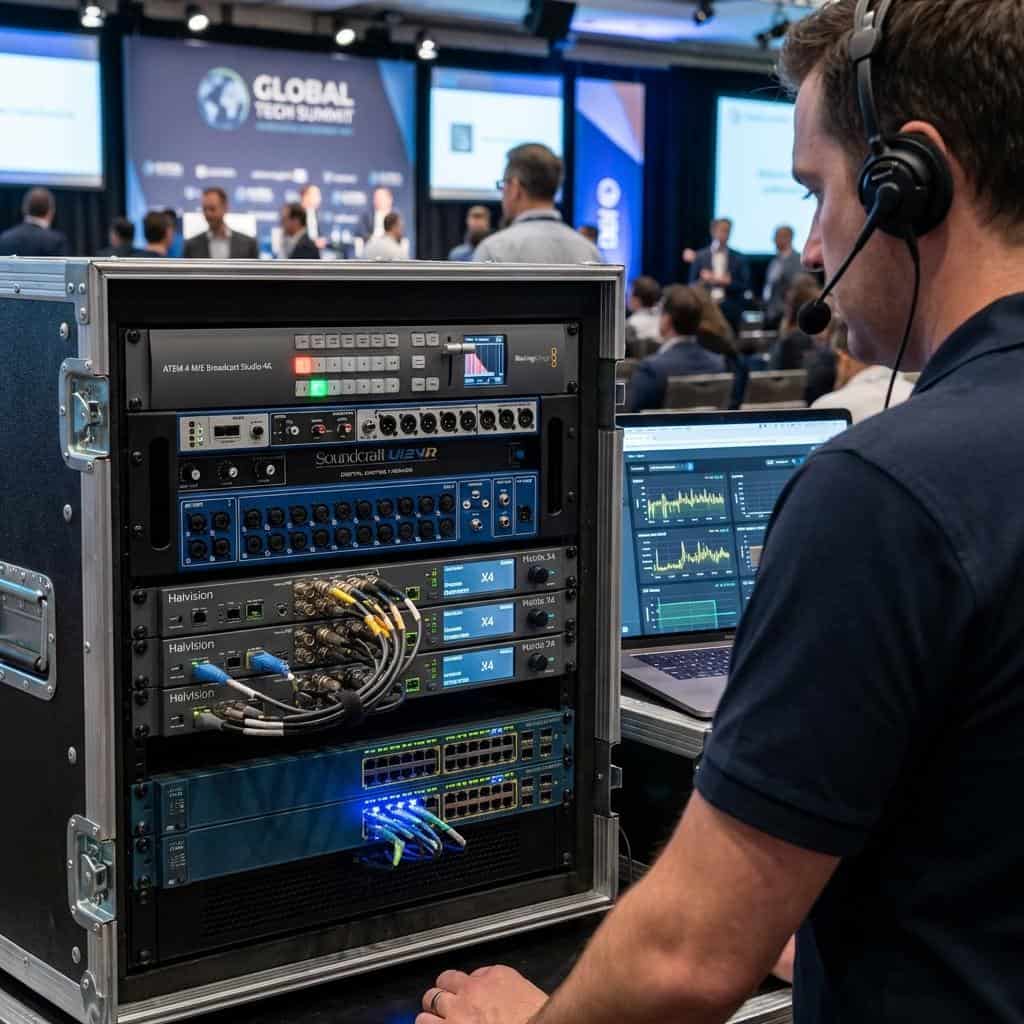
Once the source signal is ingested, it must be encoded for distribution. This is a critical stage that dictates the final quality of experience for the viewer. A managed service offers full transparency into this hardware and software layer. This includes specifying the use of broadcast-grade hardware encoders, such as solutions from Haivision or AWS Elemental, which provide superior processing and reliability compared to software-based solutions running on general-purpose computers. The encoding specifications are clearly defined and shared, outlining the H.264 (AVC) or H.265 (HEVC) codec implementation, the specific bitrate ladder for Adaptive Bitrate Streaming (ABR), and the GOP (Group of Pictures) structure. Proper GOP alignment is essential for seamless switching between different bitrates on the viewer’s end. A managed service provides clients with the exact encoding profiles being used, access to processing logs, and a clear architectural diagram of the entire transcoding pipeline, whether it is on-premise, in the cloud, or a hybrid of both. This level of detail ensures clients understand precisely how their content is being processed and prepared for global delivery.
Redundancy and Failover Architecture: Engineering for Inevitability
In live production, the critical question is not if a component will fail, but when. A professional managed streaming architecture is built on the principle of inevitability, engineering multi-layered redundancy to mitigate every potential point of failure. This proactive approach to risk management is a core tenet of building trust with enterprise clients, providing them with verifiable proof that the stream is protected against unforeseen technical issues.
Source and Encoder Redundancy (1+1 Configuration)
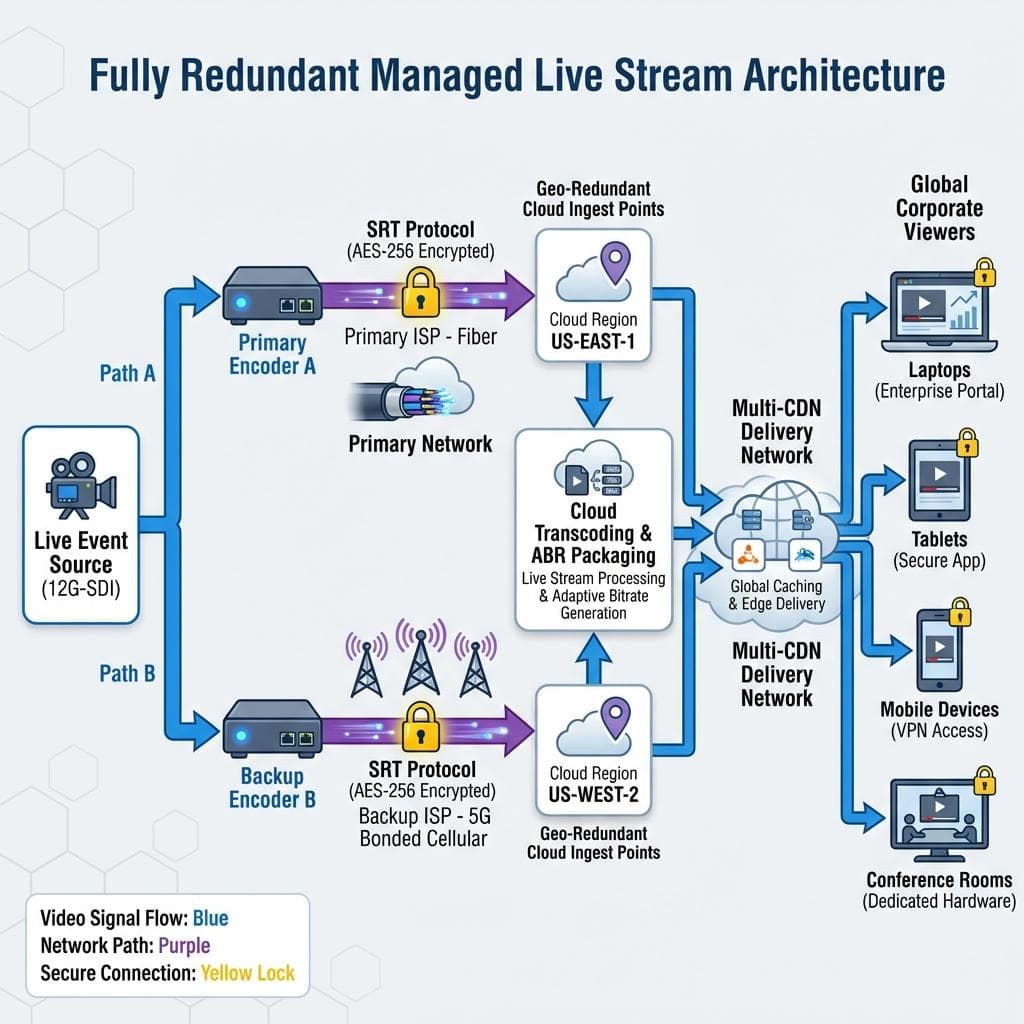
The foundation of a resilient stream is a 1+1, or fully redundant, source and encoder configuration. The primary program feed, typically a 3G-SDI or 12G-SDI signal from the production video switcher, is routed through a distribution amplifier. This creates two identical, isolated signal paths. Each path feeds a separate, independent hardware encoder. These are not a primary and a “cold” spare; both encoders run in parallel, actively processing the signal simultaneously. To ensure true isolation, they are powered from separate power circuits and connected to the network via physically distinct network switches and uplinks. The managed service documents this entire setup and implements a seamless failover mechanism in the cloud ingest layer, which can automatically switch from the primary A stream to the backup B stream with no disruption to the viewer if it detects any signal loss or degradation from the primary path.
Network Path Diversity: Mitigating Connectivity Risks
A single internet connection, regardless of its stated bandwidth, is a single point of failure. A professional managed service implements network path diversity by utilizing at least two completely different Internet Service Providers (ISPs). A common configuration is a dedicated fiber line as the primary connection, backed up by a high-speed cable modem or a bonded cellular solution. Bonded cellular technology, from providers like LiveU or TVU Networks, aggregates bandwidth from multiple cellular carriers (e.g., AT&T, Verizon, T-Mobile) into a single, highly resilient data link. In a transparent managed workflow, the client is shown real-time data on the performance of both network paths, and the contribution protocol (like SRT) can be configured to use both paths simultaneously for packet-level redundancy or to failover instantaneously if the primary link degrades.
Geo-Redundant Cloud Infrastructure and CDN Strategy
Redundancy must extend beyond the event venue and into the cloud. A robust managed streaming architecture utilizes geo-redundant infrastructure within cloud platforms like Amazon Web Services (AWS) or Google Cloud. This means the primary and backup SRT streams are ingested into separate availability zones or even entirely different geographic regions (e.g., ingest servers in both us-east-1 and us-west-2). If a regional cloud outage occurs, the stream is already being processed elsewhere. For delivery, a multi-CDN (Content Delivery Network) strategy is employed. By using multiple CDNs, traffic can be balanced and rerouted based on real-time performance, ensuring that viewers receive the stream from the best-performing network of Points of Presence (PoPs) relative to their location. This distributed architecture eliminates the risk of a single network or data center failure affecting the global audience.
Proactive Monitoring and Real-Time Communication: The Human Element
Technology and architecture are only part of the solution. The “managed” aspect of the service is what truly builds trust, and this is driven by expert human oversight and clear communication channels. A transparent service does not leave the client in the dark; it provides a constant, open line of sight into the stream’s health and performance, backed by a dedicated engineer.
The Role of the Streaming Engineer and Master Control
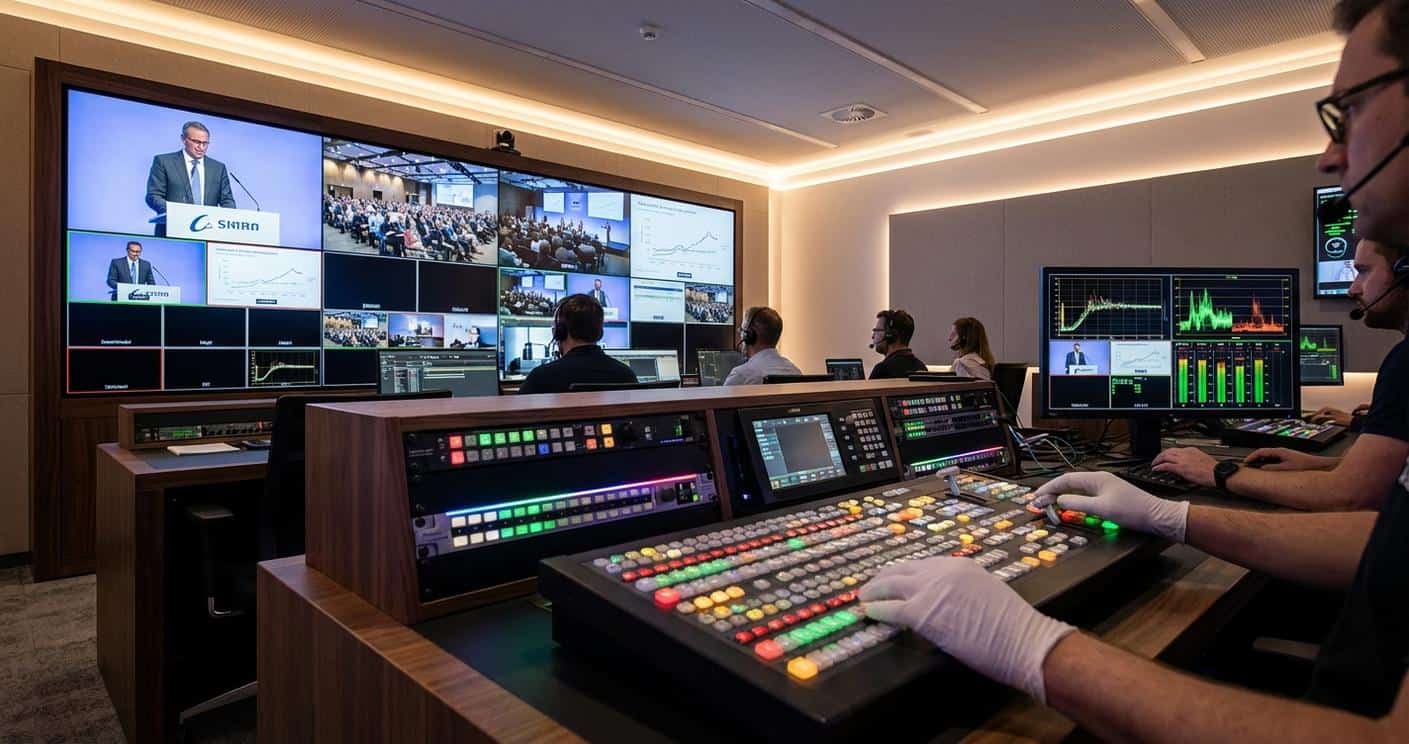
A dedicated streaming engineer or master control operator is the cornerstone of a managed event. This individual’s role extends far beyond simply starting and stopping the stream. They actively monitor the entire signal chain using a suite of professional tools. This includes a multiviewer displaying the source feed, the primary and backup encoder outputs, and a final confidence feed pulled directly from the CDN. They analyze the video signal using waveform monitors and vectorscopes to ensure color accuracy and broadcast-legal levels. Audio is monitored for loudness compliance using LUFS (Loudness Units Full Scale) meters. Critically, they watch Quality of Service (QoS) and Quality of Experience (QoE) dashboards that provide real-time metrics on CDN delivery, such as rebuffering rates, video startup times, and bitrate stability across different geographic regions, allowing them to identify and resolve potential viewer-side issues before they become widespread.
Transparent Communication Protocols: No Surprises
The most significant trust-builder is proactive and transparent communication. A managed service establishes clear communication protocols from the outset. This often involves a dedicated production intercom channel that bridges the on-site technical director with the remote streaming engineer, allowing for instant coordination. For the client, a shared communications channel, such as a private Slack channel or a dedicated phone line, is established for the duration of the event. This channel is used to provide real-time updates on pre-flight checks, stream status, key performance metrics like peak viewership, and immediate notification of any detected anomalies and the steps being taken to mitigate them. This stands in stark contrast to self-service platforms, where a problem is often first discovered through emails from frustrated executives.
Security and Access Control: Protecting High-Value Content
For corporate B2B events, content security is not an optional feature; it is a fundamental requirement. A transparent managed service provides a multi-layered security framework with verifiable controls to protect sensitive information and ensure it reaches only the intended audience.
Securing the Signal from End to End
Signal security begins at contribution. The use of SRT with AES-256 encryption ensures the feed is protected from the event venue to the cloud ingest point. For delivery, all viewer-facing assets are served via HTTPS (TLS), encrypting the HLS or DASH manifests and media segments as they travel from the CDN to the end-user’s browser. This end-to-end encryption strategy prevents unauthorized interception and ensures the integrity of the content throughout its entire lifecycle.
Enterprise-Grade Access Control and Authentication
Controlling who can view the stream is paramount for internal meetings or confidential announcements. A managed service provides a suite of enterprise-grade access control tools. This includes basic measures like geo-blocking to restrict access to specific countries, IP whitelisting for access from corporate offices only, and domain restriction to ensure the video player can only be embedded on authorized corporate intranet sites. For more advanced security, Single Sign-On (SSO) integration with enterprise identity providers like Azure Active Directory, Okta, or G-Suite is implemented. This forces viewers to authenticate against their corporate credentials before gaining access. Furthermore, token-based authentication can be used to generate secure, time-limited viewing links that cannot be shared. A transparent provider will document this security architecture and can supply a full audit trail of viewership post-event.
Ultimately, a managed live stream is about shifting from a vendor transaction to a trusted technical partnership. The advantage lies in the complete transparency of the process: a verifiable and redundant architecture, proactive expert monitoring, and a secure, controlled environment. For mission-critical B2B events where the message cannot be compromised, this investment in a transparent, professionally managed solution delivers the most valuable asset of all: complete peace of mind.