
In the dynamic landscape of modern enterprise, effective corporate storytelling transcends mere communication; it becomes a strategic imperative for conveying mission, vision, and core values. For B2B organizations, this narrative frequently unfolds across high-stakes live events, internal town halls, product launches, and investor briefings. The era of basic webcasts has evolved into a demand for broadcast-quality experiences, a technical benchmark that signifies professionalism, authority, and an unwavering commitment to excellence. This requires a profound understanding of intricate streaming protocols, sophisticated production infrastructure, and enterprise-grade solutions that extend far beyond consumer-grade streaming paradigms. The Live Streaming Studio technical team understands that delivering a truly impactful message hinges upon a robust technical foundation, where every pixel and every decibel contributes to the overarching corporate narrative.
Defining Broadcast Quality for Enterprise Streaming: Technical Benchmarks and Protocol Convergence
Achieving “broadcast quality” in a B2B streaming context is not an aesthetic aspiration; it is a quantifiable technical deliverable built upon rigorous specifications and meticulously engineered workflows. This standard differentiates enterprise communications from consumer entertainment, ensuring unparalleled clarity, reliability, and fidelity. Fundamentally, broadcast quality begins with superior image and audio acquisition, processing, and distribution.
- Resolution and Frame Rates: While 1080p Full HD remains a common standard for many corporate applications, the demand for 4K/UHD (3840×2160 pixels) is rapidly increasing, particularly for events requiring exceptional visual detail or large-format display. Professional frame rates typically adhere to 229.97 frames per second (fps) or 59.94 fps, aligning with established broadcast practices to ensure fluid motion and compatibility with professional equipment.
- Color Space and Bit Depth: Critical for color accuracy and dynamic range, professional workflows often utilize 4:2:2 chroma subsampling and 10-bit color depth. This significantly surpasses the 4:2:0 8-bit standard common in consumer-grade streaming, providing a vastly richer color palette and greater flexibility for post-production color grading, which is essential for maintaining brand consistency and visual integrity.
- Compression and Codecs: The choice of video codec is paramount. H.264 (Advanced Video Coding, AVC) remains a widely supported and efficient standard, while H.265 (High Efficiency Video Coding, HEVC) offers superior compression efficiency, delivering comparable quality at approximately half the bitrate, crucial for optimizing network bandwidth. For high-end acquisition and ISO (Isolated) recording, codecs like Apple ProRes or Avid DNxHD are often employed for their minimal compression and high fidelity, preserving maximum image data before final delivery encoding.
- Bitrate Management: Effective bitrate management is central to quality. Constant Bitrate (CBR) provides a predictable stream, while Variable Bitrate (VBR) dynamically adjusts based on content complexity, optimizing bandwidth utilization. For delivery to diverse audiences, Adaptive Bitrate (ABR) streaming is essential. This involves creating a “bitrate ladder” of multiple renditions (e.g., 720p at 3 Mbps, 1080p at 6 Mbps) allowing the client player to seamlessly switch based on network conditions, ensuring an uninterrupted viewing experience.
- Audio Fidelity: Professional audio standards demand uncompressed Pulse-Code Modulation (PCM) at 48 kHz sample rates and 24-bit depth during production, ensuring pristine sound capture. For streaming, AAC-LC (Advanced Audio Coding – Low Complexity) is a common, efficient codec that maintains high fidelity at lower bitrates, crucial for clear speech and impactful musical elements.
- Latency Optimization: While not always sub-second, professional live streams aim for controlled and minimized latency, particularly for interactive hybrid events where real-time engagement is critical. Protocol choices and infrastructure design directly impact this metric.
Signal Acquisition and Production Workflows: Building the Visual Narrative Foundation
The journey from concept to broadcast-quality stream begins with robust signal acquisition and a meticulously planned production workflow. This involves selecting professional-grade equipment and implementing industry-standard practices to capture, process, and route audio and video signals with precision.
- Camera Systems: Professional multi-camera setups are standard for corporate events, often integrating a mix of camera types. This includes high-end cinema cameras for cinematic aesthetic, broadcast ENG (Electronic News Gathering) cameras for versatility and rapid deployment, and robotic PTZ (Pan-Tilt-Zoom) cameras for discreet placement and remote control via protocols like VISCA or NDI PTZ. Lenses are equally critical; professional prime and zoom lenses provide superior optical quality, depth of field control, and low-light performance, enhancing the visual storytelling.
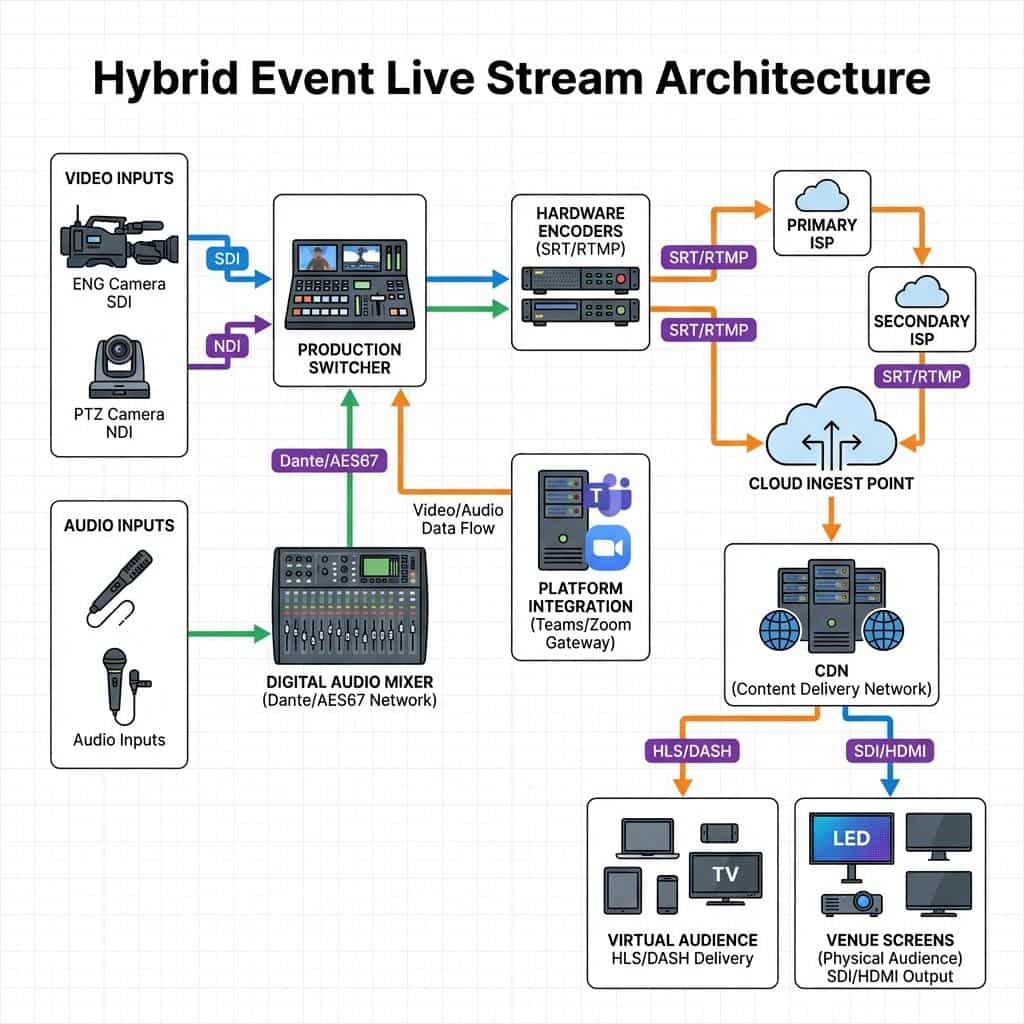
- Signal Interfacing and Transport: For traditional broadcast-grade signal transport, SDI (Serial Digital Interface) remains a cornerstone due to its robustness, low latency, and ability to carry uncompressed video over long coaxial cable runs. Standards like SMPTE 259M (SD-SDI), SMPTE 292M (HD-SDI), SMPTE 424M (3G-SDI), and SMPTE 2082 (12G-SDI for 4K/UHD) define its capabilities. For modern IP-based workflows, NDI (Network Device Interface) and its compressed variant NDI|HX offer a powerful alternative, allowing high-quality, low-latency video, audio, and control signals to traverse standard Gigabit Ethernet networks. This flexibility simplifies cabling and integrates seamlessly into IT infrastructure.
- Video Switching and Mixing: At the heart of any multi-camera production is the video switcher. Hardware production switchers, such as those from Ross Carbonite, Grass Valley K-Frame, or Blackmagic ATEM Constellation series, provide dedicated processing power for seamless transitions, graphics overlays, digital video effects (DVEs), and chroma keying. Software-defined switchers like NewTek TriCaster or vMix offer comparable functionality on commercial off-the-shelf (COTS) hardware, providing flexibility for certain production scales and budgets.
- Audio Production and Networking: Superior audio is paramount for corporate communication. Digital audio mixers from manufacturers like Yamaha (Rivage PM series), Avid (S6L), or Behringer (Wing) provide extensive channel counts, robust signal processing, and integrated effects. IP audio networking protocols such as Dante and AES67 enable multi-channel, low-latency audio distribution over Ethernet, simplifying complex audio routing and allowing seamless integration with various production elements. Audio embedding and de-embedding capabilities ensure pristine audio travels with video signals via SDI or NDI. Dedicated talkback systems (e.g., Clear-Com, RTS) are essential for real-time communication among the production crew.
- Graphics and Media Playback: Professional corporate streams frequently incorporate dynamic graphics, lower thirds, full-screen animations, and pre-recorded video segments. Character generators (CGs) and media servers are used for real-time graphics rendering and playback, integrating directly into the video switcher workflow. This ensures brand consistency and enhances the visual narrative.
- Monitoring and Quality Control: Rigorous monitoring is critical. Multiview displays allow the technical director to simultaneously observe all camera feeds, program output, and graphics. Specialized tools like waveform monitors and vectorscopes provide objective measurements of video levels and color accuracy, ensuring adherence to broadcast standards and preventing technical issues before they reach the audience.
Enterprise Streaming Infrastructure: Encoding, Delivery, and Global Reach
Once signals are acquired and produced, the next critical phase involves encoding, reliable transmission, and global distribution. This demands a robust enterprise streaming infrastructure capable of maintaining broadcast quality across diverse network conditions and geographic locations.
- Encoding Solutions: Professional encoding is the process of compressing raw video and audio into a streamable format. Dedicated hardware encoders from leading manufacturers such as Haivision (Makito X series), Elemental Live (AWS Elemental), or Teradek (Cube/Bond series) offer unparalleled reliability, performance, and advanced features like multi-bitrate encoding and built-in redundancy. Software encoders like OBS Studio or Wirecast, running on powerful workstations, can also be leveraged for specific production needs, offering flexibility and extensive customization. The choice between hardware and software often balances dedicated performance against adaptability.
- Streaming Protocols for B2B Environments:
- SRT (Secure Reliable Transport): Developed by Haivision and now an open-source protocol, SRT is a cornerstone for high-quality, low-latency, and resilient video contribution and distribution over unpredictable public internet connections. Utilizing UDP (User Datagram Protocol) for speed and an advanced ARQ (Automatic Repeat reQuest) mechanism for packet loss recovery, SRT ensures secure and reliable transport of broadcast-grade signals between production facilities, remote presenters, and cloud ingest points, even with significant packet loss and jitter. It is increasingly the go-to protocol for real-time B2B event streaming due to its inherent reliability and security features, including AES 128/256-bit encryption.
- RTMP/RTMPS (Real-Time Messaging Protocol/Secure): While an older protocol, RTMP remains widely used for ingesting live streams into many Content Delivery Networks (CDNs) and streaming platforms. Its secure variant, RTMPS, adds TLS (Transport Layer Security) encryption, essential for protecting corporate content during the ingest phase. Despite its age, its broad compatibility ensures it remains a viable, though often an intermediary, protocol in many workflows.
- HLS/DASH (HTTP Live Streaming/Dynamic Adaptive Streaming over HTTP): These HTTP-based adaptive bitrate streaming protocols are the industry standards for final delivery to end-users. They segment the video stream into small chunks and provide a manifest file (M3U8 for HLS, XML for DASH) that lists available renditions. This allows client players to seamlessly adapt the stream quality based on the viewer’s network bandwidth and device capabilities, ensuring the best possible viewing experience without buffering or interruptions. They are crucial for reaching a global audience across diverse devices (desktops, mobile, smart TVs).
- Content Delivery Networks (CDNs): For global reach and scalable distribution, Content Delivery Networks (CDNs) are indispensable. Services like Akamai, Limelight, AWS CloudFront, or Azure CDN leverage geographically distributed points of presence (PoPs) to cache and deliver content closer to the end-user, significantly reducing latency and server load. CDNs provide immense scalability to handle thousands or hundreds of thousands of concurrent viewers, offering robust performance, built-in DDoS protection, and analytics capabilities crucial for enterprise-level events.
- Network Infrastructure Requirements: Professional live streaming demands a meticulously planned network infrastructure. Dedicated fiber optic circuits with guaranteed bandwidth are often preferred for contribution and ingest. Quality of Service (QoS) configurations are essential on corporate networks to prioritize streaming traffic, minimizing packet loss and jitter. Redundant internet connections (e.g., dual ISPs, cellular bonding via Teradek Bond or LiveU units) are critical for failover. Upstream bandwidth must be carefully calculated, typically requiring 2x to 3x the peak aggregate bitrate of all outgoing streams to ensure headroom and stability.
- Cloud-based vs. On-premise Solutions: Many enterprise streaming architectures are hybrid. On-premise production allows for maximum control over sensitive content and low-latency signal processing. Cloud-based services (e.g., AWS Media Services, Google Cloud Media CDN, Azure Media Services) offer unparalleled scalability, global distribution, and flexibility for encoding, transcoding, and archiving, making them ideal for the distribution layer. A well-designed hybrid approach combines the strengths of both, providing a resilient and adaptable infrastructure.
Hybrid Event Production and Platform Integration: Bridging Physical and Virtual Audiences
The rise of hybrid events has introduced a new layer of complexity and opportunity, demanding seamless integration between in-person experiences and robust virtual participation. Conveying a unified corporate message requires a sophisticated technical architecture that caters to both physical and virtual audiences without compromise.
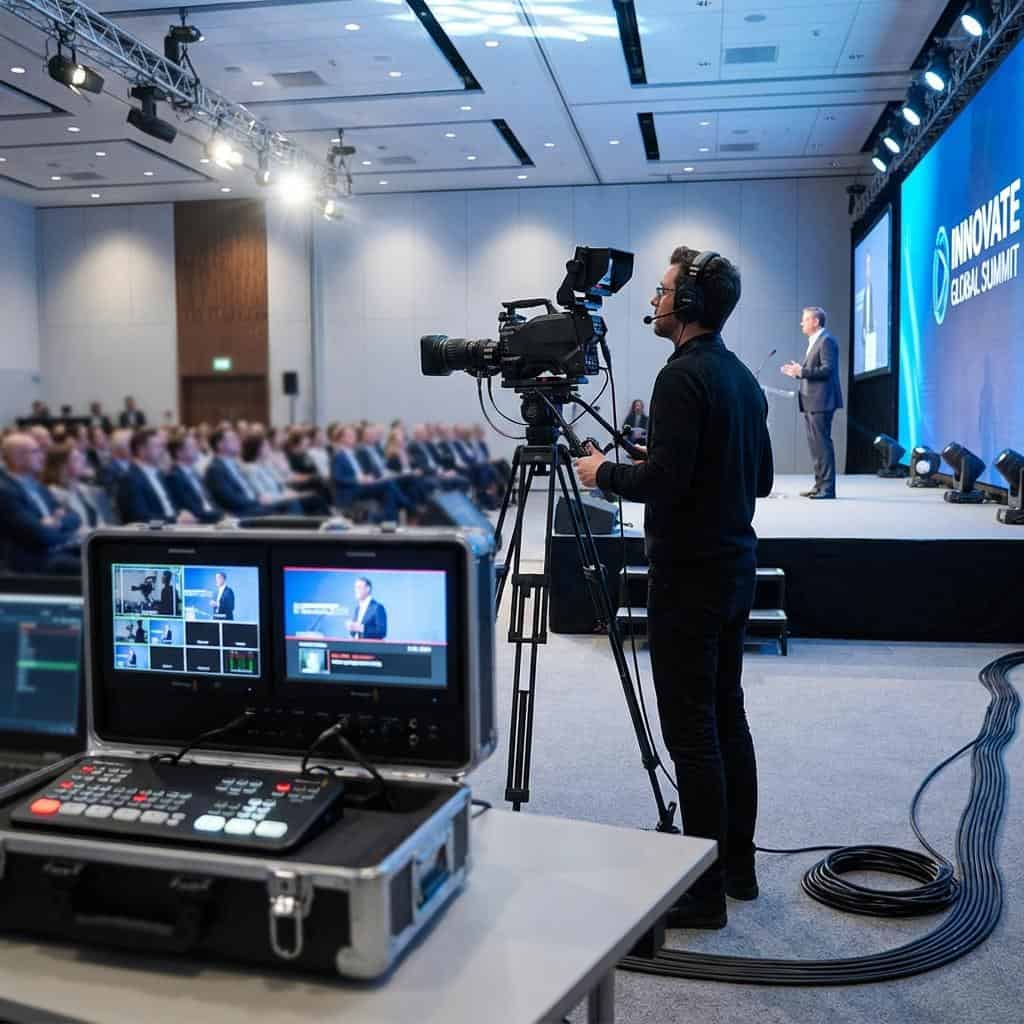
- Seamless Integration of Physical and Virtual: A truly broadcast-quality hybrid event architecture ensures that the virtual audience receives an experience as polished and engaging as the in-person attendees. This involves designing production workflows that can simultaneously feed content to large screens in the physical venue and sophisticated streaming platforms for remote viewers.
- Enterprise Platform Gateways: Integrating professional broadcast feeds (SDI or NDI) into ubiquitous enterprise collaboration platforms like Microsoft Teams, Zoom Events, or Cisco Webex Webinars is a critical technical challenge. This is typically achieved through dedicated hardware gateways such as capture cards (e.g., AJA, Blackmagic DeckLink) or NDI-to-USB converters, which translate professional video signals into a format compatible with these platforms’ virtual meeting room environments. Specialized virtual meeting room systems can also be employed to bridge the gap, ensuring high-fidelity audio and video input from the professional production switcher directly into the virtual meeting or webinar.
- Interactive Elements and Feedback Loops: Modern hybrid events thrive on interaction. Implementing Q&A sessions, live polling, and moderated chat requires a robust system to manage and integrate these elements into the live production. Questions from the virtual audience can be curated and displayed on teleprompters for presenters, or routed to a dedicated monitor in the control room for moderator review. Return feeds of virtual attendees or on-screen graphics can be brought back into the main production switcher for display to the physical audience or for multi-panel discussions.
- Return Feeds and Monitoring for Presenters: Remote presenters, or those on a virtual stage, require high-quality return feeds of the program output, confidence monitors, and talkback capabilities to interact seamlessly with the production crew and other presenters. This often involves low-latency SRT or dedicated video conferencing links. Multiview monitoring solutions are deployed to allow distributed control teams to observe all incoming feeds, program output, and virtual attendee layouts.
- Synchronized Content Delivery: Ensuring all presentation materials, pre-recorded video playbacks, and graphics are perfectly timed and synchronized for both physical and virtual audiences is paramount. This demands meticulous planning and precise execution from the production control room, often utilizing timecode synchronization across all media assets.
- Scalability for Global Participation: Designing the infrastructure to scale from a few hundred local attendees to tens of thousands of simultaneous global viewers requires careful consideration of CDN capacity, egress bandwidth, and the ability of the chosen streaming platforms to handle the load. Geo-distributed encoding and transcoding resources may be deployed to optimize delivery for specific regions.
Redundancy, Quality of Service, and Security: Ensuring Uninterrupted Corporate Messaging
For high-stakes corporate storytelling, ensuring uninterrupted delivery, optimal performance, and robust security is non-negotiable. Enterprise-grade streaming solutions must be architected with comprehensive redundancy, meticulous quality of service (QoS) implementation, and an ironclad security posture.
- Resilience and Failover Strategies:
- Encoder Redundancy: N+1 encoder configurations are standard, meaning one backup encoder is ready for immediate failover for every ‘N’ primary encoders. Automatic failover systems monitor the primary stream and instantaneously switch to the secondary encoder if a primary feed is lost, ensuring minimal disruption.
- Network Redundancy: Implementing dual internet service providers (ISPs) with diverse network paths provides critical resilience against single points of failure. Technologies like cellular bonding (e.g., LiveU, Teradek Bond) offer an additional layer of network resilience, automatically aggregating or switching to cellular networks if primary wired connections degrade or fail.
- Power Redundancy: Uninterruptible Power Supply (UPS) systems and generator backups are essential for maintaining continuous operation of all critical production and streaming equipment in the event of utility power outages.
- Geo-Redundancy: For global events, deploying streaming infrastructure across multiple geographically diverse data centers or CDN points of presence (PoPs) provides protection against regional outages and ensures optimal latency for viewers worldwide.
- Quality of Service (QoS) Implementation: On corporate networks, strict QoS policies must be implemented to prioritize streaming traffic over less time-sensitive data. This involves configuring network switches and routers to allocate dedicated bandwidth, minimize packet loss, and reduce latency for live video and audio streams, preventing network congestion from impacting stream quality.
- Security Posture for Sensitive Content: Protecting proprietary corporate information and ensuring secure delivery are paramount.
- Content Protection: For highly sensitive content, Digital Rights Management (DRM) technologies (e.g., PlayReady, Widevine, FairPlay) can be employed to control access, prevent unauthorized viewing, and restrict sharing. Tokenized access, geo-fencing (restricting viewership by geographic location), and IP whitelisting provide additional layers of access control.
- Network Security: Secure contribution paths are established using Virtual Private Networks (VPNs) to encrypt data between production sites and ingest points. Robust firewalls and Intrusion Detection Systems (IDS) are critical for protecting streaming infrastructure from cyber threats.
- Platform Security and Authentication: Integration with enterprise Single Sign-On (SSO) systems (e.g., Okta, Azure AD) simplifies user authentication and ensures that only authorized personnel and audiences can access streams. Granular access control based on user roles and groups further enhances security.
- Compliance: Adherence to industry-specific data privacy regulations (e.g., GDPR, CCPA) and security standards is meticulously maintained, particularly when handling personal data related to audience engagement or registration.
In conclusion, the pursuit of broadcast quality for corporate storytelling is a complex, multi-faceted technical endeavor that demands deep expertise across live event production, enterprise streaming infrastructure, and hybrid event architectures. It is a strategic investment that elevates a brand’s message, reinforces its credibility, and resonates profoundly with its target audience. The precise orchestration of high-fidelity signal acquisition, resilient encoding, global CDN distribution, and secure, redundant systems transforms a mere presentation into a compelling, immersive experience. The Live Streaming Studio technical team stands ready as your expert partner, designing, implementing, and managing these advanced B2B streaming solutions to ensure your corporate vision is conveyed with unmatched clarity and impact.

Michael Koh is a production specialist and entrepreneur who founded Spring Forest Studio in 2017 to provide event and virtual production solutions in Singapore. He specialises in hybrid live streaming, XR (Extended Reality) virtual production, and studio systems integration, transitioning the business from traditional videography to advanced corporate broadcasting. Operating out of a dedicated facility at NordCom2 in Singapore, he leads a technical crew to deliver multi-camera webcasts, digital sets, and technical consultations for large-scale corporate events.