
Hybrid events have moved far beyond a simple live stream bolted onto an in-person program. For corporate conferences, executive briefings, product launches, investor days, and internal town halls, the brand experience now spans a physical stage, remote keynote feeds, interactive virtual sessions, mobile devices, overflow rooms, and enterprise collaboration platforms such as Microsoft Teams, Zoom, and Webex. The technical challenge is no longer only about transmitting video, it is about maintaining a consistent visual identity, audio intelligibility, latency profile, and interaction model across every touchpoint without compromising reliability.
A unified brand experience across hybrid touchpoints depends on disciplined signal flow, repeatable production architecture, and platform-aware encoding strategies. The audience in the ballroom must see the same visual language as the participant joining from a browser. The executive panel on stage must hear the same program mix that remote viewers receive. The moderator managing Q and A from a control room must work from the same production cues used by the stream operator. These outcomes require coordination across camera systems, graphics workflows, audio routing, network engineering, and delivery protocols such as RTMP, RTMPS, SRT, and NDI.
In enterprise environments, branding is inseparable from technical execution. A fragmented hybrid experience, such as mismatched lower-thirds, inconsistent color science, delayed remote contribution, poor audio leveling, or unstable failover behavior, weakens trust and reduces engagement. A unified experience, by contrast, presents a coherent content package, regardless of whether the audience is on-site in a convention center, in a Singapore corporate office, or connected from a remote regional location. Achieving that standard requires a production model built for broadcast-grade consistency, not improvised webcasting.
Designing a Brand-Consistent Hybrid Production Architecture
The foundation of a unified hybrid experience is a production architecture that treats every endpoint as part of one content system. The control room, stage, remote contribution platform, and distribution stack must all align to the same creative and technical rules. This begins with an established visual identity package, which includes title treatment, motion graphics templates, transition logic, speaker framing, and output-safe composition guidelines for 16:9 and any auxiliary portrait or social cutdowns. The graphics operator should work from a single source of truth, typically a live production playlist or rundown system integrated with the switcher and media server.
Single source control for show assets
Brand consistency improves when the production team centralizes assets in a managed repository. That includes opening slates, animated bumpers, speaker name keys, agenda boards, sponsor acknowledgments, and sponsor-safe stingers. In practice, these elements should be rendered through a dedicated graphics engine or media server capable of frame-accurate playback, alpha-channel overlays, and synchronized triggers from the show caller or automation system. For large enterprise events, template-driven graphics reduce operator variation and ensure every speaker name, session title, and call-to-action follows brand rules.
Where possible, graphics should be prepared at the native program resolution, often 1920×1080 or 3840×2160, with correct color management for the venue displays and the encoded stream. If the event uses mixed outputs, such as IMAG for LED walls and a separate program output for remote viewers, the production team should map each destination explicitly. The LED processor may accept low-latency SDI or HDMI 2.1 feeds, while the remote stream encoder receives a clean program feed with embedded audio and no utility graphics unless they are intended for the virtual audience.
Camera composition and visual continuity
Hybrid branding depends heavily on camera language. Multi-camera setups should be designed with predictable framing for keynote presenters, panels, demonstrations, and audience cutaways. A typical corporate event workflow might include a wide master shot, two medium close-up cameras on presenters, a roving audience camera, and a dedicated slide capture input. For higher-end productions, additional robotic PTZ cameras can provide silent operation and tight control from a shading station or camera controller. Camera selection should account for sensor performance in mixed lighting, lens matching, and color matrix consistency so that all angles intercut cleanly on the program feed.
Color matching between cameras is a practical requirement, not a cosmetic preference. If one camera reads cooler than another, the shift becomes visible to both in-room participants on screens and remote viewers receiving the encoded output. Production engineers should perform matching via paint controls, white balance calibration, and waveform monitoring. For more advanced workflows, shading should be monitored using a vectorscope and waveform monitor, with exposure held within safe broadcast ranges to preserve skin tones and graphics fidelity.
Building a Robust Signal Flow for Physical and Virtual Audiences
The signal path is where hybrid experience quality is either preserved or degraded. A well-designed event stack separates acquisition, routing, switching, monitoring, encoding, and distribution. Each stage should be understood as part of an engineered system. Cameras may originate as SDI sources in 3G-SDI or 12G-SDI, or as IP sources using NDI or NDI|HX, depending on the facility and bandwidth profile. Presentation laptops often enter via HDMI 2.0 or HDMI 2.1, while remote guests may arrive through cloud contribution platforms or via SRT return feeds.
Audio architecture and intelligibility
For corporate events, audio quality carries more brand weight than most teams expect. Poor intelligibility undermines executive authority, reduces retention, and creates a perception of technical weakness. The audio path should begin with proper source capture, including wireless lavaliers, handheld microphones, podium microphones, and direct feeds from playback devices. A digital audio console should manage gain structure, dynamic processing, equalization, automixing, and routing to both in-room reinforcement and the stream mix.
Separate mixes are standard practice. The house mix serves the physical room, often with loudspeaker optimization, feedback suppression, and acoustic compensation. The stream mix should be built independently or via matrix outputs, with controlled dynamics and proper balance for online listening conditions. For remote participants joining through Teams, Zoom, or Webex, echo cancellation, speech clarity, and consistent loudness are essential. Audio levels should be managed with calibrated metering, maintaining clean headroom and avoiding clipping at the encoder input. In professional environments, a properly aligned program mix can make the difference between a polished executive presentation and an unstable virtual presence.
Program feed, ISO recording, and multiview monitoring
A unified brand experience requires the program feed to be clean, predictable, and monitored continuously. The program output is the final live stream source, while ISO recording, or isolated source recording, captures individual camera feeds, presentation sources, and sometimes a separate clean feed for post-production. ISO files allow the enterprise team to create recuts, chaptered highlights, training modules, or compliance versions after the live event without depending solely on the switched program.
Multiview monitoring is essential in a hybrid control environment. Technical directors, graphics operators, audio engineers, and stream operators should see a synchronized view of all active inputs, confidence monitors, return feeds, and stream status indicators. This includes encoder bitrate, dropped frame alarms, packet loss, audio phase checks, and destination health. If the enterprise is sending the event to a managed platform while also distributing to internal collaboration tools, multiview allows the team to confirm that the branded output remains consistent across every route.
Choosing the Right Delivery Protocol and Encoding Strategy
Streaming protocol selection has direct brand implications because latency, resiliency, and compatibility shape the audience experience. RTMP, or Real-Time Messaging Protocol, remains widely used for contribution to ingest points and legacy distribution workflows. RTMPS adds TLS encryption for secure transport. SRT, Secure Reliable Transport, is preferred in many enterprise live production workflows because it supports packet recovery, encryption, and stable transport over unpredictable networks. For local production networks, NDI provides efficient IP-based video transport, while NDI|HX reduces bandwidth requirements by using more compressed transport at the cost of some latency and image fidelity.
Bitrate, codec, and latency decisions
The encoder configuration should be selected based on the target platform, available bandwidth, and acceptable latency profile. H.264 remains the most broadly interoperable codec for enterprise streaming. H.265, also known as HEVC, can reduce bandwidth at similar quality levels, but platform support and decode complexity must be verified before deployment. For 1080p30 corporate streaming, a bitrate range often falls between 3 Mbps and 6 Mbps depending on motion complexity, content type, and platform ingest requirements. For 1080p60 or 4K/UHD delivery, higher bitrates and stronger network guarantees are necessary. The team should always align encoder settings with the ingest specifications of the destination platform rather than overdriving the stream into a constrained pipeline.
Latency is a strategic consideration. If the event requires audience interaction, live polling, remote Q and A, or executive response windows, the workflow should minimize glass-to-glass delay without sacrificing stability. SRT can help maintain integrity across higher-loss networks, while carefully tuned RTMP pipelines may remain acceptable for lower-complexity events. The lowest latency setting is not always the right setting. A slightly higher delay with stable playback, consistent audio sync, and no buffering may produce a better branded result than a fragile near-real-time stream.
Cloud-based versus on-premise infrastructure
Cloud production offers scalability, remote contribution, and distribution flexibility. It is especially useful for multi-region events, executive interviews with distributed presenters, and programs that require quick expansion across geographies. Cloud switchers, cloud graphics, and cloud transcoding can accelerate deployment, but they still depend on robust uplink capacity, reliable contribution paths, and disciplined security controls. On-premise systems provide tighter operator control, lower local latency, and greater independence from upstream internet variability. Many enterprise events use a hybrid model, with on-site acquisition and switching feeding a cloud distribution or backup workflow.
For organizations operating from Singapore or serving regional APAC audiences, network routing and cross-border connectivity should be planned well in advance. Enterprise teams must consider content delivery path stability, firewall policy, private link options, and platform compliance. A hybrid architecture can route the clean program feed through local on-premise encoders, while also creating a cloud archive and simultaneous backup path for resilience. The correct model depends on event criticality, venue topology, and internal IT governance.
Network Infrastructure, Redundancy, and Operational Resilience
Unified hybrid branding fails quickly when the transport layer is unstable. Network architecture must be engineered for throughput, redundancy, and observability. For IP-based production, managed switches, VLAN segmentation, QoS, and multicast control are essential. Production traffic should be isolated from guest Wi-Fi and general office traffic. Where NDI or SRT is in use, network engineers should validate packet pacing, port openness, and switch capacity. A congested network can create frame jitter, audio artifacts, or encoder instability long before a hard failure appears.
Redundant paths and failover planning
Enterprise live event workflows should include layered redundancy. Primary and backup encoders, dual internet connections from separate providers where possible, UPS-backed power for all critical devices, and alternate signal paths from camera to switcher to distribution are standard resilience measures. If the venue supports it, a second program feed should be available, either as a hot spare or as a readiness path for immediate takeover. Audio consoles should maintain scene recall and backup power continuity. Graphics systems should be exportable and recoverable, with synchronized show files stored securely before doors open.
Failover strategies should be tested, not assumed. The production team should run controlled tests on encoder failover, secondary WAN activation, remote guest reconnect behavior, and backup media playback. A unified experience is preserved when the audience never sees the recovery process, only a stable stream and uninterrupted presentation. That requires disciplined cueing, operator communication, and technical rehearsals that simulate actual fault conditions.
Monitoring, logging, and quality control
Quality of service depends on continuous observability. Production teams should monitor encoder status, stream health, round-trip latency, audio sync, dropped frames, network jitter, and destination acknowledgments. Where the platform supports it, logs should be retained for post-event review. This data helps identify whether the issue originated in acquisition, switching, encoding, transport, or platform ingest. For enterprise stakeholders, this is not only about technical diagnosis, it is about protecting the brand from preventable service disruption.
Professional events also benefit from structured run-of-show discipline. The show caller, technical director, audio engineer, graphics operator, and stream engineer should share a common cue stack. This ensures transitions, speaker handoffs, sponsored segments, and audience interaction moments occur with consistent pacing across physical and virtual environments. A polished hybrid event feels unified because the technical team has designed the production to behave as one system.
Practical Implementation Guidelines for Enterprise Teams
To create a unified brand experience across hybrid touchpoints, enterprise clients should establish a production standard operating model before event day. First, define the audience journey for every channel, including in-room displays, remote viewing interfaces, mobile access, and post-event assets. Second, standardize all visual templates, lower-thirds, overlays, and motion packages to match corporate brand guidelines. Third, lock the audio workflow with dedicated house and stream mixes, proper gain structure, and confirmed loudness targets. Fourth, document signal flow from source to destination, including all conversions, frame sync points, and backup routes.
Production managers should require a technical rehearsal that includes camera shading, graphics verification, remote guest checks, audio validation, and stream ingest testing. The rehearsal must confirm not only that the event works, but that it presents the same brand quality at every touchpoint. For larger events, a pre-event engineering checklist should include bandwidth testing, firewall validation, platform ingest confirmation, encoder preset verification, and final source label checks. If the event is supported by collaboration platforms such as Teams, Zoom, or Webex, the integration method should be tested in the exact room topology and audio configuration that will be used live.
Enterprise-grade hybrid production succeeds when branding and engineering are treated as one discipline. The audience does not separate the visual identity from the transport path, nor the audio mix from the camera language. They experience the whole program as a single event. That is why unified brand execution across hybrid touchpoints demands broadcast-aware production standards, resilient infrastructure, and disciplined operational control. When those elements are aligned, the event feels intentional, credible, and technically assured from the opening slate to the final sign-off.
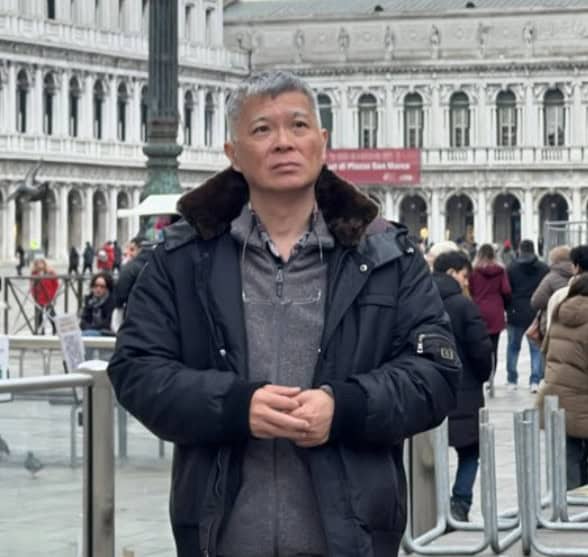
Michael Koh is a production specialist and entrepreneur who founded Spring Forest Studio in 2017 to provide event and virtual production solutions in Singapore. He specialises in hybrid live streaming, XR (Extended Reality) virtual production, and studio systems integration, transitioning the business from traditional videography to advanced corporate broadcasting. Operating out of a dedicated facility at NordCom2 in Singapore, he leads a technical crew to deliver multi-camera webcasts, digital sets, and technical consultations for large-scale corporate events.