
 March 14, 2026 by Editor |
The Imperative for Resilient Streaming in Financial Crisis Communications
In Singapore’s highly regulated financial sector, the speed and integrity of communication during a crisis are not just best practices; they are operational necessities. When market volatility, a security incident, or regulatory action occurs, the ability to disseminate precise, secure, and immediate information to stakeholders, employees, and regulators is paramount. Traditional communication methods like press releases or email chains introduce unacceptable delays and lack the required impact and control. This necessitates a robust, rapid-response streaming infrastructure designed for high-stakes B2B communication. This is not about public broadcasting; it is about creating a secure, low-latency video link from a C-suite executive to a closed, authenticated audience. A successful deployment hinges on a deep understanding of network architecture, video transport protocols, and production hardware, ensuring the system is not a point of failure but a tool for decisive action.
The core challenge lies in establishing a broadcast-grade streaming workflow that can be activated within minutes, operates flawlessly under potentially compromised network conditions, and guarantees message security. This requires a shift from viewing streaming as a marketing tool to treating it as a critical component of business continuity planning (BCP). The technical framework must address three key areas: the foundational infrastructure for signal acquisition and encoding, the transport protocol for secure and reliable delivery over public and private networks, and the distribution platform for controlled, authenticated access. For Singaporean financial firms, this infrastructure must be engineered with redundancy and security at every level, from the camera sensor to the end-user’s screen, meeting the stringent expectations of the Monetary Authority of Singapore (MAS) for operational resilience.
Architecting the On-Premise Crisis Communication Hub
The foundation of any rapid-response streaming solution is a pre-configured and rigorously tested on-premise technical setup. This hub, often a designated boardroom or a small, dedicated studio space, must be hardwired and ready for immediate activation, eliminating the variables and risks of ad-hoc setups during a high-pressure event. The architecture prioritizes signal integrity, processing power, and network resilience above all else.
Signal Flow and Routing: From Glass to Codec
The initial signal chain begins with professional acquisition hardware. At a minimum, this includes two broadcast-quality cameras, typically PTZ (Pan-Tilt-Zoom) models like the Sony FR7 or Panasonic UE160 for remote operation, providing 4K/UHD resolution at 50/59.94p for future-proofing and digital reframing. The video signals are transported via 12G-SDI (Serial Digital Interface) cabling, the industry standard for uncompressed, high-bandwidth video, ensuring zero signal degradation or latency over distances up to 100 meters. Audio is captured using professional shotgun and lavalier microphones connected to a dedicated audio mixer, such as a Yamaha QL series or a compact Sound Devices MixPre, to manage levels and EQ before embedding the final program mix into the SDI signal.
This baseband SDI signal is routed into a hardware-based video switcher, for example a Ross Carbonite or Blackmagic Design ATEM Constellation. This is a non-negotiable component. Software-based switching on a PC introduces risks of operating system updates, driver conflicts, and resource competition. A dedicated hardware switcher provides a real-time operating system (RTOS) focused solely on processing video signals, offering the highest level of reliability. The switcher output, known as the Program feed, is the final polished video containing the correct camera angle, graphics, and embedded audio. This feed is then sent to the encoding stage.
Encoding and Network Egress: The Gateway to Distribution
The most critical single point of failure in a streaming workflow is the encoder. For crisis communications, relying on software encoders (like OBS or vMix) on a multi-purpose machine is a critical error. The workflow demands a dedicated hardware encoder. Appliances from manufacturers like Haivision (Makito X4), AJA (HELO Plus), or Kiloview are designed for 24/7 operation. These devices take the SDI program feed and transcode it in real-time into a streaming format using codecs like H.264 or H.265 (HEVC). H.265 is often preferred for its superior compression efficiency, delivering higher quality at a lower bitrate, which is a significant advantage when dealing with potentially congested networks. A typical setting for a secure 1080p50 stream would be an H.265 codec at a constant bitrate (CBR) of 6-8 Mbps.
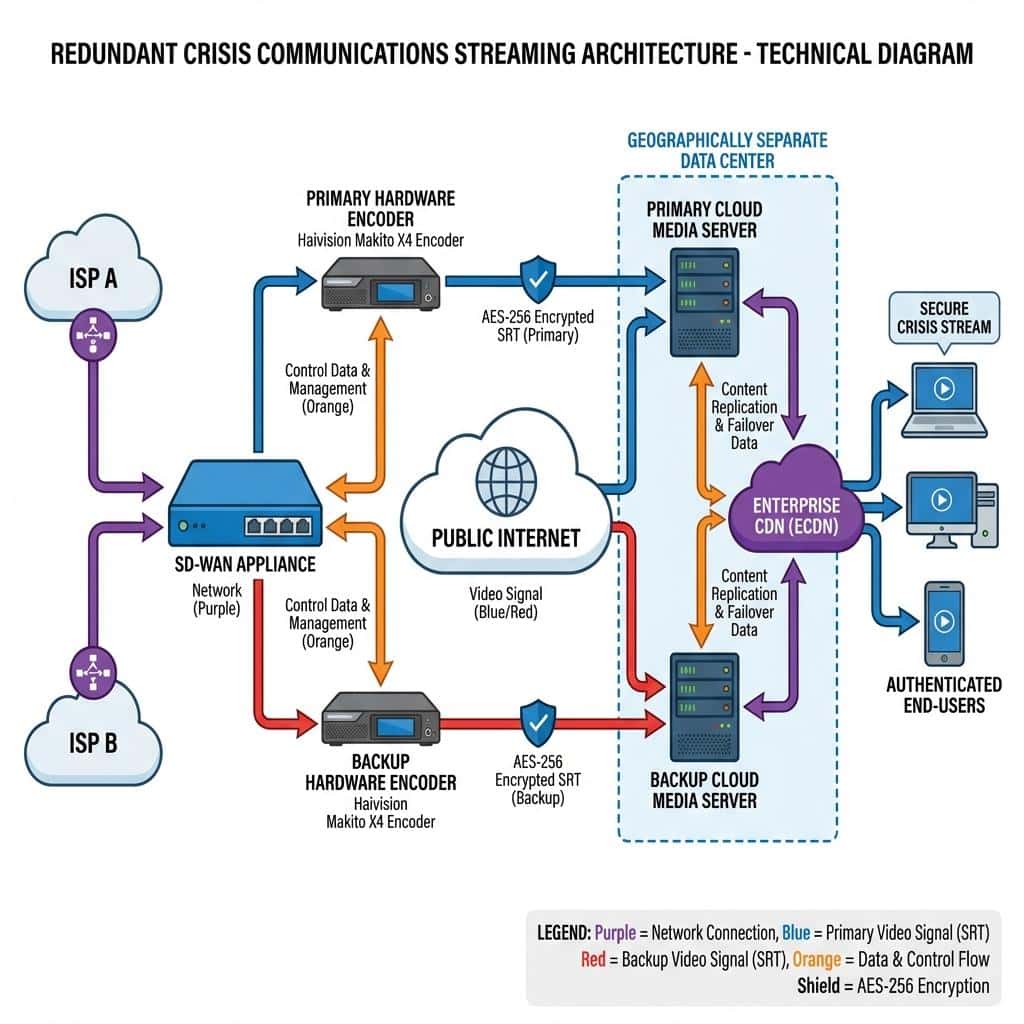
Network infrastructure is equally critical. The encoding appliance should be connected to a dedicated network switch with redundant uplinks to at least two separate, business-grade Dedicated Internet Access (DIA) circuits from different ISPs. This dual-carrier redundancy mitigates the risk of an ISP outage crippling the entire operation. An SD-WAN (Software-Defined Wide Area Network) appliance can be deployed to manage this connectivity, automatically failing over to the secondary link with minimal packet loss if the primary connection degrades or fails. This level of network resilience is the minimum requirement for any financial institution’s communication BCP.
Protocol Deep Dive: SRT as the Cornerstone of Secure Delivery
The choice of streaming protocol is a defining technical decision that directly impacts the reliability and security of the crisis communication broadcast. While RTMP (Real-Time Messaging Protocol) has been a workhorse for years, it is ill-suited for high-stakes enterprise use over the public internet due to its sensitivity to packet loss and lack of native encryption.
Why SRT Outperforms RTMP for B2B Applications
Secure Reliable Transport (SRT) is an open-source video transport protocol specifically engineered to handle the challenges of streaming over unpredictable networks like the public internet. It operates at the transport layer, providing a secure and reliable wrapper around the video/audio content. Its key advantages include:
- Packet Loss Recovery: SRT utilizes an intelligent ARQ (Automatic Repeat reQuest) mechanism to retransmit lost packets. This is far more efficient than the TCP-based error correction used by RTMP, resulting in a stable stream even with network packet loss of up to 10-15%.
- AES-256 Encryption: SRT provides end-to-end 256-bit AES encryption. This ensures that the stream content, from the encoder to the media server, is completely secure and cannot be intercepted. For financial firms, this is a non-negotiable security requirement.
- Network Jitter Resilience: The protocol incorporates a configurable latency buffer (typically set between 80ms to 1000ms) that absorbs network timing variations (jitter), delivering a smooth, consistent video stream to the distribution point.
- Firewall Traversal: SRT can operate in various modes (Caller, Listener, Rendezvous), making it highly effective at traversing corporate firewalls without requiring complex IT intervention, a crucial feature for rapid deployment.
In a crisis scenario, an executive might be broadcasting from a location with suboptimal network performance. An SRT-enabled hardware encoder can establish a stable connection to the cloud media server where a legacy protocol like RTMP would fail completely.
Implementing Internal Signal Flow with NDI
While SRT handles the external transport, Network Device Interface (NDI) technology is the standard for internal, IP-based video workflows. Within the crisis communication hub, NDI allows for flexible routing of video sources over a standard 1GbE or 10GbE local area network (LAN). For example, a presentation laptop or a remote expert joining via a Teams or Zoom call can be brought into the production switcher as a high-quality, low-latency NDI source without the need for physical SDI capture cards. This IP-based flexibility allows for the seamless integration of various data and video sources into the primary broadcast, which is essential for presenting market data, charts, or other critical information alongside the main speaker. The workflow would see NDI sources converted to baseband SDI at the switcher for reliability, then encoded and transmitted via SRT for external distribution.
Rapid Deployment Kits and Secure Distribution Architecture
While a primary on-premise hub is ideal, a crisis may necessitate broadcasting from an alternate location. For this, a pre-configured, portable rapid-deployment kit, often called a “flypack,” is a critical asset. This is a professional broadcast unit, not a consumer-level setup.
Components of a Professional Flypack
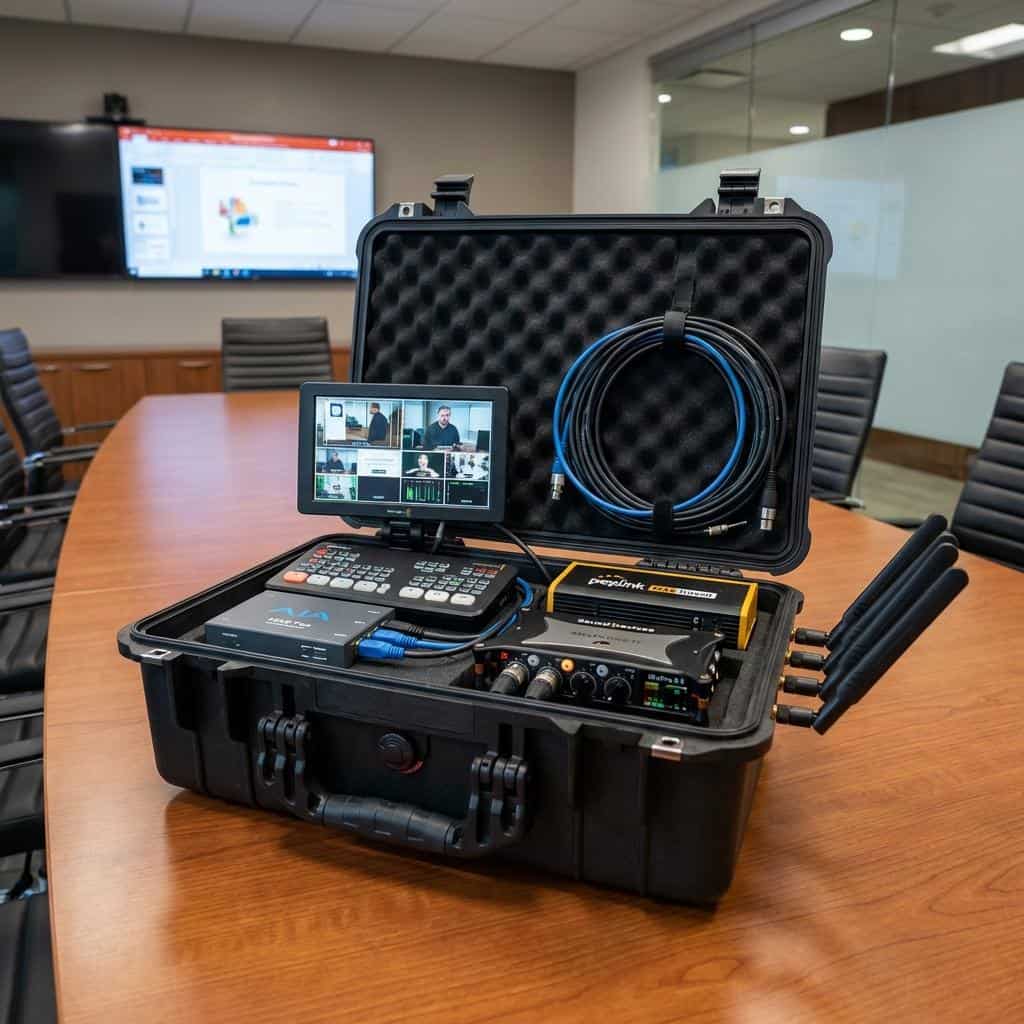
A typical flypack for this purpose is built into a ruggedized Pelican case and contains the core components of the larger studio, engineered for portability and quick setup. Key elements include:
- Compact Video Switcher: A unit like the Blackmagic Design ATEM Mini Extreme ISO or a Ross Video Carbonite Solo. The “ISO” model is particularly valuable as it records isolated feeds from all inputs, providing a complete record of all video sources for archival and compliance purposes.
- Integrated Streaming Encoder: A compact hardware encoder like the AJA HELO Plus or a Kiloview E-series, capable of both SRT and RTMPS output.
- Cellular Bonding: A crucial component for broadcasting from locations without reliable wired internet. A device from Peplink or LiveU bonds multiple 4G/5G cellular connections from different carriers to create a single, resilient, high-bandwidth uplink for the SRT stream.
- Professional Audio Interface: A compact audio mixer or interface to manage multiple microphone inputs and ensure broadcast-quality audio.
- Multiview Monitor: A small, high-resolution monitor to display all camera inputs, program output, and audio levels for the operator.
This entire kit can be powered by a single AC input or a portable battery solution (like an Anton/Bauer VCLX), allowing it to be deployed in any environment in under 30 minutes, providing a robust BCP solution for communication resilience.
Secure Distribution and Access Control
The final stage is ensuring the stream reaches only its intended audience. Public platforms are not an option. The SRT feed from the on-premise encoder or flypack should be sent to a secure cloud media server (like Wowza Streaming Engine or Nimble Streamer) hosted in a trusted cloud environment. From there, distribution is handled by an Enterprise Content Delivery Network (ECDN). An ECDN, such as those from Kollective, Ramp, or Hive Streaming, is designed to manage video traffic efficiently within a corporate network, preventing network saturation at branch offices.
Access control is the final layer of security. The video player should be embedded on a secure webpage or internal portal that requires authentication via the firm’s Single Sign-On (SSO) provider, such as Okta, Ping Identity, or Azure Active Directory. Further security measures include geo-fencing to restrict access to specific geographic locations, IP whitelisting for designated networks, and the use of expiring, tokenized URLs for the video player itself. This multi-layered approach to security ensures that sensitive internal communications remain confidential and are accessible only by authenticated and authorized stakeholders, providing a complete, end-to-end solution for mission-critical crisis communications.