
 March 17, 2026 by Editor |
Global Streaming for Multinational Corporations: A Technical Framework for East-West Cultural Integration
For multinational corporations (MNCs), executing a global town hall or a hybrid product launch is not merely a matter of broadcasting a video feed. It is a complex orchestration of technology and messaging that must resonate across disparate cultural contexts. The technical challenges inherent in bridging the communication gap between Eastern and Western audiences are significant, extending far beyond simple translation. Success requires a robust, flexible, and culturally aware production infrastructure. This involves managing everything from graphical presentation and linguistic delivery to network protocol selection and signal distribution architecture. For AV professionals and IT directors, engineering a solution that respects these nuances while maintaining broadcast-grade Quality of Service (QoS) is the primary objective.
The core challenge lies in creating a unified event experience that feels local to every participant. A presentation style that is effective in North America, characterized by directness and rapid pacing, may not be as well-received in parts of Asia, where a more measured and detailed approach is often preferred. These differences manifest as technical requirements. For instance, lower-third graphics need to accommodate different character sets and naming conventions (e.g., family name first). The audio workflow must support multiple channels for simultaneous interpretation without introducing distracting latency. The very architecture of the content delivery network must be optimized for variable last-mile conditions in different continents. Addressing these points requires a deep understanding of both broadcast engineering and the practical realities of global corporate communications.
Foundational Infrastructure for Global Streaming Delivery
The bedrock of any successful cross-continental stream is the transport and distribution infrastructure. The public internet, while ubiquitous, is a notoriously hostile environment for high-quality, low-latency video. Packet loss, jitter, and fluctuating bandwidth can degrade a pristine 1080p60 or 4K program feed into an unwatchable stream. Therefore, selecting the right protocols and network topology is a non-negotiable first step.
Protocol Selection: SRT vs. RTMP for International Contribution
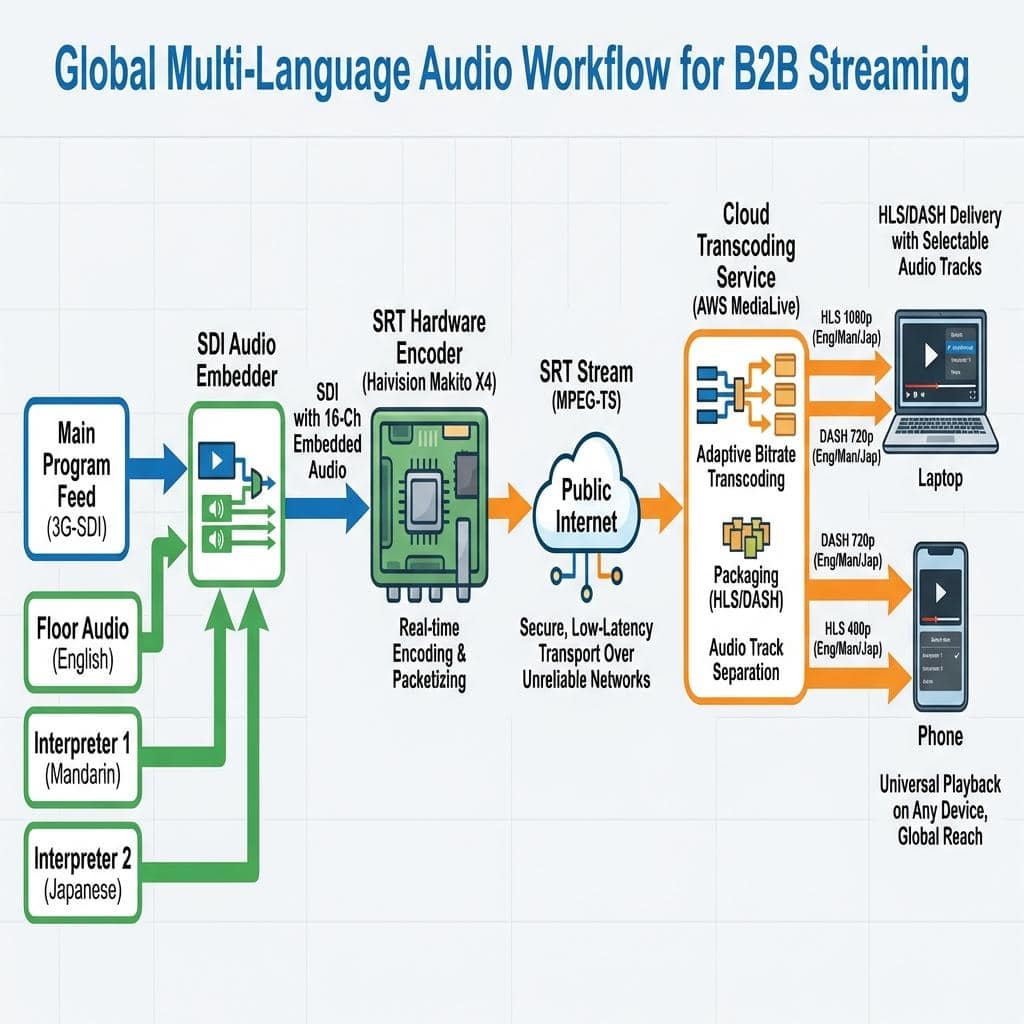
For decades, RTMP (Real-Time Messaging Protocol) was the de facto standard for contribution encoding. However, its reliance on TCP (Transmission Control Protocol) makes it ill-suited for long-haul transmission across continents. TCP’s congestion control mechanism, while ensuring delivery, can introduce significant latency as it retransmits lost packets, rendering it ineffective for real-time interaction. The modern solution is Secure Reliable Transport (SRT), a UDP-based protocol designed for high-performance streaming over unpredictable networks. SRT incorporates an ARQ (Automatic Repeat reQuest) mechanism that intelligently retransmits only the lost packets, minimizing latency overhead. This allows for stable, broadcast-quality contribution feeds with round-trip latencies low enough for real-time conversation between presenters in different hemispheres. For a global MNC event, all primary contribution feeds from remote speakers or venues should leverage SRT, transmitted from hardware encoders like the Haivision Makito X4 or software solutions like vMix to a central SRT gateway or cloud production environment.
Global Content Delivery Network (CDN) Strategy and PoP Distribution
Once the signal reaches the master control or cloud production hub, it must be distributed to a global audience. A single CDN may not provide optimal performance across all regions. A robust strategy often involves a multi-CDN approach, leveraging providers with dense Point of Presence (PoP) networks in key target regions. For an event targeting employees in both Europe and East Asia, it is critical to use CDNs with strong PoPs in locations like Frankfurt, Singapore, Tokyo, and Hong Kong. This minimizes the distance the video segments must travel to the end-user’s device, significantly reducing buffering and improving start-up times. Using DNS-based load balancing, viewer traffic can be dynamically routed to the best-performing CDN and PoP based on their geographic location and real-time network conditions. This ensures a consistent, high-quality viewing experience regardless of whether the attendee is in New York or Shanghai.
On-Premise vs. Cloud-Based Transcoding and Distribution
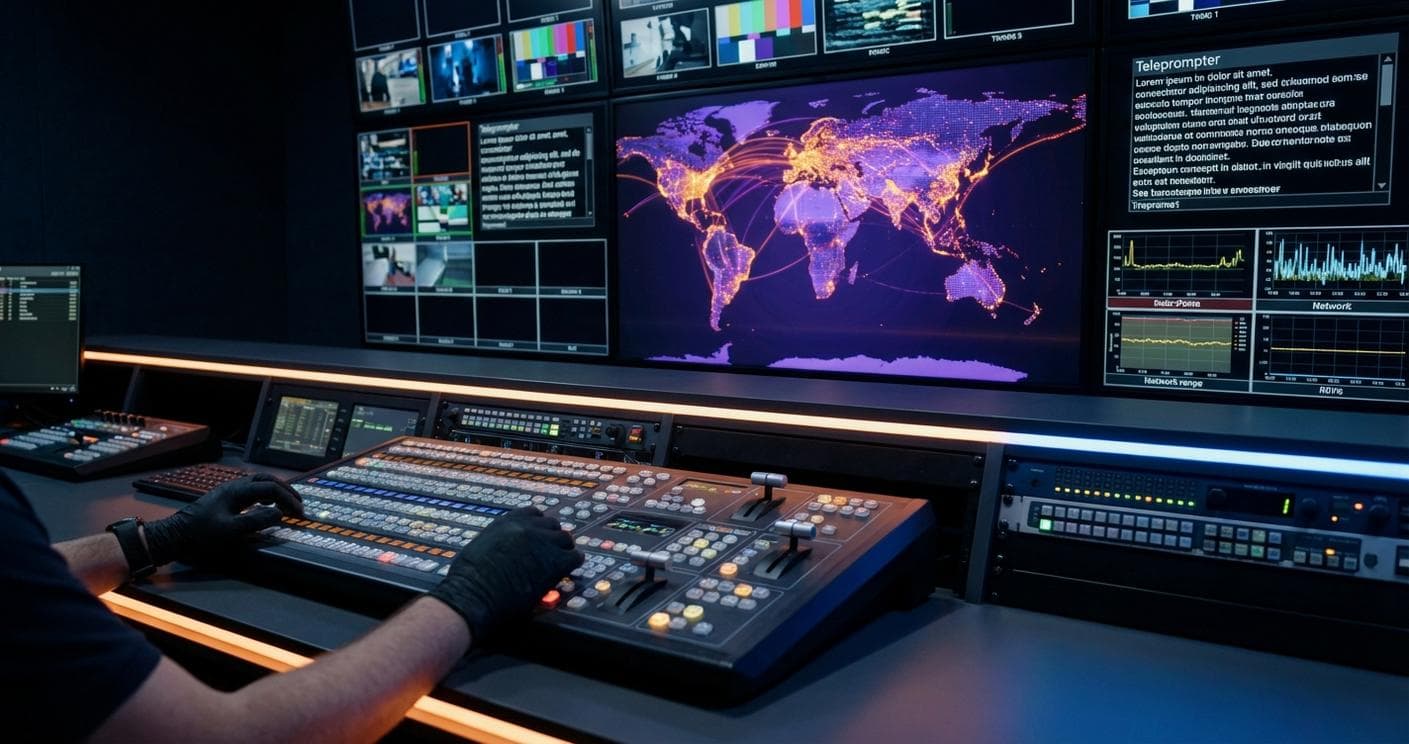
The decision to use on-premise hardware or cloud-based services for video processing is central to the architecture. An on-premise Master Control Room (MCR) provides maximum control and security, utilizing SDI routing matrices, hardware production switchers (e.g., Ross Carbonite, Grass Valley Kula), and dedicated hardware encoders. This is ideal for high-stakes events where security and absolute signal integrity are paramount. In contrast, a cloud-based workflow using services like AWS Elemental MediaLive or Microsoft Azure Media Services offers immense scalability and flexibility. It allows for the virtual spin-up of production environments, enabling complex tasks like multi-bitrate transcoding and regional stream customization without significant capital expenditure on hardware. For many MNCs, a hybrid approach is optimal. On-premise MCRs handle the primary production and high-value signal processing, while cloud services are used for scalable, global distribution and transcoding for ABR (Adaptive Bitrate) delivery to viewers.
Real-Time Production Workflows for Cross-Cultural Adaptation
With a solid infrastructure in place, the focus shifts to the live production environment where cultural adaptation is implemented in real time. This is where the technical director, graphics operator, and audio engineer execute strategies to make the content feel native to each regional audience.
Dynamic Graphics and Lower Thirds Localization
Graphics are a primary vehicle for cultural nuance. Western lower thirds typically follow a “First Name Last Name, Title” format. In many Eastern cultures, the family name comes first. Manually creating graphics for each permutation is inefficient and prone to error. A technically superior solution involves using dynamic HTML5-based graphics platforms like Singular.live or an integrated Chyron PRIME system. These platforms can be connected via API to a database or a simple spreadsheet (e.g., Google Sheets). The graphics operator simply triggers a graphic for a specific speaker, and the system automatically populates the template with the correct name order, title, and even character set (e.g., Kanji, Hanzi) based on the speaker’s region. This ensures accuracy and cultural appropriateness while maintaining brand consistency. The graphics engine renders the output as an NDI (Network Device Interface) or SDI feed, which is keyed over the program video by the production switcher.
Multi-Channel Audio for Simultaneous Interpretation
For any truly global event, simultaneous interpretation is essential. The technical execution requires a pristine audio workflow. The floor language (e.g., English) and interpretation feeds (e.g., Mandarin, Japanese, Spanish) are sourced from professional interpreter booths. These distinct audio channels are then embedded into the outgoing SDI program feed using an audio embedder. A 3G-SDI signal can carry up to 16 channels of uncompressed audio. This multi-channel signal is sent to the primary encoder. The encoder must be configured to preserve these discrete audio tracks within the stream, typically using a transport stream (MPEG-TS) over SRT. At the distribution end, the transcoding ladder creates ABR renditions that include all audio tracks. The final delivery via HLS or DASH allows the video player to present the viewer with a simple dropdown menu to select their preferred language. For archival purposes, it is critical to perform an ISO (isolated) recording of each audio channel alongside the clean program video.
Bridging Continents: The Hybrid Event Technical Blueprint
Hybrid events, with physical venues and remote presenters, add another layer of complexity, particularly across vast distances and time zones. The goal is to create a seamless experience where interaction feels immediate and natural, erasing the perception of geographic separation.
Synchronizing Remote Presenters Across Time Zones
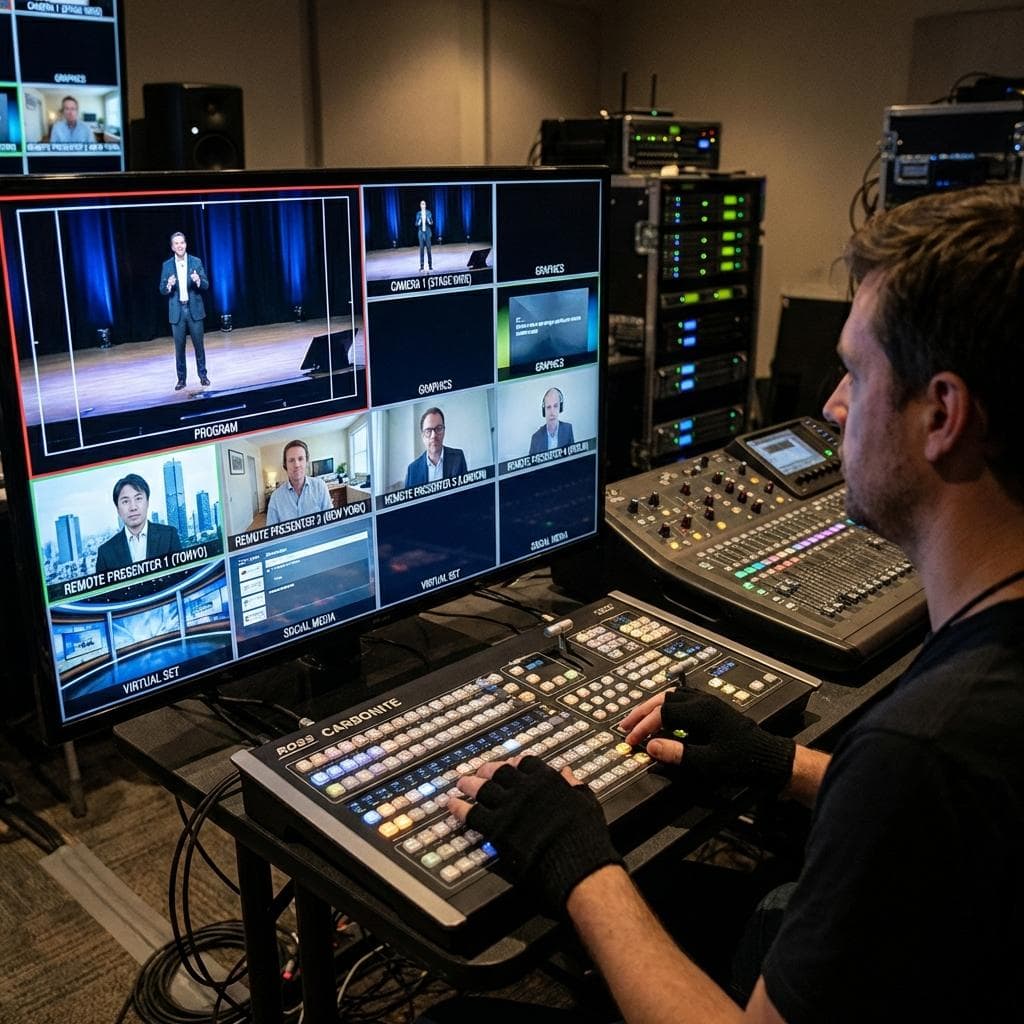
Achieving a broadcast-quality interactive discussion between a CEO on stage in London and a regional director in Tokyo requires meticulous management of latency. The contribution feed from Tokyo to London must be extremely low latency. An SRT stream running over a dedicated fiber link or a high-quality public internet connection can achieve a glass-to-glass latency of under 500ms. A critical component is the return feed to the remote presenter. They must see the main program output and hear questions without a disorienting delay. This return feed, including program video and mix-minus audio (an audio mix that excludes their own voice), is also sent via a low-latency SRT link. To ensure the remote video signal can be cleanly switched with local cameras in the London venue, the incoming SRT feed is decoded back to SDI and fed through a frame synchronizer to align its timing with the house GENLOCK signal.
Bi-Directional Feeds and Remote Audience Interaction
Engaging a remote audience requires more than just a one-way video stream. For a global town hall, questions may come from offices worldwide. A professional Q&A platform (e.g., Slido) can be integrated with the production workflow. A moderator filters questions, which are then fed via API into the graphics system to be displayed on-screen for the presenters. To create a more direct connection, remote participants can be brought “on-air.” This is accomplished by establishing a high-quality video call link, often using enterprise platforms like Microsoft Teams or Zoom with NDI outputs, or by using a dedicated SRT contribution link from the remote office’s AV system. The technical director can then route this feed into the main production switcher, creating a dynamic, two-way conversation that bridges continents and makes the entire global workforce feel like part of a single event.
Ultimately, successfully navigating the cultural nuances of East-West streaming is an exercise in technical precision and strategic planning. It demands an infrastructure built on reliable, low-latency protocols like SRT and a production workflow that is agile enough to adapt content in real time. From dynamic, data-driven graphics and multi-channel audio for interpretation to the meticulous synchronization of bi-directional feeds, every technical choice must serve the goal of creating a clear, respectful, and engaging experience for every viewer. For global corporations, partnering with a technical production team fluent in these international broadcast standards is not an option; it is a prerequisite for effective global communication.