
In an increasingly digital global economy, the principle of data sovereignty has become a paramount concern for enterprises, particularly within highly regulated jurisdictions like Singapore. For B2B live event streaming and hybrid production, where confidential corporate communications, sensitive financial disclosures, and strategic intellectual property are routinely transmitted, the imperative to ensure data remains within local geographical boundaries is not merely a preference, but a strict compliance requirement. The Live Streaming Studio Technical Team understands that modern corporate event planners, AV professionals, and IT directors face the complex challenge of leveraging global streaming technologies while simultaneously adhering to stringent national data protection laws. This article provides an advanced technical analysis of how Singaporean corporate data can be meticulously maintained within local servers throughout the entire B2B event streaming lifecycle, from ingest to archive.
Defining Data Sovereignty in the B2B Streaming Context for Singapore
Data sovereignty, at its core, refers to the legal and technical concept that digital data is subject to the laws and governance of the nation in which it is stored and processed. In the context of B2B event streaming, this extends beyond static files to encompass real-time video and audio streams, interactive audience data, system logs, and post-event archives. For Singaporean enterprises, this means navigating a sophisticated landscape of local regulations designed to protect sensitive information and maintain national control over digital assets.
Regulatory Frameworks and Compliance
Singapore’s legal framework imposes robust requirements on data handling. The Personal Data Protection Act (PDPA) mandates strict guidelines for the collection, use, and disclosure of personal data, including the requirement for consent and notification, and ensuring data accuracy and security. For financial institutions, the Monetary Authority of Singapore (MAS) Technology Risk Management (TRM) guidelines impose even more rigorous standards, demanding comprehensive risk assessments for all technology outsourced or deployed, including cloud-based services and streaming platforms. These regulations dictate that enterprises must maintain adequate controls to ensure data residency and prevent unauthorized cross-border data transfers. For a corporate town hall or an Annual General Meeting (AGM) streamed live, any attendee registration data, Q&A submissions, or poll responses constitute personal data subject to the PDPA, while financial reporting content may fall under MAS TRM scrutiny.
Implications for Live Event Production Data
During a B2B live stream, a myriad of data types are generated, each with specific sovereignty implications. The primary video and audio content itself, often containing proprietary information or sensitive discussions, is the most obvious. However, equally critical are the associated metadata streams: viewer analytics, interactive chat logs, Q&A transcripts, poll results, audience registration databases, and system telemetry logs detailing network performance and security events. Each of these data components must be meticulously tracked to ensure its residency. Consider a multinational corporation conducting a regional leadership summit where all strategic discussions and related interactive data are legally mandated to remain within Singapore. This necessitates an architecture where all processing, storage, and distribution points are physically located within the nation’s borders, preventing accidental or unauthorized data egress.
On-Premise vs. Hybrid Cloud Streaming Architectures for Data Sovereignty
Achieving true data sovereignty in B2B streaming typically involves a strategic architectural choice between fully on-premise infrastructure and meticulously controlled hybrid cloud deployments. Each approach presents distinct advantages and technical challenges in ensuring local data residency.
Advantages of On-Premise Infrastructure for Local Data Control
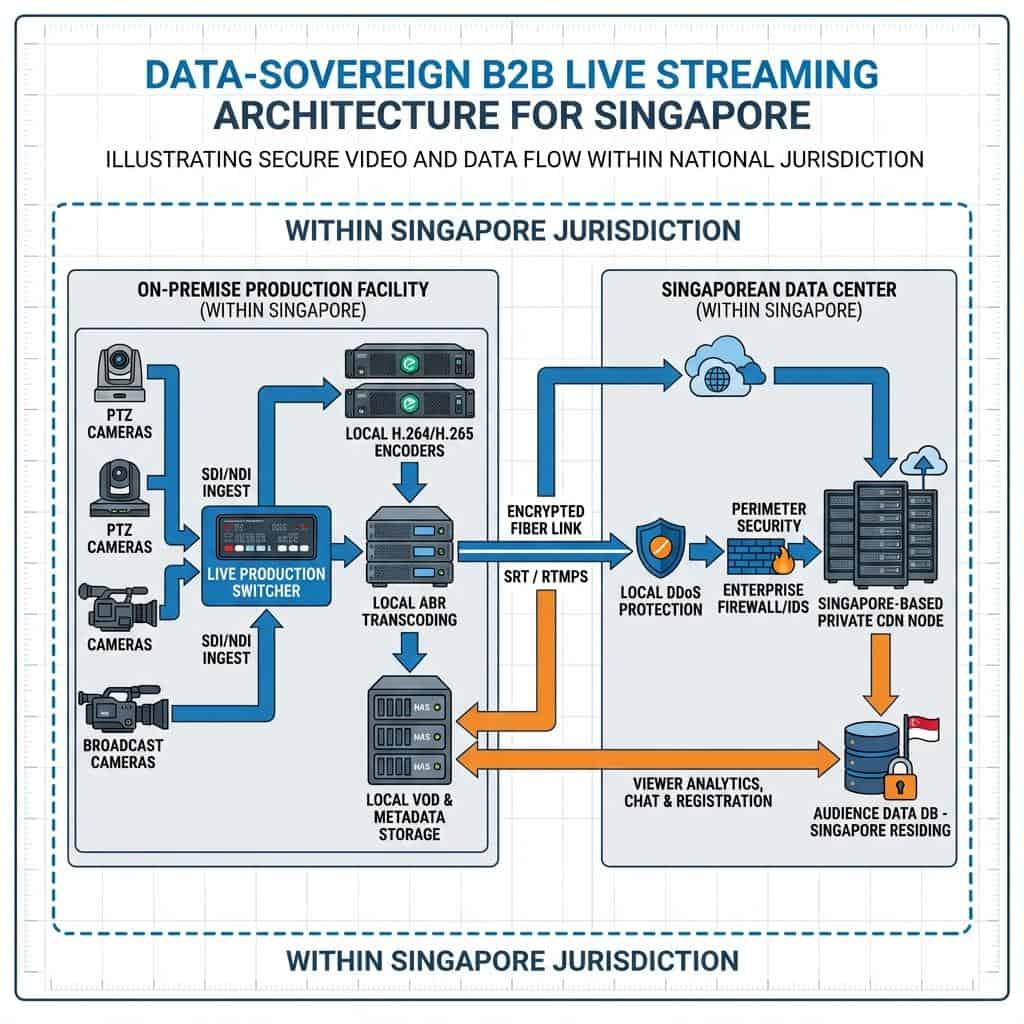
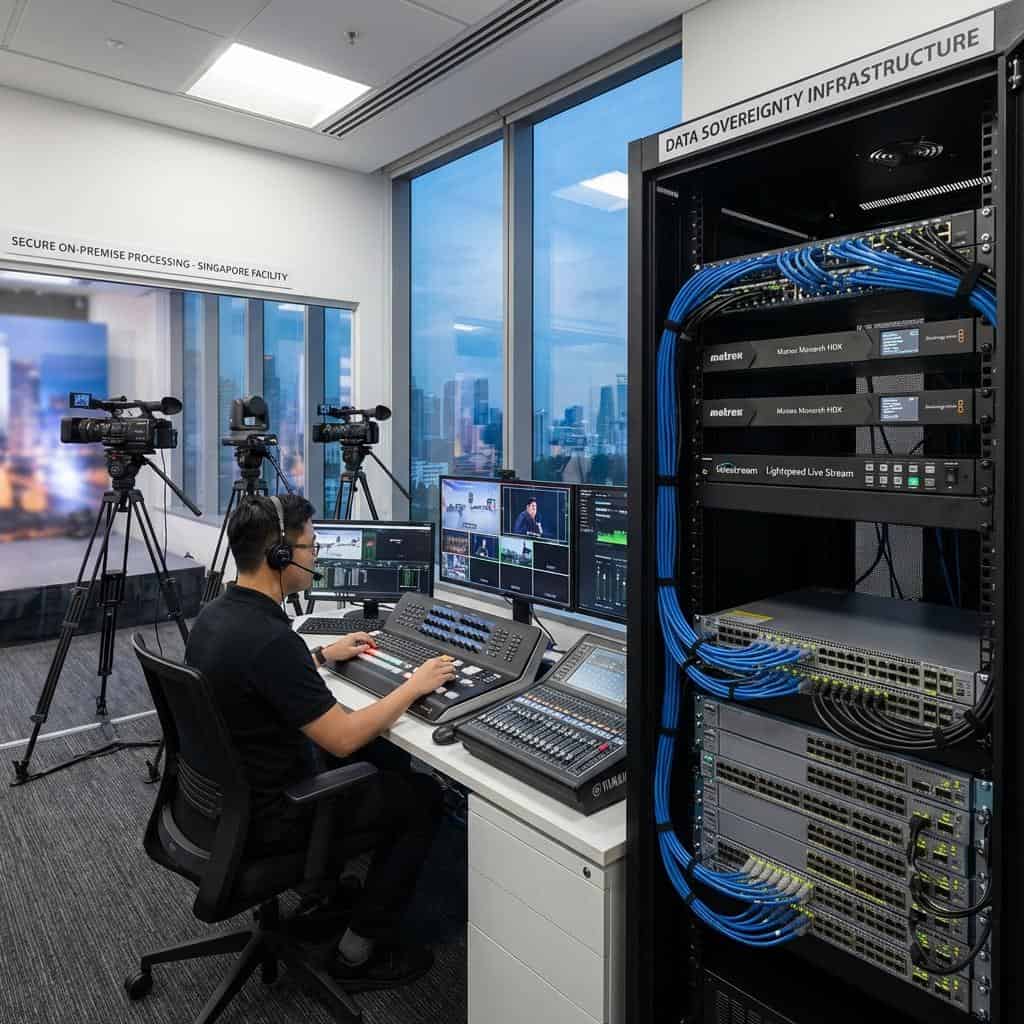
A fully on-premise streaming infrastructure provides the most direct and absolute control over data residency. Here, all hardware, software, and network components are physically owned, operated, and maintained within Singaporean corporate facilities or dedicated local data centers. This includes professional hardware encoders (e.g., Haivision Makito X series, Elemental Live appliances), media servers, video switchers, audio mixers, and high-capacity Network Attached Storage (NAS) or Storage Area Network (SAN) solutions for content archiving. For instance, ingesting raw camera feeds (SDI, NDI) directly into local hardware encoders for H.264 or H.265 encoding at specified bitrates (e.g., 1080p at 8-15 Mbps, 4K/UHD at 20-30 Mbps) ensures that the initial stream processing never leaves the local environment. Network infrastructure, including redundant internet connectivity from local providers (Singtel, StarHub, M1) via diverse fiber paths, is entirely under the client’s or Live Streaming Studio’s control, mitigating risks associated with international routing or third-party cloud infrastructure. This approach offers unparalleled oversight of physical security, access controls, and network traffic, making it the most stringent option for data sovereignty compliance.
Hybrid Cloud Models and Geofencing Strategies
While on-premise offers maximum control, hybrid cloud models provide scalability and flexibility, particularly for reaching diverse audiences. In a hybrid strategy, sensitive data processing and primary content elements requiring strict data sovereignty are handled on-premise, while less sensitive or public-facing elements leverage cloud resources that are specifically geo-fenced to Singapore. Major cloud providers, such as AWS Asia Pacific (Singapore) region or Google Cloud Singapore region, offer services that allow data to be physically stored and processed within Singaporean data centers. However, enterprises must meticulously vet cloud provider contracts and technical architectures to confirm that not only content data but also critical metadata, control plane traffic, and any ancillary services (e.g., analytics, authentication) adhere to Singaporean data residency requirements. Even with geo-fencing, it is crucial to understand potential data flows for disaster recovery, monitoring, or global load balancing that might temporarily route through or store data in other regions. A hybrid model typically involves secure, encrypted connections (e.g., dedicated AWS Direct Connect or Google Cloud Interconnect) between the on-premise facility and the Singaporean cloud region. For a live hybrid event, internal, confidential sessions might be fully processed and stored on-premise, while external, public-facing sessions are delivered via a geo-fenced Singaporean CDN. This layered approach demands expert architectural planning to segment data appropriately.
Technical Implementation Strategies for Local Data Retention
Implementing data sovereignty in B2B streaming requires precise technical strategies for encoding, delivery, and storage, all meticulously designed to keep data within Singaporean borders.
Localized Encoding, Transcoding, and Content Delivery Networks (CDNs)
The journey of a live stream begins with encoding. Raw SDI or NDI feeds from professional multi-camera setups are ingested into high-performance, on-premise hardware encoders. These encoders convert the uncompressed video into compressed H.264 or H.265 streams at various resolutions and bitrates (e.g., 720p at 3-5 Mbps, 1080p at 8-15 Mbps). For adaptive bitrate (ABR) streaming, which is essential for reaching diverse viewer devices with optimal quality, localized transcoding within Singaporean infrastructure is critical. This involves dedicated media servers or transcoders generating multiple renditions of the stream (e.g., 360p, 720p, 1080p) from the primary high-bitrate stream. Subsequently, these ABR streams are delivered via a Content Delivery Network (CDN) that has a confirmed, robust Point of Presence (PoP) within Singapore. For true data sovereignty, this should ideally be a private CDN or a public CDN meticulously configured to ensure content caching and distribution occur exclusively through its Singaporean nodes, leveraging the Singapore Internet Exchange (SGIX) for optimal local delivery without traversing international boundaries. Providers like Akamai, Cloudflare, or local Singaporean CDN services must provide explicit assurances of data residency for all cached content and associated logs.
Secure Ingest and Egress Protocols (SRT, RTMPS)
Data security during transit is as vital as data at rest. For contribution feeds from remote speakers or satellite production sites into a central Singaporean hub, the Secure Reliable Transport (SRT) protocol is invaluable. SRT, an open-source video transport protocol, offers low-latency, error-corrected, and encrypted (AES-128/256) streaming over unreliable networks, ensuring that valuable content reaches the Singaporean production facility securely and reliably. This is particularly crucial for hybrid events where remote presenters’ feeds must be ingested into a local switcher and encoder rack. For egress, or distributing the final program feed from the Singaporean infrastructure, RTMPS (RTMP Secure) or HLS/DASH over HTTPS are standard. RTMPS, the encrypted variant of Real-Time Messaging Protocol, uses TLS/SSL to secure the stream from the local media server to the local CDN or direct distribution platform. All network traffic, including control signals and metadata, must be encapsulated within TLS 1.2 or 1.3 encryption, ensuring end-to-end data protection as it moves within Singapore’s digital perimeter.
Data Storage and Archiving Solutions
Post-event, the live streams are typically archived for Video on Demand (VOD) access. For data sovereignty, these VOD archives, along with all associated metadata, chat logs, Q&A records, and analytics, must be stored exclusively on physical storage located within Singapore. This often involves high-capacity RAID (Redundant Array of Independent Disks) arrays, enterprise-grade NAS/SAN systems, or even LTO (Linear Tape Open) tape libraries for long-term cold storage. These storage solutions should reside within secure, access-controlled Singaporean data centers that comply with local regulatory standards for physical security, environmental controls, and data integrity. Backup and disaster recovery strategies must also adhere to data sovereignty, meaning any replicated data or backup copies must also be stored in geographically diverse but still Singaporean data centers. This ensures that even in a recovery scenario, data never leaves the local jurisdiction, satisfying stringent data retention policies and audit requirements.
Ensuring Data Integrity and Security within Singaporean Borders
Beyond simply keeping data local, maintaining its integrity and security within Singapore’s borders is paramount. A sovereign data architecture is only as strong as its weakest link in the security chain.
End-to-End Encryption and Access Control
Robust security measures are indispensable. All data, whether at rest or in transit, must be protected by strong encryption. For data at rest on local storage, AES-256 encryption is a standard requirement. For data in transit, the utilization of TLS 1.2/1.3 for all streaming protocols (RTMPS, HLS/DASH over HTTPS) and secure tunneling for contribution (SRT with AES encryption) is non-negotiable. Furthermore, comprehensive Identity and Access Management (IAM) systems must be implemented across all components of the streaming infrastructure. This includes multi-factor authentication (MFA) for all production team members, administrators, and platform users, alongside granular role-based access control (RBAC) to ensure that only authorized personnel have access to specific data streams, controls, or storage repositories. Strict segregation of duties should also be enforced to prevent any single individual from having unfettered control over sensitive data flows or systems.
Redundancy, Failover, and Business Continuity Planning
Professional B2B streaming demands unwavering reliability. Data sovereignty must be built upon a foundation of redundancy and robust business continuity planning. This entails deploying N+1 or 2N redundancy for all critical streaming hardware components, including encoders, media servers, network switches, and power supplies. For instance, two identical encoding paths, fed by a failover switcher, ensure that if one encoder fails, the backup can take over instantaneously, maintaining continuous service. Data replication to geographically diverse data centers within Singapore (e.g., one facility in the eastern region, another in the western region) provides robust disaster recovery capabilities without compromising data residency. Automated failover mechanisms are essential for seamless transitions, ensuring the live event proceeds uninterrupted while all data processing remains securely within Singaporean jurisdiction. Regular testing of these failover protocols and comprehensive business continuity plans are vital to validate their effectiveness.
Network Infrastructure for High-Security Live Production
The underlying network infrastructure is the backbone of a data-sovereign streaming solution. Dedicated, private network links between the live production site and local Singaporean data centers offer superior security and performance compared to relying solely on the public internet. Enterprise-grade firewalls, meticulously configured with strict ingress and egress rules, are essential to prevent unauthorized access. Intrusion Detection Systems (IDS) and Intrusion Prevention Systems (IPS) should actively monitor network traffic for suspicious activities, providing real-time alerts and automated threat mitigation. Localized DDoS (Distributed Denial of Service) mitigation services, operating from Singaporean scrubbing centers, are crucial to protect against cyberattacks that could disrupt service or compromise data. Furthermore, network segmentation using VLANs (Virtual Local Area Networks) can isolate production networks from management and public distribution networks, adding layers of security. Quality of Service (QoS) configurations must prioritize real-time video and audio streaming traffic to ensure low latency and consistent bandwidth delivery, critical for maintaining broadcast quality and a seamless viewer experience, all while adhering to the highest security standards within Singapore’s digital borders.
Data sovereignty in B2B event streaming is a multi-faceted technical challenge that demands a comprehensive, integrated approach. It requires meticulous architectural planning, expert implementation of advanced streaming protocols and security measures, and a deep understanding of Singapore’s regulatory landscape. For corporate event planners, AV professionals, and IT directors, ensuring that every byte of corporate data remains within local servers throughout the live and hybrid event production workflow is not merely a compliance task; it is a strategic imperative that safeguards sensitive information and upholds corporate trust. Live Streaming Studio provides the expertise and technical solutions to design, deploy, and manage these complex, sovereign streaming infrastructures, ensuring that your enterprise events achieve both global reach and uncompromised local data control. Partnering with a specialist in enterprise-grade production and streaming solutions, grounded in the realities of Singaporean data governance, is critical for success in this evolving digital landscape.

Michael Koh is a production specialist and entrepreneur who founded Spring Forest Studio in 2017 to provide event and virtual production solutions in Singapore. He specialises in hybrid live streaming, XR (Extended Reality) virtual production, and studio systems integration, transitioning the business from traditional videography to advanced corporate broadcasting. Operating out of a dedicated facility at NordCom2 in Singapore, he leads a technical crew to deliver multi-camera webcasts, digital sets, and technical consultations for large-scale corporate events.