
On-screen overlays are one of the most visible, technically sensitive layers in a B2B live streaming environment. For corporate town halls, investor briefings, product launches, trade show sessions, and hybrid conferences, overlays do far more than display a lower third or a logo bug. They establish visual hierarchy, reinforce brand governance, support speaker identification, guide audience attention, and maintain continuity across physical and virtual delivery paths. In enterprise streaming, an overlay system must be designed as part of the full production chain, not as a graphic afterthought. That means it has to align with the camera plan, switching logic, encoder constraints, streaming protocol selection, audio workflow, content moderation requirements, and the expectations of corporate stakeholders who often review content from boardroom displays, laptops, mobile devices, and in-room confidence monitors at the same time.
A premium overlay package for B2B platforms must also survive operational complexity. Live events frequently combine SDI and HDMI 2.1 sources, NDI and NDI|HX contribution feeds, cloud graphics engines, local playback machines, remote presenters, and platform outputs to Microsoft Teams, Zoom, Webex, or enterprise content delivery environments. A well-engineered overlay system supports all of that without compromising legibility, latency, color consistency, or encoder stability. The design target is not visual decoration. The design target is reliable information architecture for live communication. That requires an engineering-first approach to safe areas, composition ratios, graphic transitions, frame rate matching, keying methods, network throughput, and failover strategy.
Overlay Strategy in Enterprise Live Production
In corporate streaming, overlay design starts with the production objective. A shareholder meeting needs restrained identity treatment, legal-safe text handling, and clean speaker-focused composition. A product announcement may require modular title cards, animated callouts, agenda bands, and live data integration. A regional sales kickoff could demand multilingual name straps, sponsor acknowledgements, session timing markers, and brand-compliant motion graphics. Each of these use cases imposes different technical requirements on the graphics system and the live switching workflow.
Brand governance and composition hierarchy
Premium branding on B2B platforms depends on consistent treatment of logo placement, typographic scale, spacing, and contrast. Lower thirds should remain legible at both 1080p and 2160p output, with enough stroke weight and luminance separation to preserve readability after compression. In practice, corporate overlays perform best when they are built from a brand system that defines minimum font sizes, permissible motion durations, clear space around logos, and color values matched to broadcast-safe output. If the event is streaming in UHD, the graphics source should be authored at native 3840 by 2160 where possible, with attention to scaling behavior on downstream HD program feeds.
Safe area management remains critical. Titles placed too close to the frame edge may be clipped by venue confidence monitors, LED wall processors, or downstream platform transcoders. For mixed display environments, engineers should validate title placement against both action safe and title safe conventions, while also checking output framing on common 16:9, ultrawide, and portrait social cutdowns when a production package includes ancillary deliverables.
Motion design and live readability
Animated overlays in enterprise events need restrained motion profiles. Excessive speed creates cognitive overload and increases the risk of distraction during key remarks or panel discussions. Motion graphics should use predictable in and out timings, usually short enough to avoid interrupting the speaker, but long enough to complete cleanly under live program switching. For most corporate use cases, the graphic package should support fast-access stills, keyframe-based motion templates, and lower-third animations that can be recalled instantly from a graphics engine or live controller. The operator should be able to trigger them from an integrated production workflow without manual layer manipulation during the event.
Readable overlays also depend on subtitle and caption integration. If captions are burned into the program feed, the overlay architecture must prevent collisions between captions, speaker identifiers, and any persistent branding elements. When captions are delivered as a separate data service, graphics operators should still reserve lower screen real estate and define fallback positions for emergency text inserts. This becomes especially important in hybrid productions where presenter names, room Q and A prompts, and real-time polling prompts may all compete for screen space.
Technical Infrastructure for Overlay Delivery
Overlay quality is inseparable from the infrastructure that renders and transports it. The graphics engine, production switcher, replay system, and encoder must all share a coherent timing strategy. In live event environments, overlay systems often fail not because the design is poor, but because sync drift, signal format mismatches, or insufficient GPU headroom cause artifacts, delays, or dropped compositing layers. Enterprise-grade overlay design therefore requires a robust understanding of signal flow, synchronization, and compute planning.
Graphics rendering paths and keying methods
Most premium overlays are delivered through one of three methods, fill and key, upstream graphics compositing, or downstream branding insertion. Fill and key is a standard broadcast technique where the graphics system outputs a matte and a fill channel that are keyed in the switcher or mixer. This method provides precise transparency control and is widely used for broadcast-quality lower thirds and full-screen packages. Upstream compositing embeds the overlay directly into the graphics output before it enters the production switcher. That is simpler operationally, but less flexible if the same design must be modified live or repurposed for multiple outputs. Downstream insertion can be efficient for certain persistent branding elements, such as bug logos or watermark-style identifiers, but it must be tested carefully to avoid clashes with encoded bitrate budgets and chroma artifacts.
For hybrid events, graphics engines may receive source video via SDI, NDI, or SRT. SDI remains common in controlled production environments because it provides deterministic transport and low latency. NDI, including NDI|HX for bandwidth-constrained links, is practical for IP-based routing and distributed studios, but it places greater emphasis on network design and switch configuration. SRT, or Secure Reliable Transport, is valuable for remote contribution and graphics ingestion over unpredictable networks because it adds resilience through packet loss recovery and controlled latency buffering. The best choice depends on the event topology, latency tolerance, and available infrastructure.
Frame rate, resolution, and codec alignment
Overlay packages must be authored to match the program feed format. If the event is produced at 1080p60, graphics motion and typographic animation should be tested at 60 frames per second to verify motion smoothness. If the client’s distribution path includes a UHD master, all raster artwork should be prepared for 4K scaling, with line weights and typography adjusted to maintain clarity. Encoding constraints also matter. H.264 remains common for broad compatibility, while H.265, also known as HEVC, may be used where platform support and downstream decode capacity are proven. Regardless of codec, the overlay complexity should be considered in relation to bitrate management. Highly detailed motion graphics, gradients, transparency, and rapid motion can raise compression stress and introduce macroblocking or banding if the encoder profile is not tuned carefully.
For enterprise platforms, latency targets usually depend on the interaction model. A one-way executive broadcast may tolerate modest latency, while a live panel with moderator interaction or remote speaker handoff may require tighter end-to-end delay. Overlay animation duration, encoder buffer settings, and platform distribution latency all contribute to the final experience. Graphics operators should coordinate with encoding engineers to ensure that animated lower thirds and transitions remain synchronized with camera cuts and speaker cues, especially when the program feed is mirrored into Teams, Zoom, or Webex for distributed participation.
Hybrid Event Workflows and Multi-Platform Delivery
Hybrid event production introduces a second audience plane, the physical venue audience and the remote digital audience. Overlays must function well in both contexts. A lower third that reads clearly on a webinar player may become illegible on a large LED wall if it is too thin, while a dramatic stage graphic may overwhelm a small laptop display. The solution is not a single universal composition, but a production architecture that supports separate deliverables or adaptive layering.
Program feed, confidence feed, and clean feed design
Many corporate events require three distinct outputs. The program feed contains the full overlay package for the remote audience. The confidence feed provides presenters and stage management with essential show information, often including timers, speaker cues, and preview content. The clean feed strips away branding and superimposed text for archival, editing, or downstream repurposing. A disciplined graphics architecture should define which elements live on each feed before the event reaches technical rehearsal. This reduces operator confusion and prevents accidental burn-in of content that should remain optional.
Production switchers must be configured to support fast transitions between overlay states. That may include cut, mix, dip to color, stinger, and graphic wipe transitions. In larger productions, an upstream graphics operator may coordinate with a technical director, audio engineer, and show caller using talkback systems and intercom routing. This allows the production team to trigger speaker names, session countdowns, and sponsor slate transitions precisely when cameras, microphones, and slides are in sync.
Integration with enterprise collaboration platforms
When outputs are distributed through Microsoft Teams, Zoom, or Webex, overlays should be tested against each platform’s aspect ratio handling, thumbnail layout, and screen-share coexistence rules. Corporate events often require a return feed for remote presenters, which means the on-screen layout must preserve a clean area for remote speaker video while still showing branding and agenda information. In these scenarios, a composited return feed may include a branded frame, speaker ID bar, and a controlled content window for slides or gallery video. Engineers should verify that the overlay stack does not obscure platform UI elements or create duplicate branding when the platform adds its own name labels.
If a remote contributor joins over SRT or another contribution protocol, operators should measure path latency and build a graphics timeline with sufficient lead time for live introductions, lower-third triggers, and camera selection. This is especially important when integrating remote presenters into a multi-camera show using hybrid switching logic. A mismatch between remote latency and local switching rhythm is one of the most common reasons overlays appear to be late, even when the graphics engine itself is working correctly.
Network, Redundancy, and Reliability Requirements
Premium overlays are only as reliable as the transport systems that carry them. The network layer should be treated as production infrastructure, not office IT. This means switch capacity, multicast handling, QoS, VLAN segmentation, and power redundancy all matter. In an IP production environment, graphics traffic can compete with NDI, remote contribution, monitoring streams, and control data. Without prioritization and proper segmentation, even a visually simple overlay can fail under load.
Bandwidth planning and signal integrity
For local production, SDI remains highly stable because it avoids many of the jitter and congestion issues found in generic Ethernet environments. When an event uses NDI or NDI|HX, the design team should validate total throughput, especially if multiple cameras, graphics workstations, and return feeds share the same switches. SRT contribution paths should be tested on the actual venue network and on the backup internet path, because packet loss handling and latency buffering are only effective when the underlying link characteristics are known. Overlay systems that depend on cloud graphics renderers must also account for round-trip latency to the cloud region, which can be material for time-sensitive cueing.
Redundancy should be built into the graphics chain wherever the event risk profile justifies it. That may include redundant graphics playlists, mirrored graphics machines, backup switcher keyers, dual power supplies, and a secondary encoder path. For mission-critical board meetings or large corporate broadcasts, a failover design should preserve at least the most essential branding layer and critical text elements, even if advanced motion graphics have to drop out temporarily. The audience experience remains professional if the core lower thirds, logo bug, and speaker identification persist without interruption.
Quality control and preflight validation
Overlay packages should go through technical preflight before the event, not during the show. Validation should include font rendering checks, color consistency on calibrated monitors, alpha channel verification, motion timing review, encoder stress tests, and multiview monitoring assessment. Engineers should verify that graphics remain stable at the intended program resolution and that no interlacing artifacts appear when the signal is converted between formats. If the event includes ISO recording, each isolated camera feed should be checked against the program feed to ensure that overlays are only present where intended. This is essential for post-production, highlights editing, and archival compliance.
In a Singapore corporate production environment, these practices are especially relevant because many events combine international speakers, regional headquarters teams, and venue-based audiences within tight production windows. That makes technical rehearsal time valuable, and it makes disciplined system design even more important. A graphics package that is fast to deploy, easy to localize, and consistent across multiple outputs reduces operational friction and keeps the event team focused on show execution.
Implementation Guidelines for Enterprise Clients
Enterprise overlay design should be built from a production brief that defines business goals, audience hierarchy, distribution endpoints, branding governance, and technical constraints. The design team should begin by mapping every output path, including in-room IMAG, LED wall content, remote audience program feeds, recording masters, and social derivatives if applicable. From there, the graphics architecture can be aligned to the production switcher, encoder stack, and collaboration platforms.
Recommended deployment sequence
- Define master show format, resolution, frame rate, and delivery protocols before building any graphics assets.
- Specify brand-safe typography, logo placement, contrast ratios, and motion timing in a graphics style guide.
- Choose the graphics engine based on the required output method, fill and key, upstream compositing, or downstream insertion.
- Validate compatibility with SDI, HDMI 2.1, NDI, NDI|HX, and SRT sources as relevant to the venue architecture.
- Test overlays on all intended program outputs, including Teams, Zoom, Webex, recording masters, and venue displays.
- Build a failover plan that preserves essential lower thirds, logo bugs, and event identifiers if advanced motion graphics become unavailable.
When these steps are implemented correctly, overlays become a strategic production asset. They strengthen brand consistency, improve speaker identification, support hybrid engagement, and help large-scale enterprise events maintain clarity under live operational pressure. The result is a premium visual layer that feels intentional, stable, and professionally engineered from the first frame to the final sign-off.
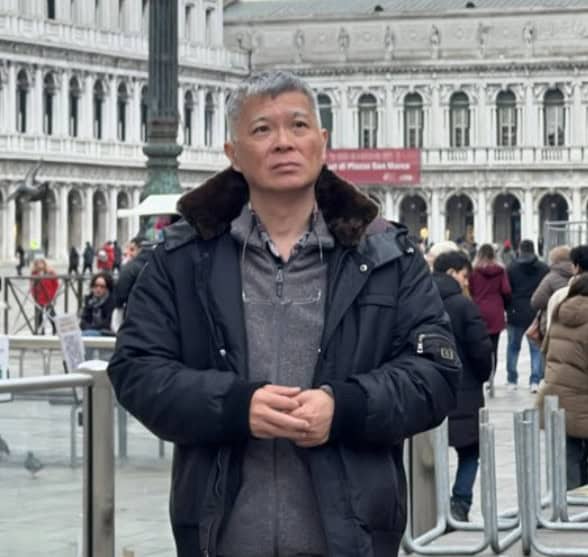
Michael Koh is a production specialist and entrepreneur who founded Spring Forest Studio in 2017 to provide event and virtual production solutions in Singapore. He specialises in hybrid live streaming, XR (Extended Reality) virtual production, and studio systems integration, transitioning the business from traditional videography to advanced corporate broadcasting. Operating out of a dedicated facility at NordCom2 in Singapore, he leads a technical crew to deliver multi-camera webcasts, digital sets, and technical consultations for large-scale corporate events.