
 April 11, 2026 by Editor |
In the high-stakes environment of B2B event production, the digital stage serves as a critical extension of an organization’s brand identity. Beyond mere logo placement, effective visual branding for premium corporate events necessitates a meticulously engineered technical infrastructure capable of delivering consistent, high-fidelity visual experiences across diverse viewing platforms. This advanced technical analysis delves into the sophisticated production methodologies, enterprise-grade streaming protocols, and robust infrastructure designs required to architect a digital stage that not only captivates but also authentically represents an enterprise’s brand ethos. We explore the intricacies of signal acquisition, real-time graphics integration, multi-platform delivery, and redundancy strategies, all critical for ensuring a flawless visual narrative in both purely virtual and complex hybrid event paradigms. Our focus remains strictly on B2B live event streaming, distinguishing it from consumer entertainment paradigms by emphasizing scalability, security, and integration with established enterprise communication ecosystems.
Technical Foundations of Visual Integrity for the Digital Stage
The bedrock of a visually compelling digital stage lies in its foundational technical infrastructure, beginning with precise signal acquisition and robust video processing. Premium corporate events often demand multi-camera productions utilizing professional broadcast-grade cameras, typically equipped with SDI (Serial Digital Interface) outputs for uncompressed, high-bandwidth video transmission over coaxial cable, or increasingly, IP-native cameras leveraging NDI (Network Device Interface) or SMPTE ST 2110 for transport. SDI offers well-established reliability over distances with robust shielding, while IP-based workflows unlock unprecedented flexibility and scalability within a networked ecosystem, particularly for geographically dispersed production teams.
Advanced Signal Acquisition and Routing Architectures
Multi-camera setups are orchestrated via production video switchers, devices designed to seamlessly transition between video sources. Modern enterprise-grade switchers, from hardware-based professional broadcast models to sophisticated software-defined video production platforms, support a multitude of input formats including 3G-SDI, 12G-SDI for 4K/UHD resolutions, and increasingly NDI or SRT (Secure Reliable Transport) feeds. Signal routing, a critical component, is managed through dedicated SDI routers or, in IP-centric environments, through managed network switches leveraging multicast traffic for NDI or PTP (Precision Time Protocol) for SMPTE ST 2110. This ensures precise timing and synchronization across all video elements, preventing artifacts like tearing or dropped frames that can severely compromise visual brand integrity.
Encoding Standards and Bitrate Management for Visual Fidelity
Once sources are switched and composited, the program feed undergoes encoding. H.264 (AVC) remains a ubiquitous standard for its balance of compression efficiency and broad compatibility, while H.265 (HEVC) offers superior compression, delivering equivalent quality at roughly half the bitrate, crucial for optimizing bandwidth consumption and reducing latency. Professional hardware encoders or high-performance software encoders are deployed to convert the baseband video signal into a streamable format. Bitrate management is paramount: delivering 1080p Full HD at a sustained bitrate of 6-10 Mbps for critical visual elements and up to 20-30 Mbps for 4K/UHD content ensures visual fidelity. Adaptive Bitrate Streaming (ABS), employing manifest files and segmented video delivery, allows client devices to dynamically switch between multiple quality renditions (e.g., 720p, 1080p) based on available network bandwidth, guaranteeing an optimal viewing experience without manual intervention and preserving the visual brand across varying network conditions. This often involves segmenting content into small chunks (e.g., 2-10 seconds) using protocols like HLS (HTTP Live Streaming) or MPEG-DASH (Dynamic Adaptive Streaming over HTTP).
Advanced Graphics Integration and Real-time Compositing
Visual branding transcends static logos; it is a dynamic interplay of animated graphics, lower thirds, full-screen overlays, and virtual sets that reinforce messaging and enhance viewer engagement. Integrating these elements seamlessly into a live production requires sophisticated real-time compositing capabilities.
Real-time Graphics Engines and Keying Techniques
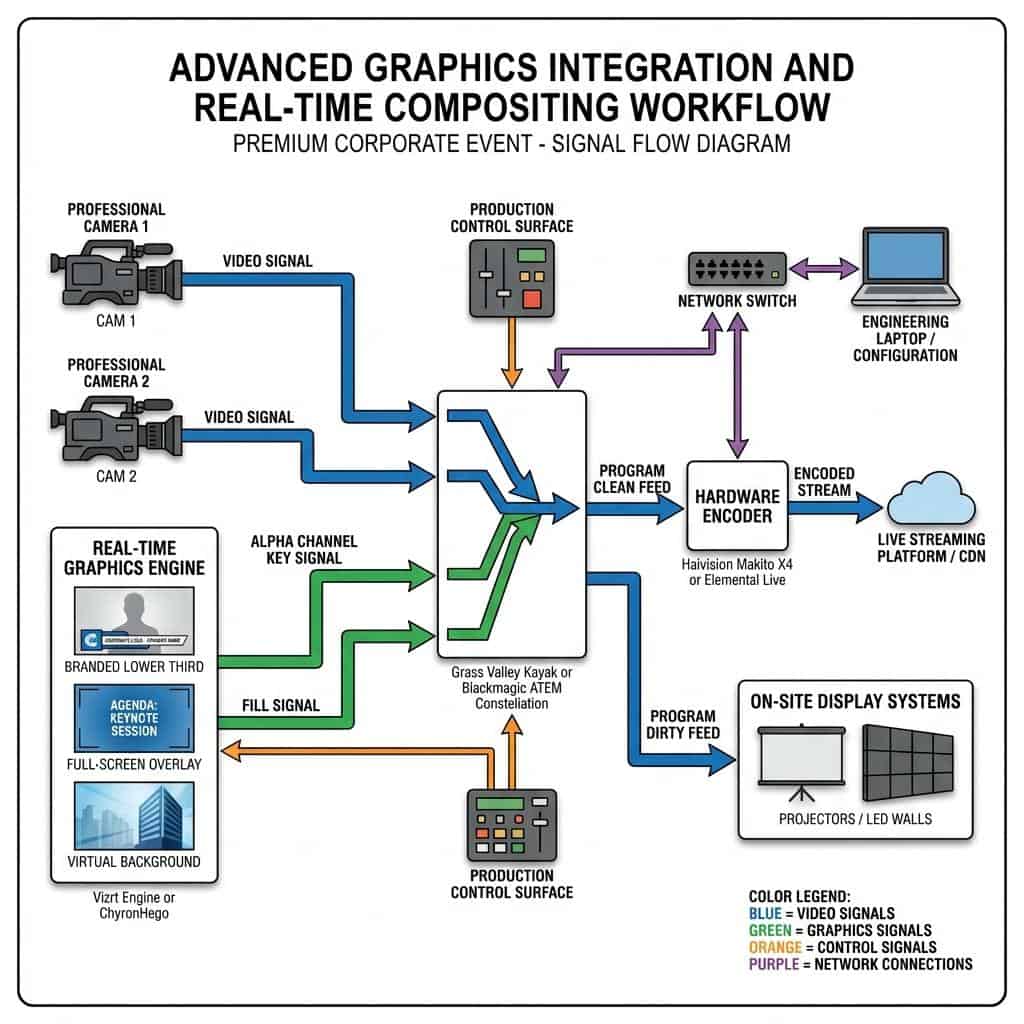
Professional graphics engines, often dedicated hardware or high-performance software running on robust workstations, generate broadcast-quality animations and data-driven graphics. These systems integrate with the video switcher via SDI or NDI. Keying techniques are fundamental: luminance keying for simple transparency, and chrominance keying (chroma key/green screen) for compositing presenters into virtual environments. Advanced systems employ luma keying with alpha channel data, providing superior edge transparency for complex graphics. Data integration with event registration systems or polling platforms allows for real-time display of attendee names, voting results, or social media feeds, dynamically incorporating audience interaction while maintaining strict brand guidelines for typography, color palette, and animation styles.
Multi-Layer Compositing and Visual Effects
Beyond simple overlays, multi-layer compositing allows for complex visual narratives. Picture-in-picture (PiP) configurations, multi-source layouts, and augmented reality (AR) elements are common in premium corporate events. These effects are managed either within the video switcher’s DVE (Digital Video Effects) capabilities or through external graphics processors. For instance, a presenter might be shown against a branded virtual background, while a product demonstration video plays in a PiP window, all synchronized and visually consistent. Color grading, applied either at the camera source, within the switcher, or during post-processing (for recorded content), ensures consistent color reproduction across all visual assets, aligning with corporate brand guidelines and delivering a polished, professional aesthetic.
Bridging Physical and Virtual: Hybrid Event Visuals
Hybrid events, integrating physical and virtual audiences, present unique visual branding challenges. The digital stage must be meticulously designed to serve both cohorts seamlessly, requiring a convergent production strategy.
Synchronized Visuals for Dual Audiences
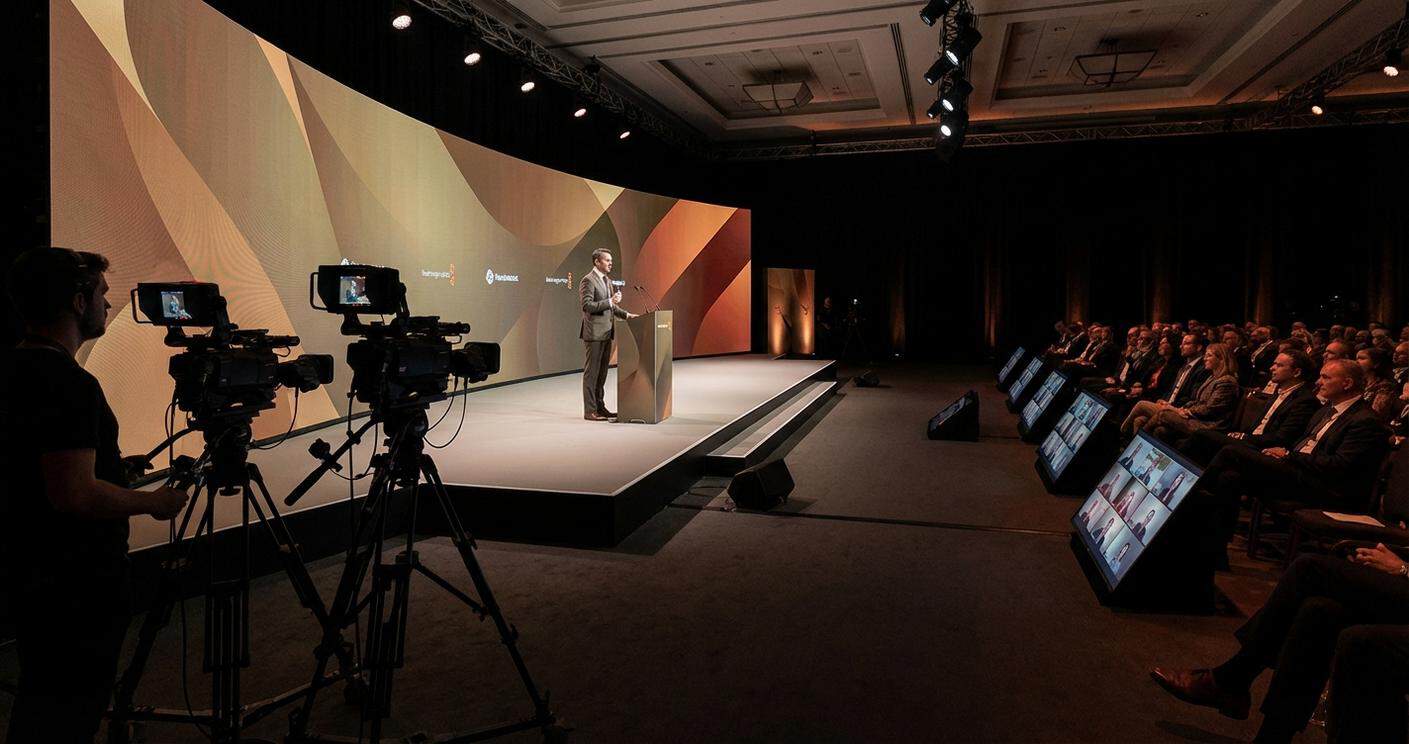
Maintaining visual consistency between the on-site projection screens and the remote streaming feed is paramount. This involves careful consideration of aspect ratios (e.g., 16:9 for streaming, potentially ultra-wide for physical screens), safe areas for graphics to ensure they are visible on all displays, and synchronized playback of pre-recorded content. A common workflow involves creating a “program clean” feed for the streaming platform and a “program dirty” feed with additional on-site overlays for large venue screens. Dedicated video distribution amplifiers and scalers ensure proper signal integrity and format conversion for various displays and streaming encoders.
Integration with Enterprise Collaboration Platforms
For hybrid events leveraging platforms like Microsoft Teams, Zoom, or Webex, the technical integration of professional program feeds is critical. Instead of relying on a webcam input, a hardware capture card (e.g., SDI-to-USB 3.0 or NDI bridge) is used to ingest the high-quality program feed into the collaboration platform as a virtual camera source. This ensures that the enterprise streaming solution delivers the professionally produced, branded content directly into the meeting environment, bypassing the inherent quality limitations of consumer-grade webcams. Furthermore, integrating return video feeds (e.g., audience questions from Zoom) back into the production switcher allows for dynamic on-screen interactions, requiring robust signal routing and latency management to maintain a natural flow.
Ensuring Visual Quality and Redundancy in Enterprise Streaming
The integrity of visual branding in enterprise streaming is directly tied to the reliability and quality of the underlying streaming infrastructure. Mitigating risks through robust design is non-negotiable.
Network Infrastructure Requirements for Professional Streaming
High-quality B2B event streaming demands dedicated and resilient network infrastructure. A minimum of 50-100 Mbps symmetrical internet connectivity is typically recommended for 1080p live streams, with significantly higher bandwidth required for 4K/UHD or multi-stream outputs. Network segmentation using VLANs (Virtual Local Area Networks) isolates streaming traffic from general enterprise network activity, prioritizing QoS (Quality of Service) for video streams to minimize packet loss and jitter. Redundant network paths and dual internet service providers (ISPs) with automatic failover mechanisms are essential to prevent service interruptions. Technologies like bonded cellular or satellite uplinks provide additional layers of redundancy for mission-critical outdoor or remote productions, ensuring continuous delivery of the branded visual experience.
Cloud-Based vs. On-Premise Streaming Solutions and Redundancy Strategies
Enterprises have the choice between fully on-premise streaming infrastructures, offering maximum control and security, and cloud-based solutions, providing scalability and global reach. Hybrid approaches often utilize on-premise encoding for immediate control, with cloud CDNs (Content Delivery Networks) for scalable distribution. Redundancy is architected at multiple layers: source redundancy (multiple cameras for key positions), hardware redundancy (duplicate switchers, encoders, and capture cards), and signal path redundancy (e.g., primary SDI path, secondary NDI path). For streaming, failover encoders that automatically take over if the primary unit fails are standard practice. Dual-path streaming, sending identical feeds to two independent CDNs, offers robust protection against single points of failure, ensuring that the branded content always reaches its intended audience, even in the event of a CDN outage. ISO (Isolated) recording of individual camera feeds provides invaluable raw footage for post-event editing and archive, serving as a critical backup for the program feed.
Latency Optimization and Quality of Service (QoS)
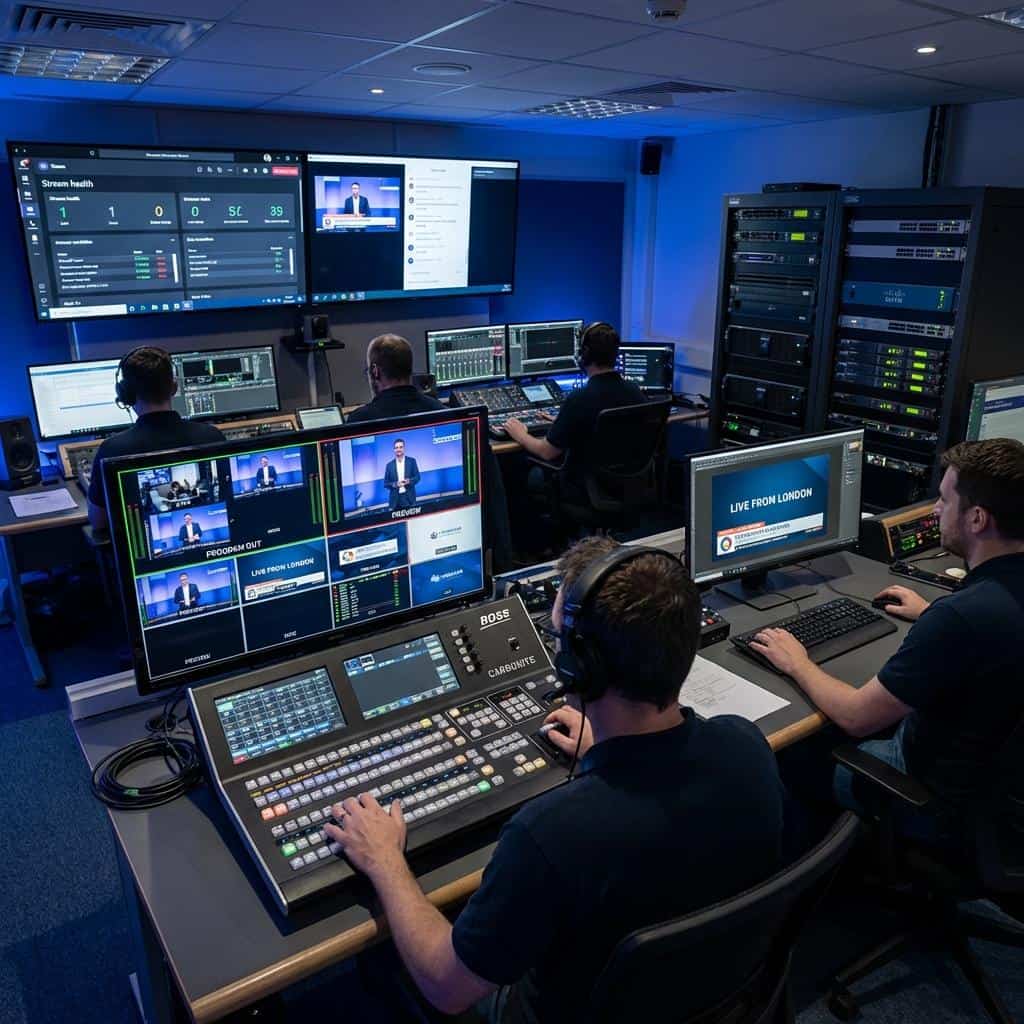
Minimizing latency is crucial for interactive corporate events, especially those with Q&A sessions or remote presenters. Protocols like SRT (Secure Reliable Transport) offer robust error correction and retransmission capabilities over challenging networks while maintaining significantly lower latency compared to traditional RTMP (Real-Time Messaging Protocol). Optimizing QoS settings on network switches prioritizes video and audio packets, guaranteeing bandwidth and minimizing delay variation. End-to-end latency targets for interactive B2B events are often in the sub-second range, while for broadcast-style presentations, a few seconds may be acceptable. Comprehensive monitoring tools, tracking bitrate, frame rate, dropped frames, and network jitter, are continuously employed to ensure the digital stage maintains its visual integrity and responsiveness throughout the event. This proactive monitoring allows production teams to identify and address potential issues before they impact the live branded experience.
Designing the digital stage for premium corporate events is an intricate engineering endeavor, demanding a holistic understanding of broadcast-grade production workflows, advanced streaming protocols, and resilient infrastructure design. By meticulously planning and implementing robust signal chains, sophisticated graphics integration, and comprehensive redundancy strategies, enterprises can ensure their visual branding remains impeccable, delivering impactful, high-fidelity experiences that resonate with their target audience and reinforce their corporate identity across all digital touchpoints. The technical precision applied to every facet of the digital stage directly translates into a powerful, authoritative brand presence in the virtual and hybrid realms.
