
The operational landscape for multinational corporations (MNCs) in Singapore, characterized by its global connectivity and dynamic economic environment, presents unique challenges, particularly when business continuity hinges on seamless communication. In an era of rapid digitization and distributed workforces, the ability to conduct critical B2B events, internal town halls, investor briefings, and high-stakes conferences without interruption has become paramount. Live streaming, once considered a supplementary communication channel, has rapidly evolved into a mission-critical infrastructure component, demanding enterprise-grade resilience and technical sophistication.
For Singaporean MNCs, navigating complex regional operations and maintaining engagement across diverse geographies requires more than basic video conferencing. It necessitates robust streaming solutions engineered for broadcast-quality delivery, stringent security, minimal latency, and unwavering reliability. This article delves into the technical intricacies that underpinned the sustained connectivity of Singaporean MNCs, exploring the advanced streaming protocols, production workflows, and infrastructure strategies that transformed potential disruptions into opportunities for reinforced organizational resilience.
The Imperative of Enterprise-Grade Streaming Infrastructure
Moving beyond consumer-grade webcam solutions, professional B2B event streaming demands an infrastructure built for precision and fault tolerance. The core distinction lies in the stringent requirements for Quality of Service (QoS), content security, scalability, and ultra-low latency, which are not optional for corporate communications impacting business decisions. A resilient enterprise streaming architecture is a complex interplay of sophisticated hardware, intelligent software, and robust network design, orchestrated to deliver a flawless experience.
Core Production Chain Components and Their Technical Specifications
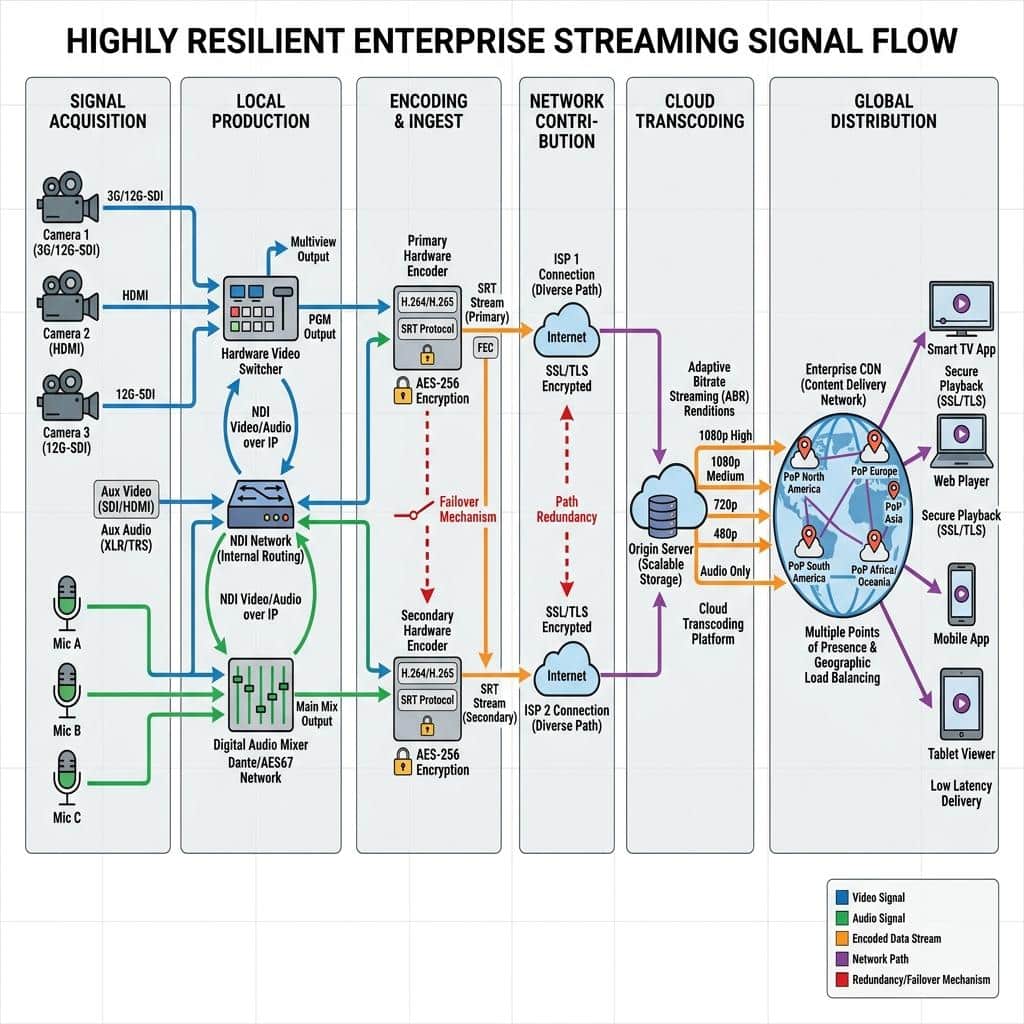
- Signal Acquisition and Processing: Professional multi-camera setups are foundational. This includes broadcast-grade cameras such as Sony PXW-FX9s or Blackmagic URSA Mini Pro 12Ks, often deployed with professional lenses and controlled via Camera Control Units (CCUs) for precise color matching and exposure. Video signals are typically delivered via Serial Digital Interface (SDI) at 3G-SDI, 6G-SDI, or 12G-SDI for HD, UHD, and 4K resolutions respectively, ensuring uncompressed, high-fidelity transmission over long cable runs. For local displays and secondary monitoring, HDMI 2.1 is also utilized.
- Video Switching and Routing: At the heart of any multi-camera production is the video switcher. Enterprise-grade deployments often leverage hardware production switchers like the Blackmagic Design ATEM Constellation 8K or Ross Carbonite series, offering multiple inputs (up to 40 12G-SDI inputs on some models), DVEs (Digital Video Effects), chroma keyers, and multiple program and auxiliary outputs. These systems allow for seamless transitions between sources, graphics overlay, and sophisticated scene composition. Signal routing matrices, such as those from AJA or Decimator, manage complex signal flows, ensuring any input can be routed to any output, critical for redundancy and flexible monitoring.
- Audio Mixing and Management: Audio quality is paramount. Digital audio consoles like the Yamaha QL or CL series, or Behringer X32, provide precise control over multiple microphone inputs (e.g., Shure ULXD or Sennheiser EW series wireless systems), playback sources, and output mixes. Networked audio protocols like Dante or AES67 are standard for distributing high-channel-count audio over IP, significantly simplifying cabling and offering inherent redundancy. Dedicated talkback systems (e.g., Clear-Com FreeSpeak II, Riedel Bolero) ensure crystal-clear communication among the production crew, irrespective of the physical layout.
- Encoding and Ingest: The conversion of high-bandwidth production feeds into streamable formats is handled by professional hardware encoders. Devices like the Haivision Makito X series or Teradek Cube/Bond encoders are preferred for their reliability and advanced features. These encoders utilize H.264 (AVC) or H.265 (HEVC) compression, optimizing bitrate management (typically 5-20 Mbps for 1080p, 20-50 Mbps for 4K) while maintaining visual fidelity. Key parameters such as Group of Pictures (GOP) structure, B-frame intervals, and profile settings (e.g., High Profile) are meticulously configured to balance quality and bandwidth efficiency.
- Transport Protocols: For contribution, the Secure Reliable Transport (SRT) protocol has become an industry standard for enterprise B2B streaming. SRT, an open-source protocol, provides secure, low-latency video transport over unpredictable networks by incorporating features like Forward Error Correction (FEC) and intelligent retransmission mechanisms. This ensures packet loss recovery, crucial for maintaining stream integrity over public internet connections. For distribution to broader audiences, Real-Time Messaging Protocol (RTMP/RTMPS) remains prevalent for ingest into Content Delivery Networks (CDNs) due to its widespread compatibility, with RTMPS offering encryption via SSL/TLS.
- Content Delivery Networks (CDNs): Enterprise-grade CDNs such as Akamai, Cloudflare, or AWS CloudFront are indispensable for global scalability and low-latency delivery. These networks leverage geographically distributed Points of Presence (PoPs) to cache and serve content close to end-users, minimizing latency and buffering. Their robust infrastructure is designed to handle sudden spikes in viewer numbers, ensuring a consistent viewing experience for thousands or tens of thousands of concurrent users.
Architecting Hybrid Event Solutions for Global Reach
Hybrid events, integrating physical attendees with a globally dispersed virtual audience, present a unique set of technical challenges that require meticulous planning and execution. The seamless convergence of on-site production elements with virtual participation platforms is critical for maintaining engagement and delivering a unified experience.
Advanced Signal Flow and Network Infrastructure for Hybrid Environments
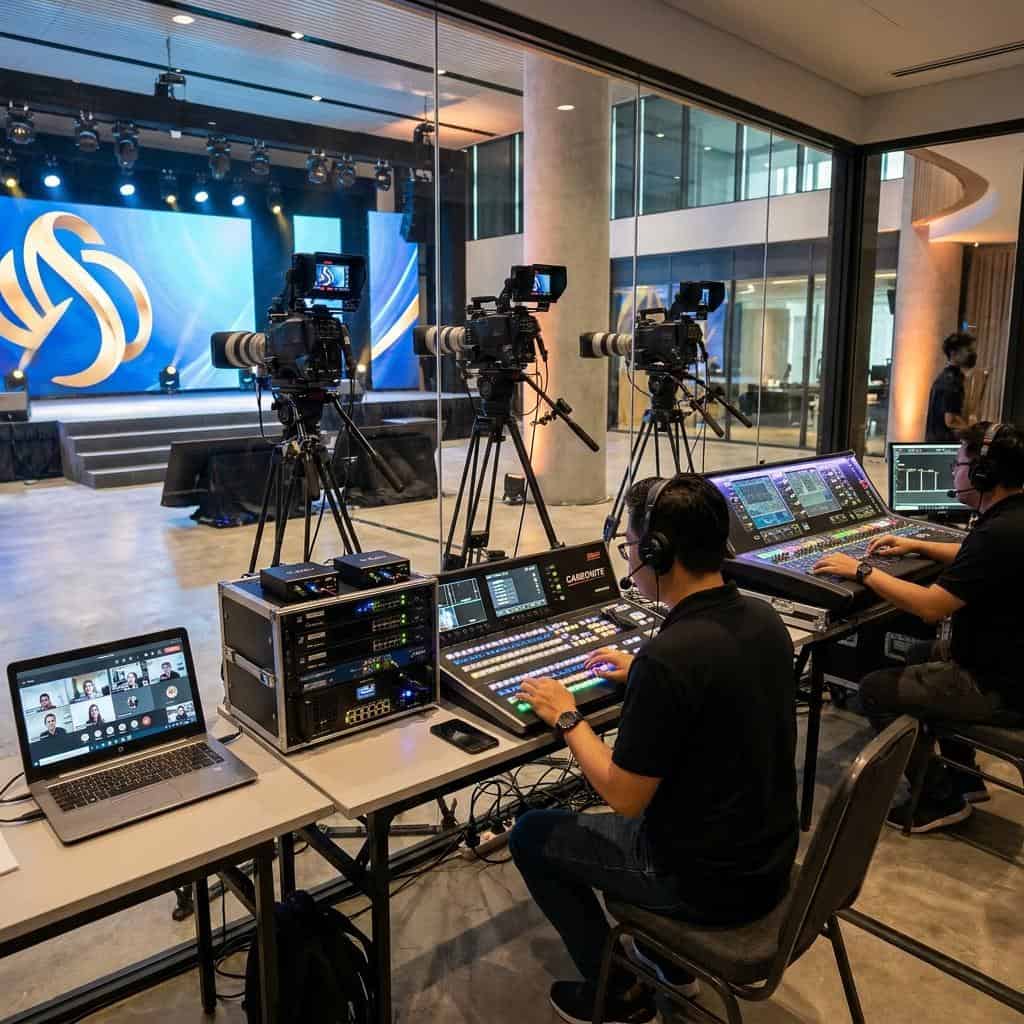
- Integrated Signal Flow: In a hybrid setup, the local AV signal acquisition (presenter microphones, stage cameras, presentation slides) is routed through a central production switcher. The program feed from this switcher is then simultaneously directed to the venue’s projection system (via SDI or HDMI 2.1) and to dedicated streaming encoders. Audio, managed by a digital audio console, often requires multiple mix-minus feeds: one for the live stream, one for the in-venue PA, and specific mixes for remote presenters joining via conferencing platforms to prevent audio feedback loops.
- IP Video Workflows with NDI: Within the local area network (LAN) of a corporate venue, Network Device Interface (NDI) has emerged as a powerful solution for IP-based video transport. NDI allows for multiple video sources (cameras with NDI outputs, graphics computers, media servers) to be transmitted and received over standard Ethernet networks, reducing the need for extensive SDI cabling. NDI|HX, a more compressed variant, offers bandwidth efficiency suitable for larger deployments or existing network infrastructures without dedicated 10 Gigabit Ethernet. This IP-centric approach simplifies routing and enhances flexibility in complex production environments.
- Synchronization and Latency Management: Maintaining perfect synchronization across multiple video and audio sources is vital. Genlock signals ensure all cameras and video devices are precisely timed to a common reference. Frame synchronizers are deployed to correct timing discrepancies from external sources. Minimizing glass-to-glass latency across the entire chain—from camera capture to viewer display—is a continuous optimization effort, particularly crucial for interactive Q&A sessions in hybrid events.
- Enterprise Platform Integration: For many MNCs, seamless integration with existing enterprise collaboration platforms such as Microsoft Teams, Zoom Events, or Webex Events is a fundamental requirement. This often involves leveraging RTMP push functionality from professional streaming encoders directly into the platform’s live event module. Custom API integrations can provide enhanced control over attendee management, Q&A moderation, and analytics within these corporate ecosystems, streamlining the virtual attendee experience.
- Network Infrastructure Requirements for Streaming: A robust, dedicated network infrastructure is non-negotiable. This includes guaranteed symmetrical bandwidth for both upstream contribution (from the venue to the CDN) and downstream distribution. For critical events, dual Internet Service Providers (ISPs) with automatic failover mechanisms are implemented. Quality of Service (QoS) policies on enterprise networks are configured to prioritize streaming traffic, often using VLANs and traffic shaping to ensure consistent packet delivery and minimize jitter. Network monitoring tools provide real-time insights into performance, allowing for immediate remediation of any bottlenecks.
Redundancy, Security, and Compliance in Enterprise Streaming
For Singaporean MNCs, the cornerstone of enterprise resilience in streaming lies in unwavering redundancy, robust security postures, and strict adherence to regulatory compliance. These elements are not merely add-ons but integrated components of the overall streaming architecture, designed to mitigate risks and protect sensitive corporate communications.
Multi-Layered Failover Strategies for Uninterrupted Delivery
- Encoder Redundancy: At the contribution point, redundant hardware encoders operating in an active-standby or active-active configuration are standard practice. If a primary encoder fails or loses network connectivity, a secondary unit automatically takes over, often through a dedicated failover appliance or a highly resilient streaming orchestrator. This ensures the continuous ingest of the stream to the CDN.
- Network Path Diversity: Beyond dual ISPs, employing diverse network paths for the primary and secondary streams—potentially routing through different network providers or even different physical cables entering the venue—provides protection against localized network outages. Technologies like VPN tunnels over disparate routes further enhance this resilience.
- CDN Redundancy: Enterprise CDNs inherently offer geographical redundancy with multiple Points of Presence (PoPs). Furthermore, some advanced deployments utilize multi-CDN strategies, distributing content across two or more CDN providers to ensure that if one experiences an outage, traffic can be seamlessly rerouted to another.
- Local Hardware Redundancy: Critical on-site production equipment, including video switchers, audio mixers, and media servers, are often deployed with hot-swappable components or complete duplicate units ready for immediate deployment. Power redundancy through Uninterruptible Power Supplies (UPS) and backup generators safeguards against electrical fluctuations or blackouts.
Fortifying Security Protocols and Data Integrity
- Encryption in Transit: The SRT protocol offers robust AES-128 or AES-256 bit encryption, safeguarding video and audio data against eavesdropping during transit over public internet links. Similarly, RTMPS (RTMP over SSL/TLS) encrypts streams ingested into CDNs. For internal corporate networks, secure VLANs and dedicated VPNs are utilized.
- Access Control and Authentication: Enterprise streaming platforms integrate with corporate Single Sign-On (SSO) systems (e.g., Azure AD, Okta), ensuring that only authorized personnel and invited attendees can access streams. Role-based access control (RBAC) further restricts functionalities for different user groups (administrators, moderators, viewers).
- Digital Rights Management (DRM): For highly sensitive or proprietary content, Digital Rights Management (DRM) technologies are employed. These solutions prevent unauthorized downloading, sharing, or screen recording of the streamed content, protecting intellectual property and confidential information.
- Network Security: Comprehensive firewall rules, intrusion detection systems (IDS), and regular penetration testing are implemented to protect the streaming infrastructure from cyber threats. Dedicated security teams monitor network traffic for anomalous activity and potential vulnerabilities.
Adhering to Regulatory Compliance and Archiving Standards
- Data Privacy Regulations: Operating in Singapore, MNCs must adhere to the Personal Data Protection Act (PDPA), ensuring that any personal data collected or processed during streaming (e.g., attendee registration, Q&A participation) is handled in accordance with local regulations. Globally, adherence to GDPR or other regional data privacy laws is also often a requirement.
- Accessibility Standards: To ensure inclusivity, compliance with Web Content Accessibility Guidelines (WCAG 2.1) is increasingly important. This includes providing accurate closed captions or subtitles, audio descriptions for visually impaired viewers, and ensuring stream player compatibility with assistive technologies.
- Content Archiving and Retention: Corporate governance policies often mandate specific retention periods for streamed content, particularly for investor calls, legal proceedings, or training sessions. Secure, long-term archiving solutions, often leveraging cloud storage with robust access controls and encryption, are implemented to meet these requirements. ISO standards for information security management (ISO 27001) provide a framework for these practices.
Advanced Production Workflows and Scalability for Enterprise Events
The successful execution of large-scale B2B events for Singaporean MNCs demands sophisticated production workflows that manage multiple dynamic elements while ensuring the highest technical quality and seamless scalability to global audiences.
Refined Multi-Camera and Audio Production Methodologies
- Multi-Camera Orchestration: For a typical large corporate event, a multi-camera setup might involve four to eight cameras. This often includes a mix of manned ENG cameras (e.g., Panasonic AJ-PX5000G) on tripods, robotic PTZ (Pan-Tilt-Zoom) cameras (e.g., Sony BRC series) for dynamic angles and close-ups, and perhaps a jib or dolly for cinematic shots. Precise camera placement, lens selection, and consistent color profiles are crucial. The program director, in conjunction with the technical director, ensures smooth cuts and transitions on the video switcher, enriching the visual narrative. ISO recording of individual camera feeds allows for post-event editing and the creation of bespoke VOD assets.
- Comprehensive Audio Mixing and Signal Processing: Beyond simply mixing microphones, enterprise events require advanced audio processing. This includes equalization (EQ), compression, and noise gating on individual channels to ensure clarity. Different audio mixes are created for distinct destinations: a ‘program mix’ for the live stream (often stereo), a ‘PA mix’ for in-venue amplification (often mono for speech clarity), and specific ‘mix-minus’ feeds for remote presenters on platforms like Zoom or Teams to prevent echo. Audio levels are meticulously monitored using digital peak program meters (PPMs) and loudness meters (e.g., adhering to ITU-R BS.1770 standards) to ensure consistent and compliant output.
- Talkback and Monitoring Systems: Effective communication among the production crew is non-negotiable. Advanced talkback systems (e.g., wired/wireless intercom from RTS, Clear-Com) provide dedicated channels for the director, technical director, camera operators, audio engineers, and graphics operators. Multiview monitors at the control position display all camera feeds, program out, graphics, and external sources simultaneously, allowing the team to anticipate and react instantly.
Architecting for Global Scalability and Performance Optimization
- Adaptive Bitrate Streaming (ABS): To cater to the diverse network conditions of a global audience, Adaptive Bitrate Streaming (ABS) is universally employed. Encoders generate multiple renditions of the stream at varying resolutions and bitrates (e.g., 1080p at 5 Mbps, 720p at 3 Mbps, 480p at 1.5 Mbps, 360p at 0.8 Mbps). The client player (web browser or dedicated app) dynamically selects the most appropriate rendition based on the viewer’s available bandwidth, ensuring a smooth playback experience with minimal buffering. This process relies on robust transcoding infrastructure, often cloud-based (e.g., AWS Elemental MediaLive, Google Cloud Media CDN), to handle the real-time conversion.
- Geographic Load Balancing and Edge Caching: For truly global events, CDNs utilize geographic load balancing to route viewer requests to the nearest available Point of Presence (PoP), minimizing network latency. Edge caching ensures that popular content segments are stored closer to the end-users, accelerating delivery and reducing origin server load. This distributed architecture is critical for delivering low-latency streams to audiences across APAC, EMEA, and the Americas simultaneously.
- Real-time Monitoring and Analytics: Comprehensive monitoring dashboards provide real-time metrics on stream health, viewer numbers, geographical distribution, bitrate quality, and error rates. These analytics are crucial for proactive troubleshooting, identifying potential issues before they impact the viewing experience, and post-event reporting for strategic insights. Key Performance Indicators (KPIs) like stream uptime, average bitrate, and buffering ratio are continuously tracked.
The enterprise resilience demonstrated by Singaporean MNCs through advanced streaming solutions is a testament to meticulous technical planning and the deployment of robust infrastructure. From the foundational choices of broadcast-grade equipment and resilient network topologies to the sophisticated orchestration of hybrid workflows and multi-layered security protocols, every element plays a pivotal role. The ability to seamlessly connect stakeholders across continents, maintain crystal-clear communication, and adapt to unforeseen circumstances underscores the transformative power of expertly engineered B2B live streaming. As the demand for high-stakes corporate communication continues to evolve, partnering with a technically authoritative live streaming studio is not merely a convenience, but a strategic imperative for sustained operational excellence.

Michael Koh is a production specialist and entrepreneur who founded Spring Forest Studio in 2017 to provide event and virtual production solutions in Singapore. He specialises in hybrid live streaming, XR (Extended Reality) virtual production, and studio systems integration, transitioning the business from traditional videography to advanced corporate broadcasting. Operating out of a dedicated facility at NordCom2 in Singapore, he leads a technical crew to deliver multi-camera webcasts, digital sets, and technical consultations for large-scale corporate events.