
In the high-stakes landscape of B2B communication, an executive’s presence on a live broadcast or hybrid event can significantly influence brand perception, stakeholder engagement, and ultimately, business outcomes. Far beyond mere public speaking acumen, effective on-camera performance for enterprise-grade streaming demands a nuanced understanding of the technical ecosystems underpinning professional live productions. At Live Streaming Studio, our technical team understands that preparing leaders for live broadcasts is not solely about presentation coaching; it is an intricate process of integrating executive readiness with robust, enterprise-grade production infrastructure and workflows. This comprehensive guide delves into the advanced technical considerations necessary to ensure flawless executive delivery, from microphone selection and signal routing to network resilience and multi-platform integration, providing actionable insights for corporate event planners, AV professionals, and IT directors alike.
Mastering the Technical Environment: Beyond the Teleprompter
The foundation of a compelling executive broadcast lies in meticulously engineered technical staging. Every component, from acoustic treatment to lens choice, impacts the final program feed delivered to a discerning B2B audience. A technically proficient executive presence begins with a deep appreciation for these underlying systems.
Microphone Selection and Placement for Optimal Gain Staging and Signal-to-Noise Ratio
Audio fidelity is paramount. The choice and placement of microphones are critical for capturing an executive’s voice with clarity and presence, ensuring an excellent signal-to-noise ratio (SNR) and preventing undesirable ambient interference. For stationary presenters, a professional-grade cardioid lavalier microphone, such as a Sennheiser ME 2-II or Shure WL185, offers excellent voice isolation, minimizing room reverberation. When dynamic movement is anticipated, a high-quality headset microphone (e.g., DPA 4088) provides consistent proximity, maintaining uniform gain. For panel discussions or a more formal studio setup, professional condenser microphones like the Neumann TLM 103, connected via XLR to a preamplifier supplying 48V phantom power, deliver broadcast-grade audio. Proper gain staging on the mixing console is essential, setting input levels to achieve maximum signal without clipping (0 dBFS digital, +24 dBu analog maximum), and applying subtle compression and limiting to manage dynamic range effectively. Acoustic treatment of the presentation space, often involving strategically placed absorption panels with a Noise Reduction Coefficient (NRC) of 0.8 or higher, further optimizes the ambient soundscape.
Lighting Architectures: Key, Fill, Back, and Practical Considerations for Color Temperature
Visual impact hinges on precise lighting. A standard three-point lighting setup – key light, fill light, and back light – is foundational for defining an executive’s form and separating them from the background. The key light, positioned at a 45-degree angle to the subject and camera, provides primary illumination. The fill light, placed opposite the key light, softens shadows, typically at half the intensity of the key. A back light, positioned behind the subject, creates a subtle halo effect, adding depth. Professional LED fixtures, controllable via DMX512 protocol, allow for granular control over intensity and color temperature (CCT). Maintaining a consistent CCT, typically around 3200K (tungsten equivalent) for indoor studios or 5600K (daylight balanced) for environments with natural light, is vital for accurate skin tone reproduction and visual continuity across multiple camera feeds. A high Color Rendering Index (CRI) of 90+ ensures natural color rendition, preventing a washed-out or artificial appearance common with lower-quality lighting. Avoiding direct overhead lighting that creates harsh shadows and ensuring sufficient separation between the subject and background prevents light spill and enhances visual separation.
Camera Optics and Framing: Resolution, Aspect Ratios, and Compositional Principles
The choice of camera and lens directly dictates image quality and presentation framing. For B2B broadcasts, professional PTZ (Pan-Tilt-Zoom) cameras (e.g., Sony BRC series, Panasonic AW-UE150) offer remote control and flexibility, while dedicated ENG (Electronic News Gathering) cameras (e.g., Sony PXW-Z280) or cinema cameras (e.g., Blackmagic URSA Broadcast G2) provide superior optical quality and sensor performance. Output resolutions typically target 1080p (1920×1080) at 29.97 or 59.94 frames per second (fps) for broadcast, with an increasing demand for 4K/UHD (3840×2160) for future-proofing and high-fidelity archival. All professional outputs adhere to a 16:9 aspect ratio. Lens selection, particularly focal length and aperture (f-stop), determines depth of field and field of view. A shallow depth of field, achieved with a wider aperture (lower f-number, e.g., f/2.8), can effectively isolate the executive from a potentially distracting background. Compositional principles, such as the rule of thirds, proper headroom (space above the head), and lead room (space in the direction the subject is facing), are crucial for creating aesthetically pleasing and professional shots. Multi-camera setups necessitate precise color grading and white balancing across all camera channels to ensure seamless transitions during live switching.
Optimizing Signal Flow and Network Resilience for Uninterrupted Delivery
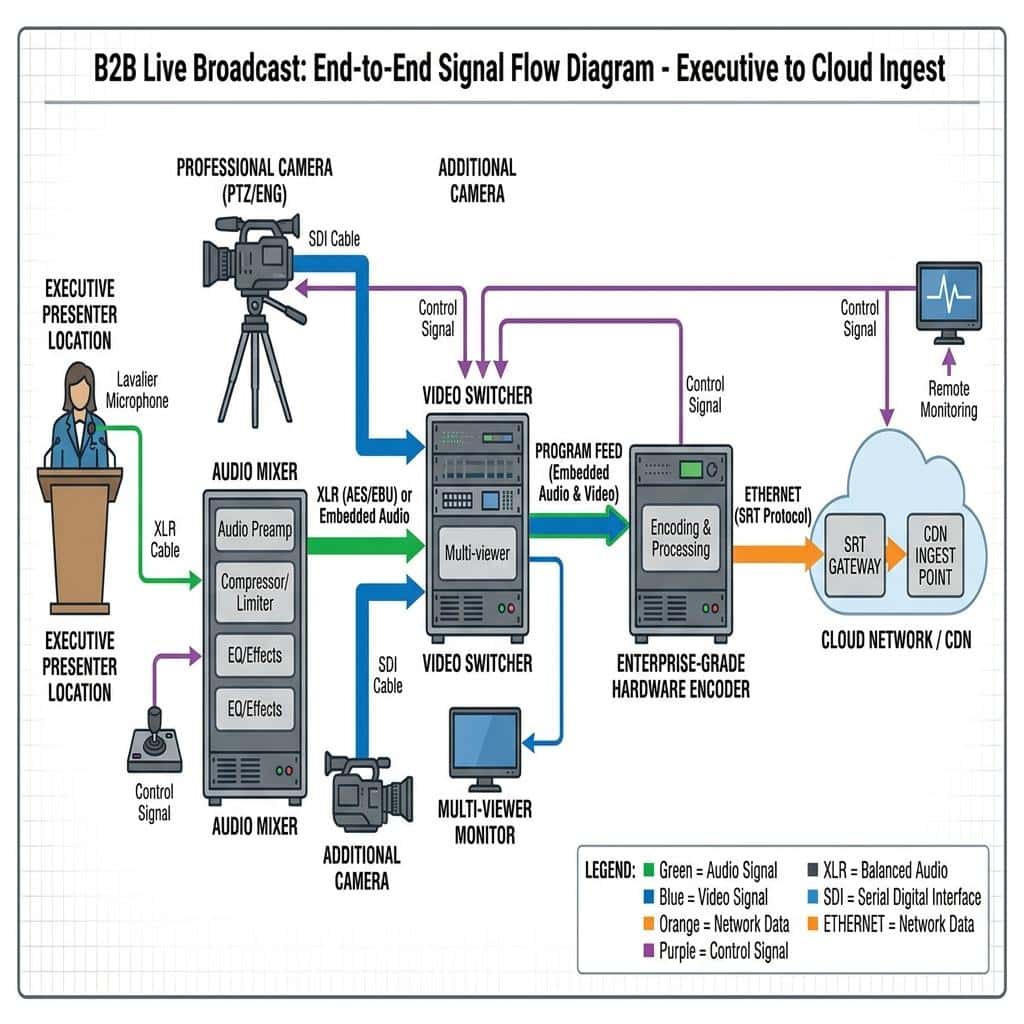
Once captured, audio and video signals embark on a complex journey through various production systems and network infrastructure. Understanding and optimizing this signal flow, coupled with robust network design, is critical for maintaining signal integrity and ensuring uninterrupted delivery to the audience.
Video Signal Routing and Switching: SDI, HDMI, and IP-based Workflows (NDI, SRT)
The efficient routing and switching of video signals are fundamental to dynamic live production. Traditional baseband video relies on Serial Digital Interface (SDI) for long cable runs (up to 100 meters for 3G-SDI on Belden 1694A coaxial cable) and embedded audio, utilizing BNC connectors. SDI offers deterministic, low-latency transmission, ideal for critical on-premises workflows. HDMI (High-Definition Multimedia Interface), while prevalent in consumer electronics, is primarily used for shorter connections to displays and projectors in professional environments due to its shorter cable length limitations (typically 15-20 meters without active extenders) and High-bandwidth Digital Content Protection (HDCP) complexities. The industry is rapidly transitioning to IP-based video workflows, offering greater flexibility and scalability. NDI (Network Device Interface) provides a low-latency, high-quality solution for video transport over standard Gigabit Ethernet networks within a local area network (LAN), integrating seamlessly with software-defined video switchers and production tools. For wide area network (WAN) contributions and secure, reliable transport over unpredictable internet connections, SRT (Secure Reliable Transport) protocol is paramount. SRT, supporting AES 128/256 encryption, provides advanced error correction, packet retransmission, and dynamic latency adjustment, making it ideal for remote contributions and cloud ingest. Hardware or software video switchers (e.g., Ross Carbonite, Blackmagic ATEM, vMix) manage these diverse inputs, providing program and preview feeds, multiview monitoring, and effects processing via M/E (Mix/Effect) banks.
Audio Mixing and Processing: From Microphone Preamp to Program Output
Beyond microphone selection, the entire audio signal chain demands meticulous engineering. Digital audio mixers (e.g., Yamaha Rivage series, Behringer X32) provide sophisticated processing capabilities. Input signals from microphones and other sources are routed, equalized (EQ) to shape frequency response, compressed to reduce dynamic range and increase perceived loudness, and gated to eliminate unwanted noise below a specific threshold. De-essers are crucial for mitigating harsh sibilance from presenters. For hybrid events involving remote participants or IFB (Interruptible Foldback) systems for on-camera talent, a precise mix-minus configuration is implemented. This technique sends a unique mix to each participant that excludes their own voice, preventing feedback loops and ensuring clean communication. Advanced IP audio protocols like Dante or AES67 facilitate high-channel-count audio transport over standard network infrastructure, simplifying cabling and routing complexity. The final program audio output adheres to loudness standards such as ITU-R BS.1770 or EBU R 128, ensuring consistent audio levels across different broadcast platforms.
Network Infrastructure for Enterprise Streaming: Bandwidth, Latency, and QoS
The network is the backbone of any professional live stream. Enterprise streaming demands dedicated, robust network infrastructure. Often, a dedicated VLAN (Virtual Local Area Network) is configured to isolate A/V traffic from general corporate data, minimizing potential interference and ensuring predictable performance. Symmetric bandwidth is critical, with typical 1080p H.264 streams requiring 10-25 Mbps upload, and 4K/UHD streams demanding 30-70 Mbps, depending on codec efficiency and desired quality. Latency optimization is achieved through careful selection of low-latency codecs, minimized buffer sizes at encoders and decoders, and direct peering agreements with content delivery networks (CDNs). Quality of Service (QoS) protocols, implemented at network switches and routers, prioritize A/V packets using Differentiated Services Code Point (DSCP) marking, guaranteeing preferential treatment over other network traffic. Redundancy is paramount: dual ISPs (Internet Service Providers), redundant network paths using technologies like Link Aggregation (LACP), and geographically diverse ingest points for CDNs provide failover capabilities, ensuring the stream remains active even in the event of a primary network failure. Monitoring network performance with tools that track packet loss, jitter, and bandwidth utilization is a continuous operational requirement.
Encoding, Transmission, and Platform Integration for Hybrid Events
With pristine audio and video signals established, the next phase involves efficient encoding, secure transmission, and seamless integration with diverse platforms to reach both in-person and virtual audiences effectively.
Enterprise-Grade Encoding Standards and Bitrate Management
Encoding transforms raw video and audio into a compressed, streamable format. H.264 (AVC) remains a widely supported and robust codec for live streaming, offering a good balance of quality and compatibility. H.265 (HEVC) provides superior compression efficiency, delivering comparable quality at significantly lower bitrates (typically 30-50% less bandwidth), ideal for bandwidth-constrained environments or 4K/UHD streaming. Bitrate management strategies include Constant Bitrate (CBR) for predictable bandwidth consumption, often used for stable network conditions, and Variable Bitrate (VBR) for optimizing quality based on content complexity. Adaptive Bitrate Streaming (ABS) is crucial for reaching diverse audiences, delivering multiple renditions of the stream at varying resolutions and bitrates (e.g., 720p at 2.5 Mbps, 1080p at 6 Mbps) to ensure optimal playback regardless of the viewer’s device or network conditions. Hardware encoders (e.g., Haivision Makito X4, AJA BRIDGE LIVE) offer dedicated processing power and superior reliability, crucial for enterprise applications, while robust software encoders (e.g., OBS Studio, vMix) can also be deployed on high-performance workstations. Keyframe intervals (typically 2-4 seconds) and Group of Pictures (GOP) structures are meticulously configured to balance compression efficiency with seeking capabilities and visual quality.
Secure and Reliable Transport Protocols: RTMPS, SRT, and Cloud Ingest
The secure and reliable transmission of encoded streams from the production site to the CDN or streaming platform is a critical link. RTMP (Real-Time Messaging Protocol), often secured with SSL/TLS as RTMPS, has been a legacy standard for pushing streams to CDNs due to its broad compatibility. However, for enhanced reliability over unreliable networks, SRT (Secure Reliable Transport) is increasingly the protocol of choice. SRT, developed by Haivision, leverages UDP for low-latency transport but adds robust error recovery mechanisms, retransmitting lost packets without significantly impacting latency. This makes SRT exceptionally resilient to packet loss, jitter, and varying bandwidth conditions, ideal for remote contributions or primary feeds over public internet. Furthermore, SRT supports AES 128 or AES 256 encryption, ensuring stream confidentiality. Cloud ingest points, strategically located globally, receive streams and distribute them to the CDN edge servers, minimizing latency for global audiences. Redundant ingest paths and failover mechanisms, such as primary/secondary encoders feeding separate cloud ingest points, are standard practice to maintain stream uptime in case of an encoder or network path failure.
Seamless Integration with Enterprise Collaboration Platforms for Hybrid Engagement
Hybrid events necessitate the seamless integration of professional broadcast feeds into enterprise collaboration platforms like Microsoft Teams, Zoom, and Webex. A clean program feed from the video switcher, often via an SDI or HDMI output, can be converted into a USB-compatible signal using a high-quality capture card (e.g., Blackmagic DeckLink, AJA Kona, Elgato Cam Link 4K) and then introduced as a virtual camera source within the collaboration software. Alternatively, IP-based solutions like NDI Virtual Input can directly present an NDI stream as a webcam. This approach ensures that the high-production-value stream, complete with graphics, lower-thirds, and multiple camera angles, is presented to the virtual audience within their familiar platform environment. Managing interaction, such as Q&A from the virtual audience, requires dedicated personnel to monitor chat feeds and relay questions to the executive or moderator. For remote presenters contributing to the main broadcast, clean feeds (program feed without their own video return) are sent, often with IFB audio, to maintain natural conversation flow and visual continuity. This intricate blend of broadcast technology and collaboration tools ensures a unified and engaging experience for both physical and virtual attendees.
Advanced Production Workflows and Post-Event Archiving
The responsibilities of a professional live streaming studio extend beyond the immediate broadcast. Comprehensive quality control, robust redundancy strategies, and intelligent post-event content management are vital for enterprise clients seeking long-term value from their streamed assets.
Multiview Monitoring and Quality Control: SMPTE Standards and Operator Responsibilities
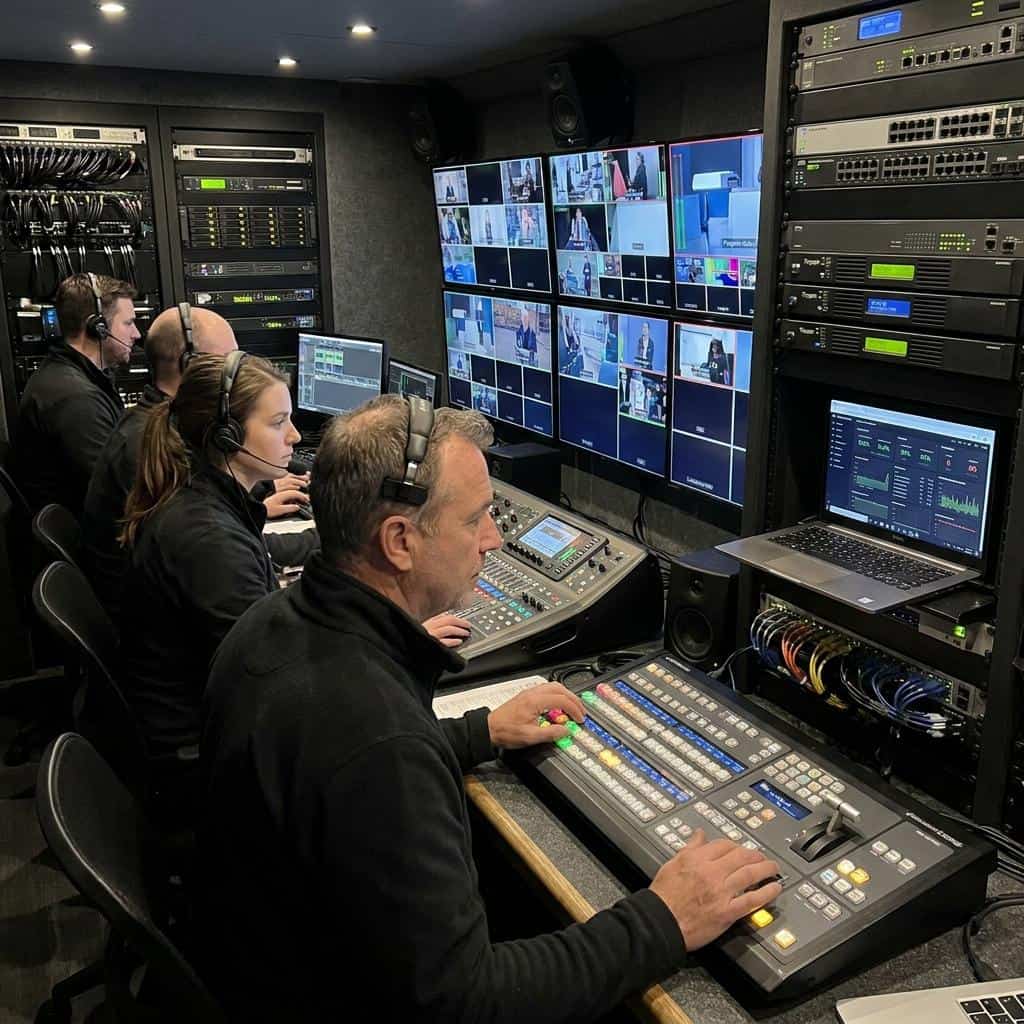
During a live broadcast, constant vigilance over technical quality is paramount. Multiview monitoring systems display all camera feeds, program output, preview, and often ISO (isolated) recordings simultaneously on a single or multiple screens. Professional multiviewers adhere to SMPTE (Society of Motion Picture and Television Engineers) standards for video levels and timing. Critical monitoring tools include waveform monitors for checking luminance levels, vectorscopes for color saturation and hue, and loudness meters (e.g., calibrated to ITU-R BS.1770 or EBU R 128 standards) for precise audio level management. The Technical Director (TD) is responsible for video switching and ensuring seamless transitions, while the Audio Engineer meticulously manages all audio sources. A dedicated Streaming Operator continuously monitors the encoded stream’s health, checking bitrate stability, frame rate consistency, and latency metrics to pre-emptively identify and address potential issues before they impact the audience experience. Real-time communication via talkback systems (e.g., Clear-Com, RTS) between all crew members is essential for synchronized operations.
Redundancy, Disaster Recovery, and Failover Architectures
In enterprise-grade live production, the concept of N+1 or 2N redundancy is not merely a recommendation but a necessity. N+1 redundancy involves having one backup component for every ‘N’ active components, while 2N redundancy provides a complete duplicate system. This applies to every critical path component: cameras, switchers, encoders, power supplies (via UPS and generator backup), and network infrastructure. Automatic failover systems are deployed, designed to detect primary component failure and seamlessly switch to a redundant backup within milliseconds, often imperceptible to the audience. This includes dual-path ingest to CDNs, where two independent streams are sent simultaneously to geographically diverse ingest points. In the event of a catastrophic failure at one location, the secondary path maintains the live broadcast. Disaster recovery planning encompasses detailed runbooks for various failure scenarios, regular testing of failover procedures, and redundant power distribution units (PDUs) to ensure continuous operation. This meticulous planning guarantees maximum uptime and mitigates risks associated with single points of failure.
Metadata Management and Archival for Enterprise Content Libraries
The value of a B2B live broadcast extends far beyond its immediate airtime. Proper metadata management and archival strategies transform a live event into a valuable, searchable asset for an enterprise’s content library. Rich metadata, including speaker names, topics discussed, timestamps for key moments, and relevant keywords, is crucial for improving discoverability and enabling efficient post-event repurposing. Content is typically archived in high-quality, post-production codecs such as ProRes or DNxHD, which retain maximum image fidelity compared to the more compressed H.264/H.265 streaming codecs, ensuring future editing and re-rendering capabilities. Storage solutions range from on-premises Network Attached Storage (NAS) or Storage Area Network (SAN) systems with RAID configurations for data integrity, to scalable cloud object storage services like Amazon S3 or Azure Blob Storage for geo-redundant and cost-effective long-term retention. Integration with Digital Asset Management (DAM) systems allows for centralized cataloging, version control, and access management of all corporate media assets, ensuring compliance with retention policies and facilitating future marketing and communication initiatives.
Preparing executives for the camera in a B2B live broadcast environment is a multifaceted challenge that demands a harmonious blend of technical expertise, precise execution, and strategic foresight. Live Streaming Studio offers unparalleled expertise in navigating these complexities, providing enterprise clients with robust, scalable, and technically superior streaming solutions. By meticulously optimizing every aspect of the production workflow, from signal acquisition and network transport to multi-platform delivery and archival, we empower leaders to communicate with clarity, confidence, and unmatched professionalism, ensuring that every live broadcast reinforces brand authority and drives meaningful engagement within the corporate landscape. Partner with us to elevate your next B2B live event to an exceptional standard of technical excellence and impactful executive presence.

Michael Koh is a production specialist and entrepreneur who founded Spring Forest Studio in 2017 to provide event and virtual production solutions in Singapore. He specialises in hybrid live streaming, XR (Extended Reality) virtual production, and studio systems integration, transitioning the business from traditional videography to advanced corporate broadcasting. Operating out of a dedicated facility at NordCom2 in Singapore, he leads a technical crew to deliver multi-camera webcasts, digital sets, and technical consultations for large-scale corporate events.