
 March 18, 2026 by Editor |
Executive Onboarding at Scale: A Technical Blueprint for Global Talent Integration
The process of onboarding new executives represents a critical inflection point in corporate strategy and talent management. For global enterprises, this process is compounded by geographical dispersion, time zone complexities, and the imperative to deliver a consistent, high-impact message that reinforces corporate culture and vision. Standard video conferencing solutions, while adequate for routine meetings, lack the production quality, security, and scalability required for such a mission-critical communication. This challenge transforms executive onboarding from a human resources function into a complex B2B live streaming and hybrid production undertaking, demanding a broadcast engineering mindset. The successful execution hinges on a robust technical infrastructure designed for high-availability, secure global distribution, and a seamless user experience that reflects the premium nature of the executive role. This article provides a technical deep-dive into the architecture, protocols, and production workflows required to deliver world-class live video onboarding experiences at an enterprise scale.
Architecting the Core Streaming Infrastructure for Global Reach and Security
The foundation of a successful global onboarding event is the streaming architecture. This core infrastructure is responsible for signal acquisition, encoding, transport, and delivery. It must be engineered to overcome the inherent instability of the public internet while ensuring secure access for a geographically diverse audience, from corporate headquarters to remote international offices and home-based executives. The selection of protocols, encoding parameters, and delivery networks directly impacts the quality, reliability, and security of the entire event.
Protocol Selection: SRT vs. RTMP for Enterprise Onboarding
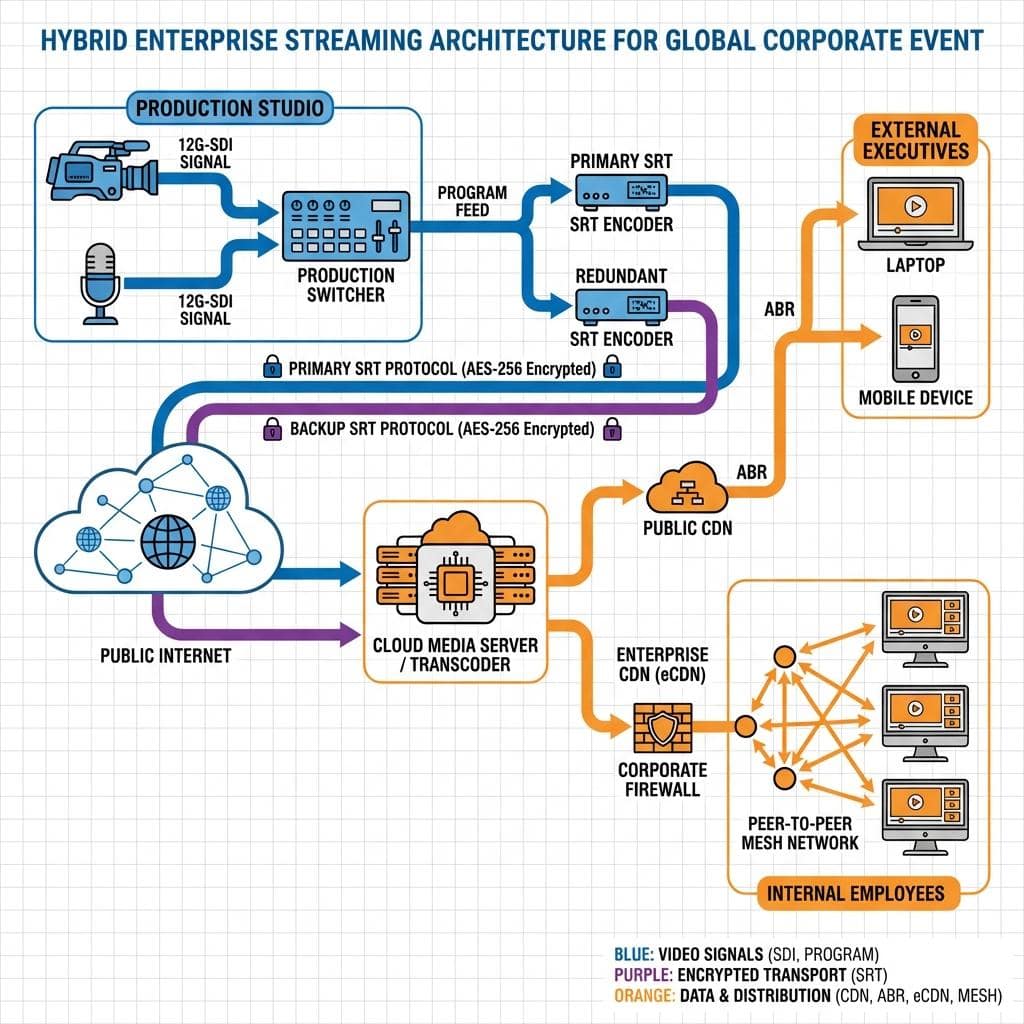
The choice of video transport protocol is a foundational decision. While the Real-Time Messaging Protocol (RTMP) has long been a standard, its reliance on TCP (Transmission Control Protocol) makes it susceptible to performance degradation and connection drops in the face of network congestion and packet loss. For enterprise-grade contribution, the Secure Reliable Transport (SRT) protocol offers a demonstrably superior solution. Developed as an open-source standard, SRT operates at the transport layer and provides robust packet loss recovery through its ARQ (Automatic Repeat reQuest) mechanism. This allows for high-quality, low-latency video transmission over unpredictable networks. Furthermore, SRT incorporates AES-128/256 bit encryption, providing an essential layer of security for sensitive internal communications like executive onboarding. This is a non-negotiable requirement for enterprises where confidentiality is paramount. Deploying SRT from the primary production encoder to the cloud media server ensures the integrity and security of the source signal.
Encoding and Transcoding for Diverse Endpoints
Once the signal is securely transported, it must be encoded and prepared for multi-platform delivery. The primary encoding is typically performed using the H.264 (AVC) codec for maximum compatibility, though H.265 (HEVC) is an increasingly viable option for 4K/UHD workflows where bandwidth efficiency is critical. The key process for scalability is adaptive bitrate (ABR) transcoding. A cloud-based media server or transcoding engine takes the high-bitrate source feed (e.g., 1080p60 at 8-10 Mbps) and creates multiple lower-resolution and lower-bitrate versions, known as an ABR ladder. A typical ladder might include: 1080p at 5 Mbps, 720p at 3 Mbps, 540p at 1.5 Mbps, and 360p at 800 Kbps. This ladder is packaged into a format like HLS (HTTP Live Streaming), allowing each viewer’s player to automatically select the optimal stream based on their real-time network conditions. This ensures a buffer-free experience whether the executive is watching on a dedicated fiber line in a corporate office or a residential connection in another country.
Content Delivery Network (CDN) and eCDN Integration
The final delivery stage requires a dual-pronged approach for a hybrid workforce. For executives and employees located outside the corporate network, a public Content Delivery Network (CDN) is essential. A CDN caches the video segments on servers located geographically close to the end-users, reducing latency and buffering. For employees located within corporate offices, streaming to hundreds or thousands of individuals simultaneously can saturate the corporate internet connection. This is mitigated by an Enterprise CDN (eCDN). An eCDN solution, such as those from Hive, Kollective, or Ramp, deploys a peer-to-peer or caching node architecture within the local network. A single stream enters the corporate network from the public CDN, and the eCDN agent distributes it internally, drastically reducing external bandwidth consumption and protecting the performance of other business-critical applications.
The Onboarding Production Hub: Signal Flow and Hybrid Integration
The production hub, whether a permanent corporate studio or a temporary setup in an event space, is where the visual and auditory narrative is crafted. This environment requires broadcast-grade equipment and meticulous signal flow planning to manage multiple video sources, remote participants, and professional audio, ensuring a polished final program feed that aligns with the organization’s brand standards. The complexity increases when integrating high-level executives participating from remote locations, which requires a hybrid workflow that maintains quality control across all inputs.
Multi-Camera Production and Signal Routing
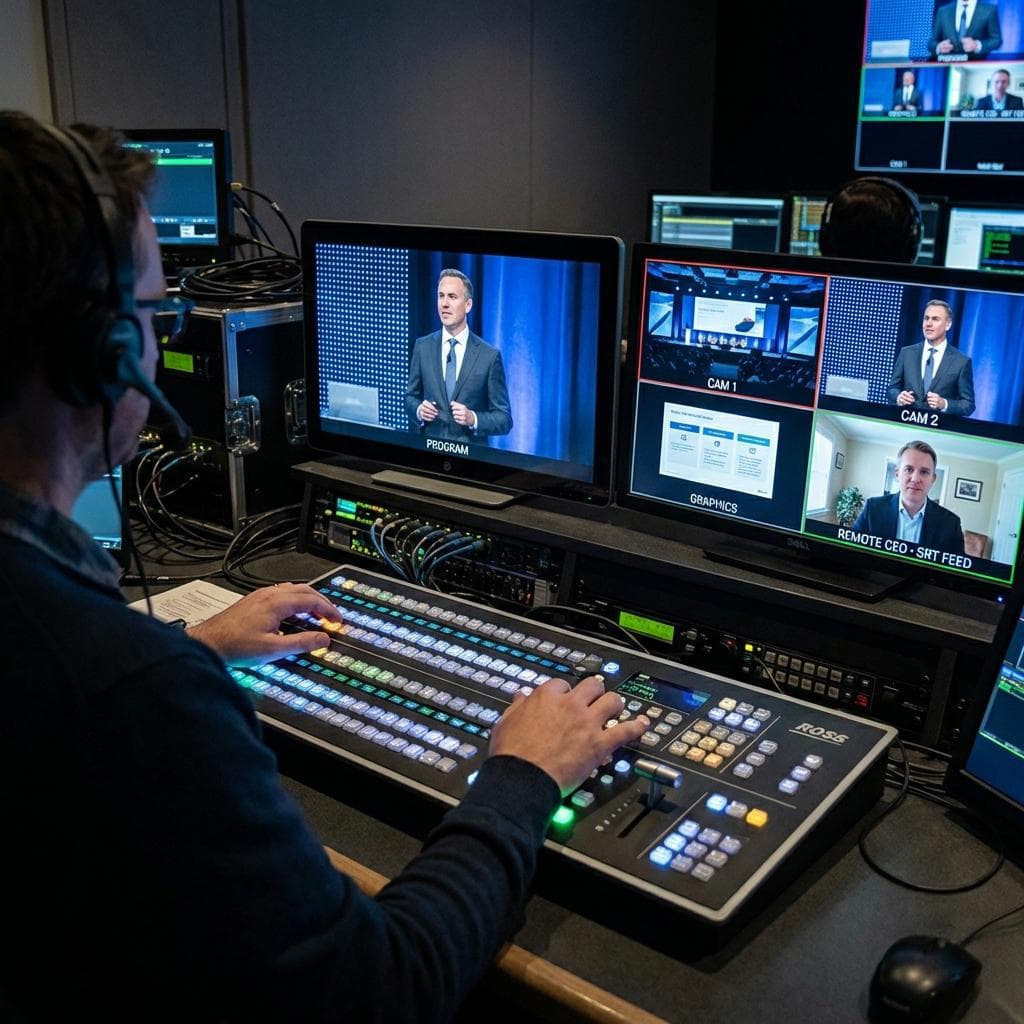
A professional production utilizes multiple cameras to create a dynamic and engaging viewing experience. In a studio setting, this may include three or more manned studio cameras or robotic PTZ (Pan-Tilt-Zoom) cameras, providing different angles of the presenters. The baseband signal standard for professional environments is SDI (Serial Digital Interface), with 12G-SDI supporting uncompressed 4K/UHD signals at 60fps over a single coaxial cable. All camera feeds, along with graphics from a character generator and playback from video servers, are routed into a central production switcher, such as a Ross Carbonite or Blackmagic Design ATEM Constellation. The technical director uses the switcher to cut, mix, and apply effects, creating the final program output. This program feed is then sent to the primary encoder for streaming, while a multiview output allows the production crew to monitor all sources simultaneously.
Integrating Remote Executives: Broadcast-Grade Contribution Feeds
Integrating a CEO or other key executives from a remote location is a common requirement. Relying on standard webcam feeds from platforms like Teams or Zoom is unacceptable from a quality control perspective. Instead, a broadcast-grade remote contribution workflow is implemented. A professional kit, including a high-quality camera, lighting, and microphone, is sent to the executive’s location. The output from this setup is fed into a dedicated hardware or software encoder that transmits the signal back to the main production hub using the SRT protocol. This provides a stable, low-latency, high-bitrate feed that can be color-matched and integrated into the program just like a local studio camera. This approach gives the production team full control over the remote participant’s video and audio quality, ensuring a seamless and professional appearance.
Audio Architecture for Clarity and Interaction
Audio is arguably more critical than video for effective communication. The audio architecture must ensure pristine clarity for all presenters and facilitate seamless interaction with remote participants. Presenters in the main studio are typically equipped with professional wireless lavalier microphones. All audio signals, including microphones, video playback sources, and remote participant feeds, are routed into a digital audio console (e.g., Yamaha QL series). An audio engineer manages levels, applies equalization and dynamics processing, and creates the final program mix. For remote participant integration, a mix-minus feed is crucial. This is a custom audio mix sent back to the remote executive that includes all program audio except for their own microphone, which prevents echo and feedback. For larger facilities, audio-over-IP protocols like Dante are used to route dozens of audio channels over a standard Ethernet network, providing immense flexibility and scalability.
Ensuring Interactivity, Security, and Resilience
Beyond the core video and audio production, an enterprise-grade onboarding event requires a platform that facilitates secure access, audience engagement, and system-wide redundancy. These elements elevate the experience from a passive broadcast to an interactive, secure, and resilient corporate event that can be trusted with the organization’s most valuable talent and information.
Platform Integration and Data Security
The video stream should be embedded within a secure enterprise video platform or a dedicated event portal, not a public-facing page. Access control is paramount. Integration with the company’s Single Sign-On (SSO) solution, such as Azure AD or Okta, ensures that only authenticated employees can view the stream. This token-based authentication is superior to simple password protection. The platform should also host interactive elements like moderated Q&A, live polling, and resource downloads. All data collected through these features must be handled in compliance with corporate data security policies and privacy regulations. The platform’s API (Application Programming Interface) may also allow for integration with internal learning management systems to track completion and engagement for compliance purposes.
Redundancy and Failover Protocols
For a mission-critical event, failure is not an option. A robust redundancy plan is essential. This starts with a fully redundant signal path, often referred to as a 1+1 or A/B path configuration. This involves two separate encoders, each fed by the same program output from the switcher. Each encoder transmits the SRT stream over a separate internet connection (e.g., a primary fiber ISP and a secondary bonded cellular or satellite backup) to two geographically distinct media server instances in the cloud. A seamless failover mechanism is configured so that if the primary path fails at any point (encoder, network, or server), the stream automatically and instantly switches to the backup path with no interruption to the viewer. This level of resilience is standard practice in broadcast television and should be applied to high-stakes corporate events like executive onboarding.
Ultimately, scaling executive onboarding with live video is a strategic technical initiative. It requires moving beyond simple webcasting tools and embracing a broadcast production methodology. By architecting a secure and resilient streaming infrastructure based on protocols like SRT, designing a professional multi-source production hub, and integrating with secure enterprise platforms, organizations can deliver a compelling and consistent onboarding experience that connects leaders, reinforces culture, and sets the stage for success for new executives, no matter where they are in the world.