Introduction: Navigating the Future of Corporate Communications
As businesses evolve, the way they communicate internally and externally must adapt to changing technologies. For Singaporean multinational corporations (MNCs), the challenge is to leverage advanced live event streaming and hybrid production solutions that align with the unique demands of enterprise communication. This roadmap outlines key strategies for future-proofing corporate communications using state-of-the-art streaming technologies.
Implementing Robust Streaming Protocols
Understanding Streaming Protocols: RTMP, SRT, and NDI
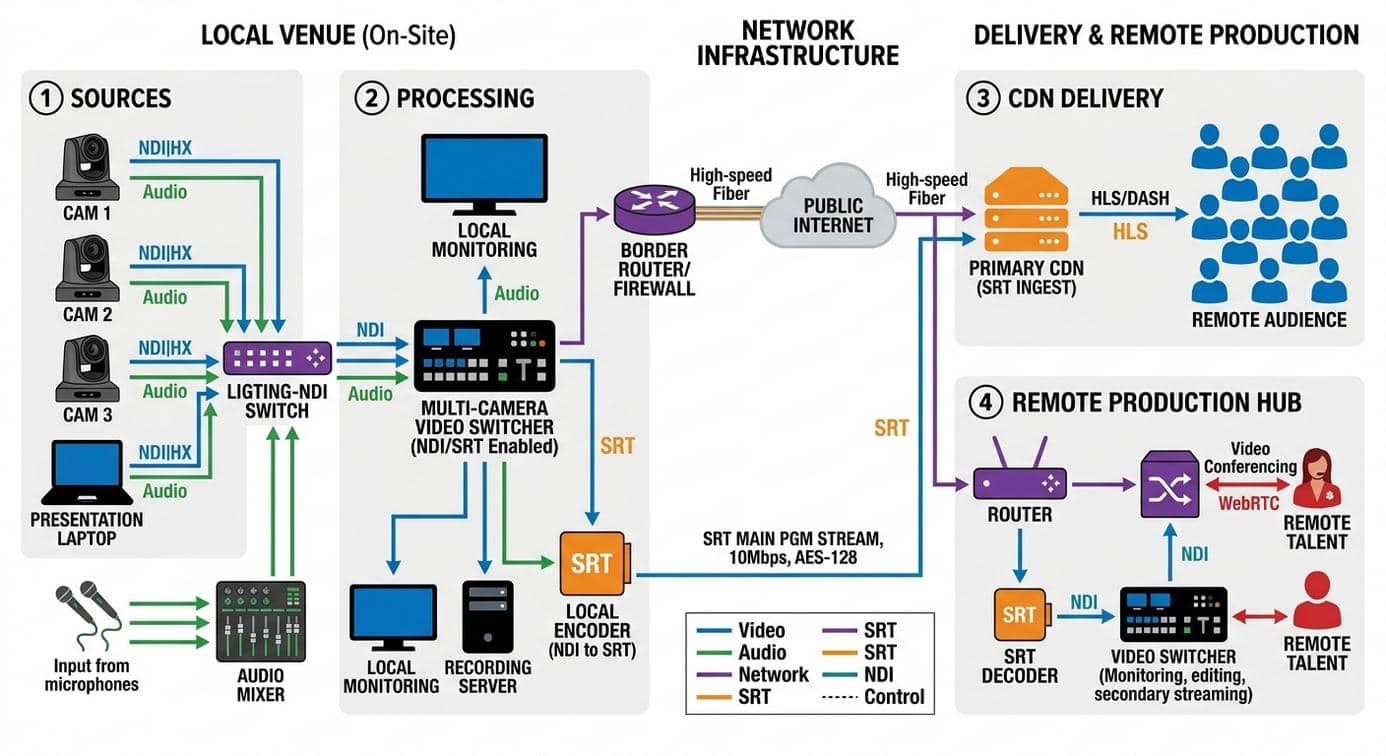
Real-Time Messaging Protocol (RTMP), Secure Reliable Transport (SRT), and Network Device Interface (NDI) are critical protocols for ensuring efficient and reliable streaming. RTMP is widely used for live video streaming to platforms such as Facebook Live; however, its security limitations can be a concern for corporate communications and is often replaced or supplemented by SRT. Designed for low-latency and secure live streaming, SRT is ideal for corporate environments requiring robust security. NDI enables efficient video over IP, particularly useful in multi-camera and mixed environment settings.
Hybrid Event Production: Bridging Physical and Digital
Integrating Physical and Virtual Audiences
The hybrid event model is revolutionizing corporate communication by merging physical events with virtual ones. Leveraging technologies like NDI for zero-latency video networking and SRT for secure remote contributions can ensure a seamless experience for both physical and virtual audiences. A critical aspect involves synchronized audio-video signal flow, which can be managed through SDI and HDMI 2.1 interfaces.
Essential Infrastructure for Hybrid Events
To facilitate hybrid events, a solid infrastructure encompassing both cloud-based and on-premise solutions is key. Cloud platforms provide scalability, while local setups ensure low latency and reliability. The infrastructure should support robust encoding processes, with codecs like H.264 and H.265 offering optimal balance between compression and quality.
Advanced Production Technology: Multicamera and Switching Systems
Multi-Camera Production Workflows
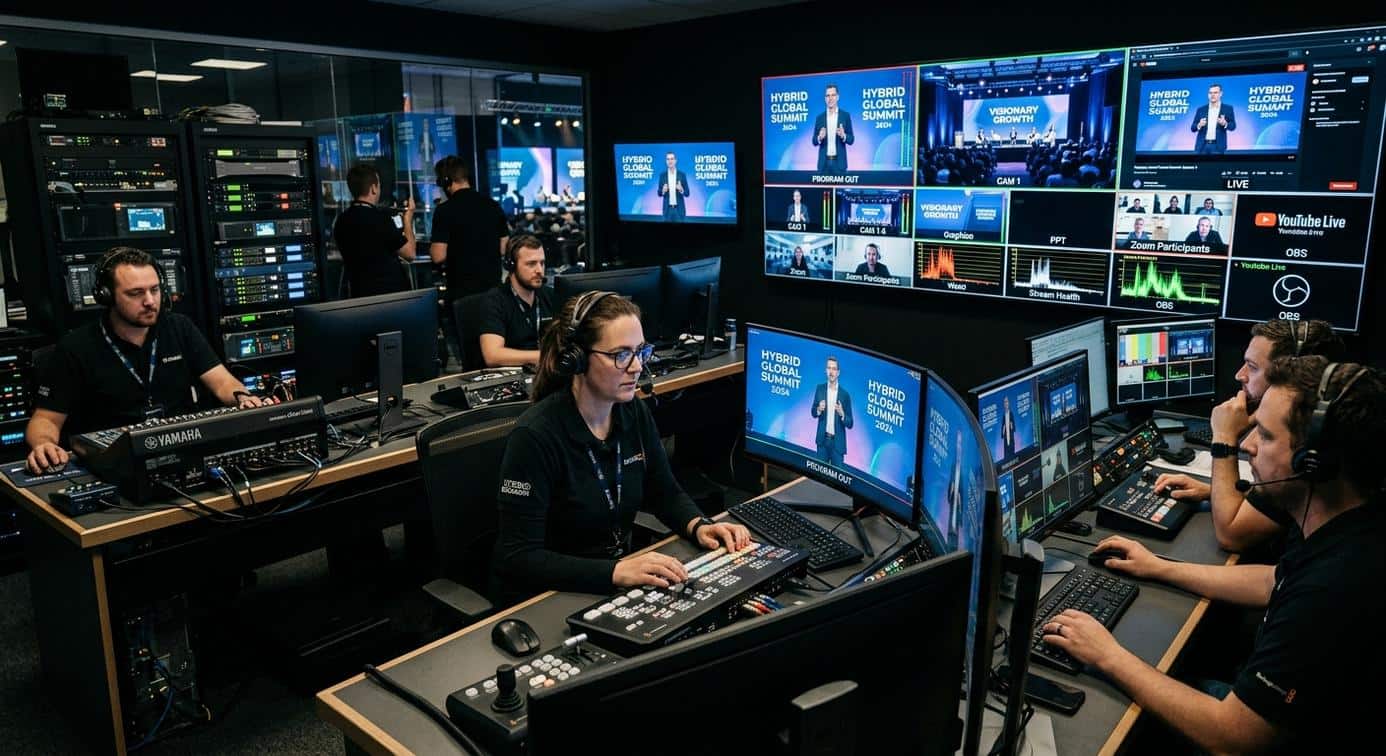
Utilizing systems like NewTek’s TriCaster or Blackmagic Design’s ATEM Switchers empowers production teams with advanced video switching capabilities. These tools support high-definition video streams and provide powerful on-the-fly editing, essential for engaging corporate broadcasts.
Real-Time Video Switching and Signal Routing
Precision in video switching is accomplished through programmable control surfaces paired with signal routers supporting SDI for high-quality, uncompressed video feeds. This setup ensures efficient signal distribution across venues, optimizing video and audio delivery.
Enhancing Network Infrastructure for Enterprise Streaming
Network Optimization for Streaming
An enterprise-grade network infrastructure is vital for uninterrupted streams. Key considerations include bandwidth management, VLAN configurations, and redundant failover mechanisms to secure uninterrupted flow and quality assurance. Ensuring Quality of Service (QoS) will prioritize streaming traffic across enterprise networks.
Cloud vs. On-Premise Solutions
Choosing between cloud-based and on-premise solutions requires a strategic evaluation of scalability, security, and latency considerations. While cloud solutions offer scalability, on-premise setups grant control over latency and security, essential for sensitive corporate communications.
Implementation Guidelines: Future-Proofing Corporate Communication
To establish robust frameworks for ongoing corporate communication, MNCs should adopt a strategic combination of technology and infrastructure enhancement. Investing in scalable network solutions, integrating cutting-edge production technologies, and adhering to broadcast standards such as SMPTE and ISO ensure sustained communication excellence.
By prioritizing security protocols, optimizing network infrastructure, and enhancing production capabilities, Singaporean MNCs can future-proof their communications, keeping pace with evolving technological landscapes and ensuring effective stakeholder engagement.
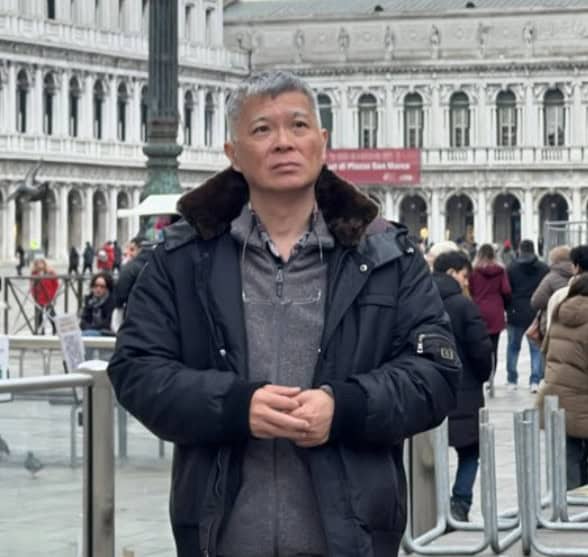
Michael Koh is a production specialist and entrepreneur who founded Spring Forest Studio in 2017 to provide event and virtual production solutions in Singapore. He specialises in hybrid live streaming, XR (Extended Reality) virtual production, and studio systems integration, transitioning the business from traditional videography to advanced corporate broadcasting. Operating out of a dedicated facility at NordCom2 in Singapore, he leads a technical crew to deliver multi-camera webcasts, digital sets, and technical consultations for large-scale corporate events.