
In the evolving landscape of enterprise communication and global B2B events, visual fidelity is no longer a luxury but a strategic imperative. Multinational Corporations (MNCs) operate at the apex of innovation, and their live streaming initiatives, whether for internal town halls, product launches, investor briefings, or hybrid conferences, demand nothing less than absolute technical excellence. The shift from High Definition (HD) to Ultra High Definition (UHD), commonly known as 4K, represents a pivotal advancement, fundamentally redefining the standard for enterprise-grade live streaming. This isn’t merely about higher pixel counts; it is about delivering unparalleled clarity, intricate detail, and immersive engagement that underpins confidence in every pixel, every frame.
The technical demands of 4K streaming for B2B applications far exceed those of consumer-grade content delivery. We are discussing complex multi-camera productions, sophisticated signal routing, robust encoding architectures, and resilient global distribution networks. For corporate event planners, AV professionals, and IT directors overseeing critical enterprise communications, understanding the core technical requirements and benefits of 4K is crucial for maintaining a competitive edge and ensuring seamless, high-impact events.
The Imperative of 4K Resolution in Enterprise Communications
The leap to 4K resolution, typically 3840×2160 pixels for UHD or 4096×2160 pixels for DCI 4K, offers a quadrupling of pixel information compared to standard 1080p HD (1920×1080). This exponential increase in data translates directly into significantly enhanced image sharpness, finer detail rendition, and more accurate color reproduction. For MNCs, this technical superiority is critical for several applications:
- Detailed Presentations and Data Visualization: Corporate presentations often involve intricate charts, dense spreadsheets, CAD designs, or complex product schematics. In HD, these details can become pixelated or illegible, leading to misinterpretation or diminished impact. 4K ensures every data point, every line, and every textual annotation remains crisp and clearly discernible, empowering audiences to absorb complex information effortlessly.
- Immersive Brand Experiences: High-profile B2B events are an extension of a brand’s identity. A 4K stream elevates the perceived production value, projecting an image of professionalism, innovation, and attention to detail. This enhanced visual quality translates into a more immersive and engaging experience for virtual attendees, bridging the gap between physical and digital participation in hybrid scenarios.
- Future-Proofing Infrastructure: Investing in 4K-capable production and streaming infrastructure today safeguards against rapid technological obsolescence. As display technologies advance and audience expectations for visual quality continue to rise, a 4K ecosystem provides a scalable foundation that accommodates future requirements without requiring immediate, costly overhauls.
- Post-Production Flexibility: Even for live events, the ability to zoom, crop, and reframe within a 4K canvas during or after production, without significant loss of quality for HD outputs, provides invaluable flexibility. This allows production teams to capture wider shots and extract multiple virtual HD camera angles from a single 4K source, optimizing camera deployment and operational efficiency.
Technical Justification: Pixel Density and Visual Acuity
The human visual system is highly attuned to detail. At typical viewing distances, the increased pixel density of a 4K image significantly reduces the “screen door effect” and aliasing artifacts often visible in lower resolutions. This is particularly relevant when viewing large-format displays or multiple concurrent streams on professional monitors. The precision afforded by 4K allows for a greater depth of field perception and more nuanced color gradients, crucial for maintaining visual integrity in complex scenes, such as multi-presenter panels or intricate demonstrations.
Moreover, the adoption of wider color gamuts, often associated with 4K content (e.g., Rec. 2020), coupled with High Dynamic Range (HDR) workflows, further enhances the visual experience. While HDR implementation adds layers of complexity to the production chain, its ability to render a broader spectrum of brightness and contrast brings a lifelike quality that standard dynamic range (SDR) cannot achieve, offering a more faithful representation of the live environment.
Mastering the 4K Production Workflow: From Capture to Delivery
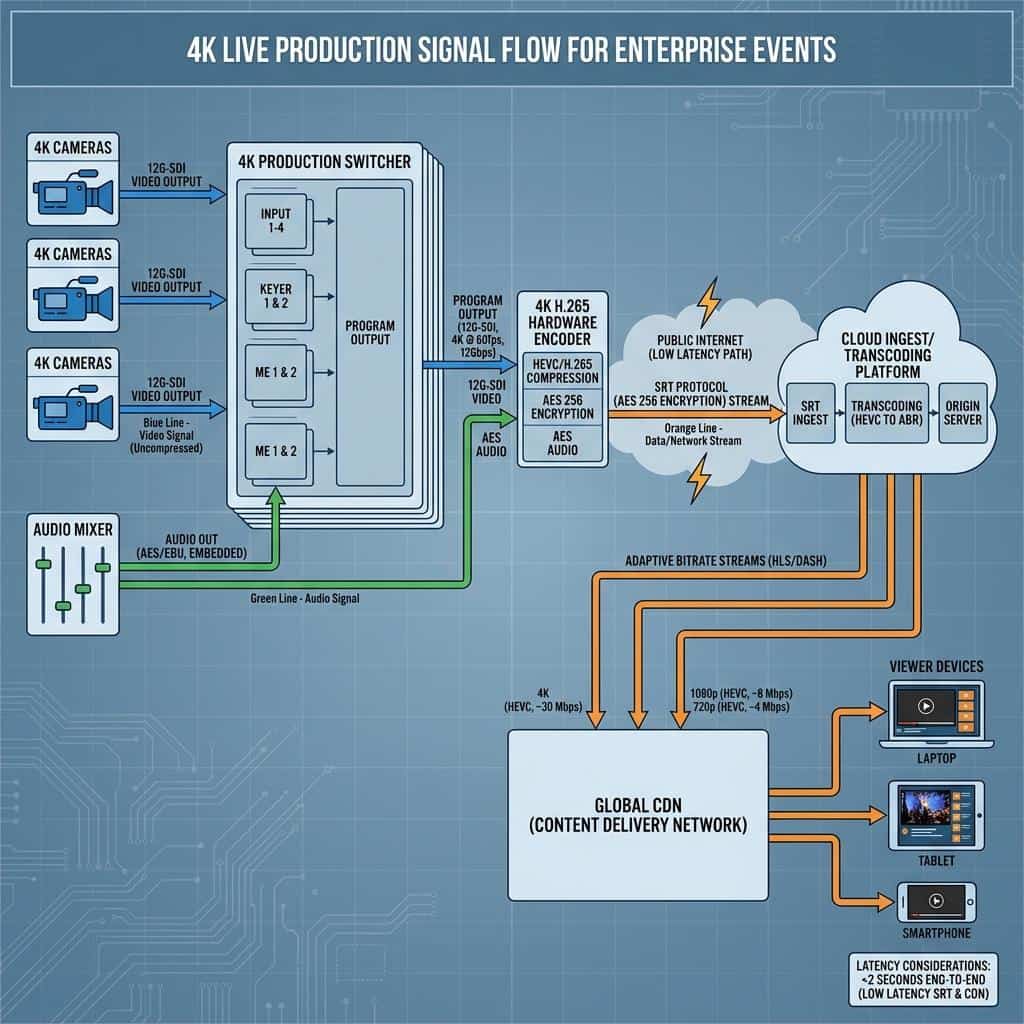
Achieving a pristine 4K live stream for enterprise clients requires meticulous planning and execution across the entire production signal chain, from initial capture to the final encoded output. The technical challenges inherent in managing 4K data rates necessitate specialized equipment and robust infrastructure.
High-Bandwidth Signal Transport and Interfacing
The raw, uncompressed 4K signal demands substantial bandwidth. Professional production environments primarily rely on Serial Digital Interface (SDI) for robust, long-distance signal transmission. For 4K UHD at 60 frames per second (fps), a single 12G-SDI cable can carry the uncompressed video signal over coaxial cable up to 70 meters. For longer runs or facilities without 12G-SDI infrastructure, quad-link 3G-SDI configurations, which combine four 3G-SDI links for a single 4K signal, are common, albeit with increased cabling complexity. Alternatively, HDMI 2.1 provides a single-cable solution for shorter distances and direct display connectivity, supporting up to 48 Gbps of bandwidth.
Network-based transport protocols like SMPTE ST 2110 are also gaining traction in broadcast and high-end enterprise facilities. ST 2110 decouples video, audio, and ancillary data streams, allowing them to be transported independently over standard IP networks. This offers immense flexibility and scalability but requires a meticulously engineered, high-capacity IP network, typically 25 Gigabit Ethernet (GbE) or 100 GbE, with strict timing synchronization protocols (e.g., PTP – Precision Time Protocol).
Advanced Video Switching and Processing
The core of any multi-camera live production is the video switcher. For 4K workflows, switchers must be capable of processing and routing native 4K signals without down-conversion or compromising color fidelity. Professional 4K production switchers feature multiple 12G-SDI or IP inputs, advanced keying capabilities, DVEs (Digital Video Effects), and multiviewer outputs that allow technical directors and vision mixers to monitor all sources, program output, and preview feeds simultaneously. Color grading, essential for ensuring consistent visual aesthetics across disparate camera sources, is often integrated into the switcher or handled by dedicated outboard processing units.
Audio integration is equally critical. Embedded audio within SDI or IP streams must be seamlessly de-embedded, mixed on professional audio consoles, and then re-embedded into the program video feed. Talkback systems, often utilizing NDI|HX or dedicated intercom hardware, ensure clear communication among the production crew, critical for precise timing and coordination during a live event.
Encoding, Protocols, and Network Infrastructure for Enterprise 4K
Once captured and switched, the 4K program feed must be efficiently encoded and transported to its intended audience. This stage presents significant challenges in balancing visual quality, network bandwidth, and latency.
Codec Selection and Bitrate Optimization
For 4K live streaming, the choice of video codec is paramount. H.264 (AVC) can technically support 4K, but its efficiency at higher resolutions and bitrates is often suboptimal, leading to larger file sizes or visible compression artifacts. H.265 (HEVC – High Efficiency Video Coding) is the de facto standard for 4K, offering approximately 25-50% better compression efficiency than H.264 at the same visual quality. This translates to lower bandwidth requirements for equivalent quality, or higher quality for the same bandwidth. Emerging codecs like AV1 offer even greater efficiency but currently require more processing power for real-time encoding, making them less prevalent for live B2B production today.
Optimal bitrate management is crucial. For a high-quality 4K 60fps live stream, typical egress bitrates can range from 20 Mbps to 50 Mbps, depending on the complexity of the content and the desired visual fidelity. Adaptive Bitrate Streaming (ABS) is essential for audience delivery, providing multiple renditions at varying resolutions and bitrates (e.g., 4K, 1080p, 720p) to accommodate diverse network conditions and viewing devices, ensuring a consistent user experience.
Secure and Reliable Transport Protocols
For contribution and distribution, several protocols are employed:
- SRT (Secure Reliable Transport): Developed by Haivision, SRT is an open-source protocol designed for low-latency, high-performance video transport over unreliable networks, such as the public internet. It utilizes UDP for speed and adds its own robust error correction and retransmission mechanisms, making it ideal for point-to-point 4K contribution from remote event locations to a central production hub or cloud ingest point. SRT encrypts streams (AES 128/256) ensuring content security, a non-negotiable for sensitive corporate communications.
- RTMP/RTMPS (Real-Time Messaging Protocol Secure): While traditionally widely used, RTMP is showing its age for 4K. It is TCP-based, which can introduce higher latency, and its efficiency for 4K is less than ideal. However, RTMPS (secure RTMP) remains a common ingest protocol for many Content Delivery Networks (CDNs) and streaming platforms due to its widespread compatibility.
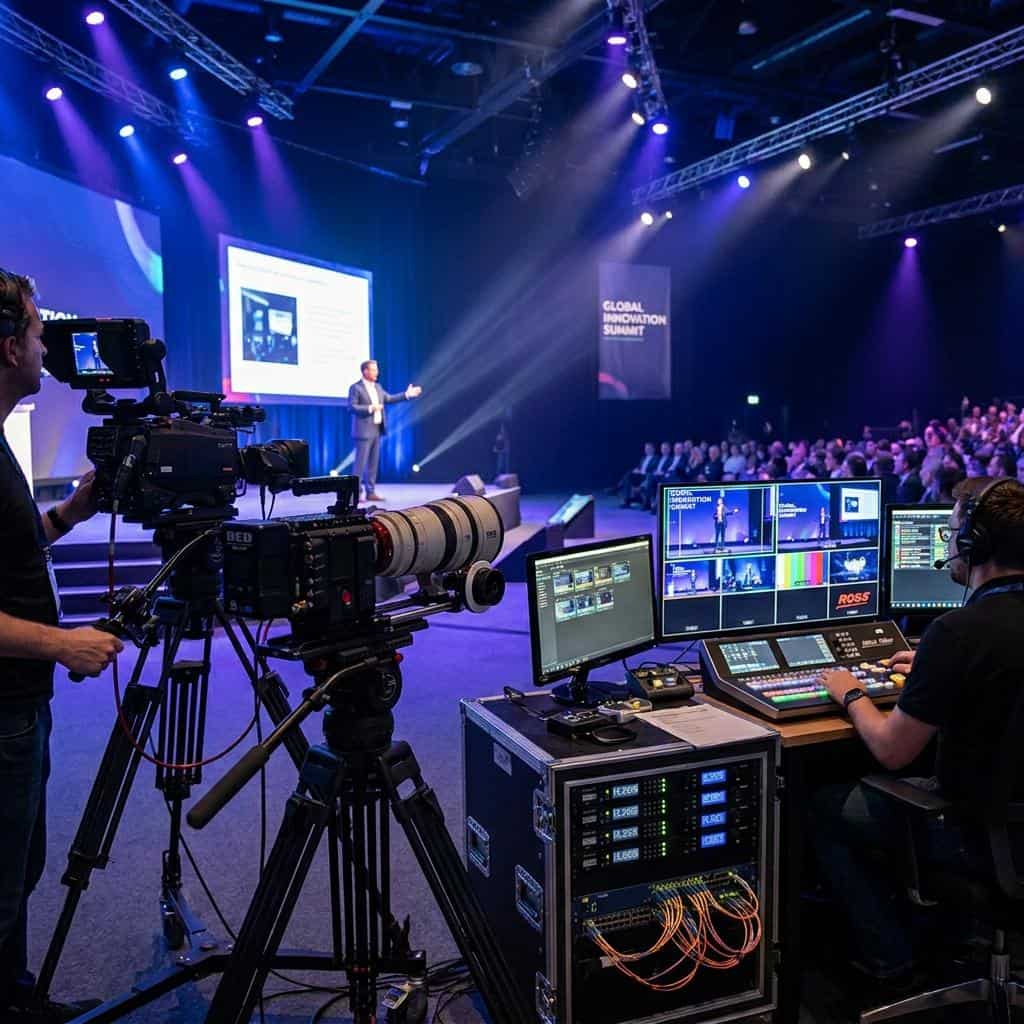
- NDI (Network Device Interface): For internal network routing within a production facility or across a campus, NDI offers a powerful, low-latency, high-quality IP video standard. NDI|HX provides a more compressed version suitable for wireless cameras or lower-bandwidth networks, while full NDI handles uncompressed or lightly compressed video streams, making it excellent for local 4K signal distribution and routing without requiring dedicated SDI cabling.
Network Infrastructure Requirements
Delivering high-quality 4K streams necessitates a meticulously engineered network infrastructure. For on-premise production, a dedicated, high-speed Gigabit Ethernet (GbE) network, segmented for video traffic, is essential. For cloud-based encoding or distribution, robust internet egress bandwidth is critical. A single 4K stream at 30 Mbps requires a significant upload capacity. For events with multiple 4K sources and simultaneous distribution streams, redundant internet connections with aggregated bandwidth and failover capabilities are mandatory to prevent disruption.
Content Delivery Networks (CDNs) play a vital role in globally distributing 4K content, caching content at edge servers closer to viewers to minimize latency and improve playback quality. Enterprise CDNs are optimized for security, scalability, and integration with corporate network architectures, ensuring reliable delivery to geographically dispersed audiences.
Hybrid 4K Deployments and Platform Integration
The rise of hybrid events, combining physical attendees with a virtual audience, has amplified the need for seamless 4K integration with existing enterprise communication platforms. MNCs often leverage platforms like Microsoft Teams, Zoom, or Webex for internal and external collaboration.
Integrating Professional 4K Feeds with UC Platforms
Directly feeding a professional 4K program stream into these Unified Communications (UC) platforms requires careful technical consideration. While these platforms can receive high-resolution video, they often re-encode streams to optimize for multi-participant video conferencing, which may reduce the pristine quality of a dedicated 4K broadcast feed. Solutions involve utilizing professional hardware encoders that can output a platform-optimized stream, or employing virtual webcam drivers that ingest the 4K program feed and present it to the UC application, allowing the platform to manage its own encoding and distribution.
For a truly hybrid experience, a dedicated 4K web stream typically runs in parallel to the UC platform integration. This ensures that the virtual audience receiving the broadcast-grade 4K stream experiences the highest possible fidelity, while internal teams can still collaborate and interact via the UC platform with a high-quality video input.
Scalability and Multi-Site Contribution
Large MNC events often involve multiple presenters from various geographic locations contributing to a central 4K program. This multi-site contribution relies heavily on SRT for secure, low-latency transport of remote 4K camera feeds back to a main production control room. Cloud-based production platforms are increasingly used to aggregate these remote sources, perform switching, and distribute the final 4K program, offering unprecedented scalability without significant on-premise hardware investment at each location.
The ability to scale 4K delivery to hundreds of thousands of concurrent viewers globally demands robust CDN partnerships and intelligent traffic management. Load balancing, geo-distribution, and real-time analytics are essential to ensure a consistent, high-quality viewing experience regardless of audience size or location.
Ensuring Resiliency and Quality of Service in 4K Live Streams
For mission-critical B2B events, confidence in the live stream’s reliability is paramount. A single point of failure can lead to significant reputational damage and financial loss. Implementing comprehensive redundancy and Quality of Service (QoS) strategies is non-negotiable for 4K enterprise streaming.
Redundancy and Failover Architectures
A truly resilient 4K live streaming architecture incorporates redundancy at every critical point:
- Camera Redundancy: Multiple cameras capturing the same scene, with automatic or manual switching capabilities.
- Signal Path Redundancy: Dual SDI or IP signal paths for critical video and audio feeds from cameras to switchers and encoders.
- Encoder Redundancy: Primary and backup encoders, often in an active-standby configuration, with automatic failover triggered by health monitoring. Cloud-based encoding solutions frequently offer built-in redundancy across different availability zones.
- Network Redundancy: Dual internet service providers (ISPs) with diverse routing, bonded connections, or 5G cellular failover options. This extends to redundant network switches and routers within the production facility.
- Power Redundancy: Uninterruptible Power Supplies (UPS) for all critical equipment, potentially backed by generator power for extended outages.
Failover strategies must be meticulously planned and regularly tested. This includes seamless switching to backup sources or encoders, often managed by automated systems that monitor stream health metrics like bitrate, frame rate, and audio levels. The goal is an imperceptible transition for the end-viewer, maintaining stream continuity even in the face of equipment malfunction or network instability.
Comprehensive Monitoring and Quality Control
Real-time, multi-level monitoring is essential for maintaining 4K stream quality. This includes:
- Video Monitoring: Professional multiviewer displays for all camera feeds, program output, and return feeds, ensuring correct framing, focus, exposure, and color fidelity. Waveform monitors and vectorscopes provide precise technical analysis of video signals.
- Audio Monitoring: Loudness meters (e.g., compliant with ITU-R BS.1770-4) and spectrum analyzers to ensure audio levels are within broadcast standards and free from distortion or noise. Dedicated audio engineers meticulously mix and monitor all audio sources, including presenter microphones, playback, and audience interaction.
- Network Monitoring: Tools to track bandwidth utilization, packet loss, jitter, and latency across the entire streaming path, from source ingest to CDN edge servers. This allows for proactive identification and resolution of network performance issues.
- Stream Health Monitoring: Specialized software and hardware solutions that monitor the encoded stream’s integrity, looking for dropped frames, blockiness, audio-video sync issues, and other artifacts. Alerts are configured to notify operators of any deviations from established QoS thresholds.
Implementing an end-to-end quality control (QC) workflow, from the camera lens to the viewer’s screen, instills “high-definition confidence.” It assures MNCs that their critical communications will be delivered with unwavering technical integrity and visual brilliance, solidifying 4K as the undeniable standard for professional B2B live event streaming.

Michael Koh is a production specialist and entrepreneur who founded Spring Forest Studio in 2017 to provide event and virtual production solutions in Singapore. He specialises in hybrid live streaming, XR (Extended Reality) virtual production, and studio systems integration, transitioning the business from traditional videography to advanced corporate broadcasting. Operating out of a dedicated facility at NordCom2 in Singapore, he leads a technical crew to deliver multi-camera webcasts, digital sets, and technical consultations for large-scale corporate events.