
In the high-stakes world of B2B event streaming and hybrid production, every element contributes to the perceived professionalism and authority of a presentation. While visual fidelity often receives paramount attention, the impact of high-fidelity audio, though frequently overlooked, is a critical determinant of executive presence and message efficacy. For corporate event planners, AV professionals, and IT directors overseeing enterprise-grade virtual and hybrid events, understanding and implementing advanced audio infrastructure is not merely a technical detail; it is a strategic imperative for conveying gravitas and ensuring clear, uninterrupted communication.
At Live Streaming Studio, our technical team understands that sound is intrinsically linked to credibility. A CEO delivering a keynote, an expert panel discussing market trends, or a critical investor briefing relies on pristine audio to project confidence and command attention. Poor audio quality, characterized by hiss, echo, dropouts, or an indistinct vocal presence, fundamentally undermines the perceived authority of the speaker and the professionalism of the entire production. This article delves into the technical intricacies of achieving broadcast-grade audio for B2B streams, exploring the advanced acquisition, processing, routing, and delivery methodologies that distinguish professional enterprise events.
The Imperative of Sonic Fidelity in B2B Communications: Beyond Basic Clarity
The objective in B2B streaming extends far beyond merely being “heard.” It is about delivering an auditory experience that is robust, immersive, and free from the cognitive burden of poor signal integrity. This necessitates a holistic approach to the audio chain, from transducer to audience endpoint. In a corporate context, the nuances of speech articulation, vocal tone, and the subtle cues of executive communication are vital. Low-fidelity audio can obscure these elements, leading to misinterpretations or, worse, a perception of amateurism.
Understanding the Foundation: Acoustics and Microphone Selection
The journey to high-fidelity audio begins at the source: the acoustic environment and microphone selection. A meticulously engineered audio chain cannot compensate for a noisy room or an improperly chosen microphone. For executive presentations, professional-grade condenser microphones, such as DPA d:fine or Sennheiser MKE series lavaliers, or Shure KSM series gooseneck microphones, offer superior transient response, broader frequency range (typically 20 Hz to 20 kHz), and higher signal-to-noise ratios (SNR) compared to consumer-grade alternatives. Placement is equally critical; proximity effect and off-axis rejection must be managed to capture a clear, consistent vocal signal while minimizing ambient noise. For panel discussions, shotgun microphones with tight polar patterns or strategically placed boundary microphones can offer excellent coverage without visual intrusion, provided they are integrated with acoustic treatment to mitigate room reflections and reverberation.
Digital Audio Workflows and Synchronization Challenges
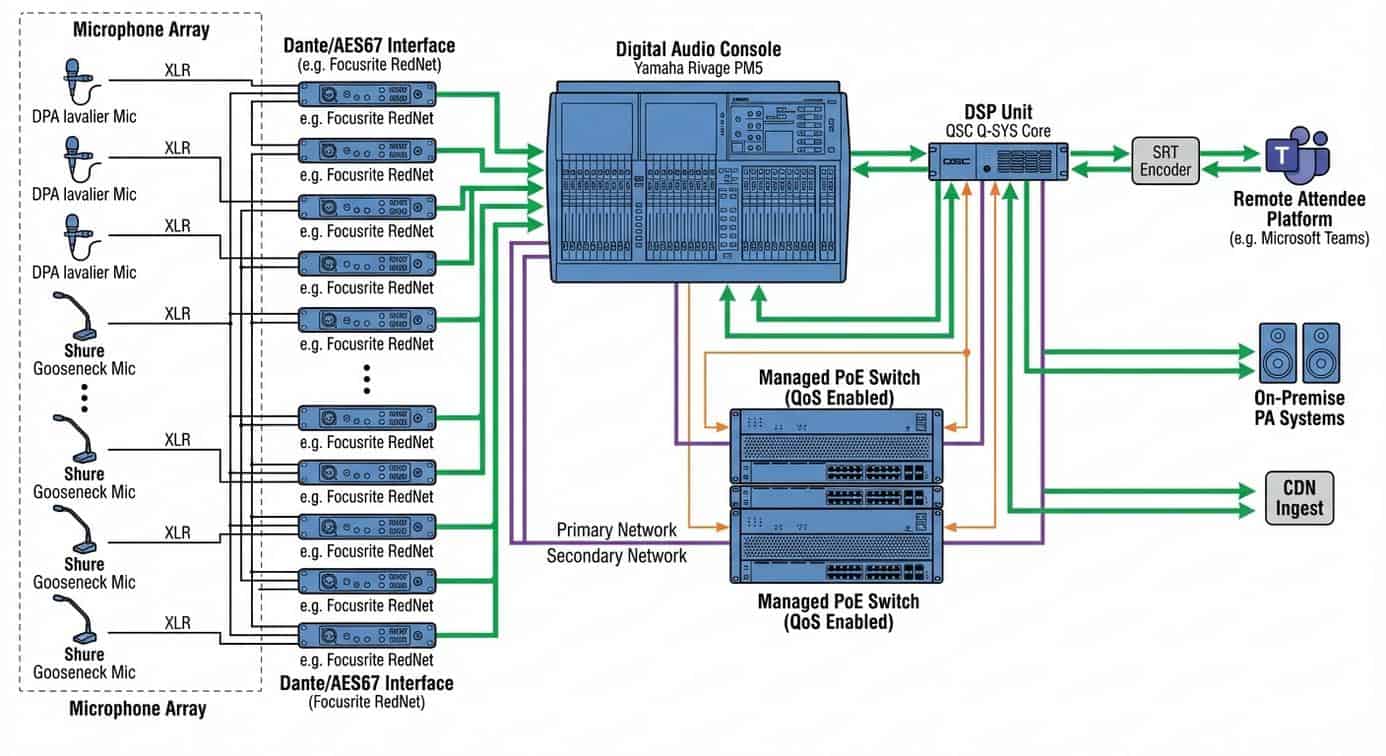
In modern B2B event production, digital audio workflows are standard, offering superior noise rejection, longer cable runs, and greater flexibility than analog counterparts. Protocols such as Dante (Digital Audio Network Through Ethernet) and AES67 (Audio-over-IP interoperability standard) are foundational. Dante, with its robust network management and low-latency capabilities, allows for the routing of hundreds of audio channels over standard IP networks, integrating microphones, digital mixing consoles, DSPs, and audio interfaces. AES67, building on this foundation, ensures interoperability between different manufacturers’ IP audio devices, a critical factor in complex, multi-vendor enterprise environments. The synchronization of audio and video streams is paramount to avoid lip-sync issues, which are highly distracting. Precision Time Protocol (PTP) is typically employed in IP-based broadcast workflows (e.g., SMPTE ST 2110) to ensure microsecond-level synchronization across all networked devices, guaranteeing that audio and video frames align perfectly at every stage of the production signal path.
Advanced Audio Acquisition and Processing for Executive Presence
Once the raw audio signal is captured, it enters a sophisticated processing chain designed to optimize clarity, consistency, and impact. This involves professional digital audio consoles, digital signal processors (DSPs), and broadcast-grade audio tools that sculpt the sound for optimal delivery.
Digital Audio Consoles and DSP Integration
Professional digital audio consoles, such as the Yamaha Rivage series, Digico SD series, or Avid S6L, are the heart of the audio mix. These consoles provide granular control over every input, offering features like parametric equalization, dynamic range compression, gating, and de-essing. Compression is particularly vital for executive vocals, as it reduces the dynamic range, making quieter speech more audible and preventing loud passages from clipping, thereby ensuring a consistent and authoritative vocal level. Gates selectively mute microphones when no one is speaking, reducing background noise and improving overall clarity, especially in multi-microphone environments. DSPs, either integrated into the console or as external units (e.g., QSC Q-SYS, Biamp TesiraFORTE), provide advanced room acoustic correction, echo cancellation, and automatic mixing functionalities, which are indispensable for hybrid events where far-end participants’ audio needs careful management to prevent feedback and improve intelligibility.
Loudness Management and Broadcast Standards
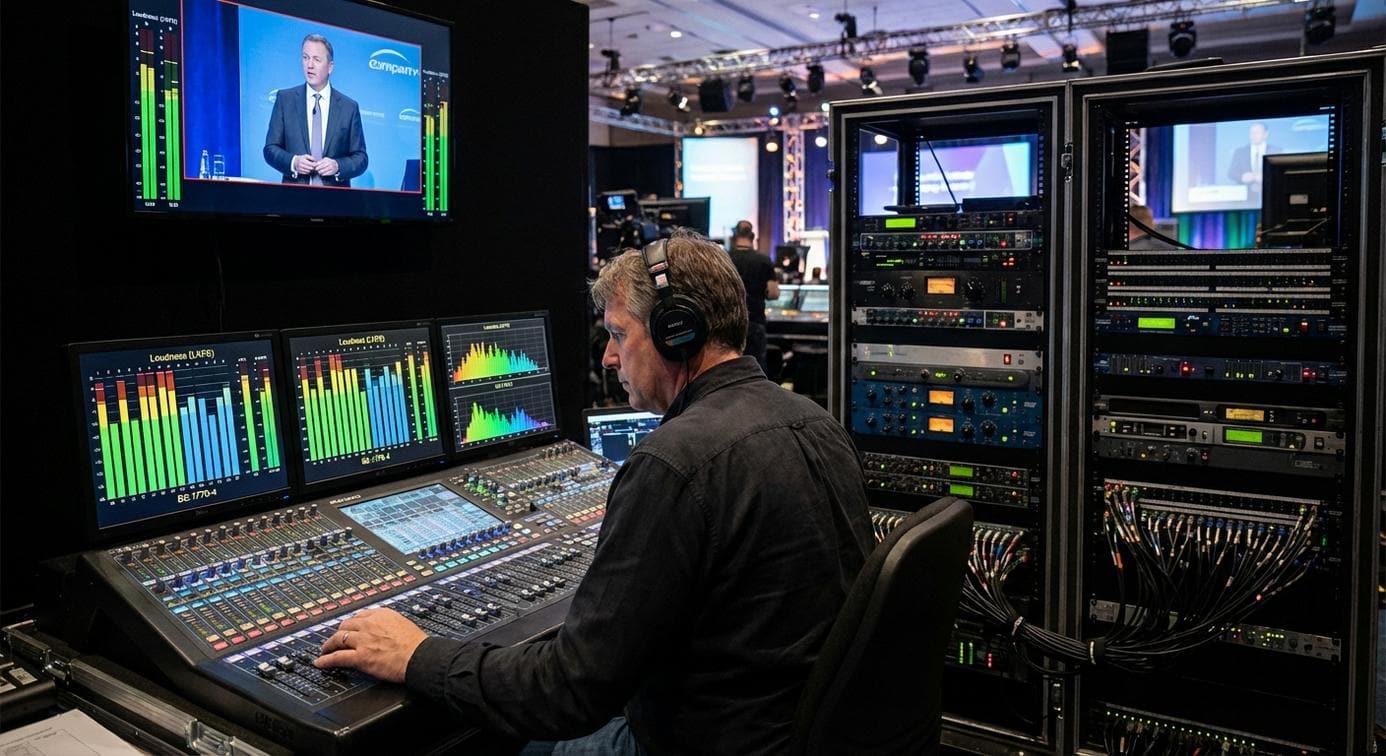
Maintaining consistent loudness levels across different program elements (e.g., spoken word, video playback, music bumpers) is crucial for a polished, professional stream. Broadcast standards like ITU-R BS.1770-4 specify target loudness levels (e.g., -23 LUFS or -24 LKFS) and true peak limits (-1 dBTP) to prevent listener fatigue and ensure compliance across various distribution platforms. Real-time loudness meters are essential tools for audio engineers to monitor and adjust levels, ensuring the final mix adheres to these standards. This level of meticulous loudness management ensures that the executive’s voice remains consistently impactful without abrupt volume shifts, maintaining a commanding presence throughout the event.
Enterprise-Grade Audio Signal Flow and Network Integration
The journey of audio from source to stream involves complex signal routing, often traversing physical and IP networks, demanding robust infrastructure and meticulous planning. This is particularly true for hybrid events that bridge on-premise production with cloud-based streaming platforms and remote participant integration.
Hybrid Audio Architectures: On-Premise to Cloud
In a hybrid event scenario, the audio signal flow becomes a intricate tapestry. On-premise sources, captured via professional microphones and mixed on a digital console, are often embedded into SDI (Serial Digital Interface) video signals for local routing and switching, or converted to IP streams (e.g., NDI – Network Device Interface, or SMPTE ST 2110-30 for audio over IP) for network distribution. For remote contributions, secure and low-latency protocols like SRT (Secure Reliable Transport) are employed to transport high-quality audio and video over unreliable internet connections, offering error recovery and encryption. The audio from remote participants, integrated via platforms like Microsoft Teams, Zoom, or Webex, must be carefully de-embedded, processed (e.g., noise reduction, echo cancellation), and re-embedded into the master program mix. This bidirectional signal flow, where on-site and remote audio are seamlessly combined and distributed, is a hallmark of sophisticated hybrid production.
Network Infrastructure Requirements for Professional Audio
The reliable transport of high-fidelity audio over IP networks demands dedicated network infrastructure. A managed Gigabit Ethernet network with Quality of Service (QoS) enabled is non-negotiable. QoS prioritizes audio and video packets, minimizing latency, jitter, and packet loss, which are anathema to pristine audio. VLANs (Virtual Local Area Networks) segment broadcast traffic from other enterprise network activities, preventing congestion and security vulnerabilities. Dedicated network switches with IGMP snooping (Internet Group Management Protocol) are essential for efficient multicast audio routing (e.g., Dante, AES67), ensuring that audio streams are only sent to devices that explicitly request them, conserving bandwidth. Redundant network paths, often implemented with LACP (Link Aggregation Control Protocol) or STP (Spanning Tree Protocol), provide failover protection, ensuring continuous audio delivery even in the event of a network component failure.
Mitigating Latency and Ensuring Redundancy for Impeccable Delivery
Low latency and robust redundancy are critical considerations for maintaining executive authority and audience engagement in live streams. Any perceptible delay between video and audio, or an unexpected audio dropout, erodes credibility instantly.
Latency Management in the Audio Chain
Latency, the delay from audio source to listener, must be meticulously managed throughout the entire production chain. In an IP-based environment, each network hop, encoder, and decoder adds a small amount of latency. Professional audio-over-IP systems like Dante typically achieve sub-millisecond latency within a local network. However, when streaming globally via Content Delivery Networks (CDNs), end-to-end latency can range from a few seconds (for standard HTTP Live Streaming – HLS, or MPEG-DASH) to sub-second (using WebRTC or specialized ultra-low latency protocols over SRT). For interactive hybrid events, maintaining minimal glass-to-glass latency for Q&A and real-time interaction is paramount. This requires carefully chosen encoders (e.g., Haivision Makito X, Elemental Live) that offer low-latency profiles, efficient decoding at the audience end, and robust network connectivity from ingest to edge servers. Audio and video synchronization tools, such as frame synchronizers and audio delay units, are indispensable for precisely aligning signals before final encoding, compensating for any discrepancies introduced upstream.
Redundancy and Failover Strategies for Uninterrupted Audio
For mission-critical B2B events, redundancy is not an option; it is a necessity. This applies to every component in the audio signal path. At the input stage, dual microphones for key presenters, routed through separate channels to distinct inputs on the digital console, provide immediate backup. Digital audio consoles often feature redundant power supplies and redundant processing engines. Network redundancy, as discussed with LACP and STP, ensures network resilience. For encoders, hardware encoders often have hot-swappable modules and can be deployed in a 1+1 or N+M redundant configuration, where a backup encoder automatically takes over if the primary fails. Dual ingest points to the CDN, receiving streams from separate encoders or even separate internet connections, offer further protection. For remote contributors, a diverse set of internet connections (e.g., primary fiber, secondary cellular bonded connection) can mitigate local network failures. Implementing these layers of redundancy ensures that the executive’s authoritative voice is never silenced, even in the face of unforeseen technical challenges.
Conclusion: The Sonic Foundation of Executive Authority
High-fidelity audio is not a luxury; it is the sonic foundation upon which executive authority, professionalism, and effective communication are built in the B2B streaming landscape. By meticulously addressing acoustics, deploying broadcast-grade microphones, leveraging advanced digital audio consoles and DSPs, implementing robust IP-based signal flows with precise synchronization, and architecting comprehensive redundancy strategies, enterprises can elevate their virtual and hybrid events to an unparalleled standard. Live Streaming Studio specializes in designing and implementing these sophisticated audio infrastructures, ensuring that every word spoken by your executives is delivered with clarity, impact, and the unwavering authority your brand commands. Investing in a professional audio strategy is an investment in your brand’s credibility and the undeniable power of your message.

Michael Koh is a production specialist and entrepreneur who founded Spring Forest Studio in 2017 to provide event and virtual production solutions in Singapore. He specialises in hybrid live streaming, XR (Extended Reality) virtual production, and studio systems integration, transitioning the business from traditional videography to advanced corporate broadcasting. Operating out of a dedicated facility at NordCom2 in Singapore, he leads a technical crew to deliver multi-camera webcasts, digital sets, and technical consultations for large-scale corporate events.