
 March 28, 2026 by Editor |
The Technical Foundation for Global B2B Streaming
For multinational corporations, executing a high-stakes global town hall, product launch, or investor relations webcast is a non-negotiable, mission-critical operation. The tolerance for technical failure is zero. Dropped frames, excessive latency, or a complete signal loss can erode audience confidence and undermine key business objectives. The challenge is not merely delivering a video stream; it is engineering a resilient, secure, and high-quality production workflow that spans continents and traverses the unpredictable public internet. This requires a strategic selection of a production and distribution hub that offers more than just a geographic advantage. It demands a location with a deeply entrenched, world-class digital infrastructure. Singapore stands as the preeminent choice in the Asia-Pacific region, providing a robust foundation of connectivity that empowers MNCs to execute flawless global streaming events.
The core of this capability lies in Singapore’s unparalleled density of subsea fiber optic cables, its ecosystem of Tier III and Tier IV data centers, and its mature internet peering fabric. This article provides a detailed technical analysis of how these infrastructure components create a resilient environment for professional B2B live streaming and hybrid event production. We will examine the specific protocols, hardware, and workflow architectures that leverage this connectivity, offering actionable implementation guidelines for enterprise clients, production managers, and IT directors responsible for delivering high-impact corporate communications.
Analyzing Singapore’s Core Connectivity: Subsea Cables and Data Center Peering
The resilience of any global stream originates at the physical layer. Singapore’s strategic position is fundamentally underwritten by its access to a vast network of submarine fiber optic cable systems. This is not simply about raw bandwidth; it is about network path diversity, which is critical for establishing redundant signal transport and mitigating the risk of single-point-of-failure events, such as a physical cable cut or regional network congestion.
Subsea Cable Network Architecture and Latency Impact
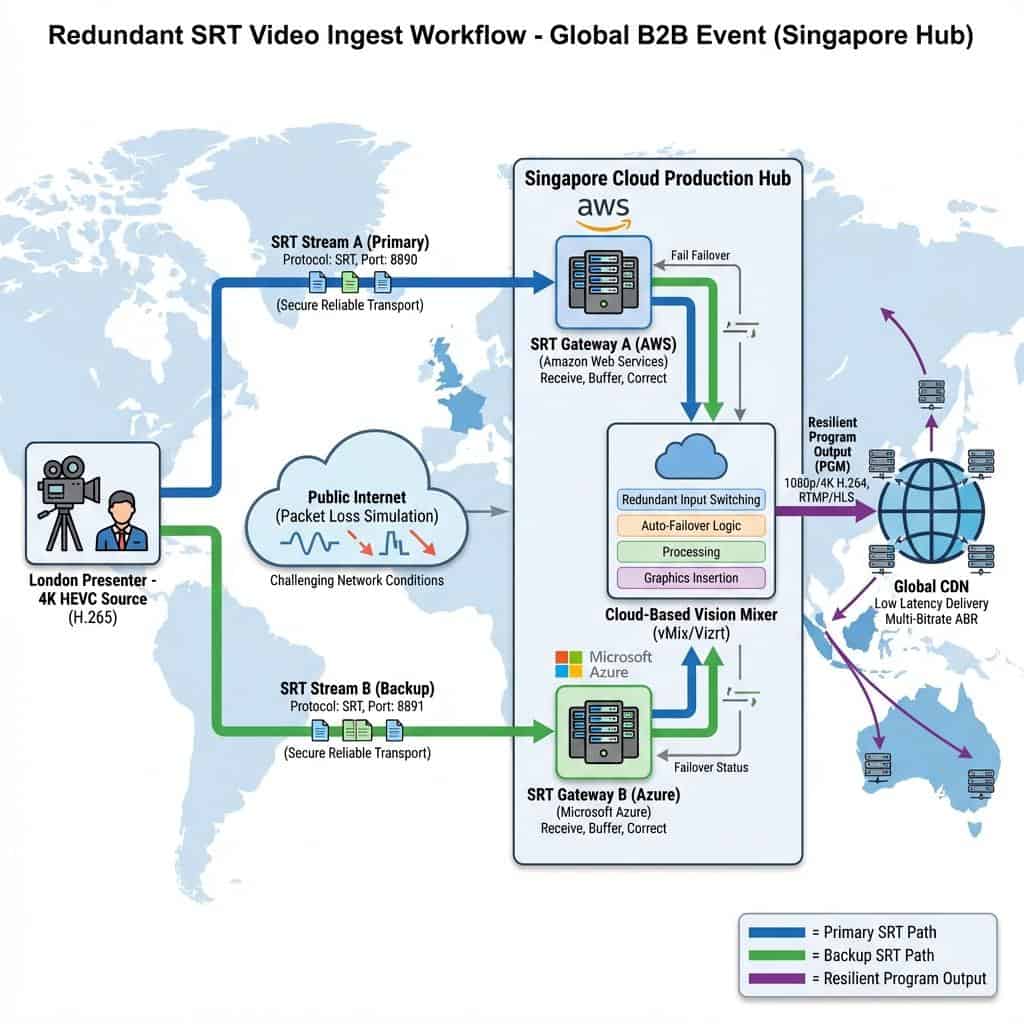
Singapore is a primary landing point for over 20 major subsea cable systems, including the Asia-America Gateway (AAG), SEA-ME-WE (South-East Asia – Middle East – Western Europe) 3, 4, and 5, and the Australia-Singapore Cable (ASC). This dense mesh of connectivity provides multiple, physically separate fiber paths to key financial and business hubs across the globe. For a B2B live production, this has tangible benefits. For instance, ingesting a primary video feed from a presenter in London can be routed via the SEA-ME-WE 5 system, while a backup feed could be provisioned over a different system. This path diversity, managed at the network layer, ensures that a fault on one cable does not interrupt the signal flow. Furthermore, this architecture results in significantly lower round-trip times (RTT). A typical RTT from Singapore to London is approximately 150-160ms, and to Tokyo, it is around 65-75ms. This low latency is critical for interactive hybrid events, enabling near real-time talkback communication between the production team in Singapore and remote presenters worldwide.
Data Center Infrastructure and Peering Fabric
This subsea connectivity terminates within Singapore’s ecosystem of high-availability data centers. Facilities from providers like Equinix, Global Switch, and Digital Realty are predominantly certified as Tier III or Tier IV. A Tier III data center guarantees 99.982% availability (N+1 redundancy), while Tier IV offers 99.995% availability (2N+1 fully redundant infrastructure). This means all power, cooling, and network components have backups, protecting production hardware from local facility failures. Inside these data centers lies the Singapore Internet Exchange (SGIX) and private peering points like the Equinix Internet Exchange. These exchanges facilitate direct, low-latency interconnection between hundreds of Internet Service Providers (ISPs), Content Delivery Networks (CDNs), and major cloud providers such as Amazon Web Services (AWS), Google Cloud Platform (GCP), and Microsoft Azure. For streaming workflows, this dense peering fabric is crucial. It allows an encoded video stream to be handed off directly from an enterprise network to a cloud provider or CDN with minimal network hops, bypassing potential congestion points on the public internet and preserving signal integrity.
Architecting Resilient Streaming Workflows for Global Ingest and Distribution
Leveraging Singapore’s infrastructure requires a deliberate approach to workflow design, focusing on protocol selection, ingest redundancy, and signal processing. The goal is to build a system that anticipates and gracefully handles potential points of failure between the source and the production hub.
Protocol Selection: SRT vs. RTMP for Global Contribution
The choice of transport protocol for ingesting video feeds from remote locations is one of the most critical decisions in the entire workflow. While the Real-Time Messaging Protocol (RTMP) was a long-standing industry standard, it is poorly suited for transport over long-haul, unpredictable networks due to its reliance on the Transmission Control Protocol (TCP). TCP’s method of acknowledging data packets in sequence can lead to severe latency and frame drops when packet loss occurs. The modern, superior alternative is Secure Reliable Transport (SRT). SRT is a UDP-based protocol that incorporates an Automatic Repeat reQuest (ARQ) mechanism. When the receiving end detects a missing packet, it requests only that specific packet to be re-transmitted, without halting the entire stream. This allows for reliable delivery over networks with packet loss percentages of 10% or more, a common scenario on transcontinental internet paths. For a typical 4K UHD (3840×2160) contribution at 50/59.94 fps, an H.265 (HEVC) encoded stream at 20-30 Mbps transported via SRT provides a broadcast-quality signal with manageable latency, often configurable from 120ms to a few seconds to build a protective buffer against network jitter.
Redundant Ingest Architecture: Cloud and On-Premise Models
To achieve maximum resilience, we design workflows with fully redundant ingest paths. A common implementation involves a remote presenter or production site sending two identical, synchronized SRT streams to two geographically and logically separate endpoints. For example, Stream A could be sent to an AWS instance in the ap-southeast-1 (Singapore) region, while Stream B is sent to a Microsoft Azure instance in the same region. A cloud-based production platform, such as vMix or Vizrt Vectar, running on a high-availability compute instance, can then be configured with both streams as sources. If Stream A experiences packet loss or a total failure, the production switcher can seamlessly cut to Stream B with no disruption to the program feed. This leverages Singapore’s low-latency connections to multiple cloud providers. Alternatively, for on-premise productions, the two SRT streams can be terminated on separate hardware decoders (e.g., from Haivision or AJA) connected to different network switches within the production facility, feeding into a physical baseband video switcher.
Hybrid Event Production: Integrating On-Premise Operations with Global Reach
For hybrid events, the challenge is to seamlessly merge a physical, in-person event in Singapore with a global virtual audience and remote contributors. This requires a robust on-premise production core and a sophisticated bridge between the baseband video world and the IP-based streaming world.
The On-Premise Production Core and Signal Flow
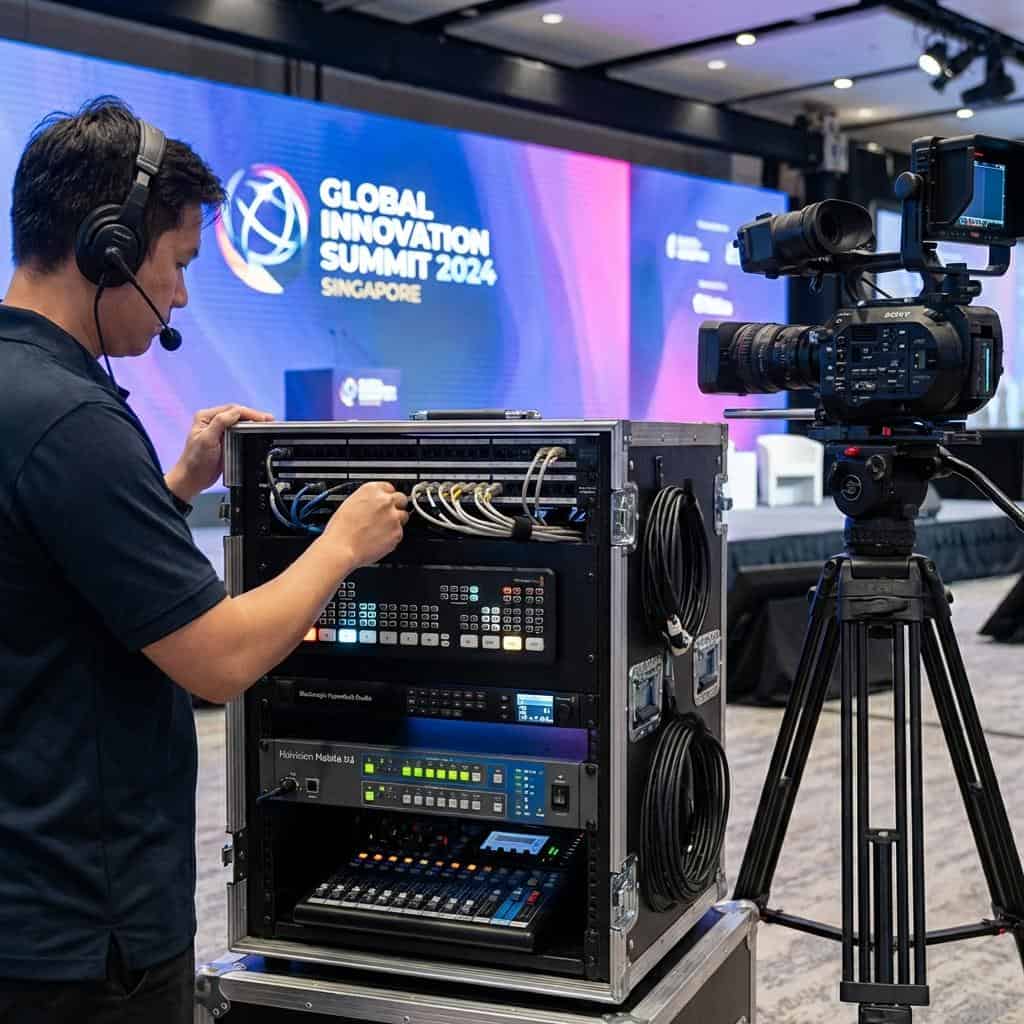
A professional production at a Singaporean venue is built on a foundation of baseband video, typically using the Serial Digital Interface (SDI) standard. For 4K UHD production, 12G-SDI is used to carry an uncompressed 2160p60 video signal over a single coaxial cable. Multi-camera setups, using broadcast cameras like the Sony FX9 or Panasonic Varicam, are synchronized using a master clock signal (genlock) to ensure frame-accurate switching on a production switcher, such as a Ross Carbonite or Blackmagic ATEM Constellation. The audio signal flow is managed separately, with microphones feeding into a digital audio console (e.g., a Yamaha QL series) where the mix is created. The final audio mix is then embedded into the SDI program feed from the video switcher. This entire on-premise system is a self-contained, high-reliability environment.
Bridging Baseband and IP: NDI and Encoding for Distribution
The bridge from the on-premise SDI world to the global IP audience is a critical conversion stage. Within the venue, Network Device Interface (NDI) can be used to transport high-quality, low-latency video over a standard 1 Gigabit Ethernet network. This simplifies cabling for elements like graphics feeds from a presentation laptop or robotic camera control. The final program (PGM) feed from the master switcher, which is a 12G-SDI signal, is then routed into a professional hardware encoder. This device, such as a Haivision Makito X4 or an AWS Elemental Live encoder, performs the crucial task of compressing the video. It uses the H.265 (HEVC) codec to reduce the massive bandwidth of the uncompressed signal (approx. 12 Gbps) to a manageable streaming bitrate (e.g., 15-20 Mbps for 4K) while preserving visual quality. This compressed feed is then packaged into the SRT protocol for its resilient journey to the cloud distribution network.
Integration with Enterprise Platforms for Internal Audiences
A key requirement for MNCs is reaching their internal audience securely. The production workflow must integrate with platforms like Microsoft Teams, Zoom Video Webinars, and Webex Events. The encoded PGM feed, once sent to a cloud media service like Wowza Streaming Cloud or AWS MediaLive, can be repackaged into RTMP or other required formats. For Microsoft Teams Live Events, this RTMP feed can be configured as the event source. For platforms like Zoom, the PGM feed can be brought in via professional hardware interfaces that present the SDI source as a virtual webcam, allowing the high-production-value output to be used directly within a webinar. This ensures that employees viewing on internal platforms receive the same high-quality, professionally switched program as the external audience.
Conclusion: Engineering Certainty in Global Corporate Communications
Singapore’s strategic advantage as a global hub for B2B event streaming is not a matter of chance; it is the direct result of a meticulously engineered and maintained digital infrastructure. The density of its subsea cable networks provides the foundational layer of resilient global connectivity. Its world-class data centers offer the secure and reliable environment needed to house critical production systems. Finally, its rich peering fabric ensures low-latency, high-performance data transfer between networks. For corporate event planners, IT directors, and production managers, leveraging this infrastructure is key to de-risking global communication events. By building workflows that utilize resilient protocols like SRT, architecting for ingest redundancy, and integrating professional on-premise production with sophisticated IP distribution methods, MNCs can execute flawless, high-impact virtual and hybrid events from Singapore. Success in this domain relies on a deep understanding of these technical components and a partnership with production teams who possess the engineering expertise to translate infrastructure capabilities into operational certainty.