
In today’s dynamically shifting enterprise landscape, where remote and hybrid work models are the norm, fostering strong internal branding and employee loyalty presents significant technical challenges. For corporate event planners, AV professionals, and IT directors, the strategic deployment of live video communications is no longer a luxury but a critical component of enterprise internal branding initiatives. This necessitates a deep understanding of professional B2B event streaming solutions, hybrid event production methodologies, and robust enterprise streaming infrastructure. Unlike consumer-grade streaming, internal corporate live video demands uncompromising quality of service (QoS), stringent security protocols, minimal latency, and seamless integration into existing IT ecosystems. Live Streaming Studio specializes in providing the advanced technical expertise required to architect, deploy, and manage these sophisticated systems, transforming internal communications into engaging, high-fidelity broadcast experiences that resonate with a geographically dispersed workforce. This article will meticulously explore the technical underpinnings, production workflows, and infrastructure considerations essential for leveraging live video to cultivate loyalty and reinforce internal branding within remote teams, ensuring every transmission upholds enterprise-grade standards and delivers measurable impact.
Architectural Foundations of Enterprise Internal Live Video
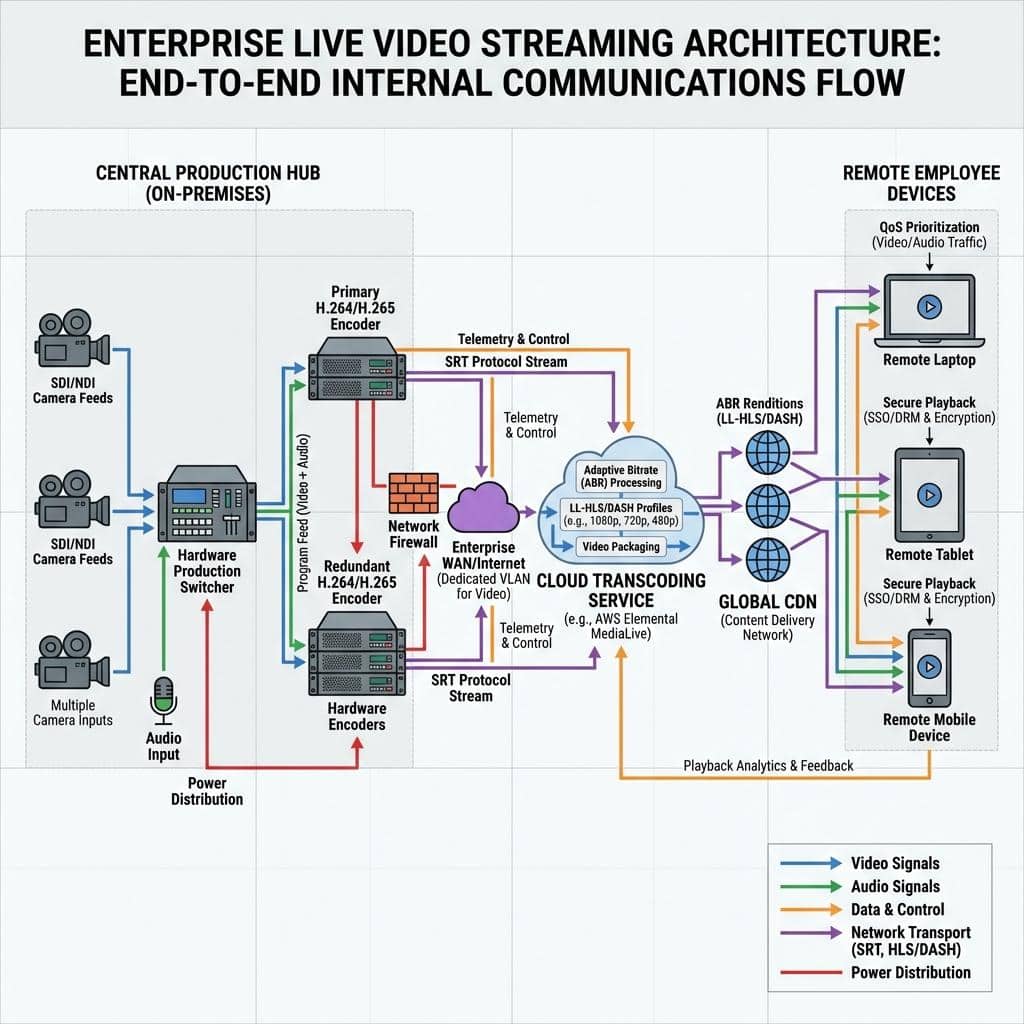
The successful implementation of live video for internal branding hinges upon a meticulously engineered streaming architecture. This architecture must not only guarantee exceptional video and audio fidelity but also ensure secure, scalable, and reliable delivery across diverse network conditions. Enterprise-level internal branding events, from CEO town halls to department-specific training sessions, require infrastructure capable of handling high concurrent viewer counts without degradation in experience.
Core Streaming Protocols and Codecs for Internal Distribution
The choice of streaming protocols and video codecs is paramount for enterprise internal communications. For robust and high-quality contribution feeds, the Secure Reliable Transport (SRT) protocol, an open-source video transport technology, is highly favored. SRT mitigates packet loss, jitter, and latency across unpredictable networks by implementing advanced retransmission techniques, making it ideal for point-to-point contribution from remote locations to a central production hub. For broader distribution, Real-Time Messaging Protocol (RTMP) and its secure variant, RTMPS, remain workhorses for ingest into content delivery networks (CDNs) or enterprise video platforms, despite their higher latency compared to newer protocols. For web-based playback, adaptive bitrate (ABR) streaming protocols like HLS (HTTP Live Streaming) and MPEG-DASH are indispensable, allowing client devices to dynamically switch between multiple video renditions encoded at different bitrates and resolutions.
Video encoding predominantly utilizes H.264 (AVC – Advanced Video Coding) for broad compatibility and H.265 (HEVC – High Efficiency Video Coding) for superior compression efficiency, particularly crucial for delivering 4K/UHD content over constrained networks. Audio encoding commonly employs AAC (Advanced Audio Coding) for its balance of quality and compression. Bitrate management, often ranging from 2 Mbps for standard definition up to 20 Mbps or higher for 1080p60 or 4K/UHD, must be meticulously planned to match available bandwidth and target quality.
Network Infrastructure for Reliable Internal Feeds
Enterprise network infrastructure must be optimized for live video traffic. Quality of Service (QoS) policies are essential to prioritize video packets, minimizing latency and packet loss. This often involves configuring network switches and routers with specific DSCP (Differentiated Services Code Point) values for video streams. Dedicated network segments or Virtual Local Area Networks (VLANs) for live video traffic can further isolate and protect critical streams from other network congestion. For organizations with geographically dispersed teams, integration with a global Content Delivery Network (CDN) is vital. A CDN caches and delivers content from edge servers closer to the end-users, drastically reducing latency and improving scalability by offloading traffic from the origin server. Bandwidth requirements for a typical 1080p30 internal broadcast can range from 3-8 Mbps per stream, with aggregate network capacity needing to scale linearly with the number of concurrent streams and locations. Redundancy in network paths, including diverse internet service provider (ISP) connections and redundant internal routing, is non-negotiable for mission-critical internal events.
On-Premise vs. Cloud-Based Encoding and Transcoding Architectures
The choice between on-premise, cloud-based, or hybrid encoding and transcoding architectures impacts capital expenditure, operational flexibility, and scalability. On-premise hardware encoders, such as those from Haivision, Elemental (AWS), or AJA, offer dedicated processing power and minimal latency, ideal for localized production hubs. These often accept SDI or HDMI 2.1 inputs and output RTMP or SRT streams. Cloud-based transcoding services, like AWS Elemental MediaLive, Google Cloud Media CDN, or Azure Media Services, provide unparalleled scalability and geographic reach, capable of generating multiple ABR renditions concurrently without the need for significant upfront hardware investment. A hybrid approach, utilizing on-premise encoders for primary ingest and contribution coupled with cloud services for global distribution and on-demand archiving, often presents the optimal balance for complex enterprise environments. Careful consideration of egress costs, processing fees, and API integration capabilities is crucial in selecting the appropriate model.
Professional Production Workflows for Engaging Internal Content
Beyond robust infrastructure, the actual production workflow dictates the quality and impact of internal live video. Professional production standards, typically associated with broadcast television, are increasingly critical for fostering loyalty and engagement in enterprise settings. This involves meticulous planning, advanced equipment, and skilled technical execution.
Multi-Camera Acquisition and Switching Systems
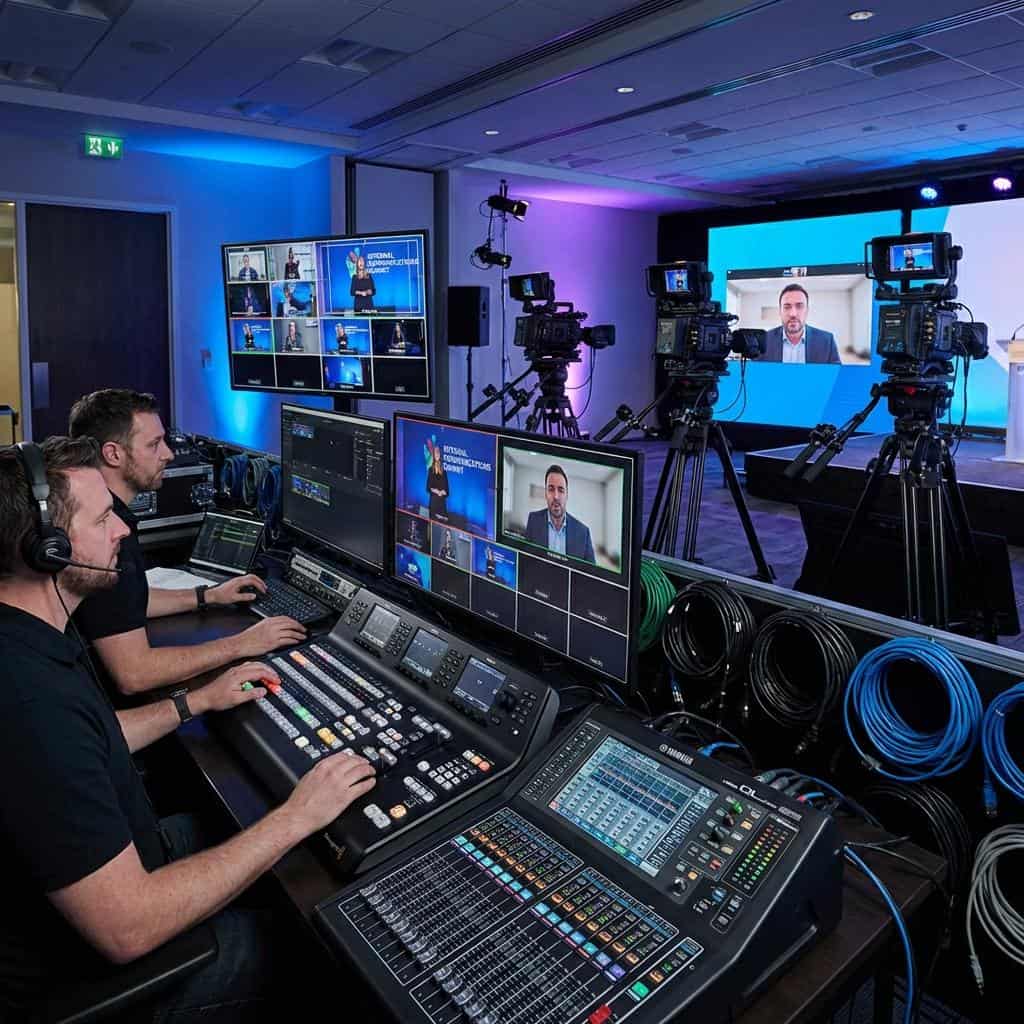
High-quality internal branding events often demand a multi-camera production setup to provide dynamic visual storytelling. Professional cameras, such as those supporting SDI (Serial Digital Interface) for long cable runs and broadcast-grade reliability, or increasingly, NDI (Network Device Interface) for IP-based video workflows, are essential. NDI|HX, a lower-bandwidth variant, is particularly useful for enterprise networks. Production switchers, whether hardware-based units like Ross Carbonite series, Grass Valley Kayenne, or Blackmagic Design ATEM Constellation, or software-defined video switchers (SDVS) running on high-performance compute platforms, are the central nervous system. These systems manage multiple video inputs, facilitate transitions, keying, and layer graphics. Multiview monitoring, displaying multiple camera feeds, program out, and auxiliary outputs on a single display, is critical for real-time operational control. The signal flow typically involves cameras feeding into the switcher, with program and preview feeds routed to encoders and confidence monitors.
Advanced Audio Engineering for Clarity and Impact
Crystal-clear audio is non-negotiable for effective internal communication. Professional audio engineering for live events includes utilizing digital audio mixers with ample input/output channels, often supporting Dante or AES67 for Audio over IP. Microphone selection is critical, ranging from lavalier microphones for presenters to shotgun microphones for panel discussions, all routed through an appropriate mixer for gain staging, equalization, compression, and noise gating. Talkback systems, often utilizing professional intercom solutions like those from Clear-Com or Riedel, are vital for seamless communication between the director, camera operators, and technical staff, ensuring a coordinated production. Environmental acoustic considerations, even for remote presenters, significantly impact perceived audio quality; recommending specific microphone techniques and room treatment is part of the comprehensive solution. The final program audio feed must be meticulously mixed and embedded with the video stream to ensure synchronous delivery.
Graphics Integration and Visual Storytelling
Visually engaging graphics elevate internal live video from a mere presentation to a professional broadcast. Lower thirds, full-screen graphics, animated intros/outros, and virtual sets enhance branding and convey information effectively. Character generators (CGs) like Ross Xpression, Chyron PRIME, or even integrated graphics engines within production switchers are used to create and display these elements. Keying technologies, including chroma keying (green/blue screen) for virtual backgrounds, allow presenters to appear within branded digital environments, fostering a consistent corporate aesthetic. Integrating these graphic elements seamlessly into the live program feed requires precise timing and coordination, often managed by a dedicated graphics operator. This visual consistency reinforces the internal brand message and enhances viewer engagement, reducing “Zoom fatigue” by offering a more polished viewing experience.
Delivering Interactivity and Scalability in Hybrid Internal Events
The rise of hybrid work necessitates hybrid event solutions that seamlessly integrate in-person and remote audiences, fostering a unified experience. This requires platforms, redundancy, and robust security measures tailored for enterprise demands.
Platform Integration for Seamless Hybrid Experiences
For internal hybrid events, integration with existing enterprise communication platforms is paramount. Solutions like Microsoft Teams Live Events, Zoom Webinars, and Webex Events offer varying degrees of functionality for large-scale internal broadcasts. However, for fully customized branding and deeper analytics, white-label streaming portals with embedded video players are often preferred. These portals can integrate with Single Sign-On (SSO) systems, providing secure, authenticated access for employees. The backend infrastructure must support simultaneous ingest to multiple platforms or a central transcoding engine that then distributes to various endpoints. Interactivity features, such as live Q&A modules, polling, and moderated chat functionalities, are essential for engaging remote participants and making them feel part of the live event. The technical architecture must ensure that interactive data flows seamlessly between the presentation layer, the moderation tools, and the broadcast control room.
Ensuring Redundancy and Failover Strategies
Mission-critical internal events demand comprehensive redundancy and failover strategies to prevent interruptions. This includes:
- Encoder Redundancy: Deploying primary and secondary (or N+1) hardware or software encoders, configured for automatic failover. This often involves identical encoder setups feeding into redundant ingests on a CDN or streaming platform.
- Network Path Diversity: Utilizing multiple diverse internet connections from different ISPs at the production location. Technologies like link aggregation or SD-WAN can bond these connections or intelligently route traffic.
- Dual CDN Ingest: Simultaneously ingesting the live stream into two separate CDNs or different ingest points within the same CDN for maximum distribution resilience.
- Power Redundancy: Uninterruptible Power Supplies (UPS) and, for critical hubs, generator backup, to safeguard against power outages.
- ISO Recording: Independent ISO (isolated) recordings of each camera feed and the program feed, locally on high-capacity SSDs or network-attached storage (NAS), provide a clean backup for post-event editing or disaster recovery. This ensures no content is lost even if the live stream fails.
These layers of redundancy are vital for maintaining trustworthiness and professional integrity, particularly when communicating critical internal messages.
Data Security and Compliance for Sensitive Internal Communications
The sensitivity of internal corporate communications mandates stringent data security and compliance measures. End-to-end encryption (E2EE) for video streams, often implemented via RTMPS, SRT with AES encryption, or secure WebRTC, protects content in transit. Robust access control mechanisms, including SAML-based SSO integration and token-based authentication, ensure only authorized employees can view the content. Digital Rights Management (DRM) can be applied for highly sensitive content to prevent unauthorized downloads or distribution. Furthermore, compliance with regional data privacy regulations such as GDPR (General Data Protection Regulation) and CCPA (California Consumer Privacy Act) is essential, particularly concerning viewer data and analytics. Enterprise streaming platforms must offer comprehensive auditing capabilities and data retention policies that align with corporate governance requirements.
Optimizing for Global Remote Teams: Latency, Localization, and Accessibility
Serving a global remote workforce introduces specific technical challenges related to delivery latency, content localization, and universal accessibility. Addressing these aspects professionally reinforces a truly inclusive internal brand.
Low-Latency Streaming Architectures
Minimizing end-to-end latency is crucial for maintaining viewer engagement and facilitating real-time interactivity, especially for Q&A sessions. While traditional HLS can introduce latencies of 10-30 seconds, newer solutions like Low-Latency HLS (LL-HLS) and Low-Latency DASH (LL-DASH) reduce this to 2-5 seconds. WebRTC-based streaming can achieve sub-second latency, ideal for highly interactive scenarios, though it often requires more dedicated infrastructure. Adaptive Bitrate (ABR) streaming profiles are configured to serve varying network conditions, dynamically adjusting video quality to prevent buffering, which significantly impacts viewer experience. Edge caching at CDN points of presence further reduces the physical distance data must travel, thereby cutting latency for geographically dispersed audiences. The optimization of encoder settings, network routing, and player buffer configurations all contribute to achieving the desired low-latency target.
Multi-Language Audio Tracks and Closed Captioning
For diverse global teams, providing content in multiple languages is key to inclusivity and brand loyalty. This can be achieved by incorporating multiple audio tracks into the video stream, allowing viewers to select their preferred language. Live interpretation services can feed these alternate audio channels into the production mixer for embedding. Similarly, closed captioning and subtitles are vital. Real-time captioning services, often powered by AI with human oversight for accuracy, can generate captions live. These are typically delivered via WebVTT (Web Video Text Tracks) files alongside the video stream. For pre-recorded segments within a live broadcast, pre-generated VTT files can be integrated. Ensuring proper synchronization between video, audio, and captions is a critical technical detail.
Accessibility Standards Compliance
Compliance with accessibility standards, such as WCAG (Web Content Accessibility Guidelines) 2.1, is not just a regulatory requirement but a commitment to an inclusive internal brand. This extends beyond captioning to include keyboard navigation for video players, comprehensive metadata for screen readers, and potentially audio descriptions for visually impaired employees. Video players embedded in white-label portals must be designed with accessibility in mind, supporting ARIA (Accessible Rich Internet Applications) attributes and clear UI elements. Providing content transcripts post-event further enhances accessibility and offers a searchable resource for employees. Prioritizing these technical aspects demonstrates a holistic approach to internal communications, strengthening employee loyalty and engagement across the entire organization.
Conclusion
The strategic deployment of professional live video for internal branding in remote and hybrid environments is a complex technical undertaking that demands a sophisticated understanding of broadcast engineering, network infrastructure, and enterprise-grade streaming solutions. From meticulously architecting robust streaming protocols and optimizing network QoS to executing multi-camera productions with pristine audio and incorporating advanced graphic overlays, every technical decision directly impacts employee engagement and loyalty. The imperative for scalability, stringent security, comprehensive redundancy, and universal accessibility for global teams further elevates the technical requirements. Live Streaming Studio offers the deep technical expertise and proven methodologies to navigate these complexities, partnering with corporate event planners, AV professionals, and IT directors to design and implement bespoke live video ecosystems that effectively reinforce internal branding and cultivate a highly connected, loyal workforce. By embracing these advanced technical frameworks, organizations can transform internal communications into a powerful strategic asset, driving engagement and fostering a strong corporate culture, irrespective of geographical distribution.

Michael Koh is a production specialist and entrepreneur who founded Spring Forest Studio in 2017 to provide event and virtual production solutions in Singapore. He specialises in hybrid live streaming, XR (Extended Reality) virtual production, and studio systems integration, transitioning the business from traditional videography to advanced corporate broadcasting. Operating out of a dedicated facility at NordCom2 in Singapore, he leads a technical crew to deliver multi-camera webcasts, digital sets, and technical consultations for large-scale corporate events.