
In the contemporary financial landscape, investor relations (IR) transcends traditional quarterly reports and static press releases. The advent of Investor Relations 2.0 mandates dynamic, transparent, and technically robust communication strategies, with professional live streaming emerging as a pivotal technology. For corporate event planners, AV professionals, production managers, and IT directors, understanding the intricate technical underpinnings of enterprise-grade streaming is no longer optional; it is a strategic imperative directly influencing shareholder perception and, by extension, share price. This article delves into the advanced technical requirements, production workflows, and infrastructure considerations essential for delivering flawless B2B live and hybrid IR events that build investor confidence and reinforce corporate value.
The Technical Architecture of High-Stakes IR Streaming
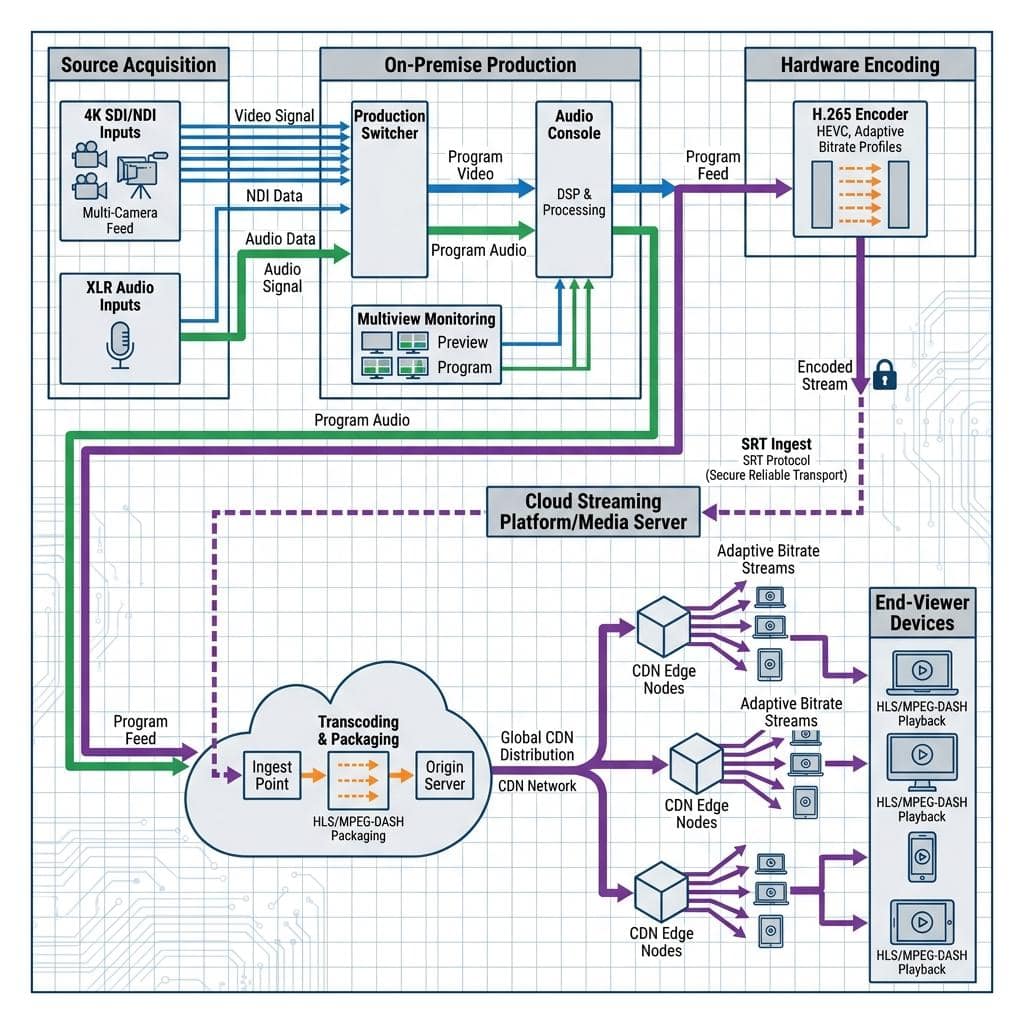
Delivering a high-fidelity investor relations broadcast requires a meticulously engineered technical architecture, starting from source acquisition and extending through pre-processing. At the core of any professional IR stream is a multi-camera production setup, often leveraging 4K/UHD (Ultra High Definition) acquisition for superior visual fidelity, captured via serial digital interface (SDI) for robust, long-distance signal transmission or via Network Device Interface (NDI) for IP-based workflows. SDI signals, typically SMPTE 292M (HD-SDI), SMPTE 424M (3G-SDI), or SMPTE 2082 (12G-SDI for 4K), offer uncompressed or minimally compressed video over coaxial cable, ensuring signal integrity in mission-critical environments. NDI|HX (High Efficiency) provides a low-bandwidth, IP-based alternative, suitable for distributed production environments where cabling infrastructure might be limited.
Audio, equally critical, must adhere to broadcast-grade standards. This involves professional condenser microphones, dedicated audio mixing consoles (e.g., Yamaha Rivage PM series or Behringer X32), and precise signal routing to ensure crystal-clear speech and ambient sound capture. Audio signals are typically ingested via XLR connections, processed through digital signal processors (DSPs) for equalization, compression, and noise gating, before being embedded into the video stream using AES3 digital audio or analog-to-digital converters for SDI workflows. Talkback systems, often utilizing Clear-Com or RTS intercom solutions, are indispensable for seamless communication between camera operators, audio engineers, and the technical director within the production control room.
The program feed, comprising switched video and mixed audio, is then routed to professional hardware encoders. These devices, such as those from Elemental Technologies (AWS Elemental Live) or Haivision Makito X series, are specifically designed for H.264 (AVC) or H.265 (HEVC) encoding. H.265 offers superior compression efficiency, delivering comparable quality at significantly lower bitrates compared to H.264, crucial for optimizing bandwidth consumption without compromising visual quality. Encoding parameters, including resolution (e.g., 1080p at 50/60fps or 4K at 30/60fps), bitrate ladders (adaptive bitrate sets for various client network conditions), and GOP (Group of Pictures) structure, are meticulously configured to ensure optimal delivery across diverse viewing platforms. Latency optimization, aiming for sub-second glass-to-glass delay, is paramount for real-time interactivity during Q&A sessions, often achieved through fine-tuning encoder settings and leveraging low-latency streaming protocols.
Ensuring Global Reach and Resilient Delivery for Enterprise IR Events
Once the video and audio streams are encoded, their secure and reliable transport to a global audience becomes the next technical hurdle. Professional IR streaming heavily relies on robust streaming protocols and a resilient content delivery infrastructure. The Secure Reliable Transport (SRT) protocol, an open-source contribution by Haivision, is frequently employed for high-quality, low-latency video ingest from the production site to a cloud-based streaming platform or media server. SRT addresses common internet network issues such as packet loss, jitter, and fluctuating bandwidth through error recovery mechanisms and intelligent retransmission, ensuring pristine video delivery even over unpredictable public internet connections.
For distribution to end-viewers, Real-Time Messaging Protocol (RTMP) and its secure variant, RTMPS, remain workhorses for pushing streams to Content Delivery Networks (CDNs). However, for delivery to modern HTML5-based web players, HTTP-based adaptive bitrate (ABR) protocols such as HLS (HTTP Live Streaming) and MPEG-DASH are preferred. These protocols segment the encoded video into small chunks and deliver them over standard HTTP, allowing client devices to dynamically switch between different bitrate renditions based on available bandwidth, thereby optimizing the Quality of Experience (QoE) for each viewer. Enterprise-grade CDNs, like Akamai, Limelight Networks, or Cloudflare, possess globally distributed edge servers, minimizing latency and maximizing throughput for audiences dispersed across different geographies. These CDNs are critical for ensuring scalability to accommodate thousands or even hundreds of thousands of concurrent viewers without degradation in service.
Network infrastructure requirements at the event venue are stringent. Dedicated, symmetric internet circuits with guaranteed bandwidth are essential, often exceeding 1 Gbps for 4K productions with multiple adaptive bitrate renditions. Redundant internet paths from diverse Internet Service Providers (ISPs), coupled with automatic failover mechanisms such as BGP (Border Gateway Protocol) routing or SD-WAN (Software-Defined Wide Area Network) solutions, are non-negotiable for business continuity. Quality of Service (QoS) configurations on network switches and routers prioritize streaming traffic, preventing congestion-related drops or latency spikes. Furthermore, on-premise streaming solutions for internal stakeholders or highly sensitive content may involve dedicated media servers (e.g., Wowza Streaming Engine, Adobe Media Server) running within a corporate data center, integrated with enterprise firewalls and network security protocols, including Virtual Private Networks (VPNs) and Transport Layer Security (TLS) encryption for all data in transit.
Hybrid Event Integration and Interactive Shareholder Engagement
The evolution of investor relations demands not only robust technical delivery but also seamless integration of physical and virtual audiences in hybrid event formats. Professional streaming infrastructure facilitates interactive engagement, transforming passive viewing into active participation. For hybrid IR events, the integration with established enterprise communication platforms such as Microsoft Teams Live Events, Zoom Webinars, or Cisco Webex Events is crucial. This typically involves feeding the high-quality program output from the hardware encoder into the chosen platform as a virtual camera or using a Real-Time Messaging Protocol (RTMP) stream key for direct ingest, bypassing the need for less-reliable software-based screen sharing solutions. This ensures that remote participants receive the same broadcast-quality video and audio as the physical audience.
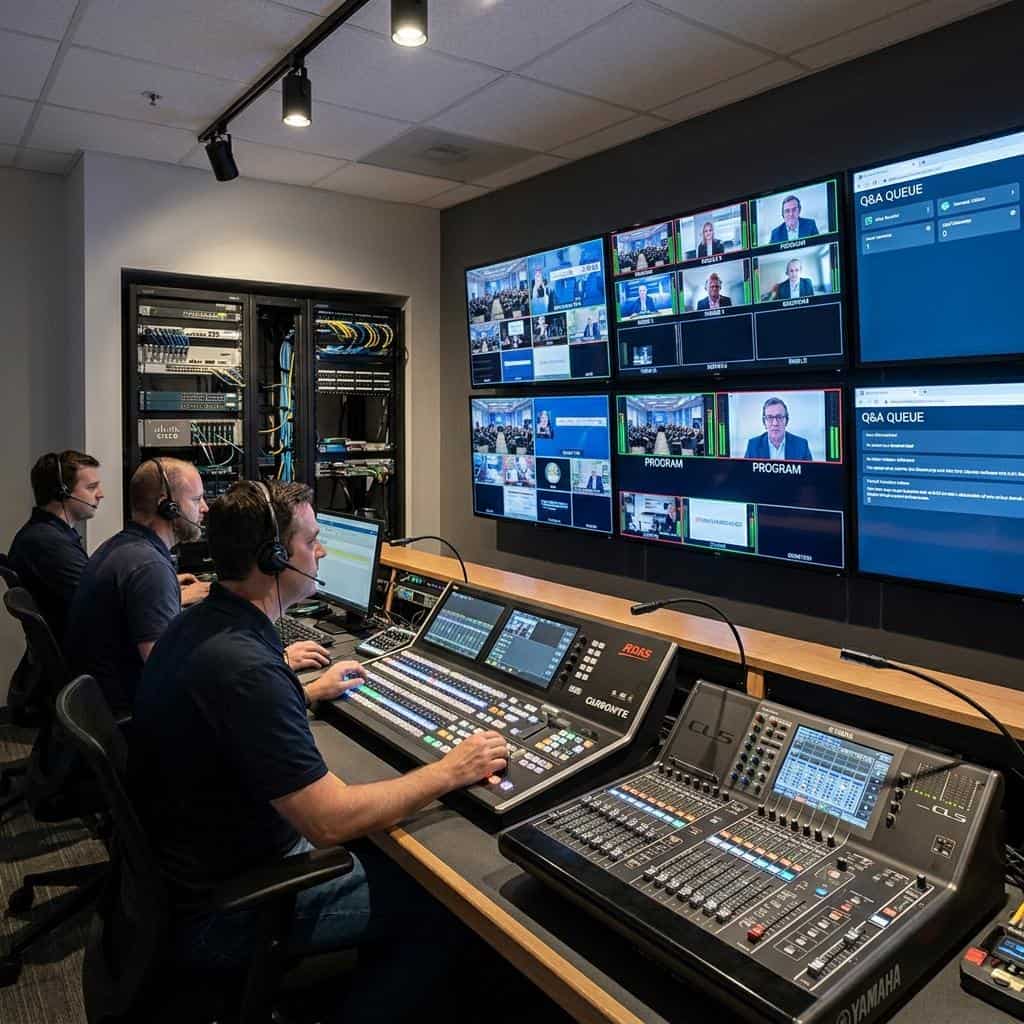
Interactive features, vital for shareholder engagement, include real-time moderated Q&A sessions. These often require dedicated software platforms that aggregate questions from virtual attendees, allowing a moderator to curate and present them to the presenters in real-time. Integrating these platforms with the production workflow means displaying selected questions on confidence monitors for presenters and on multiview monitors for the production team. Live polling features, where shareholders can cast votes on specific resolutions or provide feedback, further enhance participation. Secure authentication mechanisms, often single sign-on (SSO) integration with corporate identity management systems like Okta or Azure Active Directory, are paramount to ensure that only verified shareholders or invited guests can access sensitive IR content. Data analytics post-event, derived from viewer engagement metrics (e.g., peak viewership, average watch time, Q&A participation rates), provide invaluable insights into content effectiveness and audience reach, informing future IR strategies.
For complex hybrid events, the production setup often includes dedicated control surfaces for video switching (e.g., Blackmagic ATEM Constellation, Ross Carbonite Ultra), audio mixing, and graphics insertion (e.g., ChyronHego, Vizrt). Multiview monitoring, displaying all camera feeds, program out, preview, and graphic overlays on a single or multiple displays, allows the technical director to make real-time decisions. ISO recording, capturing each camera feed individually at high resolution, is standard practice for post-event editing and archiving, ensuring that even if a live feed encounters an issue, pristine source material is available for on-demand content. The routing architecture for audio and video signals is often managed by a central matrix router, providing flexibility and redundancy, with Dante or AES67 protocols for networked audio distribution and NDI or SDI for video.
The Tangible Impact: Quality of Experience (QoE) and Brand Perception
The direct correlation between the Quality of Experience (QoE) in professional streaming and its impact on corporate brand perception and ultimately share price cannot be overstated. A flawlessly executed, technically sophisticated investor relations broadcast signals competence, transparency, and a modern approach to corporate governance. Conversely, technical glitches such as buffering, pixelation, audio dropouts, or high latency during a critical announcement can erode investor confidence, casting doubt on the company’s operational efficiency and technological acumen. In a market where perception often translates to valuation, these technical failures are not merely inconveniences; they are liabilities.
Investing in enterprise-grade streaming infrastructure and partnering with expert production teams ensures not just technical reliability but also an elevated brand image. High-definition video with pristine audio, delivered consistently across diverse devices and network conditions, conveys professionalism. Low-latency, interactive Q&A sessions foster a sense of real-time engagement and transparency, allowing executives to directly address shareholder concerns without technical impediments. This reinforces trust and accountability, attributes highly valued by institutional and individual investors alike. The meticulous attention to detail in live event production, from camera framing and lighting to graphic overlays and seamless transitions, reflects positively on the company’s overall attention to detail and commitment to excellence.
Furthermore, the ability to securely host sensitive IR content, control access, and provide comprehensive analytics on viewership demonstrates a sophisticated approach to data management and shareholder communication. This technical proficiency, when consistently applied, contributes to a perception of stability and forward-thinking leadership. For corporate decision-makers, this translates into a tangible return on investment: enhanced shareholder loyalty, a more attractive public image, and a strengthened position in competitive markets, all of which are factors that can positively influence share price and market valuation. The adherence to industry standards, such as those from SMPTE (Society of Motion Picture and Television Engineers) and ISO (International Organization for Standardization) for video and audio codecs, further underpins the reliability and interoperability of the chosen solutions.
Conclusion
Investor Relations 2.0 is fundamentally a technical challenge disguised as a communication strategy. The impact of professional streaming on share price is not indirect; it is a direct consequence of establishing and maintaining investor trust through transparent, high-quality, and accessible communication. From multi-camera 4K/UHD acquisition and broadcast-grade audio mixing to the implementation of robust SRT and HLS/DASH streaming protocols over globally distributed CDNs, every technical choice directly influences the Quality of Experience and, by extension, corporate perception. Enterprise clients must recognize that investing in advanced hybrid event production technology, resilient network infrastructure, and experienced technical teams is not merely an operational cost but a strategic investment in their brand’s equity. Embracing these advanced B2B streaming solutions is essential for fostering a new era of investor engagement that truly moves the needle on market valuation and shareholder confidence.

Michael Koh is a production specialist and entrepreneur who founded Spring Forest Studio in 2017 to provide event and virtual production solutions in Singapore. He specialises in hybrid live streaming, XR (Extended Reality) virtual production, and studio systems integration, transitioning the business from traditional videography to advanced corporate broadcasting. Operating out of a dedicated facility at NordCom2 in Singapore, he leads a technical crew to deliver multi-camera webcasts, digital sets, and technical consultations for large-scale corporate events.