
Singaporean multinational corporations have set a demanding benchmark for hybrid event production because their business requirements combine board-level communications, investor relations, regional town halls, product launches, training, and partner enablement into one operational model. For enterprise streaming teams, this means hybrid excellence is not a cosmetic layer placed on top of a live event. It is an engineered system built from capture, switching, encoding, transport, monitoring, redundancy, and audience delivery, all aligned to corporate governance, security policy, and measurable service levels. In Singapore, where regional headquarters often coordinate audiences across Asia-Pacific, Europe, and North America, the technical challenge is to produce a consistent program feed for the room while maintaining stable remote delivery across variable network conditions and platform constraints.
Hybrid production for MNCs requires broadcast discipline with IT-grade reliability. A corporate event may involve a keynote in an auditorium, a breakout session in a boardroom, remote executives joining from Teams or Zoom, and internal stakeholders on a managed webcast platform. The production architecture must support SDI and HDMI 2.1 capture, IP-based routing, low-latency contribution, ISO recording, live graphics, multi-language audio, and synchronized monitoring. Every component has to be selected with an understanding of throughput, latency, signal integrity, failover, and interoperability. The Singapore market is especially exacting because event schedules are dense, venue access windows are narrow, and executive audiences expect uninterrupted delivery with polished audio, correct colorimetry, and frame-accurate switching.
Enterprise Hybrid Production in Singapore, Where Broadcast Standards Meet Corporate Governance
Hybrid excellence begins with operational design. For Singaporean MNCs, the production workflow is typically built around a clean program feed, multiple isolated camera feeds, redundant audio paths, and structured network transport. The objective is to present a stable, branded, and interactive experience to in-room and remote participants without exposing operational complexity to the audience. In practice, that means using a technical direction plan that defines camera counts, switching logic, graphics insertion, confidence monitoring, audio routing, backup paths, and escalation procedures.
Production design for boardrooms, ballrooms, and campuses
Corporate environments vary significantly. A boardroom webcast may require two PTZ cameras, a presentation capture feed, an audio DSP matrix, and a compact hardware encoder. A regional town hall in a ballroom may require four to six cameras, a vision mixer, lighting reinforcement, wireless microphones, presentation laptops, interpreter channels, and a simultaneous in-room display matrix. A campus-wide hybrid event may add remote presenters, redundant internet circuits, and interlinked rooms with distributed production control. The common requirement is deterministic signal flow. HDMI sources should be standardized to avoid handshake issues, with SDI used where cable runs exceed practical HDMI limits or where lockable connectors are preferred. Where networked video is used, NDI or NDI|HX should be deployed only within a managed LAN with adequate multicast, unicast, and QoS planning.
Professional hybrid events in Singapore often rely on a combination of baseband and IP workflows. SDI remains highly dependable for cameras, switchers, and converters because it is predictable and easy to troubleshoot under event pressure. NDI is useful for flexible routing, laptop capture, and rapid deployment in venues with robust switching infrastructure. SRT, Secure Reliable Transport, is a strong choice for contribution links when traffic traverses the public internet, because it adds packet loss recovery, encryption, and latency control. RTMP, or Real-Time Messaging Protocol, continues to be used for platform ingest in some delivery stacks, although RTMPS is preferred when supported because it protects transport with TLS. The right choice depends on the path, not the preference of the operator.
Signal flow discipline and fail-safe design
Every enterprise production should be documented as a complete signal chain. Cameras feed either SDI or HDMI into switchers or converters, the vision mixer outputs a program feed to the encoder, and a parallel ISO recording path captures isolated camera angles for post-event editing and compliance archiving. Audio should enter through a dedicated mixer or DSP, with microphones, playback devices, remote call audio, and ambient room microphones balanced before being embedded into the program feed. For executive events, a discrete mix-minus path is essential to prevent echo in remote participation workflows. Talkback systems allow directors, stage managers, and technicians to coordinate camera ops, presenters, and audio staff without contaminating the program audio.
Redundancy is not optional when executive communications are involved. A proper design includes redundant power supplies where available, UPS-backed racks, dual encoders, backup recording devices, and secondary internet failover through bonded cellular or a separate ISP circuit. If the venue permits, separate physical routes should be used for primary and backup network paths. For remote platform delivery, dual ingest endpoints can be configured so that an encoder failure does not terminate the event. In high-stakes sessions, the production team should maintain a hot spare camera, spare microphones, spare HDMI and SDI cabling, and pre-tested encoder presets aligned to the platform requirements.
Protocol Strategy for Reliable Transport, Low Latency, and Interoperability
Singaporean MNCs often host hybrid events with participants on enterprise collaboration platforms such as Microsoft Teams, Zoom, and Webex, while also requiring a branded event portal or internal webcast environment. This creates a transport challenge because each platform has its own latency profile, codec handling, and ingest expectations. The production engineer must align the encode profile, audio configuration, and keyframe interval to the destination environment while preserving the integrity of the in-room feed.
RTMP, RTMPS, and SRT in corporate event pipelines
RTMP remains a common ingest protocol for managed streaming platforms because it is simple and widely supported. In practice, a stable RTMP configuration typically uses H.264 video, AAC audio, and a bitrate sized to the target resolution and available headroom. For enterprise events, 1080p at 25 or 30 frames per second is a common baseline, with bitrates often ranging from 4 Mbps to 8 Mbps depending on motion, graphics density, and platform constraints. For higher fidelity or large display environments, 4K/UHD contribution may be appropriate, but it should be justified by production needs, bandwidth, and downstream compatibility.
SRT is increasingly important for contribution transport because it addresses real network variability better than older protocols. It can deliver encrypted, low-latency streams across unstable WAN links, which is valuable when a Singapore headquarters is feeding a regional production hub or a remote studio. In live event operations, SRT is especially useful for venue-to-control-room contribution, remote speaker capture, and backup ingest. Latency can be managed by tuning the receiver buffer, but the operator must always balance resilience against delay. The production plan should define acceptable end-to-end latency based on use case. A town hall may tolerate a few seconds of delay, while an interactive Q&A or executive panel may require tighter control.
Codec selection, bitrate management, and frame rate consistency
For corporate streaming, H.264 remains the most compatible codec for live platform distribution because of its broad device support and stable encoder ecosystem. H.265, also known as HEVC, can reduce bitrate at equivalent visual quality, but platform support and decoding overhead must be verified before deployment. In enterprise environments, consistency matters more than theoretical efficiency. A locked frame rate, usually 25 fps or 30 fps depending on region and content type, avoids cadence issues when switching between live camera feeds and presentation sources. Keyframe intervals should align with platform guidance, commonly two seconds in many workflows, to support reliable playback and segment alignment.
Audio deserves equal engineering attention. Corporate speech must be intelligible above ambient room noise, HVAC systems, and audience reaction. A sample rate of 48 kHz is standard in professional production, with careful gain staging to preserve headroom. Speech programs should avoid aggressive compression that creates pumping or fatigue. Where multiple rooms or remote feeds are involved, synchronization must be checked carefully to avoid lip sync drift. Audio delay can be introduced deliberately if required to align with delayed video paths, but the final result must remain perceptually coherent.
Multi-Camera Switching, Monitoring, and ISO Recording for Executive-Grade Events
Singaporean MNCs frequently expect the visual polish of a broadcast-grade event without sacrificing corporate flexibility. That requires a structured multi-camera setup, camera shading discipline, and live switching that supports both narrative and technical continuity. A well-designed hybrid production might include a wide master shot, two or more medium shots of speakers, a close reaction camera, and a presentation capture source. Larger sessions may add a roaming camera, audience camera, and stage detail feeds.
Camera systems, tally, and operator coordination
Professional cameras should be configured with matching white balance, shutter speed, color profile, and exposure values across the entire camera chain. Where multiple camera brands are used, the shading operator must normalize the look in the switcher or camera control unit to avoid visible color shifts during transitions. Tally integration gives camera operators clear on-air status, which is important in fast-moving keynote or panel environments. In larger productions, a vision mixer with aux outputs allows separate feed distribution for confidence monitors, overflow screens, and auxiliary recorders.
Switching strategy should be built around content logic. Keynotes often need clean cuts, simple dissolves, and occasional picture-in-picture for slides plus speaker. Panels benefit from rapid but disciplined switching that captures dialog dynamics without creating visual noise. Lower-third graphics, timer inserts, and agenda slates should be prepared in advance and tested against the final output resolution. If international audiences are involved, multilingual titling or translation overlays should be planned early so that the graphics pipeline can support the required language sets.
ISO recording, post-event workflows, and compliance value
ISO recording, which means isolated recording of each source, is highly valuable for corporate events. It allows post-event editing, content repurposing, compliance review, and executive approval workflows. A clean program recording alone is often insufficient when a marketing team wants a highlight reel, the legal team wants a verbatim archive, and the internal communications team wants separate clips for regional use. ISO workflows require sufficient storage throughput, often on SSD or RAID-based recorders, and careful file naming conventions so the post-production team can identify camera angles and timecode references quickly.
Timecode alignment and record verification are critical. SMPTE, the Society of Motion Picture and Television Engineers, standards inform many professional practices around signal timing, video format interoperability, and timecode management. Even when a production is not broadcast television, using SMPTE-aligned discipline improves editability and troubleshooting. For multi-room hybrid events, all recorders should be checked for clock drift and duration accuracy before the event starts, especially when separate units are used for backup recording.
Network Infrastructure, Platform Integration, and Cloud Versus On-Premise Deployment
Hybrid event reliability is ultimately limited by network design. Singaporean MNCs often operate in secure, segmented enterprise environments, which means event streaming must coexist with firewalls, proxy policies, VLAN segmentation, and security review requirements. A production team must work with IT early to validate port access, content delivery paths, DNS resolution, bandwidth ceilings, and fallback behavior. Events that depend on a single consumer-grade router or uncontrolled venue Wi-Fi do not meet enterprise expectations.
Bandwidth planning, QoS, and network separation
For live streaming, upstream bandwidth should be sized with generous headroom. If the outgoing stream is encoded at 6 Mbps, the actual available uplink should be substantially higher to absorb overhead, control traffic, and transient network variation. Quality of Service, or QoS, can prioritize contribution traffic on managed networks, but only if the entire path is under operational control. For NDI deployments, internal bandwidth planning is even more important because multiple high-bit-rate video streams can saturate a flat network very quickly. Engineers should isolate production traffic on dedicated VLANs wherever possible and verify multicast behavior before the event day.
Latency and packet loss are not abstract metrics. They affect lip sync, motion smoothness, and the reliability of remote contributor feeds. SRT can absorb some packet loss through retransmission, but it still needs adequate network stability. Where the venue has only one fixed line, a secondary path through a separate provider or bonded cellular backup can protect against last-mile outages. For enterprise events with strict uptime requirements, the backup path should be live-tested, not merely assumed to work.
Teams, Zoom, and Webex integration
Many Singaporean MNC events include remote panelists, distributed leadership teams, or hybrid breakout rooms running through Teams, Zoom, or Webex. Integration typically occurs through dedicated laptops, virtual audio devices, capture cards, and return feeds. The production team should define the remote contributor process clearly, including camera framing, lighting guidance, microphone use, network requirements, and rehearsal timing. A controlled guest workflow reduces the risk of audio echo, wrong aspect ratio, screen-share errors, and platform permission issues.
When bridging a production switcher to a collaboration platform, the team should plan for program return, remote presenter return, and separate communication channels. A confidence monitor allows remote contributors to see the live program. A return audio mix can be created for presenters so they hear the right program elements without feedback. In larger deployments, a dedicated virtual event engineer should manage platform settings, participant permissions, and backup dial-in procedures while the live director focuses on content flow.
Operational Excellence for Singaporean MNCs, From Rehearsal to Redundancy
Hybrid excellence is not produced on the event day alone. It is created through pre-production, technical rehearsal, documented runbooks, and disciplined change control. Singaporean MNCs often operate under tight compliance and brand requirements, so the event team must provide clear technical documentation before go-live. This includes stage plots, audio patch lists, network diagrams, encoder profiles, platform ingest details, contingency paths, and rollback procedures.
Rehearsal methodology and technical validation
Every meaningful hybrid event should include a full systems rehearsal. That rehearsal should verify camera shading, microphone gain, playback levels, remote guest join procedures, graphics timing, recording start and stop behavior, failover transitions, and stream health metrics. The engineering team should monitor bitrate stability, dropped frames, encoder temperature, audio peaks, and sync alignment. If the event supports multiple locations or languages, those elements must be rehearsed in the same operational order used on show day.
Technical validation should include the venue internet path, firewall permissions, platform ingest testing, and display checks on all in-room screens. For board-level sessions, the team should also verify that no confidential content appears on preview monitors or confidence displays that could be visible to unauthorized attendees. Security-conscious clients may require separate networks for production equipment, guest devices, and corporate systems, with controlled access to any cloud services used for streaming or distribution.
Practical recommendations for enterprise clients
Singaporean MNCs get the best results when they treat hybrid events as engineered communications products. The production brief should define audience composition, interactivity requirements, data sensitivity, platform constraints, and acceptable latency. The technical partner should recommend the transport protocol, encoder profile, camera topology, and backup strategy based on the event risk profile. If the session is executive critical, build redundancy into every layer that can fail, from power to network to encoding to recording. If the session includes remote presenters, prioritize audio clarity and onboarding support, because remote participant failure is one of the most common causes of avoidable disruption.
In practical deployment, the most resilient hybrid stack often combines SDI for critical camera paths, HDMI only where short and controlled, SRT for contribution over uncertain networks, RTMP or RTMPS for platform ingest, and NDI for managed internal routing. Pair that with a quality audio DSP, clean communication lines, proper multiview monitoring, and an operator team that understands both broadcast and corporate expectations. That combination is what defines hybrid excellence in Singapore, not only the ability to go live, but the ability to stay live, stay intelligible, and stay consistent across every audience touchpoint.
For enterprise event planners, AV professionals, production managers, and IT directors, the strategic lesson is straightforward. Hybrid production succeeds when the technical architecture supports business continuity, executive confidence, and scalable communication. Singaporean MNCs lead by demanding systems that are repeatable, secure, measurable, and adaptable. The production partner that can deliver that standard, with disciplined engineering and clear operational control, is the partner that defines hybrid excellence.
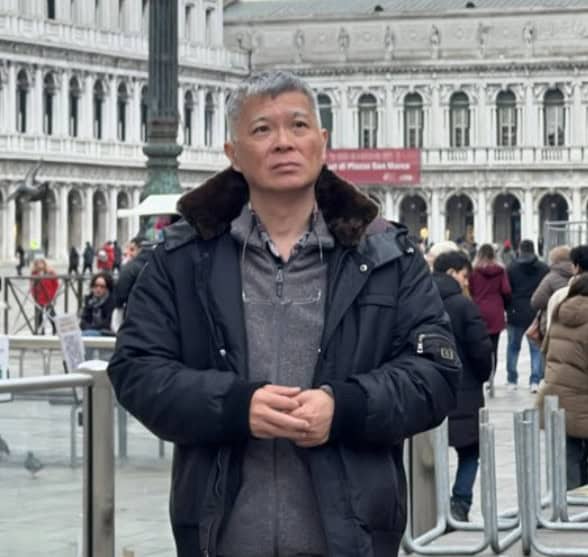
Michael Koh is a production specialist and entrepreneur who founded Spring Forest Studio in 2017 to provide event and virtual production solutions in Singapore. He specialises in hybrid live streaming, XR (Extended Reality) virtual production, and studio systems integration, transitioning the business from traditional videography to advanced corporate broadcasting. Operating out of a dedicated facility at NordCom2 in Singapore, he leads a technical crew to deliver multi-camera webcasts, digital sets, and technical consultations for large-scale corporate events.