
Low-Latency Excellence: The Technical Peak of Singaporean B2B Streaming
In the dynamic realm of B2B event production, where corporate communications, global town halls, product launches, and high-stakes financial announcements converge, the demand for ultra-low latency streaming has escalated from a desirable feature to a fundamental technical imperative. As enterprise decision-makers and AV professionals navigate the complexities of hybrid events, ensuring real-time interactivity and seamless engagement for both in-person and remote participants becomes paramount. Singapore, with its unparalleled digital infrastructure and strategic position as a global connectivity hub, stands at the technical vanguard of delivering this low-latency excellence.
This article delves into the advanced technical solutions, sophisticated protocols, and robust infrastructure that collectively define the peak of Singaporean B2B streaming, offering a detailed blueprint for achieving sub-second, glass-to-glass latency in mission-critical enterprise environments. We will explore the architectural considerations, encoding strategies, network topologies, and operational workflows that enable flawless, instantaneous content delivery, reinforcing the brand Live Streaming Studio’s commitment to professional B2B event streaming and hybrid production services.
The Indispensable Role of Ultra-Low Latency in Enterprise Events
For B2B events, latency is not merely a technical specification; it is a critical factor influencing audience engagement, interaction efficacy, and the overall perception of professionalism. Unlike consumer streaming, where a few seconds of delay might be tolerable, corporate events demand near-instantaneous feedback loops. Imagine a live global Q&A session where remote participants experience significant delays; questions arrive late, responses are out of sync, and the interactive flow collapses. This disconnect diminishes engagement, erodes trust, and ultimately undermines the event’s objectives.
Technically, latency refers to the total time delay from the moment an action occurs in front of the camera lens (glass) to when that action is displayed on the end-user’s screen. This “glass-to-glass” delay is an accumulation of various processing stages: video acquisition, encoding, network transit, decoding, and client-side buffering. Minimizing each component of this delay is crucial. In critical scenarios such as financial results briefings, highly interactive virtual classrooms, or precision surgical demonstrations for medical professionals, even a two-second delay can have profound operational and reputational consequences. The technical challenge is to compress this aggregate delay into the lowest possible milliseconds, creating a truly synchronized experience across distributed audiences.
Architecting for Speed: Protocols, Codecs, and Network Topologies
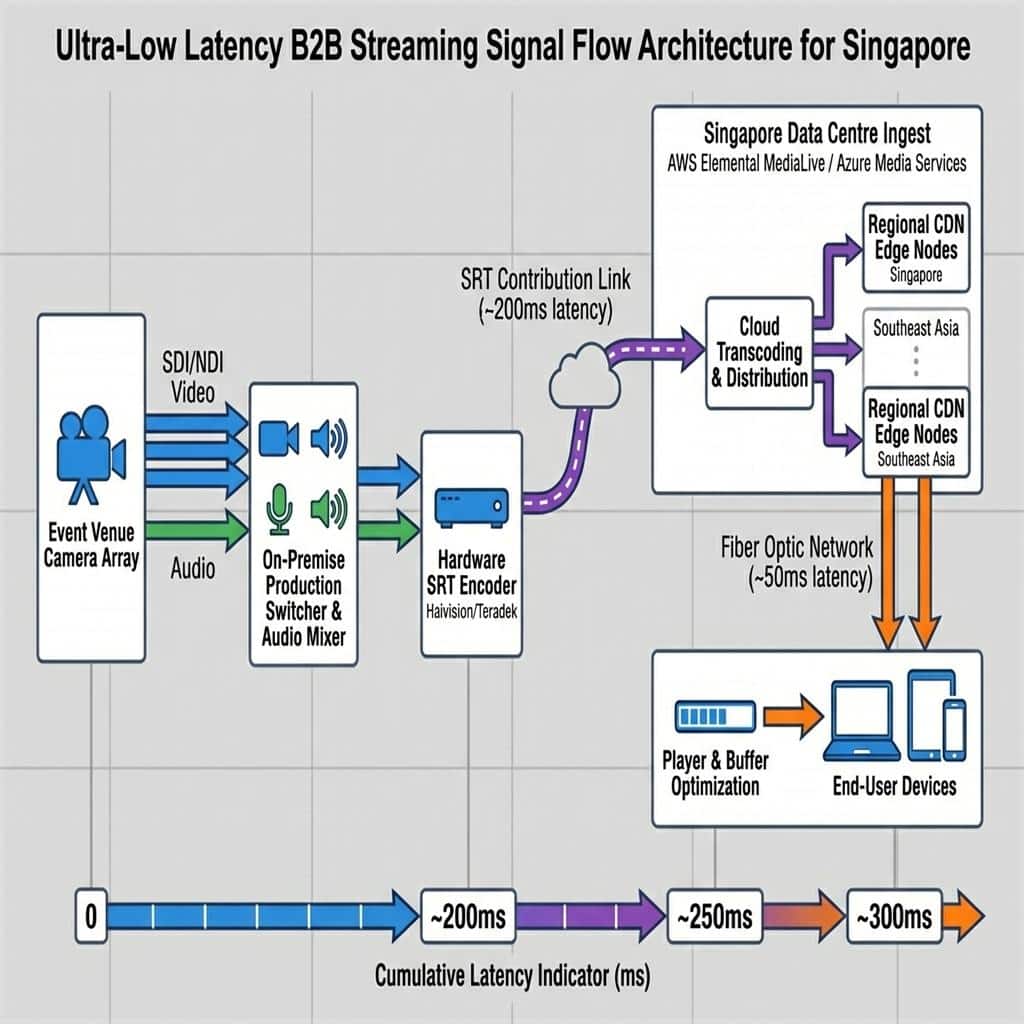
Achieving ultra-low latency requires a meticulously engineered signal chain, leveraging protocols and codecs optimized for speed and reliability. The choice of these foundational technologies dictates the inherent latency ceiling for any B2B streaming deployment.
Secure Reliable Transport (SRT) for Resilient Low-Latency Transmission
At the forefront of low-latency, high-quality video transport is the Secure Reliable Transport (SRT) protocol. Developed by Haivision, SRT is an open-source, UDP-based protocol designed to optimize streaming performance across unpredictable networks, including the public internet. Its core advantages for B2B applications include robust error recovery mechanisms, specifically Automatic Repeat Request (ARQ), which retransmits lost packets to maintain stream integrity without significantly impacting latency. SRT also supports advanced stream multiplexing and features robust 128/256-bit Advanced Encryption Standard (AES) encryption, critical for protecting sensitive corporate communications.
Unlike the traditional Real-Time Messaging Protocol (RTMP) and its secure counterpart, RTMPS, which are TCP-based and incur substantial latency due to their retransmission overheads, SRT’s UDP foundation allows for more efficient packet recovery and lower latency, typically achieving sub-second delays over significant geographical distances. For Singaporean B2B events, SRT is indispensable for reliable contribution feeds from remote speakers or venues into a central production hub, as well as for distribution to private content delivery networks (CDNs) or enterprise video platforms.
NDI for Intra-Production Low-Latency Workflows
Within the local production environment, NewTek’s Network Device Interface (NDI) protocol provides an IP-based framework for transporting high-quality, low-latency video, audio, and metadata over standard Ethernet networks. NDI, including its more compressed variant NDI|HX, enables seamless interoperability between a wide array of production equipment, from PTZ (Pan-Tilt-Zoom) cameras and graphics generators to vision mixers and playback systems. Implementing NDI within a Singapore-based production facility allows for agile, distributed workflows with virtually imperceptible latency, enabling a centralized control room to manage multiple camera feeds, ingest remote NDI sources, and route program feeds with precision timing. This IP-centric approach simplifies cabling, enhances flexibility, and significantly reduces the internal signal processing delays inherent in traditional Serial Digital Interface (SDI) workflows.
Advanced Encoding Strategies for Latency Reduction
The choice and configuration of video codecs are fundamental to managing latency. The H.264 (Advanced Video Coding, AVC) and H.265 (High-Efficiency Video Coding, HEVC) codecs are industry standards, balancing compression efficiency with computational demands. For low-latency applications, H.264 remains a widely adopted choice due to its established hardware support and lower processing overhead compared to H.265, which, while offering superior compression, often introduces more encoding/decoding delay. The Group of Pictures (GOP) structure within these codecs is critical: a shorter GOP size, ideally with frequent I-frames (intra-coded frames), minimizes the dependency on preceding frames, thereby reducing decoding delay. However, shorter GOPs increase bandwidth requirements. Therefore, a careful balance between bandwidth, visual quality, and latency must be struck through precise bitrate management, often favoring Constant Bitrate (CBR) encoding for predictable network performance in latency-sensitive B2B scenarios.
Singapore’s Digital Edge: Infrastructure Supporting Peak Performance
Singapore’s advanced digital ecosystem provides a robust foundation uniquely suited for ultra-low latency B2B streaming. Its strategic geographical location, coupled with aggressive investment in cutting-edge network infrastructure, creates an unparalleled environment for high-performance content delivery.
As a key peering point and major hub for submarine communication cables connecting Asia, Europe, and the Americas, Singapore boasts exceptionally low intercontinental network latency. This global connectivity is complemented by an incredibly dense and high-speed domestic fiber optic network, ensuring minimal propagation delay within the city-state itself. The proliferation of carrier-neutral data centers, such as Equinix and ST Telemedia Global Data Centres, further enhances this, providing hyper-interconnected environments with direct, low-latency access to major cloud providers and Content Delivery Network (CDN) points of presence.
For B2B events targeting regional or local audiences, strategic CDN deployment within Singapore and across Southeast Asia is critical. Leveraging edge computing principles, content can be cached and served from nodes geographically closer to end-users, drastically reducing egress latency and network congestion. Furthermore, Singapore’s robust cybersecurity posture and redundant network architectures provide a reliable backbone, mitigating risks from distributed denial-of-service (DDoS) attacks and ensuring continuous, high-quality service for mission-critical corporate streams.
Enterprise-Grade Production Architectures for Sub-Second Delivery
Translating theoretical low-latency advantages into practical B2B event streaming requires meticulous attention to the entire production signal chain, from acquisition to final output. Every component must be chosen and configured with latency optimization as a primary objective.
Multi-Camera Acquisition and Advanced Switching
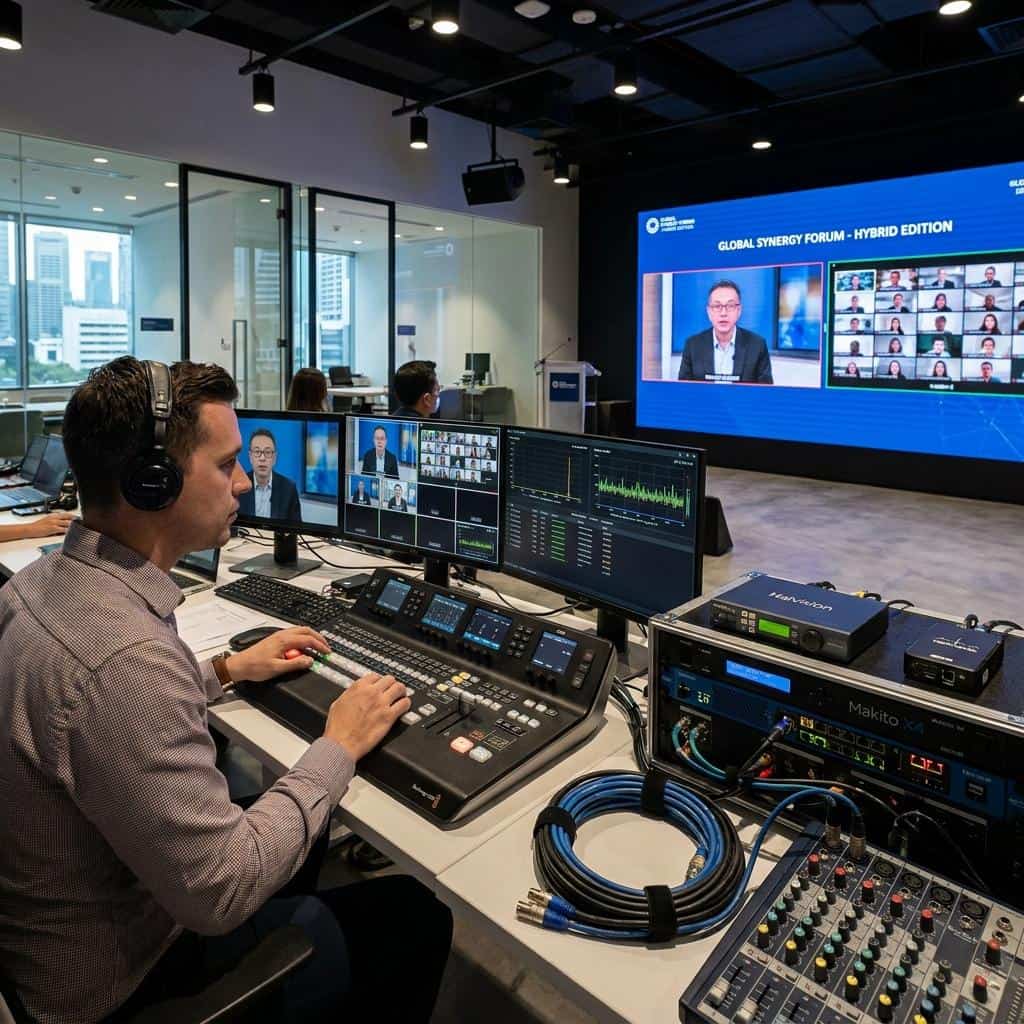
Professional B2B events frequently involve multi-camera setups utilizing broadcast-grade cameras with SDI or NDI outputs, such as Blackmagic URSA Broadcast G2 or Sony FS7. These cameras offer superior image quality, precise color control, and low inherent processing delay. The integration of these feeds into a hardware-based vision mixer or production switcher, like Grass Valley K-Frame, Ross Carbonite, or Blackmagic ATEM Constellation series, is crucial. Hardware switchers provide real-time, frame-accurate switching and effects generation with near-zero latency, far surpassing software-based solutions for mission-critical live productions. Concurrently, professional audio mixing consoles, such as Yamaha QL series or Behringer X32, manage embedded and discrete audio signals with precise synchronization, ensuring audio-video alignment. Furthermore, dedicated talkback systems, like Clear-Com or RTS intercoms, are essential for instantaneous, crystal-clear communication between the director, camera operators, audio engineers, and graphics operators, enabling synchronized cues and preventing human-induced delays.
Signal Flow and Routing Optimization
Within the production control room, signal routing is a significant factor in latency management. Traditional SDI routing matrices, such as Blackmagic Smart Videohub or Evertz routers, provide robust physical signal distribution with minimal latency. For IP-centric workflows, NDI or SMPTE 2110 compliant IP routers facilitate flexible, scalable signal management with equivalent low-latency performance. Achieving perfect synchronization across all video and audio sources is paramount, necessitating meticulous genlock and timecode synchronization. All cameras, graphics engines, and playback devices must be locked to a common reference clock to eliminate frame drift and ensure cohesive, low-latency program output.
Dedicated Encoding Hardware and Cloud Integration
The encoding stage is a primary source of latency. For professional B2B streaming, dedicated hardware encoders are indispensable. Appliances like the Haivision Makito X series, Teradek Cube/Bond units, or AJA HELO Plus provide specialized hardware acceleration for H.264/H.265 encoding, delivering significantly lower latency than CPU-based software encoders. These encoders typically support SRT for resilient, low-latency contribution to the cloud or CDN ingest points. While on-premise encoding minimizes local latency to the first ingest, strategic integration with cloud-based transcoding and distribution services (e.g., AWS Elemental MediaLive, Azure Media Services) becomes vital for global scalability and robust delivery. The key is to optimize ingest latency to the cloud and leverage distributed cloud transcoders for regionalized delivery, maintaining low latency where it matters most for the target audience.
Redundancy, Quality of Service, and Scalability for Mission-Critical Events
For high-stakes B2B events, ensuring uninterrupted, high-quality, low-latency streaming requires a comprehensive strategy encompassing redundancy, stringent Quality of Service (QoS) implementation, and robust scalability planning. The integrity of corporate communications cannot be compromised by technical failure or performance degradation.
Implementing Robust Failover and Redundancy Strategies
A resilient streaming architecture mandates redundancy at every critical point of failure. This includes deploying primary and secondary hardware encoders, often in an active-active or active-passive configuration, capable of instantaneous failover. Redundant network paths, utilizing diverse internet service providers (ISPs) and physical cabling, are essential to mitigate network outages. Power redundancy, via Uninterruptible Power Supplies (UPS) and backup generators, ensures continuous operation even during utility power disruptions. Comprehensive monitoring and alerting systems, leveraging Simple Network Management Protocol (SNMP) or custom dashboards, are deployed to provide real-time visibility into the health and performance of every component, enabling proactive intervention before an issue impacts the live stream.
Ensuring Quality of Service (QoS) Across the Chain
Quality of Service (QoS) protocols are implemented across the network infrastructure to prioritize video and audio traffic, ensuring it receives preferential treatment over less time-sensitive data. This involves configuring dedicated VLANs (Virtual Local Area Networks), implementing traffic shaping rules, and guaranteeing minimum bandwidth allocations. Continuous network performance monitoring, tracking metrics such as packet loss, jitter, and bandwidth utilization, is vital to diagnose and resolve potential bottlenecks. For SRT streams, its inherent Forward Error Correction (FEC) and Automatic Repeat Request (ARQ) mechanisms further enhance QoS by recovering lost packets without significantly increasing latency, ensuring a stable and pristine viewing experience.
Scalability for Large-Scale Enterprise Deployments
B2B events can range from intimate executive briefings to global town halls with tens of thousands of simultaneous viewers. Scalability is achieved through sophisticated CDN architectures that distribute the streaming load across numerous geographically dispersed servers, minimizing latency for global audiences and preventing overload at any single point. Intelligent routing algorithms ensure viewers are directed to the closest, best-performing CDN edge node. Integration with enterprise video platforms (EVPs) provides robust security, granular access control, comprehensive analytics, and seamless archiving for Video On Demand (VOD). For events with unpredictable audience spikes, hybrid cloud solutions offer burst capacity, allowing on-premise production infrastructure to seamlessly scale into public cloud resources to handle peak demand without compromising latency or quality.
Conclusion
Singapore’s advanced digital ecosystem, combined with a deep understanding of B2B event production nuances, positions it as a global leader in delivering ultra-low latency streaming solutions. The convergence of cutting-edge protocols like SRT and NDI, meticulously designed encoding strategies, robust fiber optic infrastructure, and enterprise-grade production architectures creates a technical environment where sub-second glass-to-glass latency is not just achievable, but consistently delivered. For corporate event planners, AV professionals, and IT directors, mastering these technical aspects is no longer optional but essential for creating truly interactive, engaging, and impactful hybrid events and critical communications. Partnering with experts possessing this comprehensive technical acumen ensures that your mission-critical B2B streams not only meet but exceed the highest standards of low-latency excellence.

Michael Koh is a production specialist and entrepreneur who founded Spring Forest Studio in 2017 to provide event and virtual production solutions in Singapore. He specialises in hybrid live streaming, XR (Extended Reality) virtual production, and studio systems integration, transitioning the business from traditional videography to advanced corporate broadcasting. Operating out of a dedicated facility at NordCom2 in Singapore, he leads a technical crew to deliver multi-camera webcasts, digital sets, and technical consultations for large-scale corporate events.