
The modern corporate landscape, particularly within a dynamic global hub like Singapore, demands an unprecedented level of agility and connectivity from its leadership. Boardroom meetings, once confined to physical spaces, have profoundly transformed into intricate hybrid events, blending in-person participants with remote directors and stakeholders across diverse geographies. This paradigm shift, accelerated by global dynamics, presents significant technical challenges for corporate event planners, AV professionals, and IT directors alike. Ensuring a seamless, secure, and high-fidelity experience for all participants, whether local or international, requires a sophisticated understanding of enterprise-grade live event streaming and hybrid production technologies. This article delves into the critical infrastructure, advanced protocols, and strategic implementation necessary to master the hybrid boardroom, providing Singaporean directors with the tools to lead effectively in an increasingly interconnected world. Our focus is strictly on B2B event streaming solutions, leveraging robust production workflows and broadcast-quality standards, far removed from consumer-grade streaming applications. We will explore multi-camera production setups, advanced audio signal processing, resilient network architectures, and secure content delivery mechanisms that define the state-of-the-art in corporate communication.
Core Hybrid Boardroom Infrastructure: A/V Signal Flow and Network Foundations
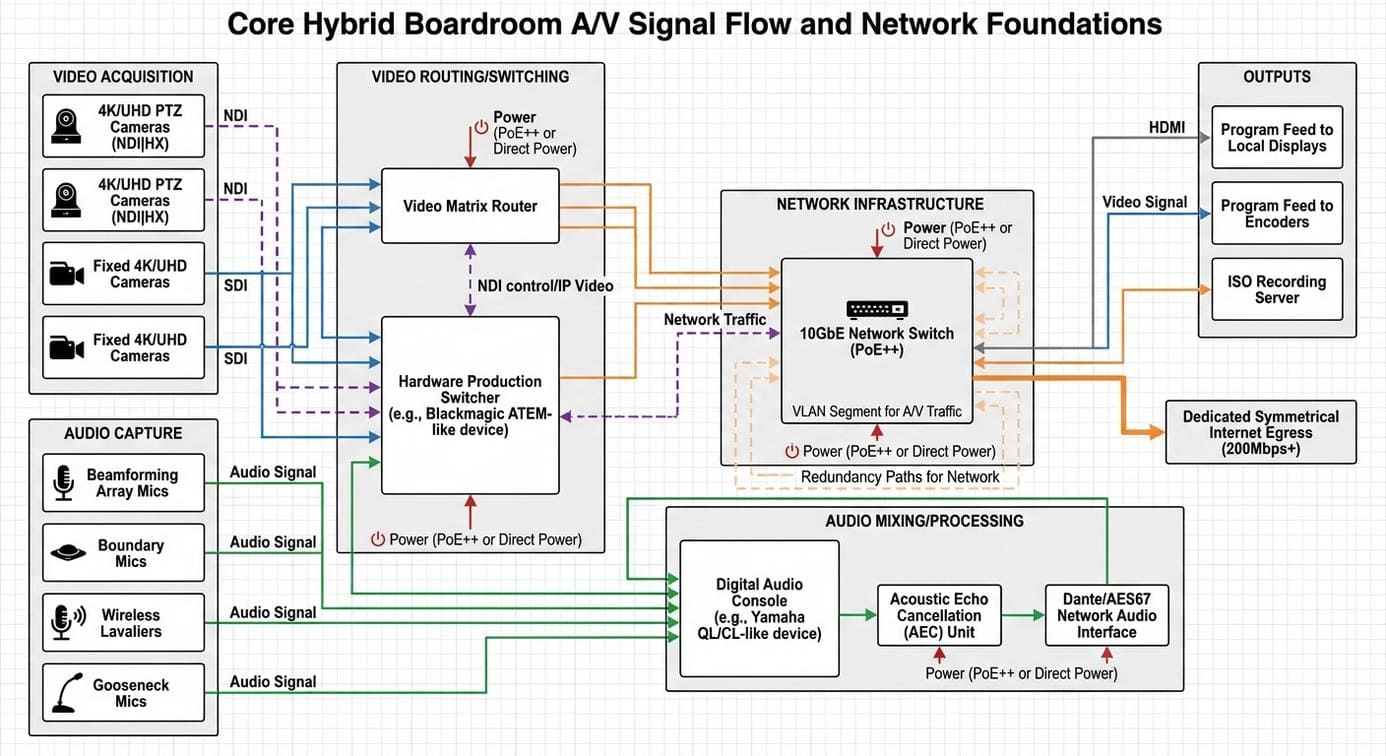
The bedrock of any successful hybrid boardroom lies in its foundational audio-visual (A/V) signal flow and the underlying network infrastructure. Achieving broadcast-quality output necessitates meticulous planning and deployment of professional-grade equipment.
High-Fidelity Video Acquisition and Routing
Video acquisition in a hybrid boardroom extends beyond a single webcam. Professional deployments utilize multi-camera setups, often incorporating robotic Pan-Tilt-Zoom (PTZ) cameras, such as those enabled with NDI|HX (Network Device Interface High Efficiency), for their flexibility and remote operability. These are complemented by fixed 4K/UHD (Ultra High Definition) cameras to capture wider room views or specific presentation areas with impeccable clarity. The choice of video signal transport is paramount: SDI (Serial Digital Interface) remains the industry standard for long cable runs and broadcast-level quality, transmitting uncompressed or minimally compressed digital video. HDMI 2.1 (High-Definition Multimedia Interface) is suitable for local display integration due to its high bandwidth and support for resolutions up to 8K. For IP-based workflows, Full NDI offers near-zero latency, high-quality video, audio, and control over standard Gigabit Ethernet (GbE) networks, simplifying cabling and increasing routing flexibility within the boardroom ecosystem.
Video switching systems are the command center for visual narratives. Enterprise environments demand hardware-based production switchers from manufacturers like Blackmagic Design ATEM or Ross Video Carbonite, which offer dedicated processing power, multiple inputs, professional transitions, and multi-program outputs. While software-defined video mixers can be suitable for smaller, less mission-critical applications, the reliability and robust feature sets of hardware switchers are indispensable for corporate board meetings. Furthermore, sophisticated video matrix routers provide unparalleled flexibility for routing any video source to any destination display or encoder, crucial for multiview monitoring and varied output requirements. The ability to generate a clean program feed for live streaming while simultaneously performing ISO (Isolated) recording of individual camera feeds for post-production or archival purposes is a fundamental requirement.
Pristine Audio Capture and Mixing Architectures
Audio quality is often overlooked but is the true cornerstone of effective communication, particularly in hybrid settings where adverse acoustic conditions can plague remote participants. Microphone selection is critical, encompassing ceiling-mounted beamforming arrays that intelligently track speakers, boundary microphones for conference tables, and gooseneck microphones for dedicated presenter stations. For greater mobility, professional wireless lavalier microphones utilizing DECT (Digital Enhanced Cordless Telecommunications) or UHF (Ultra High Frequency) spectrums ensure clear vocal capture without interference.
Digital Audio Consoles, such as the Yamaha QL/CL series or Behringer X32/M32, are essential for precise control over multiple audio inputs, equalization, dynamics processing, and mixing. The integration of audio over IP protocols, primarily Dante or AES67, enables network-based audio routing with extremely low latency, simplifying complex audio setups and allowing for seamless integration with other networked A/V components. Critical to the hybrid boardroom is advanced acoustic echo cancellation and noise reduction technology, preventing disruptive feedback and ensuring remote participants hear clearly. The audio system must also intelligently integrate with the local Public Address (P.A.) system for in-room sound reinforcement, while providing separate, optimized audio feeds for remote participants via collaboration platforms and the main live stream.
Dedicated Network Infrastructure for Real-time Media
A robust and meticulously engineered network infrastructure forms the backbone for all real-time media transport. A minimum of Gigabit Ethernet (GbE) is required, with 10 Gigabit Ethernet (10GbE) highly recommended for high-bandwidth applications like uncompressed NDI or multiple 4K streams. Network segmentation through VLANs (Virtual Local Area Networks) is paramount to isolate A/V traffic, ensuring Quality of Service (QoS) and preventing contention with general corporate network traffic. Power over Ethernet Plus Plus (PoE++) ports are crucial for powering NDI-enabled cameras and other network devices, simplifying cabling and deployment.
Network redundancy is not merely an option but a critical necessity for mission-critical board meetings. Strategies include Link Aggregation (LAG) for increased bandwidth and failover capability, and completely redundant network paths to guard against single points of failure. The internet egress connection requires symmetrical, dedicated bandwidth, with at least 200 Mbps upload recommended for reliable 4K streaming with multiple simultaneous feeds. Performance monitoring of network latency, jitter, and packet loss is continuous to proactively address any potential disruptions.
Enterprise Streaming Protocols and Encoding Strategies
Effective content delivery from the hybrid boardroom to a geographically dispersed audience hinges on the selection of appropriate streaming protocols and efficient encoding strategies.
Low-Latency, High-Reliability Transport: SRT and NDI
For transmitting video across unpredictable public internet connections, SRT (Secure Reliable Transport) has emerged as an industry leader. This UDP-based (User Datagram Protocol) protocol leverages ARQ (Automatic Repeat reQuest) for robust packet recovery, effectively mitigating packet loss and jitter over wide area networks (WANs). SRT also incorporates AES 128/256-bit encryption, ensuring the confidentiality and integrity of sensitive boardroom discussions during transmission. It is an ideal solution for connecting the Singaporean boardroom to remote production facilities, cloud ingest points, or international content delivery networks (CDNs) where low latency and high reliability are paramount.
Within the local boardroom or campus environment, NDI (Network Device Interface) provides an IP video standard for high-quality, low-latency communication. Full NDI offers visually lossless video over a local area network (LAN), while NDI|HX provides highly efficient, compressed video streams suitable for cameras and lower bandwidth applications. NDI simplifies the traditional SDI routing matrix, allowing for discovery and connection of A/V devices over standard IP networks, enabling agile camera control, signal routing, and multiview monitoring with minimal latency. Its application significantly streamlines complex production setups, moving away from point-to-point physical cabling towards a more flexible network-centric approach.
Industry-Standard Encoding and Delivery: H.264/H.265 via RTMP/RTMPS
Video encoding is the process of compressing raw video data into a manageable format for transmission. H.264 (MPEG-4 AVC) remains a widely adopted codec, offering excellent compression efficiency and broad compatibility across devices and platforms. For even greater efficiency, H.265 (HEVC – High Efficiency Video Coding) provides superior compression, allowing for similar quality at lower bitrates or higher quality at the same bitrate, though requiring more processing power and newer decoding hardware.
Dedicated hardware encoders, such as those from Haivision (Makito series) or Teradek, are the gold standard for enterprise applications. These appliances offer superior reliability, consistent performance, and specialized features like redundant power supplies and multiple streaming outputs, far exceeding the capabilities of software-based encoders on general-purpose workstations. While RTMP (Real-Time Messaging Protocol) is still a prevalent ingest protocol for many streaming platforms and CDNs, its secure variant, RTMPS (Real-Time Messaging Protocol Secure), encrypts the stream payload, addressing crucial security concerns for corporate content. Bitrate management, including the implementation of Adaptive Bitrate Streaming (ABR), is essential to deliver a high-quality viewing experience across diverse audience network conditions, dynamically adjusting stream quality based on available bandwidth.
Cloud vs. On-Premise Streaming Architectures
Enterprises face a strategic decision regarding their streaming infrastructure: fully on-premise, cloud-based, or a hybrid model. On-premise solutions involve dedicated encoding hardware, local media servers for content management, and maintaining full control over infrastructure and security policies. This offers maximum security and predictable performance within the corporate firewall. Conversely, cloud-based platforms offer unparalleled scalability, global reach through extensive CDN networks (e.g., Akamai, Cloudflare), and simplified deployment without significant upfront hardware investment. These platforms are ideal for distributing content to vast, geographically dispersed audiences. A hybrid approach often represents the optimal balance for corporate boardrooms: on-premise ingest and initial encoding for maximum control and security, followed by distribution through robust cloud-based CDNs for global reach and scalability.
The Hybrid Boardroom Workflow: Integration and Scalability
Beyond the core infrastructure and protocols, the true mastery of the hybrid boardroom lies in the seamless integration of various systems and the strategic planning for scalability and resilience.
Seamless Integration with Enterprise Collaboration Platforms
Modern boardrooms must integrate fluidly with enterprise collaboration platforms such as Microsoft Teams, Zoom, and Webex. This typically involves feeding the professional program output from the hardware switcher into these platforms using dedicated hardware gateways or NDI Virtual Input applications. This ensures that remote participants within the collaboration platform receive a high-quality, professionally produced feed, rather than a single webcam view. Simultaneously, a separate, clean feed can be routed to a professional live streaming platform for broader external audiences or archival. Advanced security measures are paramount for these integrations, safeguarding sensitive discussions from unauthorized access or data breaches, often leveraging platform-specific encryption and access controls.
Advanced Production Techniques for Engagement
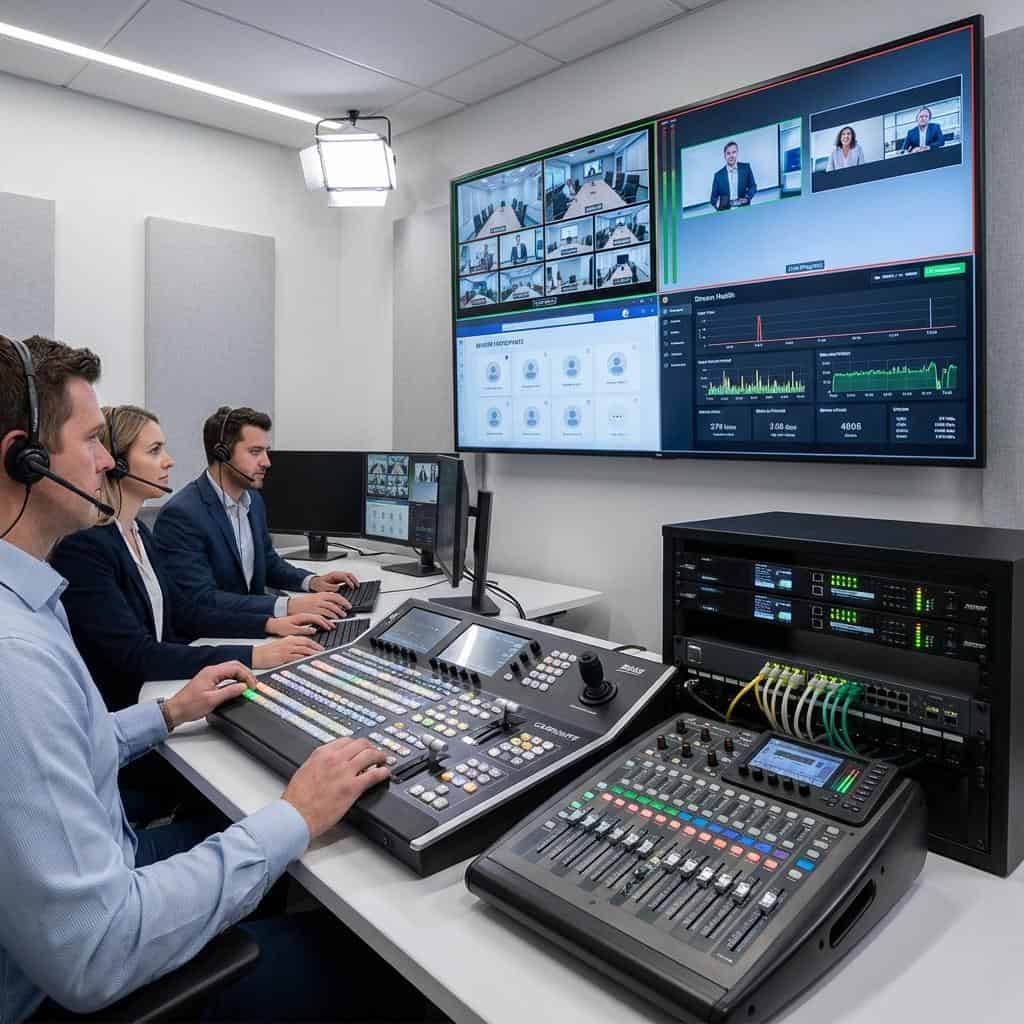
To maintain engagement for both in-person and remote participants, advanced production techniques are indispensable. Multiview monitoring systems allow directors and the production crew to simultaneously observe all camera feeds, program output, graphic overlays, and remote participant views, enabling real-time decision-making. Professional character generators (CG systems) are used for dynamic graphic overlays, lower thirds, and titling, enhancing the visual professionalism of the stream. Critical for seamless communication between the production team, technical staff, and presenters is a dedicated talkback system, such as those offered by Clear-Com or Riedel. These systems ensure clear, private, and low-latency communication, coordinating camera movements, graphic insertions, and presenter cues without disrupting the meeting. Integrating remote presenters securely into the main production feed requires dedicated video conferencing bridges (e.g., Pexip, Haivision Connect) that can bring high-quality feeds into the production switcher, allowing them to be treated as any other local camera source.
Scalability, Redundancy, and Quality of Service (QoS)
For large corporate events or board meetings with a global audience, scalability is paramount. A well-defined CDN strategy, leveraging edge servers and intelligent caching, ensures that content is delivered efficiently and with minimal latency to viewers worldwide, regardless of their geographical location. Redundancy and failover mechanisms are non-negotiable for mission-critical events. This includes deploying redundant encoders, establishing primary and secondary streaming paths (e.g., dual SRT streams to different ingest points), and implementing Uninterruptible Power Supply (UPS) systems for all critical A/V and network equipment. Continuous monitoring and analytics provide real-time insights into stream health, audience engagement metrics, and network performance, allowing for proactive intervention. Furthermore, strict adherence to data privacy regulations, such as Singapore’s Personal Data Protection Act (PDPA), and enterprise-wide security policies is fundamental to building and maintaining trust in these advanced hybrid environments.
Conclusion: Empowering Singaporean Directors with Future-Ready Technology
Mastering the hybrid boardroom in Singapore’s competitive business landscape is no longer a luxury but a strategic imperative. The intricate blend of high-fidelity video acquisition, pristine audio engineering, resilient network infrastructure, and advanced streaming protocols forms the backbone of effective corporate communication. By embracing enterprise-grade solutions like NDI for internal routing, SRT for reliable WAN transport, and robust hardware encoders for H.264/H.265 delivery, modern Singaporean directors can ensure their messages resonate with clarity, security, and impact, irrespective of geographic boundaries. The expertise in integrating these technologies with existing enterprise collaboration platforms, coupled with professional production techniques, elevates standard meetings into engaging, broadcast-quality experiences. Live Streaming Studio stands ready to partner with corporate event planners, AV professionals, and IT directors to design, implement, and manage these sophisticated hybrid boardroom environments, delivering future-ready solutions that empower leadership and drive business success.

Michael Koh is a production specialist and entrepreneur who founded Spring Forest Studio in 2017 to provide event and virtual production solutions in Singapore. He specialises in hybrid live streaming, XR (Extended Reality) virtual production, and studio systems integration, transitioning the business from traditional videography to advanced corporate broadcasting. Operating out of a dedicated facility at NordCom2 in Singapore, he leads a technical crew to deliver multi-camera webcasts, digital sets, and technical consultations for large-scale corporate events.