
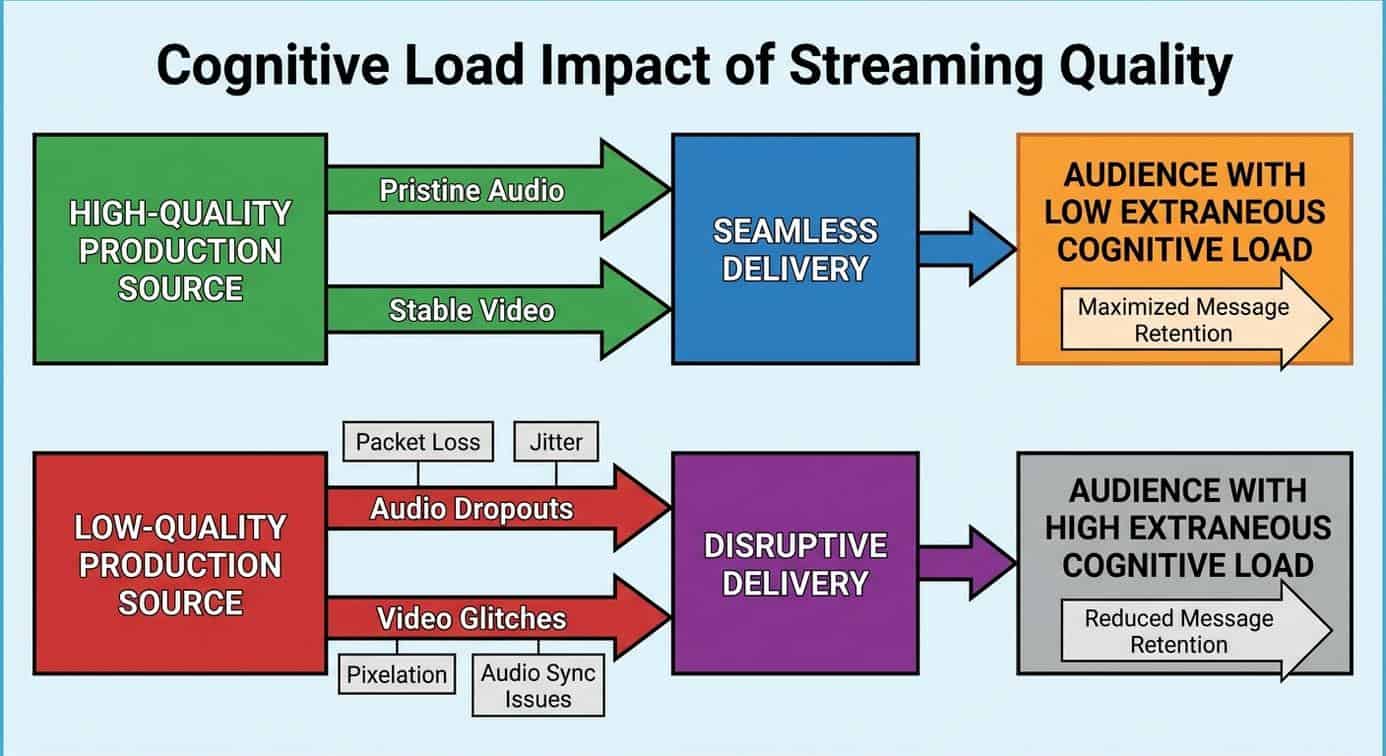
The efficacy of corporate communication in the modern enterprise landscape hinges not only on the content of the message but equally, if not more critically, on the fidelity of its delivery. In the realm of B2B event streaming and hybrid production, technical deficiencies are not mere inconveniences; they are significant impediments to message retention, directly impacting an audience’s ability to absorb and act upon crucial information. This phenomenon can be systematically understood through the lens of cognitive load theory. When attendees, whether virtual or in-person, are subjected to suboptimal production quality—be it audio dropouts, video pixelation, or excessive latency—their cognitive resources are involuntarily diverted from processing the core content to compensating for technical imperfections. This article will deconstruct the technical underpinnings of high-quality B2B event production and demonstrate why it is indispensable for minimising cognitive load and maximising message retention, positioning Live Streaming Studio as the authority in delivering unparalleled technical execution for enterprise-grade events.
The Neurological Impact of Technical Glitches on Attention and Retention
Cognitive load theory posits that the human mind possesses a finite capacity for processing information. This load is typically categorized into intrinsic, extraneous, and germane. Intrinsic load relates to the inherent complexity of the information itself. Germane load pertains to the cognitive effort devoted to schema construction and learning. Crucially for B2B streaming, extraneous cognitive load is generated by poor instructional design or, in this context, suboptimal delivery mechanisms. When a virtual attendee experiences audio synchronization issues, video freezing, or inconsistent bitrates, their brain expends valuable processing cycles attempting to reconcile these discrepancies, rather than engaging with the speaker’s key points or visual aids. This ‘split-attention effect’ directly hinders the formation of durable memories and comprehension.
Consider a live stream where the presenter’s microphone intermittently cuts out. The audience’s focus immediately shifts from understanding the quarterly earnings report to anticipating the next audio drop, attempting to infer missing words, or even becoming frustrated with the platform. This micro-level distraction, compounded over the duration of an event, fragments attention and diminishes the overall impact of the presented material. Furthermore, the human brain is hardwired to identify and react to anomalies; a sudden spike in latency leading to a jarring video stutter, or a shift in color balance, triggers a primal response that pulls focus away from the intended message. Achieving seamless, transparent technical delivery is therefore not merely a luxury; it is a fundamental prerequisite for respecting and optimizing the audience’s cognitive capacity, ensuring their germane load is maximized.
Core Pillars of Enterprise-Grade Production Quality
Building an event that truly minimises cognitive load requires a meticulous approach to every facet of production, from initial signal acquisition to final distribution. Live Streaming Studio leverages industry-standard equipment and workflows to ensure uncompromised quality.
Pristine Audio Acquisition and Processing
Audio is often underestimated but is arguably the most critical component for message retention. Poor audio quality can render even the most compelling visuals ineffective. Our approach begins with sophisticated microphone selection tailored to the environment and speaker. This includes using professional-grade directional lavalier microphones for individual presenters to isolate their voice, shotgun microphones for panel discussions to capture multiple speakers with minimal ambient noise, and high-fidelity condenser microphones for pristine capture of room audio or musical performances. Proper gain staging at the source is paramount to achieving an optimal signal-to-noise ratio (SNR), preventing clipping and maintaining dynamic range.
The signal then routes through enterprise-grade digital audio mixers, which allow for precise equalization (EQ), compression, and noise gating. These processes are not about aesthetic enhancement but about clarity and intelligibility. EQ is used to mitigate room resonances and enhance vocal presence, while compression ensures consistent volume levels, preventing listener fatigue from sudden dynamic shifts. For complex hybrid events, we implement Audio over IP (AoIP) networks utilizing standards such as Dante or AES67. These protocols enable redundant, low-latency, uncompressed multi-channel audio distribution across vast physical spaces or network topologies, ensuring every audio input and output is perfectly synchronized and robustly routed. Crucial for seamless production are dedicated talkback systems, employing two-way communication devices for precise, real-time coordination among the technical crew, ensuring cues are met and issues addressed silently and instantaneously.
High-Fidelity Video Capture and Encoding
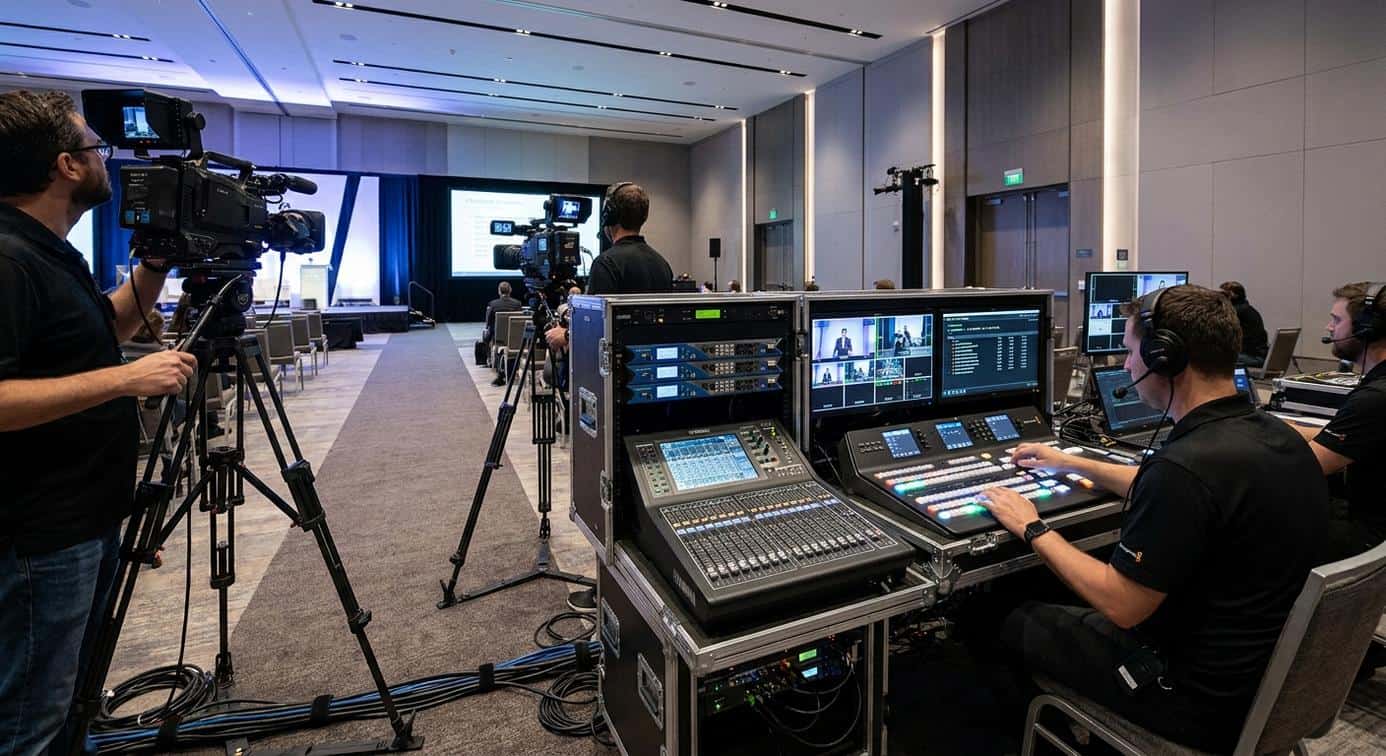
Visually, the goal is to present a crisp, consistent, and engaging image that supports the narrative without distraction. This starts with professional camera systems, often comprising multiple broadcast-grade 4K/UHD cameras and robotic PTZ (Pan-Tilt-Zoom) cameras. Each camera is meticulously calibrated for color temperature, white balance, and exposure, with operators skilled in understanding parameters such as aperture, ISO, and shutter speed to achieve cinematic depth and clarity. For multi-camera productions, Camera Control Units (CCUs) provide centralized control over critical image parameters, ensuring visual consistency across all sources. Video signals are typically transported via robust Serial Digital Interface (SDI) cables for long runs and broadcast reliability, or increasingly, over IP using protocols like NDI (Network Device Interface) for flexible routing and scalability within a local area network (LAN).
Seamless transitions between camera angles, graphics, and pre-recorded content are executed via professional video switching matrices. These devices eliminate jarring cuts or black frames that can disrupt viewer flow. Post-switcher, the program feed enters high-performance hardware encoders. Live Streaming Studio employs encoders capable of supporting modern codecs such as H.264/AVC and H.265/HEVC. Bitrate management is key; we balance target resolution (e.g., 1080p at 29.97 fps or 59.94 fps) with network bandwidth, using intelligent Constant Bitrate (CBR) or sophisticated Variable Bitrate (VBR) encoding profiles. Furthermore, the Group of Pictures (GOP) structure is optimized to balance quality and latency, with shorter GOPs generally favoring lower latency. Color space adherence, particularly to Rec. 709 for standard dynamic range (SDR) and Rec. 2020 for high dynamic range (HDR) content, is rigorously maintained from capture through encoding to ensure accurate visual reproduction on diverse display devices. ISO recording of individual camera feeds provides invaluable post-production flexibility and a critical backup.
Robust Network Infrastructure and Streaming Protocols
Even the most meticulously produced content will falter without a resilient and optimized network infrastructure. The journey of high-quality video and audio from the production environment to the global audience is a complex technical orchestration.
Latency Optimization and Real-time Delivery
For hybrid events, particularly those with interactive Q&A sessions or remote presenters, low latency is paramount to foster a sense of real-time engagement and minimize the conversational delay that increases cognitive load. Traditional streaming protocols like RTMP (Real-Time Messaging Protocol) and its secure variant RTMPS remain widely adopted for their broad compatibility and relatively mature ecosystem for ingest and distribution to various Content Delivery Networks (CDNs). However, for scenarios demanding ultra-low latency, such as bidirectional communication or critical event interaction, we employ protocols like SRT (Secure Reliable Transport). SRT, developed by Haivision, is an open-source video transport protocol that optimizes streaming performance across unpredictable networks by incorporating robust error correction, packet recovery, and dynamic firewall traversal. It allows for configurable latency buffers, enabling a trade-off between absolute minimal latency and resilience against network jitter and packet loss. For true real-time, browser-based interactivity, WebRTC (Web Real-Time Communication) offers sub-500ms latency, integrating directly into web browsers for two-way communication without requiring specialized plugins, though its scalability for large audiences requires careful architectural consideration and custom server infrastructure.
Network Redundancy and Quality of Service (QoS)
Reliability is non-negotiable for enterprise events. Live Streaming Studio implements multi-layered network redundancy strategies. This includes procuring multiple dedicated, high-bandwidth internet circuits, often from different providers, at event venues. For mission-critical scenarios or remote locations, we utilize bonded cellular aggregation devices that combine multiple 4G/5G connections into a single, robust uplink, sometimes augmented with satellite uplinks for ultimate failover. On the encoder side, dual encoders configured for automatic failover ensure that if a primary encoder or its network path fails, a secondary unit seamlessly takes over, maintaining the stream’s integrity without interruption. Network segmentation through VLANs (Virtual Local Area Networks) is crucial; video and audio traffic are prioritized (Quality of Service – QoS) over general IT traffic to guarantee the necessary bandwidth and low latency. Proactive network monitoring tools continuously analyze metrics such as packet loss, jitter, latency, and bandwidth utilization, providing real-time alerts to technical teams for immediate intervention.
Seamless Integration and Scalability for Hybrid Environments
The complexity of modern B2B events often involves integrating sophisticated production workflows with established enterprise collaboration platforms and ensuring scalability for diverse audience sizes.
Platform Integration and Workflow Automation
A significant challenge in hybrid event production is the seamless integration of professional broadcast-grade content into enterprise platforms like Microsoft Teams Live Events, Zoom Webinars, or Webex Events. Live Streaming Studio utilizes specialized hardware and software interfaces that act as bridges, converting professional SDI or NDI program feeds into a virtual webcam or screen share input for these platforms. This allows for multi-camera switching, high-quality audio mixing, and professional graphics to be presented within the familiar interface of the corporate collaboration tool, elevating the production value far beyond standard webcam presentations. Integration extends to Graphics Generation systems that deliver real-time lower thirds for speaker identification, full-screen informational graphics, and dynamic data visualizations directly into the program feed. Workflow automation, often orchestrated via scripting or dedicated production software, ensures that these graphic overlays, video playback cues, and scene changes are executed precisely, further reducing the chance of human error that could introduce cognitive friction for the audience.
Scalability and Future-Proofing Enterprise Streaming
Enterprise events can range from intimate executive briefings to global virtual conferences with hundreds of thousands of attendees. The streaming infrastructure must be inherently scalable. Live Streaming Studio designs solutions that leverage either robust on-premise streaming solutions, offering maximum control and security for sensitive data, or flexible cloud-based streaming platforms that provide elastic scaling capabilities to accommodate fluctuating audience numbers without requiring massive upfront hardware investments. These cloud platforms often utilize globally distributed CDNs to ensure low latency and high availability for audiences worldwide. Our production systems are built with modularity in mind, allowing for easy expansion of camera counts, audio inputs, and encoding capacities based on the specific event’s requirements. Furthermore, we advise clients on future-proofing their streaming infrastructure, considering emerging technologies such as 8K resolution streaming, advanced immersive experiences like virtual reality (VR) and augmented reality (AR) integrations, and the potential of AI-driven production assistance for automated camera switching or content summarization. Ensuring a robust foundation today allows enterprises to adapt to the technological evolutions of tomorrow without needing complete overhauls.
Elevating Message Retention Through Uncompromised Production Excellence
In the high-stakes environment of B2B communication, every detail of event production contributes to or detracts from the audience’s ability to engage with and retain vital information. Minimizing cognitive load is not a soft skill; it is a direct outcome of meticulous technical planning and execution. From the precise calibration of audio gain staging and the nuanced control of video colorimetry to the strategic implementation of resilient network protocols like SRT and the seamless integration with enterprise collaboration platforms, every technical decision directly influences message retention.
Live Streaming Studio stands at the forefront of this technical imperative, offering unparalleled expertise in designing, deploying, and managing enterprise-grade live event streaming and hybrid production solutions. Our commitment to industry best practices, adherence to broadcast standards (e.g., SMPTE, ISO), and deep understanding of streaming infrastructure ensures that your corporate message is delivered with absolute clarity, devoid of the technical distractions that impede comprehension. By partnering with Live Streaming Studio, organizations can transform their events into highly effective communication channels, where superior production quality becomes the silent enabler of profound message retention and impactful business outcomes.

Michael Koh is a production specialist and entrepreneur who founded Spring Forest Studio in 2017 to provide event and virtual production solutions in Singapore. He specialises in hybrid live streaming, XR (Extended Reality) virtual production, and studio systems integration, transitioning the business from traditional videography to advanced corporate broadcasting. Operating out of a dedicated facility at NordCom2 in Singapore, he leads a technical crew to deliver multi-camera webcasts, digital sets, and technical consultations for large-scale corporate events.