
The global product launch from a strategic hub like Singapore represents the pinnacle of complex B2B event streaming. Beyond showcasing innovation, these events demand absolute precision in content delivery, ensuring every visual cue, every spoken word, and every supporting graphic aligns perfectly across diverse geographical locations and time zones. For enterprise decision-makers and AV professionals, the challenge is not merely broadcasting; it is orchestrating a synchronized, high-fidelity experience that upholds brand integrity and captures the undivided attention of a worldwide audience. Live Streaming Studio’s technical team specializes in dissecting and mastering these intricacies, transforming potential synchronization nightmares into seamless global showcases.
The Imperative of Sub-Second Global Synchronization for Enterprise Events
In the realm of B2B product launches, synchronization transcends aesthetic preference; it becomes a critical determinant of perceived professionalism, legal compliance, and market impact. Imagine a C-suite presentation where the presenter in Singapore gestures to a product feature, yet the corresponding on-screen graphic appears half a second later for viewers in London or New York. Such desynchronization, even if minor, undermines credibility and introduces cognitive dissonance. For global marketing campaigns, misaligned content can also lead to misinterpretations or even legal discrepancies in regulated industries. Achieving sub-second synchronization across continents, therefore, is not optional; it is a fundamental requirement for enterprise-grade streaming.
The primary technical hurdles include inherent network latency, encoding and decoding delays, and the propagation time across Content Delivery Networks (CDNs). Professional broadcast standards, such as those defined by SMPTE (Society of Motion Picture and Television Engineers), provide foundational principles for timecode generation (e.g., SMPTE LTC – Longitudinal Time Code, VITC – Vertical Interval Time Code) and signal alignment, though these often need adaptation for IP-based global streaming. Our approach leverages these standards, integrating them into a robust end-to-end IP workflow that minimizes glass-to-glass delay and ensures temporal accuracy for every viewer, irrespective of their location.
For a global launch emanating from Singapore, establishing a centralized, accurate time base is paramount. This is typically achieved through Network Time Protocol (NTP) for general system synchronization, and where ultra-precision is required within the local production facility, Precision Time Protocol (PTP – IEEE 1588) for sub-microsecond synchronization of IP-enabled production equipment such as NDI devices and SMPTE ST 2110 compliant infrastructure. This foundational time alignment ensures that all production elements, from multi-camera feeds to graphics servers and audio mixers, are operating on a unified clock, thus mitigating internal production delays before content even leaves the facility.
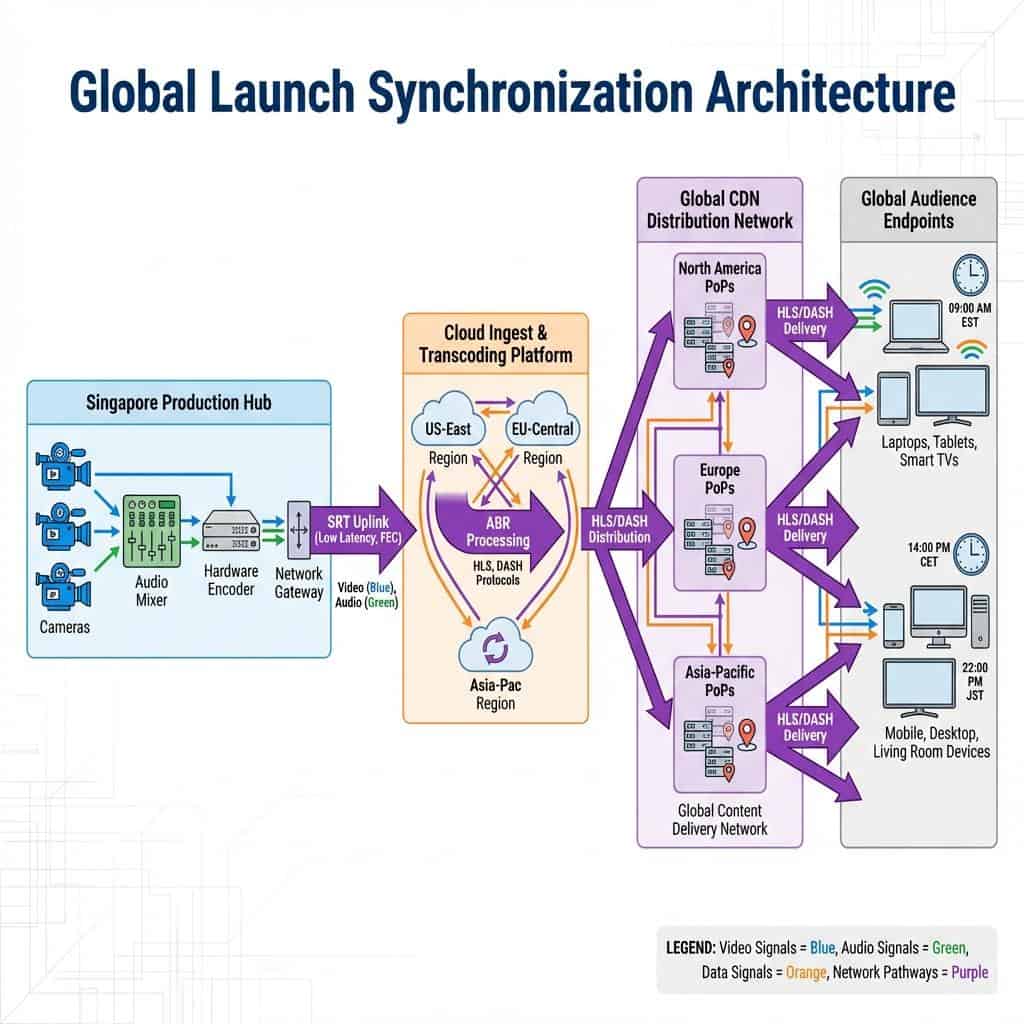
Architecting the Singapore Hub: On-Premise Production and Uplink Infrastructure
The bedrock of a successful global launch is the on-premise production and uplink infrastructure at the source location, in this case, Singapore. This phase is characterized by meticulous engineering of audio-visual capture, processing, and encoding systems designed for pristine quality and minimal latency.
Multi-Camera Production and Switching Systems
A sophisticated multi-camera setup is standard for high-profile product launches. This involves professional broadcast cameras, often 4K/UHD capable, equipped with high-quality lenses to capture intricate product details. These cameras are integrated into a centralized vision mixer or production switcher, such as a Ross Carbonite or Grass Valley Kula, via SDI (Serial Digital Interface) or increasingly, NDI (Network Device Interface) for IP-native workflows. The switcher manages transitions, picture-in-picture effects, and incorporates graphics generated from dedicated character generators. Precise signal routing is paramount, ensuring that all video sources are correctly framed, color-graded, and aligned before being passed to the encoding stage. For hybrid events, the multiview monitoring system is critical, allowing technical directors to see program feeds, preview feeds, and various return feeds from remote presenters or audience engagement platforms simultaneously.
Audio Production and Mixing Consoles
Audio quality is as critical as video, especially for speech intelligibility during product presentations. Our setups utilize professional digital audio consoles, such as Yamaha Rivage or Behringer Wing, capable of handling numerous microphones, playback sources, and routing to various destinations. Integrated talkback systems (e.g., Clear-Com, Riedel) facilitate seamless communication between the director, camera operators, and presenters. Multi-channel audio embedding, often leveraging protocols like AES67 or Dante for IP-based audio-over-IP, ensures that all discrete audio channels, including program audio, international language tracks, and descriptive audio, are correctly synchronized and multiplexed with the video stream at the encoder. Accurate audio levels, measured in dB, are constantly monitored and adjusted to meet broadcast loudness standards (e.g., ITU-R BS.1770).
Encoder Selection and Configuration for Global Distribution
The choice and configuration of encoders are pivotal. We deploy high-quality, low-latency hardware encoders specifically designed for enterprise streaming. These units are far superior to software-only solutions for mission-critical events, offering dedicated processing power and superior reliability. Encoding typically utilizes H.264 (AVC) for broad compatibility or H.265 (HEVC) for greater efficiency, especially with 4K/UHD content. Critical configurations include:
- Bitrate Management: Implementing Constant Bitrate (CBR) encoding, often with specific target bitrates in Mbps (Megabits per second), for predictable network utilization and consistent quality.
- GOP Structure: Optimizing Group of Pictures (GOP) length for efficient seeking and lower latency, typically using a closed GOP structure with a keyframe interval of 1-2 seconds.
- Codec Profiles: Selecting appropriate profiles (e.g., High Profile for H.264) to balance quality and compatibility.
For the uplink from Singapore to cloud ingest points, the Secure Reliable Transport (SRT) protocol is the preferred choice. SRT provides robust error correction, packet recovery, and dynamic latency adjustment, making it ideal for combating packet loss and jitter over unpredictable internet connections. This ensures a stable, high-quality contribution feed, significantly reducing the chance of frame drops or audio desynchronization during the critical journey from Singapore to the cloud processing infrastructure. While RTMP/RTMPS remains prevalent for final-mile distribution to some platforms, SRT excels as a contribution protocol due to its reliability and security features.
Robust Network Infrastructure for Uplink
The network connection from the Singapore production hub is arguably the most critical component for global synchronization. Dedicated, high-bandwidth fiber optic links with diverse network paths are essential to provide redundancy and minimize single points of failure. Quality of Service (QoS) configurations are rigorously applied on all network switches and routers (e.g., Cisco Catalyst series, Juniper EX series) to prioritize streaming traffic, ensuring consistent bandwidth allocation and minimizing latency. Furthermore, the implementation of SD-WAN (Software-Defined Wide Area Network) solutions provides intelligent traffic management, allowing for dynamic path selection and failover across multiple internet service providers, guaranteeing an uninterrupted and high-performance uplink even in the event of a primary circuit degradation.
Cloud-Based Orchestration and Global Content Delivery Network (CDN) Integration
Once the pristine, synchronized signal leaves Singapore, it enters the cloud-based orchestration layer for global distribution. This stage involves sophisticated transcoding, packaging, and delivery mechanisms designed to reach every audience member with optimal quality and minimal latency.
Cloud Ingest and Transcoding Workflows
The SRT feed from Singapore is ingested into cloud media services such as AWS Elemental MediaLive, Google Cloud Media CDN, or Azure Media Services. Here, the single high-bitrate source stream is transcoded into multiple adaptive bitrate (ABR) renditions. This process creates various resolution and bitrate combinations (e.g., 1080p at 5 Mbps, 720p at 2.5 Mbps, 480p at 1.2 Mbps), packaged into standard manifest files like HLS (HTTP Live Streaming) and DASH (Dynamic Adaptive Streaming over HTTP). ABR allows client devices to dynamically switch between these renditions based on their local network conditions, ensuring a continuous playback experience. Crucially, precise timecode and audio-video synchronization are maintained throughout this transcoding process, a critical technical requirement for preserving the initial synchronization achieved at the source.
Global CDN Strategy for Latency Reduction
To minimize global latency and ensure content delivery at scale, integration with a robust Global Content Delivery Network (CDN) is indispensable. CDNs leverage geographically dispersed Points of Presence (PoPs) to cache and serve content from the closest available server to each viewer. This significantly reduces the network distance the content must travel, thereby decreasing latency and improving load times. Our strategy involves:
- Strategic PoP Selection: Utilizing CDNs with extensive global networks and strong presence in target audience regions (e.g., Akamai, Cloudflare, Limelight Networks).
- Edge Caching: Maximizing edge caching to reduce origin server load and speed up content delivery.
- Dynamic CDN Switching: Employing intelligent systems that can monitor CDN performance in real-time and dynamically route traffic to the best-performing provider, ensuring resilience and optimal latency.
Multi-Platform and Hybrid Event Integration
Modern product launches often require distribution across multiple platforms, including custom branded event portals, and seamless integration with enterprise collaboration platforms for hybrid components. We ensure:
- Custom Event Platforms: Delivering the primary synchronized stream to bespoke, secure web platforms offering interactive features tailored for the B2B audience.
- Enterprise Platform Integration: For interactive segments, our solutions can integrate the primary program feed into Microsoft Teams, Zoom, or Webex events, allowing for secure Q&A sessions, virtual breakouts, and remote speaker participation, while maintaining a synchronized experience for the broader streaming audience.
- Security Protocols: Implementing robust security measures, including DRM (Digital Rights Management), token-based authentication, and geo-blocking, to protect proprietary content and control audience access.
Achieving Millisecond Accuracy: Synchronization Strategies and Monitoring
The ultimate success of a globally synchronized launch hinges on continuous, real-time monitoring and proactive latency management. This involves a multi-layered approach to ensure every element remains perfectly aligned from glass to glass.
Centralized Timecode Generation and Distribution
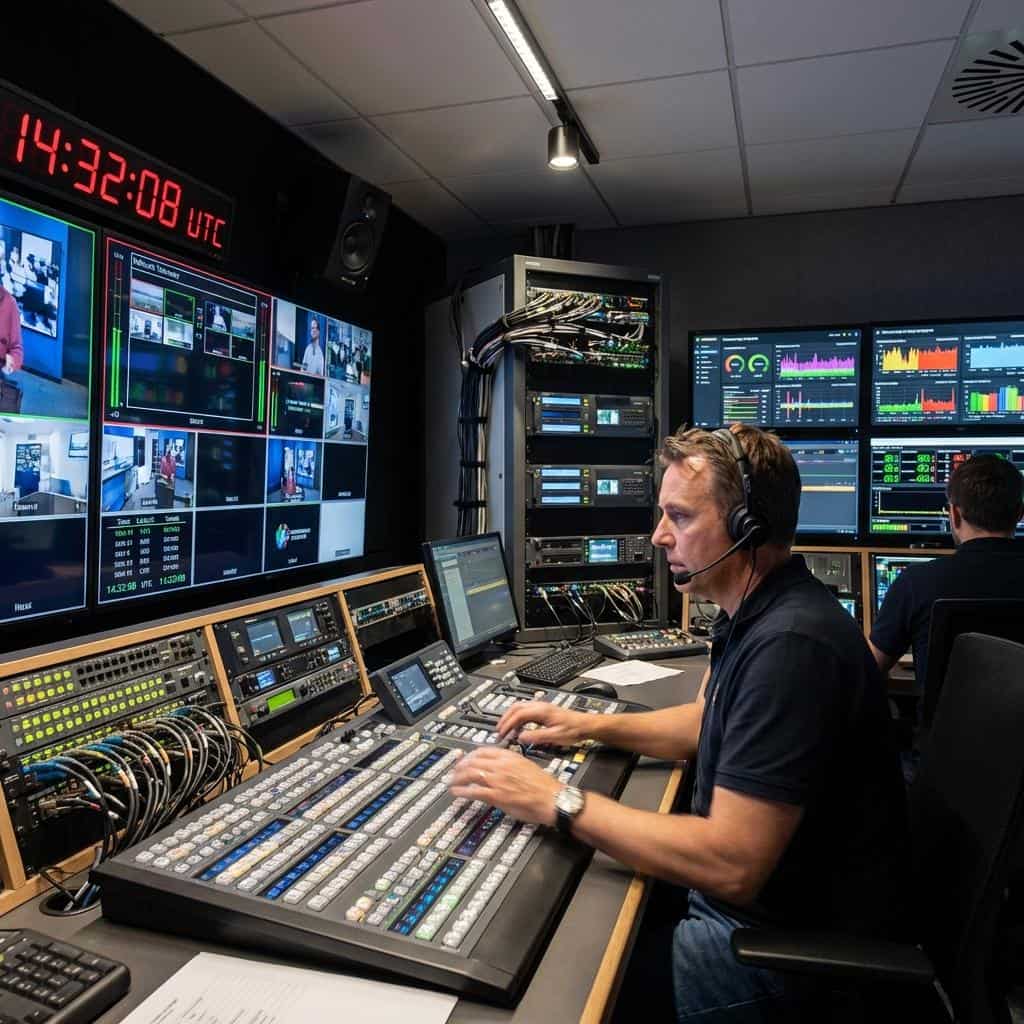
Beyond initial setup, continuous timecode synchronization is vital. All production equipment, servers, and cloud instances involved in the workflow are rigorously synchronized to a common master clock, often a GPS-referenced NTP server. For the most demanding applications, PTP (Precision Time Protocol) is deployed within the local production LAN, providing sub-microsecond accuracy essential for SMPTE ST 2110 IP video workflows. Critical to global distribution is the embedding of timecode (e.g., SMPTE LTC) directly into the video stream, allowing for downstream verification and re-synchronization if needed. This embedded timecode acts as a digital timestamp, proving invaluable for post-event analysis and debugging any synchronization discrepancies.
Real-time Monitoring and Latency Management
Sophisticated monitoring tools are deployed throughout the entire signal chain. At the local production hub, waveform monitors and vectorscopes provide visual confirmation of video signal integrity, while dedicated audio meters monitor levels and phase. Network analyzers (e.g., Wireshark) track packet flow and identify jitter or packet loss on the uplink. Cloud-based streaming analytics platforms offer real-time insights into:
- End-to-End Latency: Tracking the total delay from camera lens to viewer screen, measured in milliseconds (ms), against predefined thresholds.
- Stream Health: Monitoring key metrics like bitrate consistency, frame rate, and audio sync across all ABR renditions.
- CDN Performance: Observing content delivery speeds and error rates from different PoPs globally.
Proactive alerts are configured to immediately notify technical teams of any deviation from synchronization targets or performance degradation. Automated and manual protocols are in place for rapid detection, diagnosis, and resolution of desynchronization events, which may involve adjusting encoder buffer settings, switching CDN paths, or initiating failover procedures.
Redundancy and Failover for Uninterrupted Synchronization
A global product launch leaves no room for error. Therefore, a comprehensive redundancy and failover strategy is fundamental to maintaining continuous synchronization and uninterrupted delivery. This includes:
- N+1 Redundancy: Implementing N+1 redundancy for all critical hardware components, including cameras, vision mixers, audio consoles, and especially encoders and network gateways. This means having one active unit plus at least one hot-standby unit ready to take over instantly.
- Geographically Dispersed Cloud Ingest: Utilizing multiple, geographically separated cloud ingest points for the SRT stream. If one region experiences an outage, the stream can be automatically rerouted to an alternative, active ingest location.
- Automated Failover Mechanisms: Configuring automated failover systems for network paths, encoders, and CDN routes. These systems detect failures or performance degradation and initiate immediate, seamless transitions to redundant systems with minimal, often imperceptible, disruption to the live stream.
- Backup Power: Uninterruptible Power Supplies (UPS) and backup generators ensure the local production hub remains operational during power fluctuations or outages.
The meticulous planning and execution of these redundancy measures are paramount to guaranteeing that a global product launch, despite its inherent complexity, delivers a flawless, synchronized experience to every stakeholder, everywhere.
Conclusion
Executing a globally synchronized product launch from a hub like Singapore is a formidable technical undertaking, demanding a profound understanding of live event production technology, enterprise streaming infrastructure, and global content delivery mechanisms. It necessitates moving beyond basic streaming to embrace precision timing, robust redundancy, and intelligent content orchestration. The Live Streaming Studio technical team stands as your authoritative partner in navigating these complex waters. Our expertise in broadcast-grade production, advanced streaming protocols like SRT, meticulous network engineering, and seamless cloud integration ensures that your enterprise events achieve unparalleled synchronization, global reach, and a flawless representation of your brand’s innovation. Entrust your next global launch to experts who define the standard for precision in B2B event streaming.

Michael Koh is a production specialist and entrepreneur who founded Spring Forest Studio in 2017 to provide event and virtual production solutions in Singapore. He specialises in hybrid live streaming, XR (Extended Reality) virtual production, and studio systems integration, transitioning the business from traditional videography to advanced corporate broadcasting. Operating out of a dedicated facility at NordCom2 in Singapore, he leads a technical crew to deliver multi-camera webcasts, digital sets, and technical consultations for large-scale corporate events.