Precision tracking is the control layer that makes 3D virtual sets behave like a real, camera-native environment during live corporate events, executive broadcasts, product launches, town halls, and hybrid conferences. In a B2B production workflow, the goal is not visual novelty alone. The goal is repeatable camera-to-render alignment, low-latency compositing, stable color and exposure matching, and deterministic behavior across all capture devices, graphics engines, and distribution paths. When the tracking system is accurate, the talent can move naturally, operators can reframe live, and the virtual environment maintains correct perspective, parallax, and shadow interaction without visible drift. When tracking is unstable, the entire hybrid production pipeline loses credibility very quickly.
For enterprise streaming teams, the hardware behind virtual set tracking matters as much as the render engine or the encoder. The tracking layer determines whether the system can sustain sub-frame synchronization between camera motion and on-screen perspective, whether it can tolerate long operating sessions, and whether it can integrate cleanly into an SDI, NDI, or IP-based workflow. In practical terms, precision tracking must coexist with switchers, routers, tally systems, audio mixers, intercom, multi-view monitoring, ISO recording, and streaming encoders while preserving signal integrity across the production chain. For corporate clients, especially those deploying hybrid event environments across boardrooms, studios, convention centers, and regional offices, tracking hardware must be robust, scalable, and operationally predictable.
Core Tracking Hardware and How It Interfaces with the Virtual Production Stack
The most reliable 3D virtual set workflows use tracking hardware that converts physical camera movement into real-time position and orientation data. That data is then ingested by the rendering platform, typically through a tracking protocol or device driver layer, so the virtual camera in the engine mirrors the physical camera in the studio. The hardware category used depends on the production format, budget, studio size, lens requirements, and whether the system is built for a fixed corporate studio or a mobile event deployment.
Optical, inertial, and hybrid tracking systems
Optical tracking systems use cameras, reflective markers, active markers, or coded reference points to calculate position and rotation. These systems can provide high spatial accuracy, especially in controlled studios with clean sightlines and calibrated marker fields. They are well suited to fixed installations where the camera path is repeatable and the environment can be controlled. The main requirement is uninterrupted line of sight, which means truss placement, lighting fixtures, LED walls, and presenters must be designed to avoid occlusion.
Inertial tracking systems use gyroscopes, accelerometers, and sometimes magnetometers to calculate movement from motion sensors mounted on the camera or lens assembly. These devices are compact, fast to deploy, and useful for mobile corporate productions, but inertial drift must be managed carefully. For long-form live events, drift compensation and periodic re-referencing become critical. Hybrid systems combine inertial measurement units, often called IMUs, with optical or reference-based correction to deliver both responsiveness and stability.
For enterprise use, hybrid systems often offer the best balance. A camera-mounted IMU provides low-latency motion data, while optical or survey-based reference points correct cumulative error. This matters in multi-hour conferences where camera repositioning, talent movement, and scene transitions occur constantly.
Lenses, encoders, and metadata path integrity
Precision virtual set rendering depends not only on camera position, but on lens metadata. Zoom, focus, iris, and sometimes distortion characteristics must be available to the render engine to maintain geometric accuracy. Lens encoders, coupled to zoom and focus rings or integrated into camera systems, output positional information that informs the virtual perspective. Without reliable lens metadata, the render engine cannot maintain correct frustum matching, and the perceived set will shift as focal length changes.
Production engineers should validate lens encoder resolution, repeatability, and calibration persistence. In practical terms, a lens that reports position inconsistently will create floating virtual lines, mismatched parallax, and incorrect key-to-background relationships. This becomes especially visible in wide-angle corporate presentations, where the set often includes branded architecture, lower-third placement zones, and virtual monitor surfaces.
Camera interfaces also matter. SDI remains highly relevant in virtual production because it provides deterministic transport, genlock compatibility, and low operational complexity. HDMI 2.1 can be used in some compact environments, but long-distance reliability, signal locking, and interoperability favor SDI in enterprise-grade workflows. In IP-centric facilities, NDI and NDI|HX may be used for monitoring, contribution, or selected camera paths, but critical tracking and keying paths still require disciplined latency management and clock synchronization.
Calibration, Synchronization, and Latency Control in Live Hybrid Production
The best tracking hardware is ineffective without precise calibration. A virtual set workflow is fundamentally a synchronization system, where camera motion, lens state, renderer output, switcher timing, and final encode chain must behave like one coordinated platform. For live event producers, the engineering challenge is not just image quality, but temporal alignment across heterogeneous devices.
Camera calibration and coordinate matching
Calibration aligns the physical camera’s sensor, lens, and tracking origin with the virtual camera inside the graphics engine. The process typically includes sensor alignment, nodal point measurement, lens distortion profiling, and spatial registration to the studio coordinate system. Accurate calibration ensures that when the camera pans, tilts, dollies, or cranes, the virtual background responds with proper perspective and depth cues.
In a corporate studio, calibration should be stored, versioned, and verified before each major event. Mechanical camera changes, tripod height changes, or lens swaps can invalidate prior calibration. Engineering teams should establish a standardized pre-show checklist that includes reference chart capture, focus verification, lens metadata inspection, and a motion test across the full operating range. If the production uses multiple cameras, each camera path must be calibrated independently, then validated against a common virtual environment scale.
Genlock, timecode, and system timing
Genlock is essential whenever multiple cameras, switchers, LED walls, and graphics systems must move in phase. By locking devices to a common reference, genlock reduces frame tearing, switching glitches, and mismatched scan timing. In multi-camera corporate events, this is especially important when the program feed is distributed to conference platforms such as Microsoft Teams, Zoom, or Webex, because the live switched output may also feed recording systems and local displays.
Timecode, often distributed via LTC or embedded within a synchronized production system, supports ISO recording and post-event editing. ISO recording captures isolated camera feeds, allowing post-production teams to repair transitions, re-time speaker segments, and generate executive highlight reels without relying solely on the live program feed. For high-stakes enterprise events, this archival strategy is standard practice because it reduces downstream editorial risk and supports compliance workflows.
Latency management must be engineered end to end. Tracking latency, render latency, keying latency, switcher processing time, encoder delay, and network contribution latency all accumulate. A technically sound setup minimizes each stage, then maintains predictable total latency so the presenter can interact naturally with virtual elements and remote participants. SRT, or Secure Reliable Transport, is commonly used for contribution over challenging networks because it offers packet recovery and resilience on unpredictable links. RTMP and RTMPS remain relevant for certain distribution endpoints, but in enterprise hybrid events, the selection of protocol must reflect the required latency, security posture, and compatibility with the event platform.
Network, Routing, and Signal Architecture for Enterprise-Grade Virtual Sets
Precision tracking systems operate inside a broader production fabric that includes video routers, audio DSP, control surfaces, and network switches. If the network architecture is weak, tracking data packets can arrive late, cameras can lose sync, and render engines can desynchronize from live sources. Enterprise clients should design virtual production infrastructure with the same discipline used for broadcast control rooms and mission-critical collaboration networks.
Signal flow and routing design
A clean signal flow begins with camera capture, tracking metadata, and lens data, then passes through a production switcher or vision mixer, and finally reaches the encoder and distribution nodes. In modern facilities, SDI remains common for primary program paths, while NDI can support flexible monitoring, confidence feeds, and selected remote workflows. The key is not to force every signal onto one transport, but to use the right transport for each stage. For example, a studio may keep camera-to-switcher paths in SDI, use NDI for multiview and remote production assists, and use SRT for contribution to an offsite processing or backup location.
Audio must be equally disciplined. Virtual sets often fail perceptually when audio and camera motion do not feel anchored to the same space. Professional audio mixing requires clear gain staging, consistent microphone placement, echo management, and tight coordination between the audio console and the video director. Talkback systems are essential for keeping camera operators, shader operators, and technical directors aligned during live changes. In corporate events, where presenters may pivot between keynote delivery, product demonstration, and remote Q&A, the intercom path is as operationally important as the camera path.
Bandwidth, QoS, and redundancy
Enterprise production networks should be segmented for video, control, audio, and general-purpose traffic. Quality of service, or QoS, ensures that latency-sensitive streams receive priority over non-critical traffic. Managed switches should be configured with VLAN segmentation, appropriate multicast handling where required, and clear bandwidth headroom. NDI and NDI|HX deployments require careful attention to network congestion because video-over-IP traffic can scale quickly across multiple cameras and monitoring endpoints.
Redundancy is not optional for high-visibility corporate events. Dual network paths, redundant encoders, spare tracking sensors, backup power via UPS systems, and failover switching strategies all reduce operational exposure. For onsite and remote hybrid events, it is prudent to design a primary and secondary contribution path, one local and one remote, so if the venue uplink degrades the show can continue through alternate connectivity. Where possible, encoding should support H.264 and H.265 profiles that match the destination platform’s ingest requirements, while retaining enough bitrate to preserve rendered detail, branded graphics, and readable on-screen text.
Cloud, On-Premise, and Hybrid Deployment Models
There is no single deployment model that suits every enterprise virtual production use case. The right choice depends on latency tolerance, security requirements, staff expertise, venue connectivity, and how often the studio is used. Precision tracking hardware integrates into all three primary models, but the operational implications differ.
On-premise virtual production studios
On-premise deployments provide maximum control. Tracking sensors, render engines, routers, encoders, and monitoring all reside within the same local facility, reducing external network dependence. This is the preferred model for corporate headquarters studios, executive briefing centers, and recurring brand broadcast environments. It simplifies troubleshooting because the engineering team can validate every stage of the chain in the same room. It also improves security posture, which matters for confidential financial announcements, product launches, and internal leadership meetings.
Cloud-assisted and remote production workflows
Cloud-based elements are useful for transcoding, clipping, content distribution, and collaborative control, but the core tracking loop should remain as local and deterministic as possible. In remote production scenarios, it is common to transport contribution feeds to a central facility using SRT, then handle monitoring, playout, and post-event asset generation in the cloud. The tracking data itself usually remains local to the camera and render engine because the latency requirements are too strict for internet-based round trips. A hybrid model is often the most practical, with local capture and tracking at the venue, and cloud services for archive, distribution, and analytics.
Integration with Teams, Zoom, and Webex
Hybrid events frequently require integration with Microsoft Teams, Zoom, or Webex for live audience participation, executive meetings, or remote panel discussions. These platforms impose their own format, bitrate, and latency constraints, so the production engineer must normalize the output to the platform’s ingest expectations. That may involve frame rate conversion, audio sample rate alignment, and color space management. The tracking system remains upstream of this process, but its stability directly affects the polish of the final output. If the virtual camera jitters, the remote audience sees it immediately, even on a compressed conferencing feed.
Implementation Guidelines for Enterprise Clients
Successful virtual set deployment begins with requirements engineering, not equipment shopping. Define the use case clearly, whether it is a quarterly earnings webcast, a leadership town hall, a product education session, or a hybrid conference with remote presenters. Map the number of cameras, expected movement patterns, floor space, lighting design, and branding requirements. Then match the tracking architecture to the production goals.
Practical commissioning sequence
- Confirm camera, lens, and tracking device compatibility before deployment.
- Establish a stable reference coordinate system and document it for future re-calibration.
- Test genlock, timecode, and frame rate alignment across all devices.
- Validate tracking performance during full camera motion, including pan, tilt, dolly, and crane movements if used.
- Measure end-to-end latency from capture to program output and confirm that all switchers, encoders, and conferencing endpoints remain within the show standard.
- Run a failover rehearsal that includes network interruption, encoder substitution, and backup tracking recovery.
Enterprises should also treat operator workflow as part of the system design. A virtual production environment is only as reliable as the people running it. Camera operators need clear movement boundaries. Graphics operators need a stable interface between tracking data and the render engine. Audio engineers need predictable cueing, and technical directors need well-defined escalation paths when a sensor, lens, or network element fails. Documentation, labeled patching, and pre-show rehearsal are not administrative extras, they are core reliability controls.
For corporate event planners and AV professionals, the business case is straightforward. Precision tracking hardware protects the visual integrity of the production, preserves the credibility of executive messaging, and reduces the likelihood of on-air technical defects. In a hybrid event, every frame must serve both the in-room audience and the remote audience. A stable 3D virtual set supports that requirement by making the environment feel engineered rather than improvised.
In Singapore and across regional enterprise production hubs, demand for professional hybrid events continues to favor systems that are modular, secure, and maintainable. Precision tracking hardware, when paired with disciplined routing, standards-based transport, and resilient network architecture, gives production teams the foundation they need to deliver broadcast-quality virtual environments at scale. For organizations operating under tight schedules, multi-site coordination, and high stakeholder visibility, that foundation is what separates a visually impressive event from a technically dependable one.
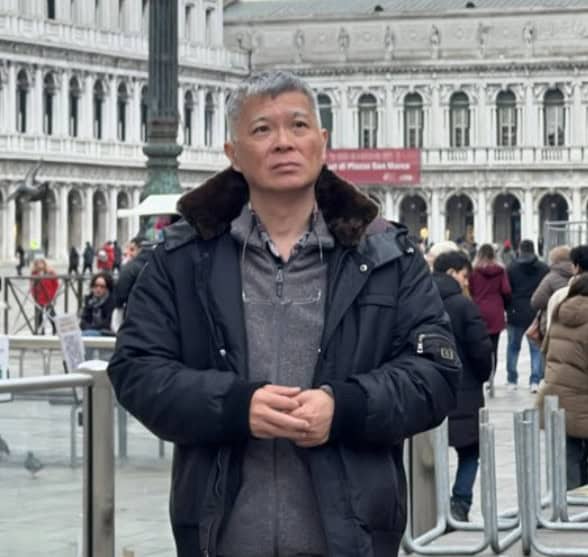
Michael Koh is a production specialist and entrepreneur who founded Spring Forest Studio in 2017 to provide event and virtual production solutions in Singapore. He specialises in hybrid live streaming, XR (Extended Reality) virtual production, and studio systems integration, transitioning the business from traditional videography to advanced corporate broadcasting. Operating out of a dedicated facility at NordCom2 in Singapore, he leads a technical crew to deliver multi-camera webcasts, digital sets, and technical consultations for large-scale corporate events.