
 April 17, 2026 by Michael Koh |
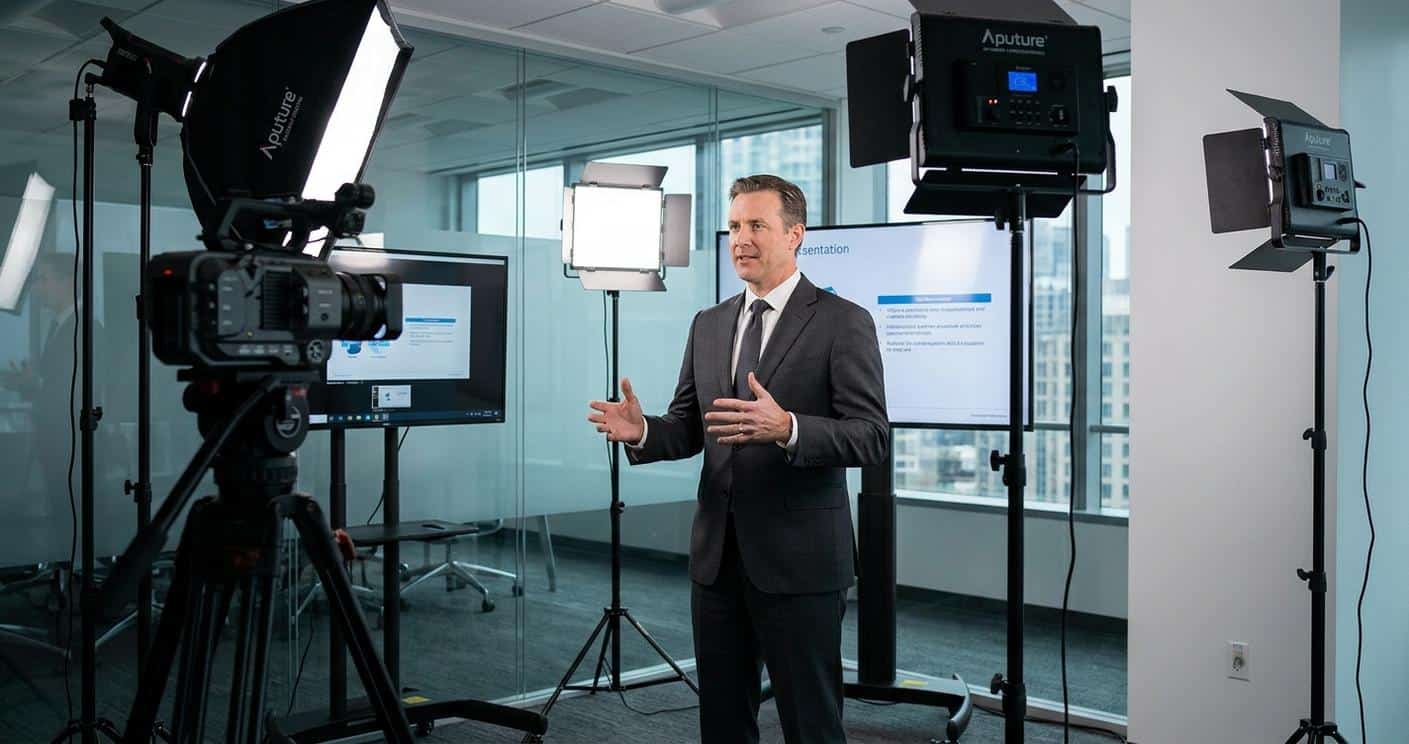
In the high-stakes environment of B2B event streaming and hybrid productions, the on-camera presence of C-suite executives is paramount. Beyond articulate communication and compelling content, visual authority is intrinsically linked to technical production quality. While robust streaming protocols like Secure Reliable Transport (SRT) and Network Device Interface (NDI), high-fidelity audio signal chains, and resilient network infrastructures are foundational, professional lighting is the unsung hero that elevates a presentation from adequate to truly authoritative. For corporate event planners, AV professionals, production managers, and IT directors, understanding the intricate technicalities of broadcast-grade lighting is critical for delivering enterprise-level virtual experiences that reflect brand excellence and executive gravitas. This advanced technical analysis delves into the scientific principles, system architectures, and practical implementation guidelines for optimizing professional lighting in B2B streaming scenarios, ensuring C-suite presenters project confidence, credibility, and clarity.
The Physics of Light and Camera Sensors in B2B Production
Achieving a professional aesthetic for C-suite presentations begins with a foundational understanding of how light interacts with camera sensors and how these interactions impact the final streamed output. This is not merely about brightness, but about the nuanced interplay of color, intensity, and spatial distribution, all captured by sophisticated imaging pipelines.
Understanding Color Temperature and White Balance for Broadcast Quality
Color temperature, measured in Kelvin (K), dictates the perceived warmth or coolness of light. For professional broadcast and B2B streaming, consistent color temperature is non-negotiable. Standard daylight (5600K) and tungsten (3200K) are common benchmarks. Variations in ambient lighting, such as fluorescent fixtures or natural window light, can introduce undesirable color casts. Professional production cameras, whether high-end cinematic cameras like the ARRI ALEXA Mini LF or broadcast workhorses such as the Blackmagic URSA Broadcast G2 or Sony PXW-FX9, rely on precise white balance calibration to render colors accurately. Mismatched color temperatures lead to color shifts in the program feed, requiring extensive post-production color grading or, more critically for live events, presenting an inconsistent and unprofessional visual. High Color Rendering Index (CRI) LED fixtures (typically CRI >90) are essential to accurately reproduce skin tones and corporate branding colors, ensuring the C-suite executive’s appearance is truthful and vibrant, not artificially tinted.
Illuminance, Luminance, and Dynamic Range in Enterprise Video
Illuminance refers to the amount of light falling on a surface, measured in Lux (lx) or foot-candles (fc). Luminance, conversely, is the amount of light emitted or reflected from a surface, crucial for how a camera perceives brightness. Professional camera sensors operate within a defined dynamic range, which is their ability to capture detail in both the brightest highlights and darkest shadows simultaneously. Exceeding this dynamic range results in clipping (loss of detail in highlights) or crushing (loss of detail in shadows). For C-suite presentations, a controlled lighting environment allows for optimal exposure settings (f-stop, ISO, shutter speed) on cameras, preventing blown-out faces or overly dark backgrounds. Achieving a suitable contrast ratio, often monitored via waveform monitors and vectorscopes on a multiview display, is vital to prevent image quality degradation during H.264 or H.265 encoding for streaming. Maintaining a consistent video signal with optimal luminance levels is paramount for bitrate management and artifact reduction, especially when streaming at resolutions up to 4K/UHD over protocols like RTMP/RTMPS or SRT.
Core Lighting Techniques for Executive Presence
Beyond theoretical understanding, practical application of lighting principles directly impacts the perceived authority and professionalism of an on-camera executive. Strategic deployment of fixtures and control over light characteristics are fundamental.
Three-Point Lighting System: Key, Fill, and Backlight for Dimensionality
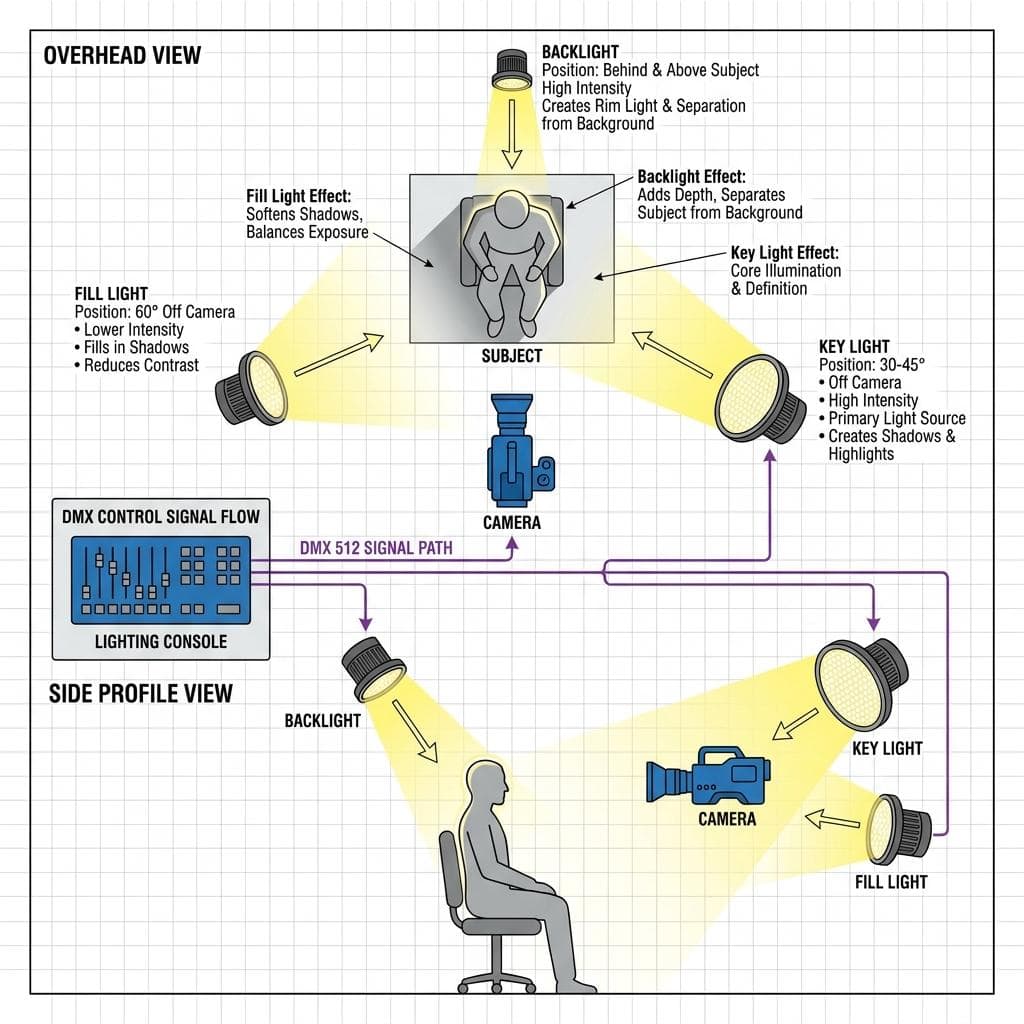
The industry standard for isolating a subject from the background and adding dimensionality is the three-point lighting system. This setup typically involves:
- Key Light: The primary light source, positioned slightly off-axis from the camera (typically 30-45 degrees to one side) and slightly above the subject, casting subtle shadows to define facial contours. Its intensity is usually the highest.
- Fill Light: Placed on the opposite side of the camera from the key light, at a lower intensity (often half the key light’s intensity, producing a 2:1 ratio for a natural look), its purpose is to soften the shadows created by the key light without eliminating them entirely, preserving depth.
- Backlight (Hair Light/Rim Light): Positioned behind and above the subject, aiming towards the back of their head and shoulders. This light creates a subtle rim of light, separating the subject from the background and adding visual pop.
Precise positioning and intensity control of these three elements ensure a well-modeled, flattering, and authoritative look that translates exceptionally well through multi-camera production setups and video switching systems like Ross Carbonite or Blackmagic ATEM Constellation, before being encoded for distribution.
Avoiding Pitfalls: Hot Spots, Glare, and Unflattering Shadows
Amateur lighting often suffers from common pitfalls that detract from executive presence. “Hot spots” or specular highlights, particularly on shiny skin or glasses, can be mitigated through diffusion. Using softboxes, diffusers, or bouncing light off a white surface creates a broader, softer light source. Glare on monitors or reflective surfaces can be controlled by careful fixture placement, polarization filters, or adjusting the angle of monitors. Unflattering shadows, such as harsh shadows under the chin or nose, are typically a result of incorrect key light angle or lack of adequate fill. Understanding the inverse square law of light, where light intensity diminishes rapidly with distance, is crucial for maintaining consistent exposure across the set and preventing uneven illumination. Moreover, ensuring the background is appropriately lit, without distracting bright spots or deep shadows, is critical for maintaining visual balance and minimizing focus pulling issues with large sensor cameras during live acquisition.
Advanced Lighting Systems and Control for Hybrid Events
Modern B2B event production, especially hybrid events integrating physical and virtual audiences, demands sophisticated lighting infrastructure that is precise, flexible, and seamlessly integrated into the overall production workflow.
LED Fixtures and DMX Control for Precision and Flexibility
The advent of high-output, color-tunable LED lighting fixtures has revolutionized professional production. Fixtures like ARRI SkyPanel, Astera Titan Tubes, or Aputure Nova P600c offer full RGBW (Red, Green, Blue, White) capabilities, allowing for millions of color combinations, and precise CCT (Correlated Color Temperature) tuning from 2700K to 10000K. This level of control is achieved via DMX512 (Digital Multiplex) protocol, the industry standard for theatrical and live event lighting control. Modern DMX consoles (e.g., grandMA3, Hog 4, Avolites) provide intricate control over intensity, color, zoom, focus, and movement for hundreds of fixtures. For hybrid events, the ability to rapidly change lighting cues to match different segments, presenter entries/exits, or corporate branding elements is vital. Advanced DMX networking via Art-Net or sACN (Streaming ACN) over standard Ethernet infrastructure allows for robust, scalable control across complex venues, ensuring real-time response and synchronized lighting effects.
Integrating Lighting with Multi-Camera Production Workflows
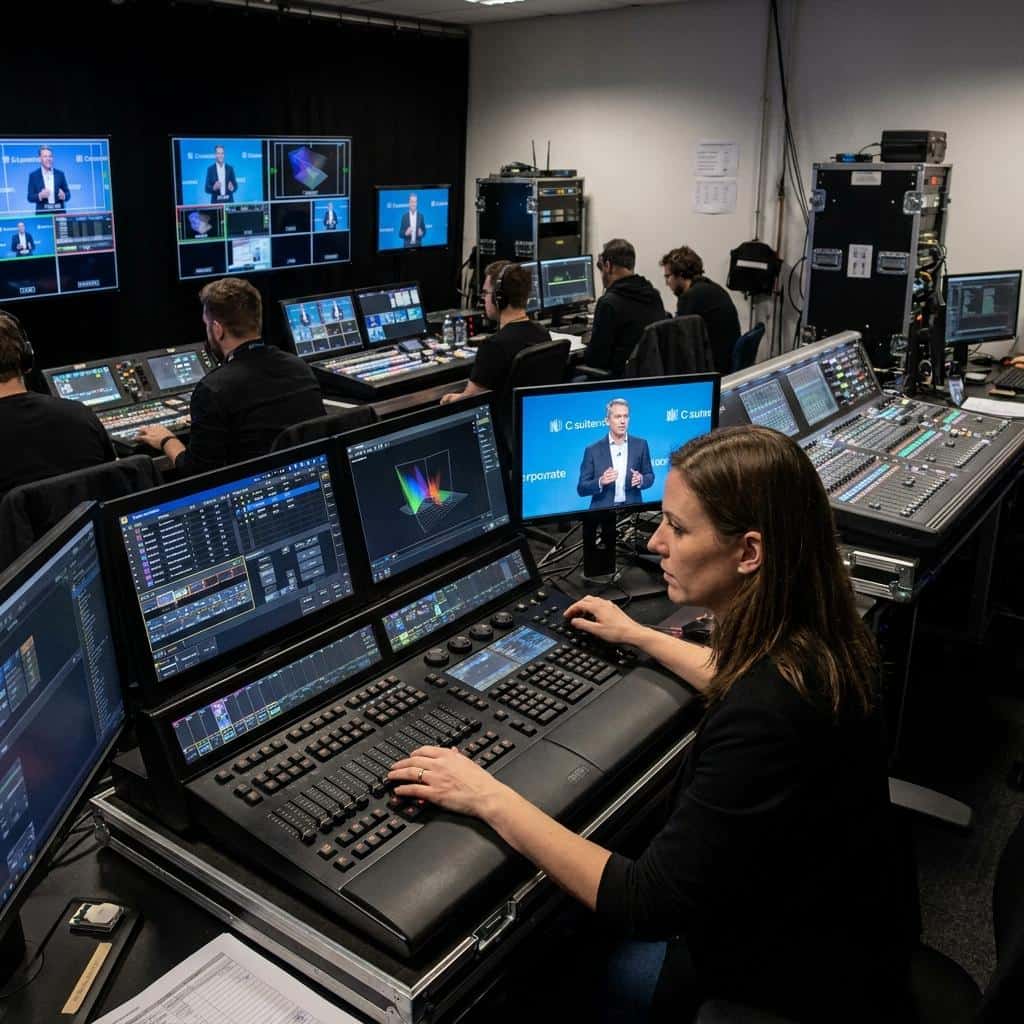
Lighting is not an isolated discipline; it is an integral component of the multi-camera production workflow. Proper lighting directly impacts the output quality of each camera feed, affecting decisions made by the vision mixer/technical director. Consistent exposure, color rendition, and dynamic range across multiple camera angles (e.g., wide shot, tight shot, profile shot) are achieved through careful lighting design and, critically, camera shading (matching color and exposure between cameras using CCU/RCP units). Without optimal lighting, the camera shading engineer faces an uphill battle to achieve a cohesive program feed. Furthermore, lighting cues can be synchronized with video playback servers (e.g., PlaybackPro, Resolume Arena) and audio mixing consoles (e.g., Yamaha Rivage PM series, DiGiCo SD series) to create a fully immersive and professional live experience. This synchronization is crucial for delivering a polished final product, whether transmitted via dedicated fiber links, SDI over IP (SMPTE 2110), or encoded for distribution via Content Delivery Networks (CDNs).
Power Management and Signal Integrity for Reliable Operations
The reliance on sophisticated LED and intelligent fixtures necessitates meticulous power management and signal integrity. Enterprise-grade productions require dedicated power distribution units (PDUs) and often Uninterruptible Power Supplies (UPS) for critical control systems and specific lighting fixtures, ensuring continuity during power fluctuations or outages. DMX signal integrity is equally critical; long cable runs, electromagnetic interference, or improper termination can lead to flickering lights, unresponsive fixtures, or complete system failures. Utilizing shielded DMX cables, opto-splitters, and DMX boosters ensures robust signal transmission. For advanced networked DMX systems using Art-Net or sACN, a dedicated gigabit Ethernet network with appropriate Quality of Service (QoS) prioritization is essential to prevent latency or dropped packets, which would manifest as delayed or erratic lighting changes. Redundant DMX universes and failover mechanisms are often implemented to mitigate single points of failure, adhering to the high reliability standards expected in B2B live event environments.
Environmental Factors and Practical Implementation for Corporate Venues
Translating theoretical lighting principles into practical, effective solutions within diverse corporate event venues requires adaptability and foresight, addressing ambient conditions and operational workflows.
Mitigating Ambient Light and Minimizing Reflections
Corporate venues frequently present challenges from uncontrolled ambient light sources, such as large windows or overhead house lighting. Direct sunlight can create harsh shadows and dramatically shift color temperature. Strategies include deploying blackout curtains or heavy drapes to control natural light and using dedicated dimmers for house lighting. Minimizing reflections from glass surfaces, glossy tables, or screen displays requires careful light positioning, employing gobos to shape light, or using anti-reflective filters on cameras. Even the placement of teleprompters needs consideration to avoid creating bright spots in the presenter’s eyes or lens flares. A professional site survey prior to production is essential to identify and plan for these environmental variables, ensuring the lighting design can effectively overpower or integrate with existing conditions without compromise to the C-suite’s visual presentation.
Ergonomics and Operator Workflows in Lighting Design
The efficiency and accuracy of lighting control during a live event heavily depend on ergonomic design and streamlined operator workflows. A well-configured lighting console with intuitive user interfaces, customizable layouts, and efficient cue stacking capabilities allows a lighting director to execute complex transitions seamlessly. Pre-programming specific looks for different presenters, segments, or moods, and storing them as cues or scenes, significantly reduces live operational burden. Integration with production switchers via General Purpose Interface (GPI) triggers or even timecode synchronization can automate lighting changes, ensuring precise timing. Furthermore, effective communication channels, such as talkback systems (e.g., Clear-Com, RTS Intercoms) between the lighting director, camera operators, technical director, and stage manager, are crucial for adapting to unforeseen circumstances in real-time without disrupting the program feed.
Scalability and Redundancy in Enterprise Lighting Solutions
For enterprise clients, scalability and redundancy are paramount considerations for all production elements, including lighting. A robust lighting system must be capable of adapting from a small executive interview setup to a large-scale hybrid general session. This involves selecting modular LED fixtures that can be easily deployed and networked, and DMX control systems capable of managing multiple universes. Redundancy planning includes having spare fixtures, DMX signal splitters with automatic failover, and backup power sources. In critical B2B streaming scenarios, where broadcast uptime is directly linked to corporate reputation, a comprehensive failover strategy for lighting ensures that even in the event of equipment malfunction, the C-suite presentation maintains its professional integrity. This level of meticulous planning and implementation underscores the commitment to enterprise-grade reliability that Live Streaming Studio consistently delivers.
The visual impact of a C-suite executive on camera is directly proportional to the professionalism of the lighting. From understanding the nuanced physics of light and its interaction with high-end camera sensors, through mastering advanced three-point lighting techniques and DMX-controlled LED systems, to navigating the complexities of hybrid event environments, every technical detail contributes to an authoritative presence. Live Streaming Studio provides the deep technical expertise and infrastructure required to design, implement, and manage these sophisticated lighting solutions. By partnering with us, corporate event planners and AV professionals can ensure their C-suite leaders always present with unparalleled clarity, confidence, and visual distinction, reinforcing brand strength in every streamed interaction across the global enterprise landscape.
Michael Koh is a production specialist and entrepreneur who founded Spring Forest Studio in 2017 to provide event and virtual production solutions in Singapore. He specialises in hybrid live streaming, XR (Extended Reality) virtual production, and studio systems integration, transitioning the business from traditional videography to advanced corporate broadcasting. Operating out of a dedicated facility at NordCom2 in Singapore, he leads a technical crew to deliver multi-camera webcasts, digital sets, and technical consultations for large-scale corporate events.