Introduction
In a world where corporate communication is increasingly conducted through live events, ensuring message clarity for executive leaders like CEOs has become paramount. Professional scripting plays a crucial role in delivering this clarity, especially in the context of B2B event streaming and hybrid productions. With the rise of sophisticated streaming technology and hybrid event frameworks, the intricacies of scripting for CEOs require an advanced technical understanding of both the production and broadcasting environments.
Technical Considerations in Live Event Scripting
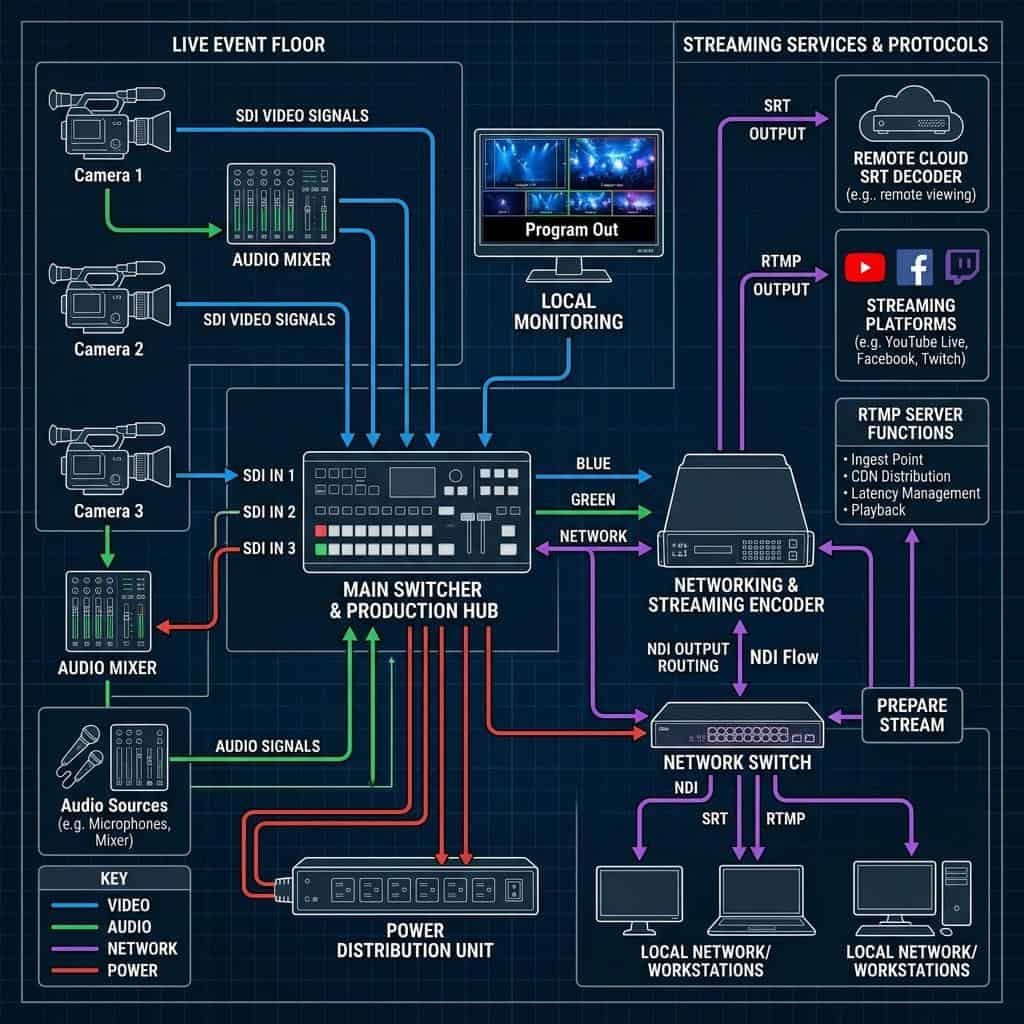
Understanding the technical environment is vital when crafting scripts for live events. The integration of Secure Reliable Transport (SRT) and Real-Time Messaging Protocol (RTMP) allows seamless content delivery across complex network infrastructures. These protocols ensure low-latency communication, which is crucial for real-time speech delivery where any lag could disrupt the audience’s experience.
Interfacing with Production Technology
Scripting must account for the specific hardware and software interfaces in use. For instance, NewTek’s NDI (Network Device Interface) offers flexible, IP-based broadcast workflows, facilitating seamless transitions between cameras and ensuring high-quality video streams.
Crafting the Executive Message
The process of crafting messages for CEOs involves not only wordsmithing but understanding the visual and audio delivery mechanisms. High-definition SDI (Serial Digital Interface) and HDMI 2.1 connections deliver clear, crisp visuals that complement the precise scripting required for corporate events, reinforcing the CEO’s presence and gravitas.
Managing Audio/Video Sync
Accurate synchronization of audio and video feeds is crucial. Using professional audio mixing consoles and video switching systems, crews can ensure that the messaging aligns perfectly with live delivery, avoiding the pitfalls of mismatched lips and sound.
Hybrid Event Scripting Challenges
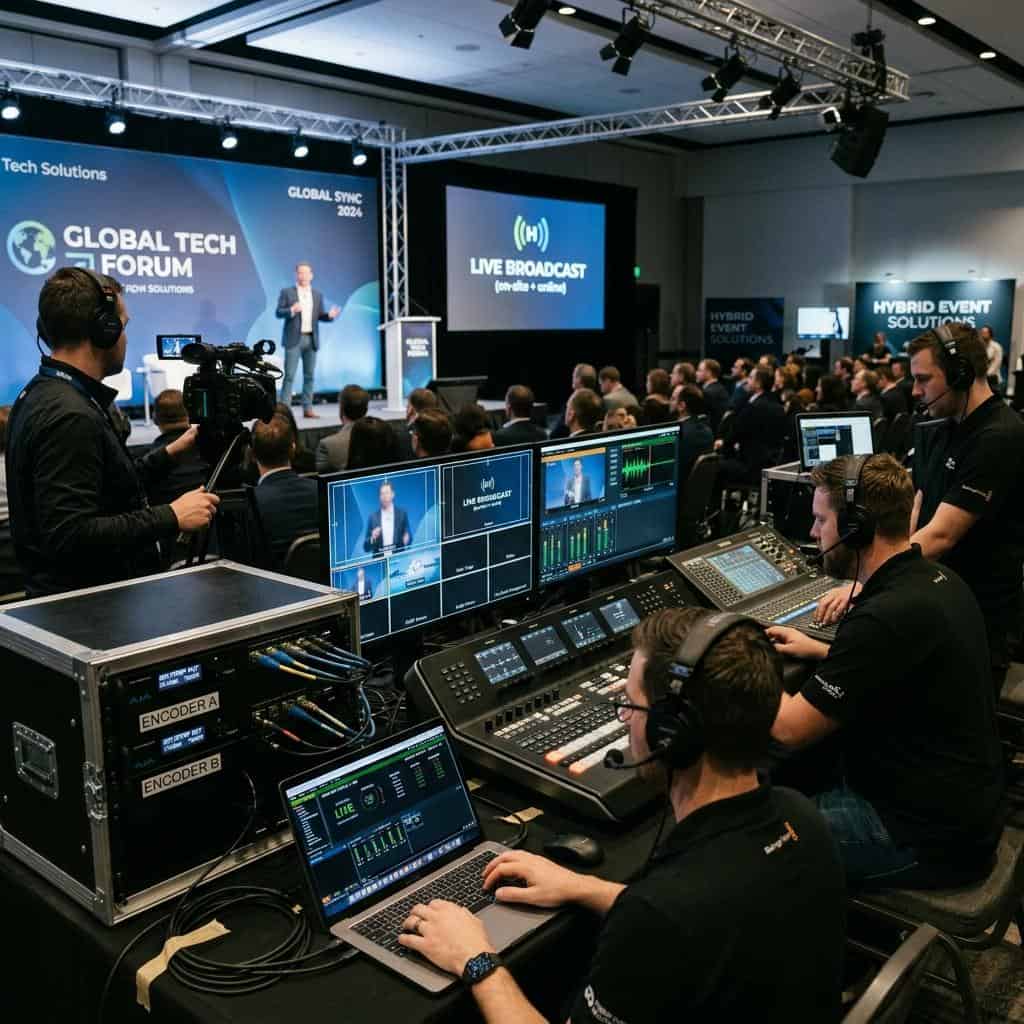
Hybrid events introduce a dual-mode participation model, combining in-person and virtual audiences. This duality increases scripting complexity, as content must be relevant to both audiences. Advanced multiplexing technologies enable the management of multiple signal paths, ensuring personalized experiences for diverse participants.
Network Infrastructure and Scalability
Scalability in hybrid events is addressed through a robust network infrastructure utilizing both cloud-based and on-premise solutions. Key protocols like SRT and RTMP, paired with H.264/H.265 encoding, allow dynamic scaling to accommodate fluctuating audience sizes without compromising on quality.
Enterprise-grade Streaming Protocols
Protocols such as RTMP/RTMPS and SRT have set the standard for secure, reliable enterprise communications. Ensuring message clarity requires these protocols to be effectively configured within enterprise-grade encoder and decoder setups, maintaining the integrity and security of broadcasts.
Cloud-based Solutions vs. On-Premise Infrastructure
The decision between on-premise and cloud-based solutions hinges on the specific needs of the event. Both offer unique advantages—on-premise setups provide control and customization, while cloud-based deployments offer scalability and reduced overhead.
Conclusion
For corporate event planners and AV professionals, understanding the convergence of enterprise-grade streaming technology and professional scripting is essential for successful live event execution. By aligning technical capabilities with well-crafted scripts, organizations can enhance communication effectiveness, ensuring CEOs’ messages are delivered with clarity and impact.
Michael Koh is a production specialist and entrepreneur who founded Spring Forest Studio in 2017 to provide event and virtual production solutions in Singapore. He specialises in hybrid live streaming, XR (Extended Reality) virtual production, and studio systems integration, transitioning the business from traditional videography to advanced corporate broadcasting. Operating out of a dedicated facility at NordCom2 in Singapore, he leads a technical crew to deliver multi-camera webcasts, digital sets, and technical consultations for large-scale corporate events.