
 March 6, 2026 by Editor |
Navigating High-Stakes Streaming: A Technical Framework for SGX Compliance
For publicly listed companies on the Singapore Exchange (SGX), the Annual General Meeting (AGM) or an Extraordinary General Meeting (EGM) represents a critical intersection of corporate governance, shareholder engagement, and regulatory obligation. The migration to virtual and hybrid meeting formats has shifted the burden of compliance from physical event management to the domain of network engineering and live production technology. Meeting SGX’s stringent requirements for live streaming is not a simple IT task; it is a broadcast-level challenge demanding a robust, redundant, and secure technical architecture. A failed stream is not a technical glitch; it is a compliance failure with significant corporate repercussions. This article provides a deep technical analysis of the infrastructure, protocols, and production workflows required to achieve and exceed SGX standards for shareholder meeting webcasts, ensuring uninterrupted service, verifiable participation, and complete data integrity.
The core of the challenge lies in satisfying the SGX mandate for “real-time” and “interactive” proceedings. These terms, while seemingly straightforward, translate into complex technical specifications. “Real-time” necessitates ultra-low latency delivery, while “interactive” requires the seamless and secure integration of third-party platforms for live Q&A and polling. For enterprise IT and AV teams, this requires a strategic move away from standard corporate webinar tools toward a professional production ecosystem. The entire signal chain, from the camera lens in the ballroom to the shareholder’s display, must be engineered for resilience, security, and performance under the pressure of a high-stakes, legally mandated event.
Deconstructing SGX’s Technical Mandates for Live Webcasts
Achieving compliance with SGX regulations for electronic meetings is fundamentally an engineering problem. The guidelines implicitly demand a broadcast-quality infrastructure that guarantees uptime, security, and equitable participation for all shareholders, regardless of their location. This section breaks down the primary regulatory requirements into tangible technical benchmarks and the systems needed to meet them.
Real-Time Transmission and Latency Optimization
The SGX requirement for proceedings to be broadcast in “real-time” is a direct challenge to standard HTTP Live Streaming (HLS) protocols, which often operate with latencies of 30-45 seconds. Such a delay is unacceptable for interactive events like AGMs where polling and Q&A must be timely. The acceptable glass-to-glass latency (from camera lens to viewer’s screen) for a compliant AGM stream should be engineered to be under 15 seconds, and ideally, under 10 seconds. Achieving this requires a specific protocol stack. While Real-Time Messaging Protocol (RTMP) has been a workhorse, its TCP-based nature can lead to buffering and increased latency over unstable networks. The modern broadcast standard is Secure Reliable Transport (SRT), a UDP-based protocol that provides low-latency packet recovery and AES-256 bit encryption. For direct browser playback, WebRTC (Web Real-Time Communication) offers sub-second latency, making it an excellent choice for the final delivery leg from the media server to the end-user, ensuring a truly interactive experience.
Ensuring Uninterrupted Service: Redundancy and Failover Architecture
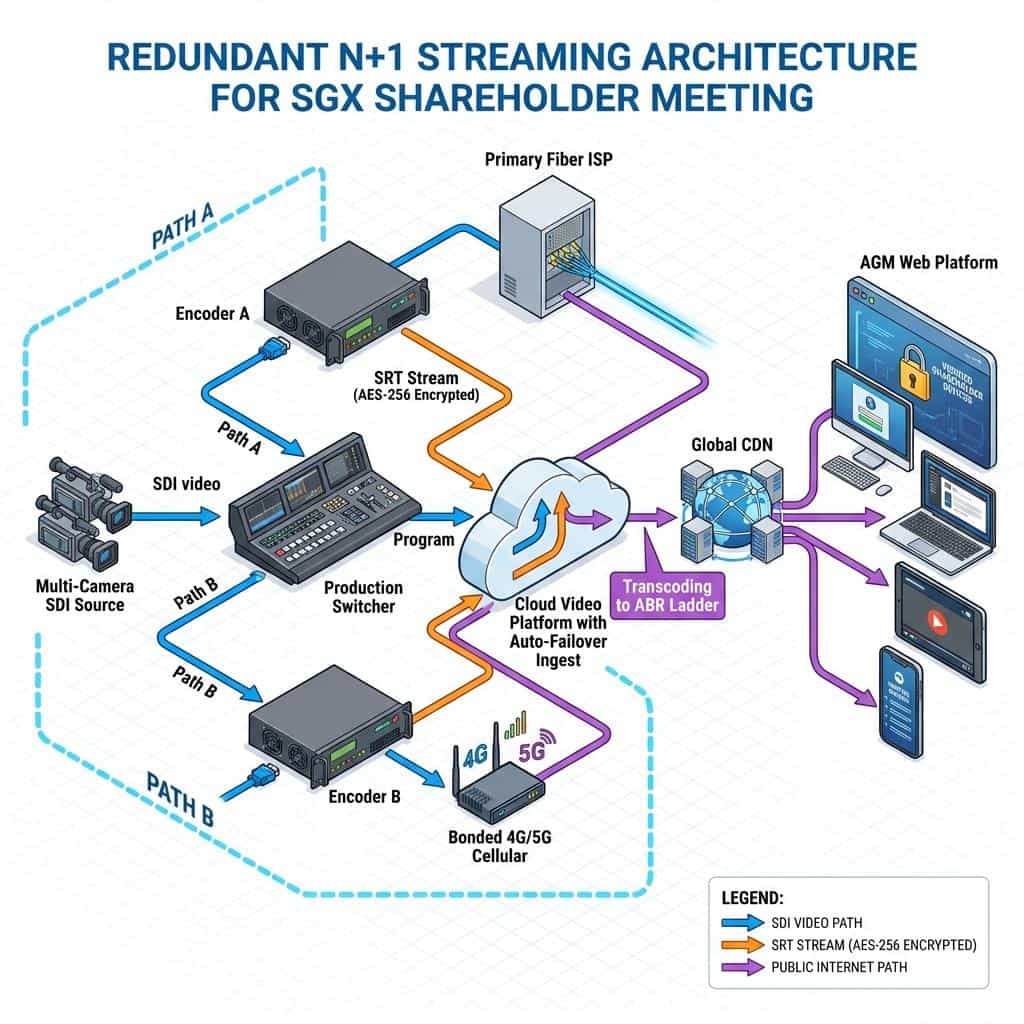
SGX compliance mandates an uninterrupted broadcast. A single point of failure in the production chain is not an option. A robust solution requires a fully redundant N+1 or 1+1 architecture. This begins with the contribution feed. The primary program output from the video switcher must be fed into two separate hardware encoders. These encoders should be configured with identical settings (e.g., 1080p50, 6 Mbps H.264 Main Profile) but routed over physically diverse network paths. The primary path could be a dedicated enterprise fiber line, while the secondary path could utilize a bonded cellular solution (combining multiple 4G/5G carriers) or a separate ISP. Both SRT streams are sent to a cloud-based media server or video platform that is configured with primary and backup ingest URLs. This platform must be capable of seamless, automatic failover, meaning if the primary SRT feed is interrupted for even a few seconds, the system instantly switches to the secondary feed with no disruption to the downstream viewer. This redundancy must extend to power, with all critical components (switchers, encoders, routers) connected to an Uninterruptible Power Supply (UPS).
Verifiable Shareholder Participation: Q&A and Polling System Integration
The interactive component of SGX guidelines requires a secure and auditable method for shareholders to ask questions and vote. This functionality is typically handled by specialized AGM platforms (e.g., Lumi, Boardroom, Convene). From a production standpoint, the video stream must be securely embedded within this platform’s web interface. Integration is managed via Application Programming Interfaces (APIs). The production team works with the AGM platform provider to ensure the video player iFrame is correctly implemented and authenticated. Crucially, the Q&A and polling data travels on a separate, secure HTTPS channel, completely independent of the video stream. The production workflow must include a system for a moderator to receive, vet, and queue questions from the online portal and relay them to the chairperson. This ensures that virtual attendees have the same opportunity to participate as those in the physical venue, a key tenet of the regulations.
Architecting the Production Infrastructure for Compliance
The foundation of a compliant SGX stream is the physical and virtual hardware that acquires, processes, and distributes the video and audio signals. This is not a task for off-the-shelf webinar software; it requires a professional broadcast production workflow built with enterprise-grade components. The architecture must be meticulously planned to ensure signal integrity, processing power, and absolute reliability from end to end.
Signal Acquisition and Routing: From Camera to Encoder
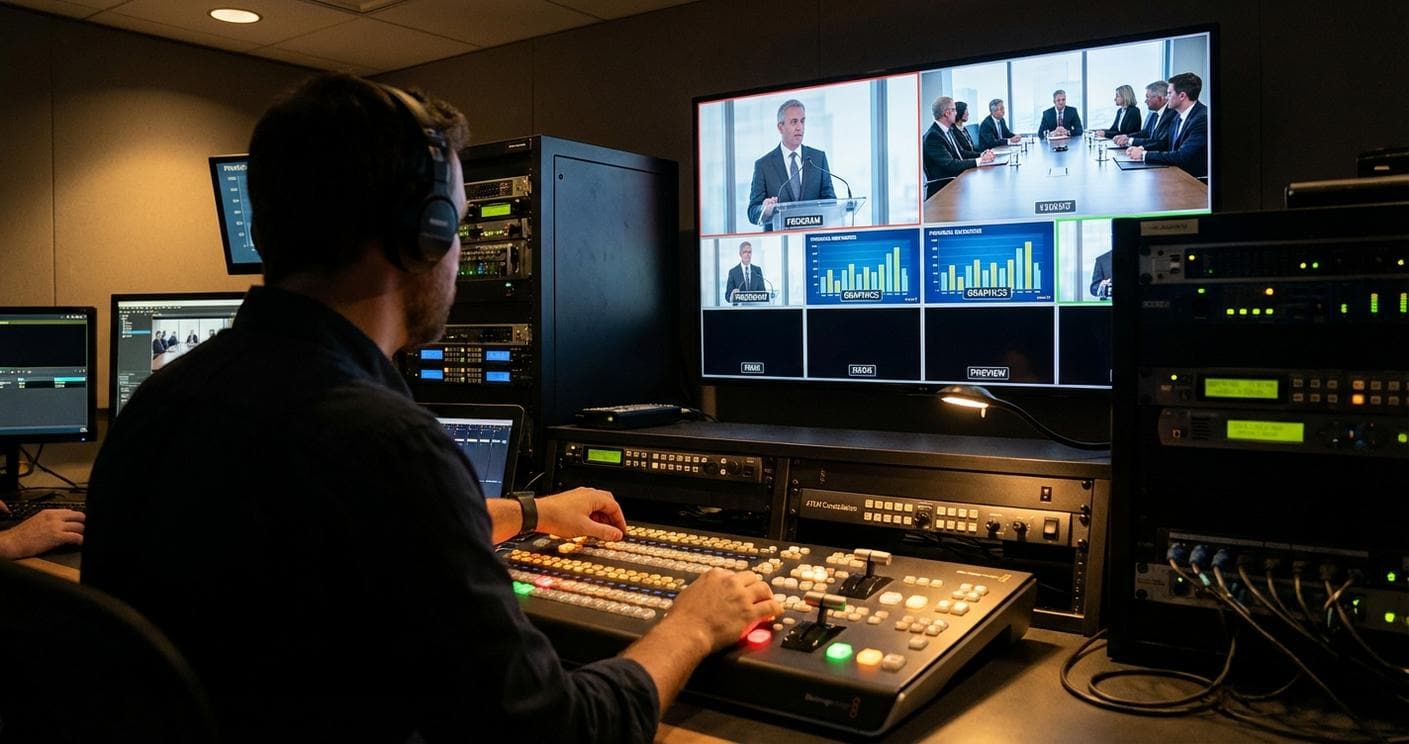
A typical hybrid AGM requires a multi-camera setup to capture the chairperson, the board of directors, and any presentation screens. Professional broadcast cameras outputting via Serial Digital Interface (SDI), specifically 3G-SDI for 1080p or 12G-SDI for 4K/UHD resolutions, are the standard. These baseband video signals are routed into a production video switcher, such as a Blackmagic Design ATEM Constellation or a Ross Video Carbonite. The technical director uses the switcher to cut between camera angles, mix in graphics (lower thirds, presentation slides), and create the final Program (PGM) feed. This PGM feed, which is what the online audience will see, is then output from the switcher via SDI. It’s also best practice to record each camera feed in isolation (ISO recording), providing a complete record of the event and a backup should the PGM recording fail. The PGM SDI signal, with embedded audio, is the primary source that feeds the dual-encoder setup for streaming.
Encoding, Transcoding, and Contribution Protocols
The encoder is the heart of the streaming workflow, converting the SDI baseband video signal into a compressed IP-based format for transmission over the internet. For SGX compliance, hardware encoders (e.g., Haivision Makito X4, AJA HELO Plus) are strongly preferred over software solutions due to their stability and processing power. The primary codec used is H.264 (AVC), which offers the best balance of quality, low latency, and device compatibility. While H.265 (HEVC) is more efficient, H.264 remains the universal standard. A typical encoding profile for an AGM would be 1920×1080 resolution at 50 frames per second, with a constant bitrate (CBR) of 6 to 8 Megabits per second (Mbps). The encoded feed is then packaged using the Secure Reliable Transport (SRT) protocol for its superior performance on public networks. SRT’s ability to correct for packet loss and its mandatory AES-256 encryption make it the definitive choice for secure, high-quality contribution feeds, far surpassing the capabilities of the older, less reliable RTMP.

Network and Security: The Backbone of a Compliant Stream
The most sophisticated production setup is rendered useless by a poorly configured or insecure network. For SGX-compliant streams, network infrastructure and security protocols are not afterthoughts; they are primary components of the system design. The network must provide sufficient, prioritized bandwidth, and the entire transmission must be shielded from unauthorized access.
Enterprise Network Configuration for High-Bitrate Streaming
Streaming a high-quality 8 Mbps SRT feed requires a stable upstream connection. For a fully redundant setup, this means provisioning at least 20-25 Mbps of dedicated, uncontended bandwidth. On a corporate network, this traffic must be isolated from general office data. This is typically achieved by configuring a dedicated Virtual LAN (VLAN) for all production equipment. Furthermore, Quality of Service (QoS) policies should be implemented at the firewall and switch level to prioritize SRT (on its designated UDP port) and other critical production traffic. This prevents packet loss or jitter caused by other network activity and ensures the encoders have a clean, stable path to the internet. Rigorous pre-event network testing, including long-duration packet loss and bandwidth stress tests, is a mandatory step in the preparation process.
Content Delivery Network (CDN) and Geo-Distribution
Once the SRT feed reaches the cloud ingest point, the stream is prepared for mass distribution. This is the role of a Content Delivery Network (CDN) like Akamai, Cloudflare, or AWS CloudFront. The cloud media server transcodes the single 8 Mbps contribution feed into a multi-bitrate ladder (e.g., 1080p, 720p, 480p, 360p). This allows for Adaptive Bitrate (ABR) streaming, where the player on the viewer’s device automatically selects the best quality stream their connection can handle, minimizing buffering. The CDN then distributes these streams across its global network of Points of Presence (PoPs) or edge servers. When a shareholder in another country joins the stream, they receive the video from a server geographically close to them, reducing load times and improving playback stability. This global distribution is essential for ensuring all shareholders have a consistent, high-quality viewing experience.
Securing the Transmission: Encryption and Access Control
Security is paramount. The entire signal path must be encrypted. The SRT contribution feed provides AES-256 encryption from the venue to the cloud ingest. For final delivery to the viewer, the stream must be delivered over HTTPS (TLS encryption). Beyond transport encryption, access control is critical. The stream must only be accessible to verified shareholders. This is accomplished through multiple layers. The AGM platform handles the initial user authentication. The video stream itself is then protected using token-based authentication. When a verified shareholder loads the page, the AGM platform generates a unique, time-limited token that is passed to the video player. The player presents this token to the CDN, which validates it before starting the stream. This prevents unauthorized viewing or embedding of the stream on other websites. Further security can be added through domain and IP-based restrictions, ensuring the stream can only be played on the designated AGM portal.
Conclusion: Engineering Certainty for Corporate Governance
Fulfilling the SGX’s technical requirements for virtual and hybrid shareholder meetings is a complex engineering discipline that extends far beyond basic web conferencing. It demands a broadcast production methodology centered on the core principles of signal and network redundancy, low-latency transport protocols like SRT, robust multi-layered security, and seamless integration with specialized shareholder platforms. The entire workflow, from SDI signal acquisition and routing to multi-bitrate transcoding and secure CDN delivery, must be designed and executed with precision. For corporate decision-makers, entrusting this critical compliance task to a dedicated production partner with proven expertise in enterprise-grade streaming architecture is the most effective strategy for mitigating risk. By investing in a professionally engineered solution, companies can ensure their AGMs are not only compliant but also serve as effective, secure, and reliable platforms for shareholder engagement.