
In the dynamic landscape of modern business, Small and Medium-sized Enterprises (SMEs) experiencing rapid growth face an increasingly complex challenge: how to effectively scale their corporate culture and operational communication without sacrificing efficiency or cohesion. Traditional communication methods, often sufficient for smaller teams, quickly become bottlenecks as an organization expands, making seamless knowledge transfer, consistent training, and unified messaging difficult to achieve. This is where enterprise-grade B2B event streaming and hybrid production solutions emerge not merely as technological enhancements, but as fundamental strategic assets for maintaining a robust corporate culture, fostering internal alignment, and executing external communication with professional precision. Unlike consumer-focused video platforms, B2B streaming infrastructure is engineered for high-stakes corporate environments, demanding superior quality of service, stringent security protocols, and unparalleled scalability to manage everything from company-wide town halls and specialized training modules to critical investor briefings and multi-vendor product launches.
The Imperative of Enterprise-Grade Streaming for Growing SMEs
As SMEs grow, their communication needs evolve from simple video calls to complex, multi-faceted broadcasts that require professional-grade production values and robust delivery mechanisms. The informal nature of consumer conferencing applications like basic Zoom or Microsoft Teams calls, while useful for daily ad-hoc meetings, is fundamentally inadequate for large-scale corporate communications. Enterprise streaming, conversely, is built upon a foundation of broadcast-quality standards, offering capabilities such as multi-camera acquisition, dedicated audio mixing, professional lighting integration, and graphic overlays, ensuring that every message is delivered with clarity, authority, and impact. This technical distinction is crucial for rapidly expanding SMEs, as it directly influences employee engagement, brand perception, and the overall professional image projected to stakeholders. The infrastructure underpinning these solutions must provide dedicated bandwidth, employ advanced encoding techniques for optimal video and audio fidelity, and guarantee secure, low-latency distribution across diverse geographical locations, often leveraging global Content Delivery Networks (CDNs).
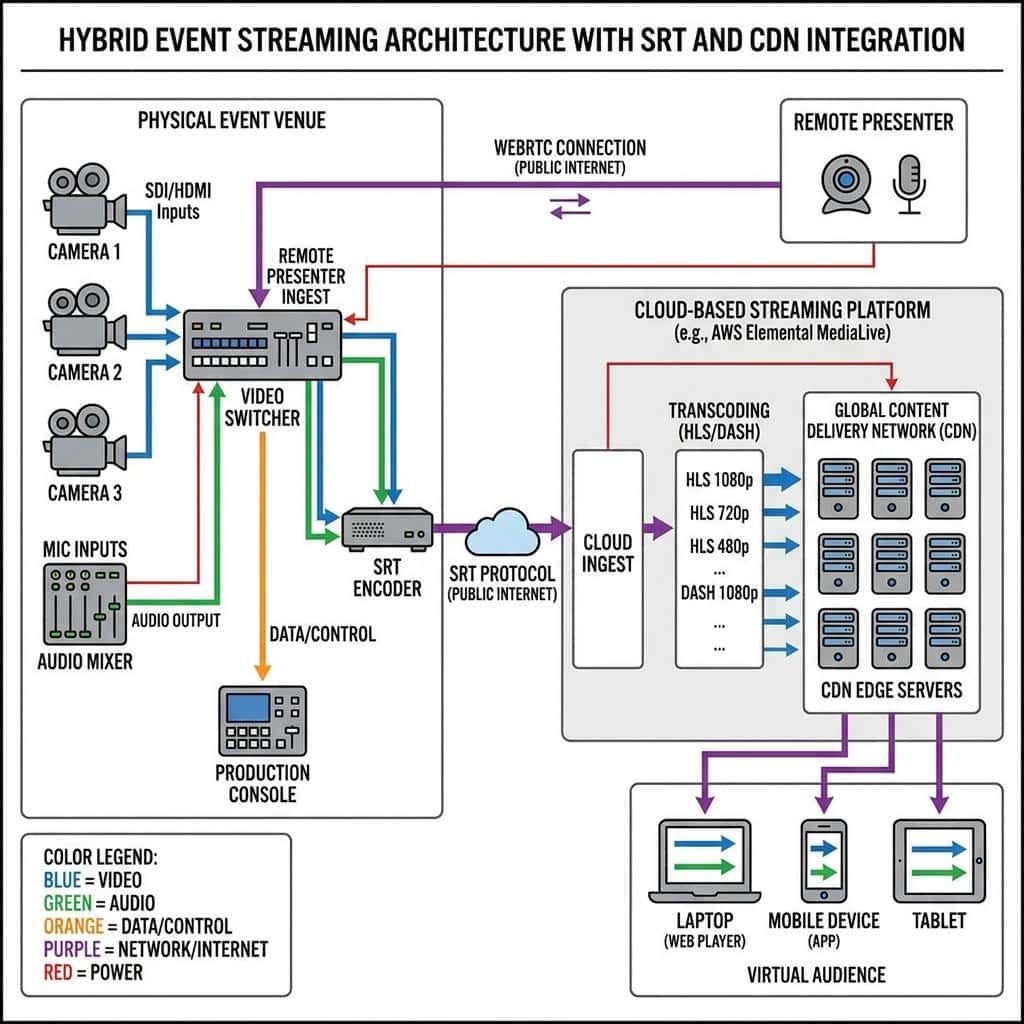
Moreover, the technical requirements for B2B streaming extend far beyond mere transmission. It encompasses a comprehensive ecosystem from content creation to post-event analytics. This includes robust video acquisition systems employing professional cameras (e.g., Sony FS7, Blackmagic URSA Broadcast G2) with SDI or HDMI 2.1 outputs, precision audio capture via professional condenser or dynamic microphones connected to digital audio consoles (e.g., Yamaha QL series), and sophisticated video switching equipment capable of handling multiple input sources and managing complex visual presentations. The reliability and security of this technical stack are paramount for critical business communications. Uninterrupted streaming, achieved through redundant systems and failover protocols, is not a luxury but a necessity to prevent operational disruptions and maintain stakeholder confidence. Furthermore, data privacy and intellectual property protection demand robust encryption (e.g., RTMPS, SRT) and access control mechanisms, which are inherent features of enterprise streaming platforms, differentiating them significantly from their consumer counterparts.
Core Infrastructure for Scalable B2B Streaming
Video Acquisition and Production Workflows
The foundation of any professional B2B streaming operation lies in its video acquisition and production workflow. This typically involves a multi-camera setup to capture different angles and perspectives, enhancing viewer engagement and production value. Professional PTZ (Pan-Tilt-Zoom) cameras, often controlled remotely via IP (e.g., NDI|HX), provide flexibility for various room configurations, while broadcast camcorders equipped with SDI (Serial Digital Interface) outputs ensure uncompressed, high-quality signal transmission over long cable runs, bypassing the limitations of consumer HDMI. The video signals from these cameras are routed into a central video switching system, such as a hardware-based Blackmagic ATEM Television Studio Pro or a software-defined solution like vMix or OBS Studio tailored for enterprise use. These switchers allow for seamless transitions between camera feeds, integration of graphic overlays, pre-recorded video inserts, and presentation slides. Advanced switchers support various input formats, including 1080p and 4K/UHD at frame rates like 29.97 fps or 59.94 fps, critical for broadcast-grade outputs.
Audio is equally critical and requires a dedicated mixing console, such as a Behringer X32 or Midas M32, to balance multiple microphone inputs, integrate program audio, and manage gain staging to achieve optimal audio levels (typically targeting -12dB to -6dB on the program bus). Microphone selection is crucial, ranging from lavalier microphones for individual presenters, shotgun microphones for wider sound capture, to boundary microphones for conference tables. Communication among the production crew is facilitated by professional intercom or talkback systems (e.g., Clear-Com, Riedel), operating over wired or wireless circuits to ensure precise coordination. The final mixed video and audio signals constitute the program feed, which is sent to encoders for live distribution. Additionally, many professional setups incorporate ISO recording, where individual camera feeds are recorded separately, providing flexibility for post-production editing and archival purposes.
Encoding and Transcoding Protocols
After production, the program feed must be efficiently encoded for delivery. H.264/AVC (Advanced Video Coding) remains a widely used standard, offering a balance of compression efficiency and broad compatibility. For higher quality at lower bitrates, H.265/HEVC (High Efficiency Video Coding) is increasingly employed, especially for 4K/UHD content, though it requires more processing power for encoding and decoding. Bitrate management, distinguishing between Constant Bitrate (CBR) for predictable network loads and Variable Bitrate (VBR) for optimizing quality, is essential. Enterprise encoders (e.g., from Haivision, Teradek) manage these parameters to ensure a stable stream at resolutions up to 4K, typically aiming for bitrates between 5 Mbps to 20 Mbps for high-quality 1080p content, depending on the complexity of the video and network conditions.
The choice of streaming protocol is paramount for delivery reliability and latency. RTMP (Real-Time Messaging Protocol) and its secure variant RTMPS, while common, inherently introduce higher latency (typically 5-15 seconds). For applications demanding near real-time interaction, SRT (Secure Reliable Transport) is the protocol of choice. SRT provides low-latency, high-performance streaming over unreliable networks like the public internet, using error recovery mechanisms to mitigate packet loss and jitter. This makes it ideal for hybrid event scenarios where remote presenters or participants need to interact seamlessly with an on-site audience. For internal IP-based production environments, NDI (Network Device Interface) offers extremely low-latency, high-quality video, audio, and metadata transport over standard Ethernet networks, simplifying signal routing and reducing the need for traditional SDI cabling. SMPTE ST 2110 is another robust IP standard used in broadcast facilities, providing uncompressed video and audio transport over IP, suitable for highly demanding production environments with stringent quality requirements.
Hybrid Event Architectures and Remote Participation
Integrating Physical and Virtual Audiences
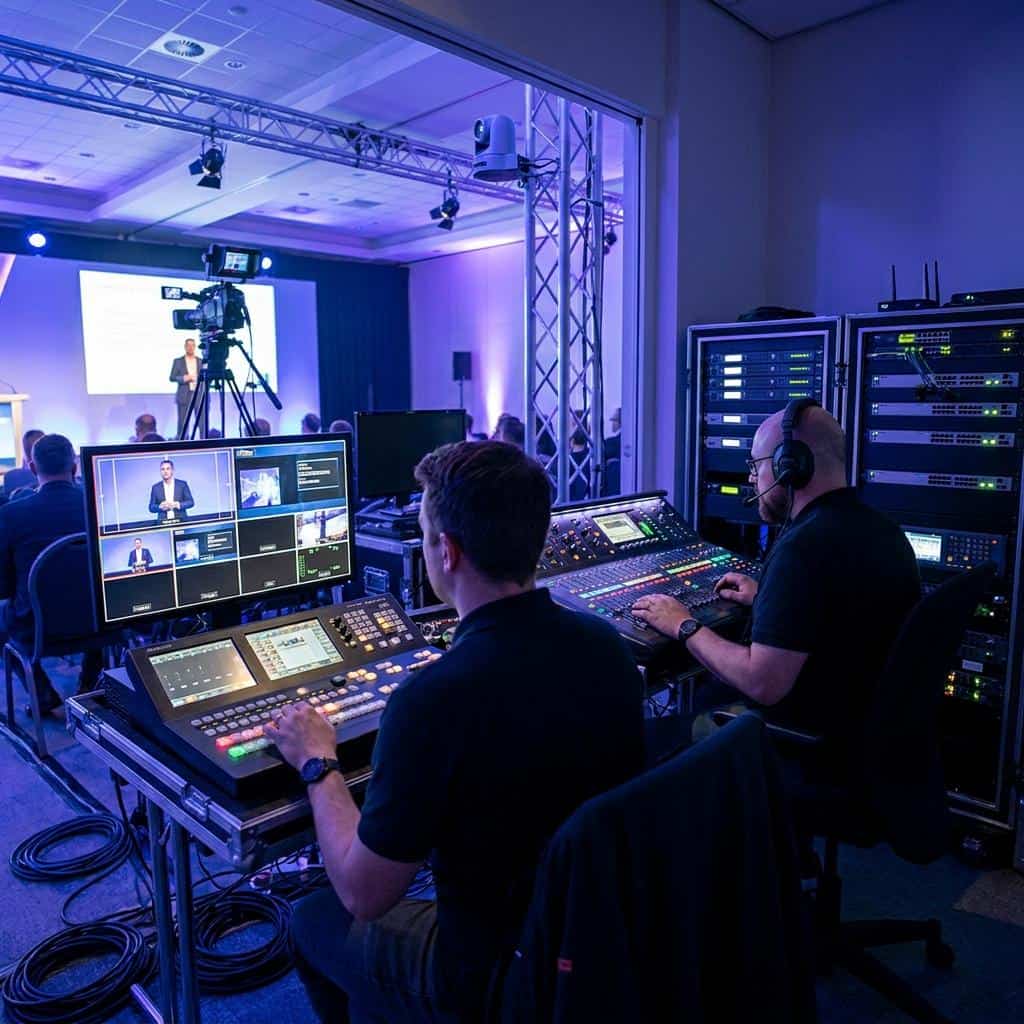
The success of modern corporate events increasingly hinges on a robust hybrid architecture, seamlessly bridging physical attendees with a distributed virtual audience. This integration requires a sophisticated signal flow from the physical venue to various streaming platforms. The program feed, meticulously crafted from the multi-camera production setup and professionally mixed audio, is ingested by dedicated streaming encoders. These encoders then transmit the stream, often via SRT for its resilience and low latency, to a cloud-based streaming platform or a robust Content Delivery Network (CDN). For instance, AWS Media Services, Azure Media Services, or specialized enterprise platforms like Vimeo Enterprise provide the scalability and global reach necessary to distribute the stream to thousands or even hundreds of thousands of concurrent viewers worldwide.
Critically, the hybrid experience is not merely about one-way transmission. It necessitates mechanisms for remote presenters and virtual audience interaction. This often involves WebRTC (Web Real-Time Communication) integrations within the streaming platform or specialized bridging tools that can pull remote participants from enterprise communication platforms such as Microsoft Teams, Zoom Meetings, or Webex Events into the professional production switcher. The signals from these remote participants are then treated as additional inputs, allowing for dynamic on-screen layouts, Q&A sessions, and moderated discussions that feel natural and integrated, rather than fragmented. Return feeds, providing program audio and video back to remote presenters, are essential for their situational awareness and confidence, requiring careful management of audio mix-minus configurations to prevent echo and feedback loops.
Network Infrastructure and QoS
A resilient network infrastructure is the bedrock of any successful B2B streaming operation. For professional production, dedicated gigabit or even 10 Gigabit Ethernet networks are standard, separate from general corporate IT traffic, to guarantee sufficient bandwidth and minimize contention. VLAN (Virtual Local Area Network) segmentation is routinely implemented to isolate AV traffic, ensuring Quality of Service (QoS) can be effectively applied. QoS prioritization mechanisms configure network switches and routers to allocate preferential bandwidth to real-time streaming data, minimizing packet loss and maintaining consistently low latency and jitter, which are critical for smooth video and audio delivery. Without robust QoS, even minor network congestion can lead to significant degradation of the streaming experience.
Redundancy in network paths and internet connections is non-negotiable for mission-critical events. This often involves deploying multiple internet service providers (ISPs) with automatic failover capabilities, or even incorporating cellular failover solutions (e.g., 5G modems) as a last resort. Continuous monitoring of network performance, including latency, jitter, and packet loss, is performed using network analysis tools to proactively identify and address potential issues. The goal is to ensure that the outbound stream from the encoder to the cloud, and the inbound streams from remote participants, traverse stable, high-performance network paths, thus upholding the integrity and reliability demanded by enterprise-level communications.
Scalability, Security, and Redundancy for Enterprise Streaming
Achieving Scalability
Rapidly growing SMEs demand streaming solutions that can scale effortlessly from small internal meetings to large-scale, global corporate events. The primary mechanism for achieving this scalability is the strategic integration of Content Delivery Networks (CDNs). CDNs cache streaming content at edge servers geographically closer to viewers, significantly reducing latency and load on the origin server. This distributed architecture allows for the simultaneous delivery of high-quality streams to hundreds of thousands or even millions of concurrent viewers without degradation. Enterprise streaming platforms often leverage auto-scaling cloud infrastructure, dynamically allocating computing and networking resources based on real-time demand, ensuring seamless performance during peak viewership. Multi-bitrate adaptive streaming, typically implemented via HLS (HTTP Live Streaming) or DASH (Dynamic Adaptive Streaming over HTTP) protocols, further enhances scalability and viewer experience. These technologies deliver multiple renditions of the stream at varying resolutions and bitrates, allowing client devices to automatically switch to the most appropriate stream based on their network conditions and processing capabilities, ensuring optimal playback across diverse user environments.
Security and Compliance
For B2B communications, security is paramount. Enterprise streaming solutions integrate robust security features to protect sensitive corporate information and intellectual property. Digital Rights Management (DRM) technologies provide encryption and access control to prevent unauthorized viewing and redistribution of content. Token-based authentication, IP whitelisting, and Geographic IP restrictions ensure that only authorized users in specific regions can access streams. All data in transit, including video and audio streams, should be encrypted using protocols like RTMPS or SRT encryption, and delivered over HTTPS for web-based access. Compliance with data privacy regulations such as GDPR (General Data Protection Regulation) and, where applicable, HIPAA (Health Insurance Portability and Accountability Act) for healthcare-related content, is a critical consideration for enterprise clients. Streaming platforms must offer features for user authentication, role-based access control, and comprehensive audit logs to ensure regulatory adherence and maintain trustworthiness.
Redundancy and Failover Strategies
Business continuity is non-negotiable for corporate events. Therefore, redundancy and failover strategies are integral to enterprise streaming infrastructure. This includes deploying dual encoders in a primary/secondary configuration, each capable of taking over the live stream instantly if the other fails. Redundant power supplies for all critical hardware, along with Uninterruptible Power Supplies (UPS) and even backup generators, mitigate power disruptions. Network redundancy involves multiple internet connections from diverse ISPs, often with automatic failover routers. For cloud-based solutions, geographically distributed streaming servers and data centers ensure that if one region experiences an outage, another can seamlessly take over the streaming workload. Hot standby systems, where backup equipment is fully powered and configured to immediately assume operations, are standard practice. Automated failover mechanisms, monitored by sophisticated systems, ensure that any detected failure triggers an immediate switch to backup components, minimizing downtime and maintaining uninterrupted delivery of critical corporate communications. This layered approach to redundancy safeguards against a wide array of technical failures, ensuring that rapidly growing SMEs can rely on their streaming infrastructure even in the most demanding scenarios.
Conclusion
For rapidly growing SMEs, professional B2B event streaming and hybrid production are not merely technological conveniences; they are strategic imperatives for sustaining and scaling corporate culture. By embracing enterprise-grade solutions that incorporate advanced video acquisition, robust encoding protocols like SRT and NDI, sophisticated hybrid event architectures, and comprehensive security and redundancy measures, organizations can ensure that their internal and external communications are consistently delivered with broadcast quality, unwavering reliability, and unparalleled reach. The complexities of managing multi-camera productions, optimizing network infrastructure, and securing content demand a deep understanding of industry standards and professional workflows. Engaging with expert technical teams capable of designing, implementing, and managing these intricate systems is essential for transforming streaming from a mere utility into a powerful tool for cultural cohesion, talent development, and market leadership in a rapidly evolving global economy.

Michael Koh is a production specialist and entrepreneur who founded Spring Forest Studio in 2017 to provide event and virtual production solutions in Singapore. He specialises in hybrid live streaming, XR (Extended Reality) virtual production, and studio systems integration, transitioning the business from traditional videography to advanced corporate broadcasting. Operating out of a dedicated facility at NordCom2 in Singapore, he leads a technical crew to deliver multi-camera webcasts, digital sets, and technical consultations for large-scale corporate events.