
 March 31, 2026 by Editor |
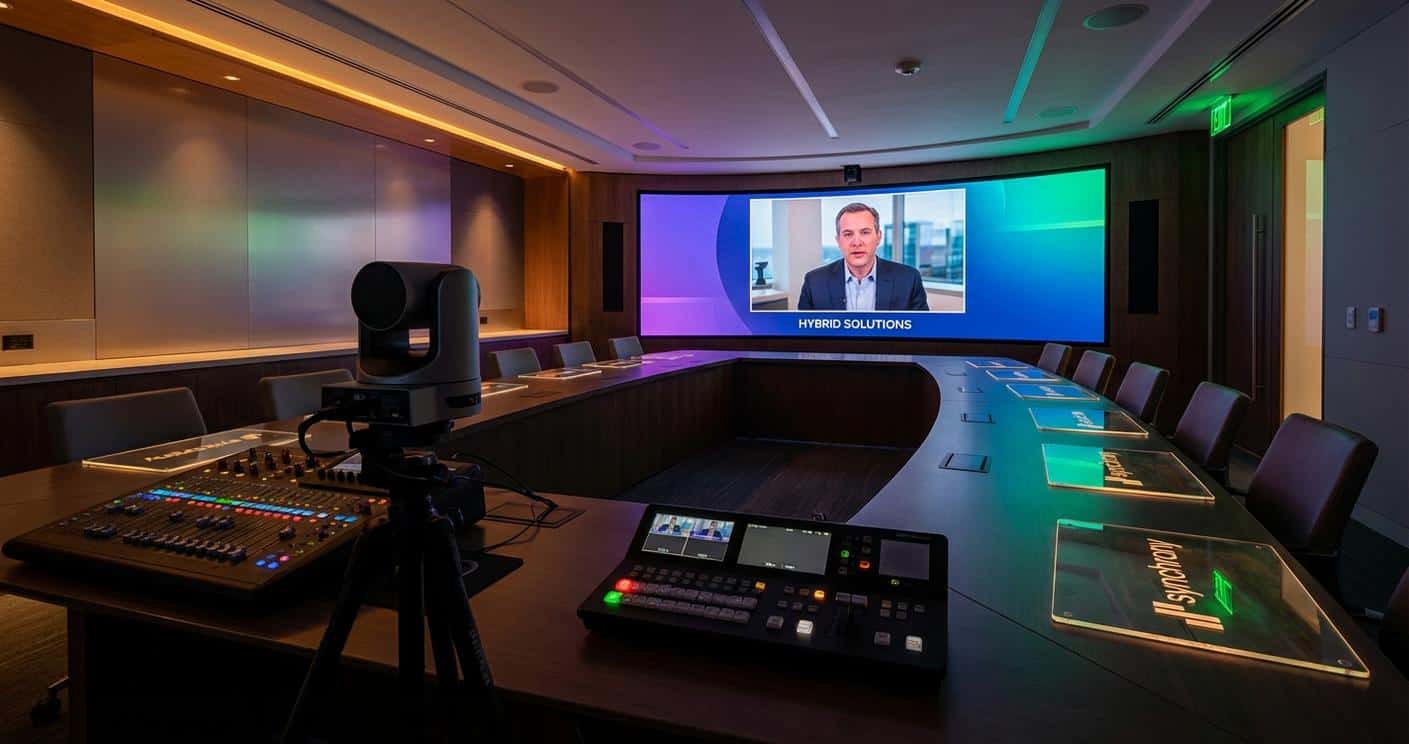
In the evolving landscape of global enterprise, the ability to rapidly adapt and pivot regional operations is a critical differentiator. Live video streaming, when implemented with robust B2B-grade infrastructure and expert technical execution, transcends its role as a mere communication tool; it becomes a strategic imperative for seamless operational alignment, real-time decision-making, and fostering unified corporate directives across geographically dispersed teams. This article delves into the advanced technical considerations and strategic frameworks for leveraging live video to achieve significant operational agility in a B2B context, moving beyond basic video conferencing to embrace full-scale, broadcast-quality event streaming and hybrid production.
Architecting the Backbone: Enterprise-Grade Streaming Infrastructure for Regional Reach
Deploying a live video solution capable of supporting regional operational pivots necessitates a meticulously engineered streaming infrastructure. This foundation must ensure low-latency delivery, high availability, and superior visual fidelity, paramount for critical corporate communications, training sessions, and town halls. The architecture demands a comprehensive understanding of network topology, encoding methodologies, and resilient delivery protocols.
Network Infrastructure Requirements and Content Delivery Networks (CDNs)
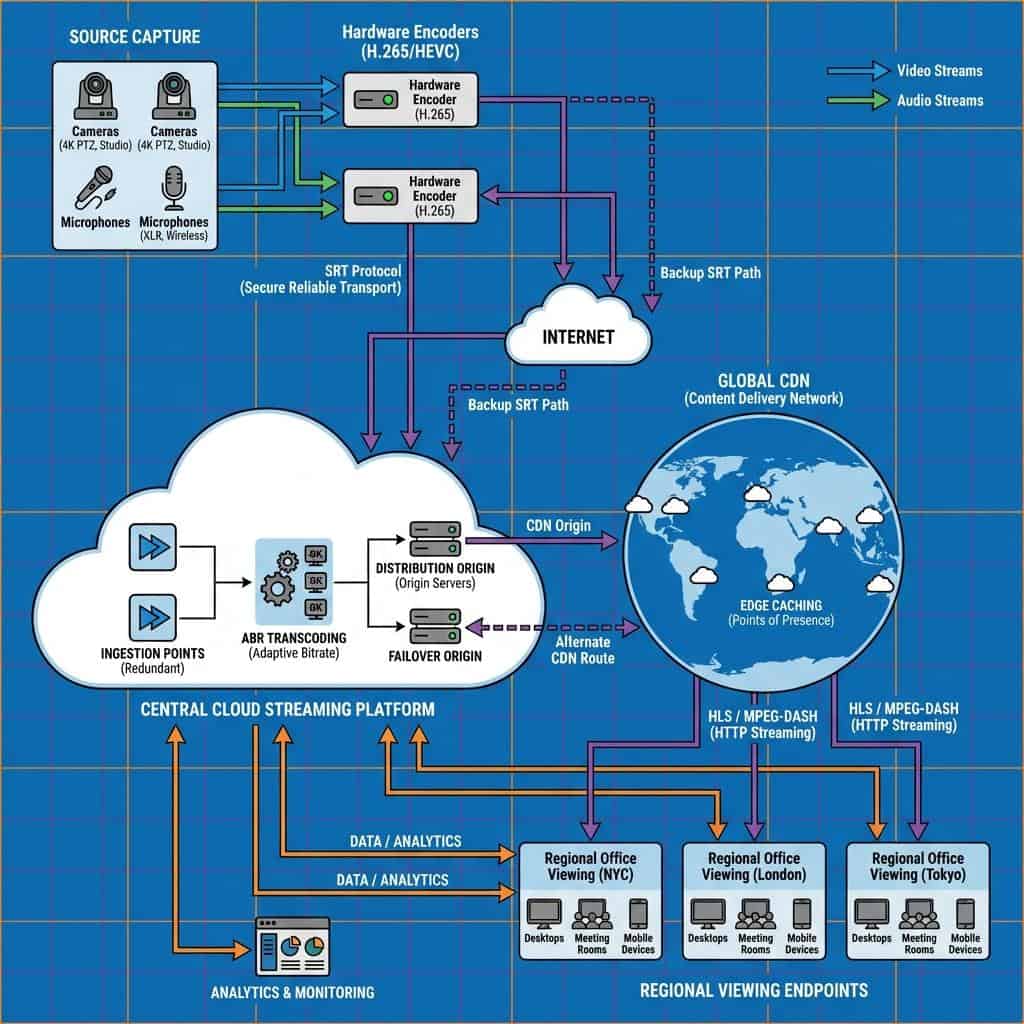
For enterprise-grade streaming, a robust network backbone is non-negotiable. This involves dedicated bandwidth provisioned for live video traffic, segregating it from general data to prevent congestion and ensure Quality of Service (QoS). For global or regional reach, integrating with a geographically distributed Content Delivery Network (CDN) is essential. A professional CDN, unlike consumer-grade services, offers advanced features such as intelligent routing, edge caching, and scalable ingestion points. This minimizes latency by serving content from the closest available server to each regional endpoint, significantly enhancing the viewer experience. Considerations must include peering agreements, uplink/downlink capacities in Mbps, and redundancy protocols for CDN failover, ensuring continuous service even during regional network anomalies. We recommend a minimum dedicated uplink of 50-100 Mbps per primary stream for 1080p60 production, scaling proportionally for 4K/UHD streams which may require 150-300 Mbps or more, depending on H.264/H.265 encoding profiles and target bitrates.
Encoding Standards and Streaming Protocols for Interoperability
The choice of encoding standards and streaming protocols directly impacts compatibility, latency, and quality. For professional B2B applications, H.264 (AVC) remains a widely adopted codec, offering a balance of quality and compression efficiency. However, H.265 (HEVC) is gaining traction for its superior compression, allowing for higher quality at lower bitrates, crucial for bandwidth-constrained regional offices. Modern hardware encoders often support simultaneous H.264 and H.265 output, enabling adaptive bitrate (ABR) streaming to diverse regional endpoints. This ensures optimal viewing across varying network conditions.
Protocol selection is equally vital:
- RTMP/RTMPS (Real-Time Messaging Protocol Secure): A long-standing protocol for ingestion from encoders to streaming platforms. While widely supported, its TCP-based nature can lead to latency spikes on unstable networks.
- SRT (Secure Reliable Transport): An open-source protocol developed by Haivision, offering significant advantages for high-quality, low-latency video contribution over unreliable networks. SRT employs UDP-based transmission with advanced error correction (ARQ – Automatic Repeat reQuest) and packet loss recovery, making it ideal for robust regional contribution and distribution links. Latency can be finely tuned, often achieving sub-second delivery.
- NDI (Network Device Interface): A NewTek protocol for video over IP within local area networks (LANs). NDI|HX (High Efficiency) is particularly relevant for regional offices, allowing for high-quality video transport over standard gigabit Ethernet, simplifying multi-camera setups without extensive SDI cabling. Full NDI provides uncompressed or lightly compressed, broadcast-grade video.
- HLS (HTTP Live Streaming) and MPEG-DASH: These are primarily for final distribution to viewers, leveraging standard HTTP infrastructure for scalability and broad device compatibility. While introducing higher latency (typically 5-30 seconds), they are excellent for large-scale, adaptive bitrate delivery to end-users in regional offices.
Integrating these protocols intelligently ensures a seamless workflow from source capture to regional viewing platforms.
Mastering Hybrid Event Production: Seamless Integration for Dispersed Teams
Pivoting regional operations often involves hybrid events, where both in-person and remote participants engage simultaneously. This demands a sophisticated production setup that bridges the physical and virtual worlds with technical precision.
Multi-Camera Production and Advanced Switching Systems
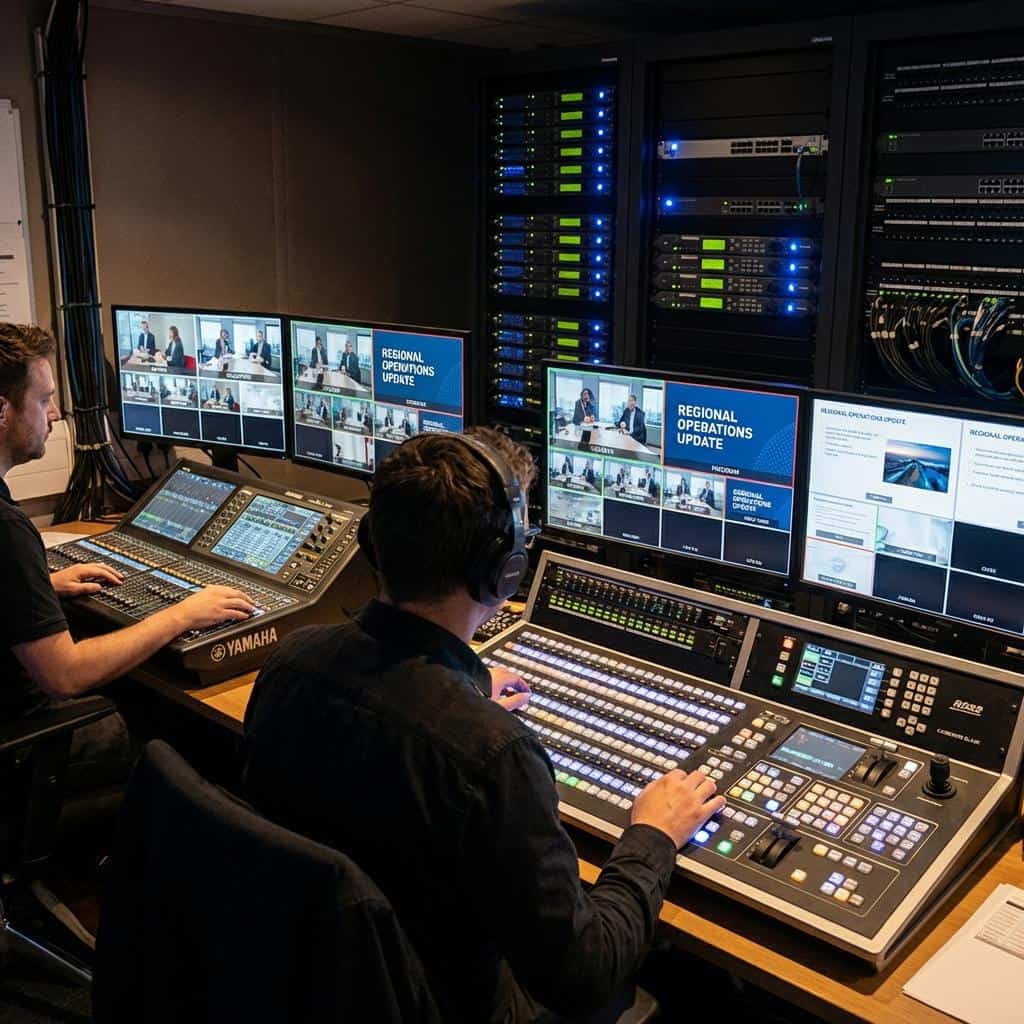
Professional hybrid events necessitate multi-camera production to provide dynamic perspectives, capture nuances, and maintain audience engagement. Cameras, ranging from broadcast-grade PTZ (Pan-Tilt-Zoom) units to cinematic Super 35mm sensors, are strategically deployed. Signal acquisition typically employs SDI (Serial Digital Interface) for robust, uncompressed video up to 12G-SDI for 4K/UHD, or increasingly, NDI for IP-based workflows. These signals feed into a broadcast-grade video switcher, such as a Blackmagic ATEM Constellation or Ross Carbonite, capable of managing multiple inputs, performing cuts, dissolves, wipes, and DVE (Digital Video Effects). Key features include multiview monitoring, program and preview outputs, and integration with graphics generators for lower thirds, branding, and data visualization. Audio signal flow is managed via professional digital audio mixers (e.g., Yamaha QL, Allen & Heath dLive) supporting Dante or AES67 networking, ensuring crystal-clear sound from presenter microphones, panel discussions, and remote participant audio feeds.
Integrating with Enterprise Collaboration Platforms for Bidirectional Engagement
A critical aspect of hybrid events is the seamless integration of professional live streams into enterprise collaboration platforms like Microsoft Teams, Zoom Enterprise, or Cisco Webex. This integration facilitates bidirectional communication, allowing remote regional participants to ask questions, engage in Q&A sessions, and participate interactively. This requires a dedicated clean program feed from the video switcher, often through a hardware encoder, to be ingested into the virtual meeting platform. Conversely, remote participants’ video and audio feeds from the collaboration platform must be brought back into the main production switcher for display on venue screens, multiviews, and inclusion in the final program mix. This often involves NDI virtual inputs/outputs or dedicated capture cards to bridge the platforms, managing echo cancellation, and maintaining audio/video synchronization.
Ensuring Uninterrupted Excellence: Redundancy, Quality of Service, and Scalability
The strategic importance of live video in regional operations means any interruption can have significant business implications. Therefore, redundancy, meticulous QoS management, and scalability planning are paramount.
Redundancy and Failover Strategies for Mission-Critical Streams
Enterprise-grade streaming demands comprehensive redundancy. This extends from primary hardware encoders (e.g., 1+1 or N+1 configurations with automatic failover) to network paths (primary and secondary internet service providers, cellular bonding solutions), and CDN providers. Dual-encoder setups, often using diverse network routes, ensure that if one encoder or network path fails, the backup automatically takes over with minimal interruption to the stream. This often involves sending duplicate SRT streams to different ingestion points or utilizing cloud-based transmuxing services that can dynamically switch between redundant inputs. Power redundancy, via UPS (Uninterruptible Power Supply) and generator backups, is also a fundamental component of a resilient production setup, safeguarding against electrical outages in both originating studios and critical regional hubs.
Quality of Service (QoS), Bitrate Management, and Latency Optimization
Maintaining a consistent QoS is vital for a professional viewing experience. This involves active bitrate management, adapting the stream’s bitrate based on available network conditions using ABR profiles. For internal corporate communications, a high target bitrate (e.g., 8-15 Mbps for 1080p) is often desired to maximize clarity, while public-facing streams might use a wider range of ABR profiles. Latency optimization is achieved through careful selection of protocols (SRT for low latency contribution), encoder settings (GOP structure, B-frame usage), and CDN configurations. While some latency is inherent in HLS/DASH distribution, strategies such as low-latency HLS (LL-HLS) can reduce glass-to-glass latency to within 2-5 seconds, significantly improving interactivity for regional viewers.
Scalability Considerations for Large Corporate Events
The ability to scale the live video infrastructure to accommodate regional growth or large-scale corporate events is a key strategic advantage. This involves cloud-based streaming platforms that can dynamically provision resources (transcoding, distribution bandwidth) on demand. Architects must consider the peak concurrent viewer count, regional distribution requirements, and the number of simultaneous active streams. Horizontal scaling of encoding and ingestion infrastructure, often leveraging virtualized environments or containerization, allows for flexible resource allocation. Cloud-native solutions offer cost efficiencies and rapid deployment capabilities, crucial for agile operational pivots.
Strategic Implementation and Operational Best Practices
Beyond the technical architecture, successful deployment of live video for regional alignment hinges on rigorous operational best practices and a strategic approach.
Comprehensive Pre-Production and Technical Rehearsals
Thorough pre-production is non-negotiable. This includes detailed technical specification documents, signal flow diagrams, network readiness assessments for all regional sites, and comprehensive connectivity tests. Every piece of equipment, from cameras to encoders, audio mixers, and network switches, must be tested end-to-end. Full technical rehearsals, mirroring the actual event schedule and involving all regional participants, are critical to identify and rectify potential issues before going live. This includes testing failover scenarios, audio levels, video switching cues, and graphic overlays, ensuring all regional viewing points receive a pristine feed.
Expert Staffing and On-Site/Remote Technical Support
Even the most advanced technology requires skilled personnel. A professional production team comprising a technical director, video engineer, audio engineer, and streaming operator is essential. For regional operations, a hybrid support model, with on-site technical leads at critical regional hubs and a central remote operations center, ensures rapid issue resolution. Expertise in diagnosing network issues, troubleshooting encoder malfunctions, and managing complex audio/video routing is paramount. Clear communication protocols between all technical teams, often via dedicated talkback systems (e.g., Clear-Com, RTS) or professional intercom over IP, are crucial for coordinated execution.
Post-Event Analytics and Continuous Optimization
The strategic value of live video extends beyond the live event. Post-event analytics provide invaluable insights into regional engagement, viewership patterns, peak concurrent users, geographical distribution, and drop-off rates. These metrics, provided by enterprise streaming platforms, inform future content strategy, infrastructure improvements, and regional outreach efforts. Continuous optimization based on performance data ensures that the live video strategy evolves, enhancing its effectiveness as a tool for dynamic regional operational alignment.
In conclusion, leveraging live video to strategically pivot regional operations is a complex undertaking that demands a deep understanding of advanced streaming technology, broadcast-grade production workflows, and robust network infrastructure. By meticulously planning the architecture, embracing resilient protocols like SRT and NDI, mastering hybrid event production, and adhering to stringent operational best practices, enterprises can unlock the full potential of live video as a transformative tool for achieving unparalleled agility and cohesive global-regional strategic alignment.