
 March 21, 2026 by Editor |
In the high-stakes environment of a multinational corporation (MNC) merger or acquisition, the successful integration of disparate corporate cultures is a critical determinant of long-term value. While strategy and finance dominate boardroom discussions, the technical execution of communication is what translates executive vision into a unified global workforce. For IT directors, production managers, and corporate event planners, the challenge is immense: how do you foster a single, cohesive culture across continents, time zones, and legacy infrastructures? The answer lies in the strategic deployment of professional, broadcast-grade live video and hybrid event production, a domain that extends far beyond standard enterprise video conferencing tools.
This is not about simply enabling a video call. It is about architecting a secure, scalable, and resilient communications backbone capable of delivering high-impact, professionally produced events to thousands of employees simultaneously. These events, such as global town halls, leadership addresses, and departmental integrations, are the primary vehicle for aligning mission, values, and operational directives. Their technical success or failure directly impacts employee engagement, trust, and the overall momentum of the post-acquisition integration. This requires a deep understanding of streaming protocols, production infrastructure, and enterprise network topology. At Live Streaming Studio, our technical teams engineer these solutions, ensuring that the critical message of unity is delivered with flawless technical precision.
Architecting the Global Town Hall: Core Infrastructure and Protocols
The foundation of any successful global streaming initiative is the core infrastructure. This system must be designed for high availability, low latency, and robust security, ensuring that every employee, whether at a major corporate campus or a remote regional office, receives a consistent and high-quality experience. This involves critical decisions regarding encoding, transport protocols, and redundancy.
On-Premise vs. Cloud-Based Encoding and Distribution
The first architectural decision point is where to process the primary video and audio signals. An on-premise solution involves dedicated hardware encoders, such as units from Haivision or Teradek, located at the primary event venue. These devices convert the 12G-SDI (Serial Digital Interface) or HDMI 2.1 program feed from the production switcher into a compressed IP stream. The primary advantage is direct control over the hardware and signal path. Conversely, a cloud-based workflow sends a high-bitrate contribution feed to a cloud media service like AWS Elemental MediaLive or Microsoft Azure Media Services. In the cloud, this stream can be transcoded into multiple adaptive bitrate (ABR) profiles for delivery to diverse endpoints. A hybrid approach is often optimal, using an on-premise encoder for the initial contribution stream to the cloud, leveraging the cloud’s scalability for global distribution.
Protocol Selection for Global Reach: SRT vs. RTMP/RTMPS
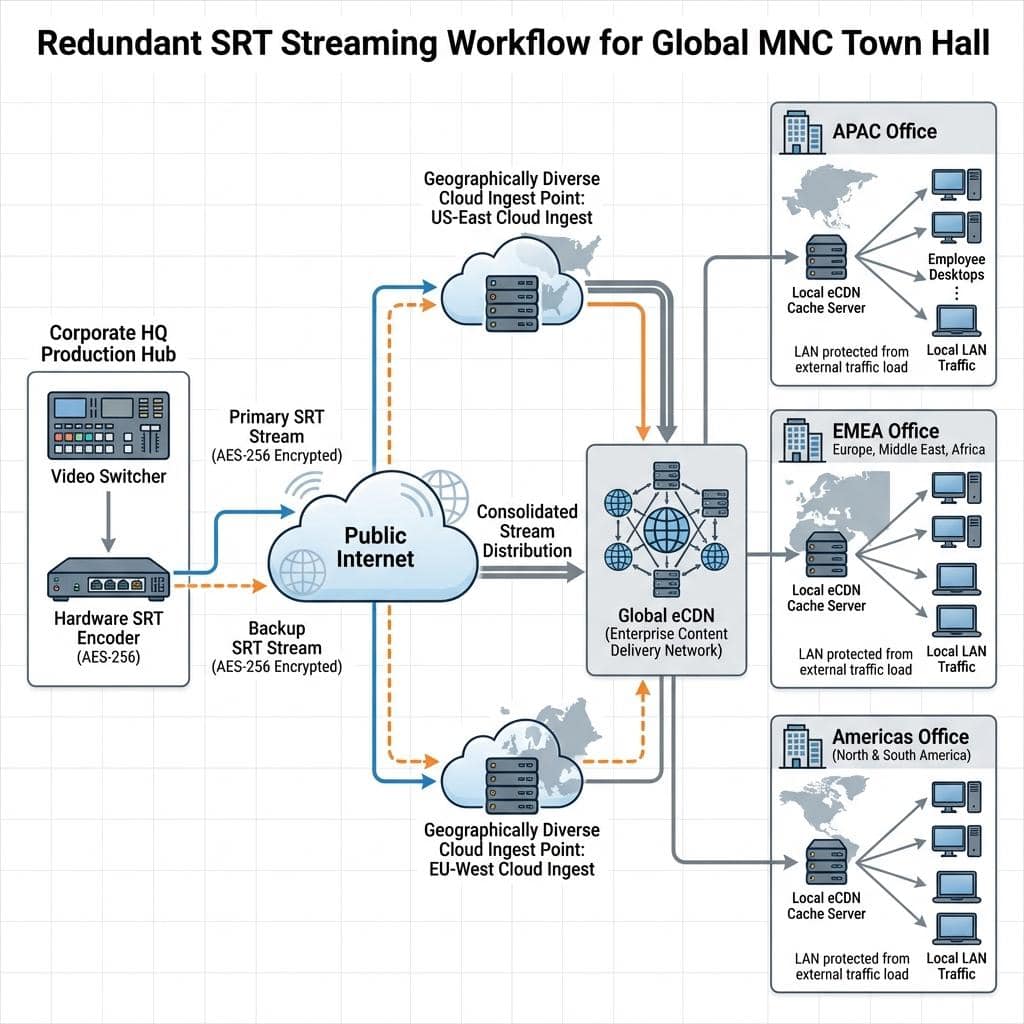
For decades, RTMP (Real-Time Messaging Protocol) and its secure variant RTMPS were the de facto standards. However, for global delivery across unpredictable public internet links, RTMP’s reliance on TCP (Transmission Control Protocol) can lead to significant latency and buffering when packet loss occurs. This is where Secure Reliable Transport (SRT) provides a decisive advantage. SRT, an open-source protocol, operates at the transport layer, providing the reliability of TCP with the low latency of UDP (User Datagram Protocol). Its advanced error correction mechanism allows for rapid recovery from packet loss, making it ideal for sending high-quality video between continents with minimal delay, typically achieving sub-second latency. Furthermore, SRT includes built-in AES-256 encryption, a critical requirement for sensitive internal corporate communications.
Redundancy and Failover Strategy
A single point of failure is unacceptable in a mission-critical corporate event. A multi-layered redundancy strategy is essential. This begins with bonded cellular technology, using devices from LiveU or TVU Networks that aggregate multiple cellular connections (4G/5G) with Ethernet and Wi-Fi to create a single, highly resilient internet uplink from the event location. For the stream itself, a dual-path streaming configuration is a best practice. This involves sending two identical SRT streams from the primary encoder via separate network paths to two geographically distinct cloud ingest points. A cloud-based switcher or stream manager can then automatically failover to the secondary stream if the primary is interrupted, ensuring a seamless experience for the viewer.
The Hybrid Production Hub: Integrating Physical and Virtual Audiences
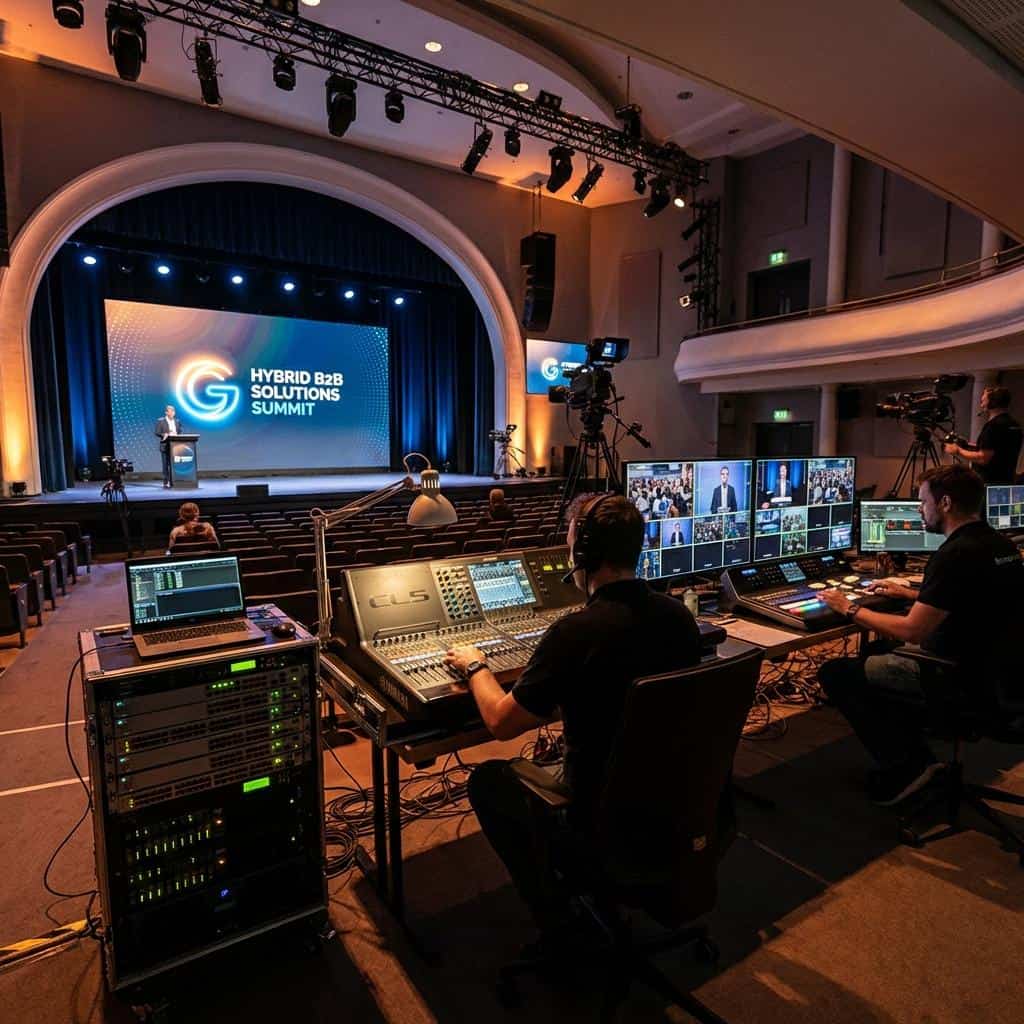
A post-merger town hall is rarely a purely virtual event. It is a hybrid experience, with a live audience and executive team at a primary location, joined by thousands of virtual attendees globally. The production hub must be engineered to serve both audiences with equal fidelity, ensuring the virtual experience feels as engaging and immediate as being in the room.
Signal Acquisition and Routing in a Multi-Location Setup
A professional production relies on multiple high-quality video sources. This typically includes a mix of broadcast cameras for wide shots and presenter close-ups, and robotic PTZ (Pan-Tilt-Zoom) cameras for audience reactions or secondary stages. These sources are captured in resolutions up to 4K/UHD (3840×2160) at 59.94 frames per second. The signals are transported via 12G-SDI cabling to a central production switcher, like a Blackmagic Design ATEM Constellation or a Ross Video Carbonite. For IP-based workflows within the facility, Network Device Interface (NDI) is a powerful tool. NDI allows for the transport of high-quality, low-latency video over a standard 1GbE or 10GbE network, simplifying cabling and allowing sources from across a corporate campus to be integrated into the production. A sophisticated routing matrix is essential for managing signal flow, sending specific feeds to multiview monitors, ISO (isolated) recorders, and the primary program output.
Advanced Audio Integration for Clarity and Inclusivity
Audio is arguably more critical than video for corporate communications. The audio system must capture pristine sound from presenters using a combination of lectern microphones and wireless lavalier or headset systems. To integrate remote speakers seamlessly, a mix-minus audio setup is crucial. This sends each remote participant a custom audio mix containing the main program audio minus their own voice, completely eliminating echo and feedback. For routing audio signals throughout the production environment, Dante (Digital Audio Network Through Ethernet) is the industry standard. It allows hundreds of channels of uncompressed digital audio to be routed over a standard IP network with near-zero latency. For MNCs, this setup must also accommodate multi-language support, integrating feeds from simultaneous interpreters into discrete audio tracks within the final stream, allowing global employees to select their native language.
Enterprise Platform Integration and Scalable Delivery
The most sophisticated production is ineffective if it cannot be delivered reliably and securely within the corporate IT environment. This final-mile delivery requires careful planning to avoid network saturation and to integrate smoothly with the platforms employees use daily.
Secure Delivery via Enterprise Content Delivery Networks (eCDNs)
Streaming a high-quality 1080p video stream to 50,000 employees simultaneously would saturate most corporate WAN (Wide Area Network) circuits. This is where an Enterprise Content Delivery Network (eCDN) becomes a mission-critical component. Solutions from providers like Ramp or Kollective deploy a caching layer within the corporate network. A single high-quality stream enters the network from the cloud, and the eCDN agents on local servers or even employee computers share the stream peer-to-peer across the Local Area Network (LAN). This intelligent caching and distribution model prevents the corporate internet connection from being overwhelmed, ensuring smooth playback for all viewers while protecting other business-critical network traffic.
Integrating with Microsoft Teams, Zoom, and Webex
While an eCDN and a dedicated video portal are ideal for large-scale broadcasts, many meetings require the interactive features of platforms like Microsoft Teams, Zoom, or Webex. Integrating a professional production into these platforms elevates the experience far beyond a simple webcam. The program feed from the production switcher can be ingested into these platforms in several ways. The simplest method is using a device like a Blackmagic Web Presenter, which makes an SDI or HDMI source appear as a standard USB webcam. For higher quality, the production feed can be sent via RTMP or SRT directly to platforms that support custom streaming inputs, or through a virtual camera output from production software like vMix or OBS Studio. This allows the use of professional graphics, multi-camera switching, and pre-produced video roll-ins within the familiar collaborative environment.
Data, Analytics, and Post-Event Asset Management
The value of a global town hall extends beyond the live event. During the stream, real-time analytics provide insight into viewer engagement, tracking metrics like total viewership, geographic distribution, and drop-off rates. Integrated Q&A and polling modules provide direct feedback channels, which are invaluable during a period of cultural transition. After the event, the production assets must be managed. Best practice involves ISO recording every camera feed and the final program output. This provides immense flexibility for post-production, allowing for the creation of highlight reels, departmental summaries, and a polished Video on Demand (VOD) version of the full event for employees who were unable to attend live. This VOD asset becomes a permanent part of the corporate knowledge base, reinforcing key messages long after the live stream concludes.
Ultimately, unifying diverse cultures after a merger is a communications challenge rooted in technical execution. By architecting a robust, broadcast-quality streaming and hybrid production solution, MNCs can ensure their message of unity and shared purpose is delivered with the clarity, reliability, and impact it deserves. It transforms a simple announcement into a shared experience, laying a stable technical foundation for building a single, cohesive global identity.