
Tailored Interaction: Custom Polling Features for Enterprise-Grade AGMs
The landscape of Annual General Meetings (AGMs) has undergone a profound transformation, moving from traditional, in-person gatherings to sophisticated hybrid and fully virtual formats. This evolution, driven by technological advancements and global accessibility demands, places an unprecedented emphasis on secure, reliable, and highly interactive virtual engagement. For enterprise decision-makers and corporate event planners, merely streaming an AGM is no longer sufficient; the imperative now is to replicate and enhance the critical interactive elements of a physical meeting, most notably through custom polling and secure voting mechanisms. This requires a deep understanding of enterprise-grade streaming infrastructure, robust data integrity protocols, and seamless integration with complex production workflows. Live Streaming Studio specializes in providing these advanced B2B event streaming solutions, ensuring AGMs maintain their crucial governance and engagement functions, regardless of audience location.
The technical challenges inherent in deploying custom polling for a high-stakes enterprise AGM are substantial. Unlike consumer-grade interaction tools, an enterprise solution demands meticulous attention to security, auditability, scalability, and integration within existing corporate IT frameworks. This article will delve into the advanced technical considerations for implementing tailored interaction, focusing on custom polling features that transcend basic feedback, enabling critical decision-making and transparent governance for hybrid and virtual AGMs.
Architectural Foundations: Designing Robust Polling Infrastructure for Hybrid AGMs
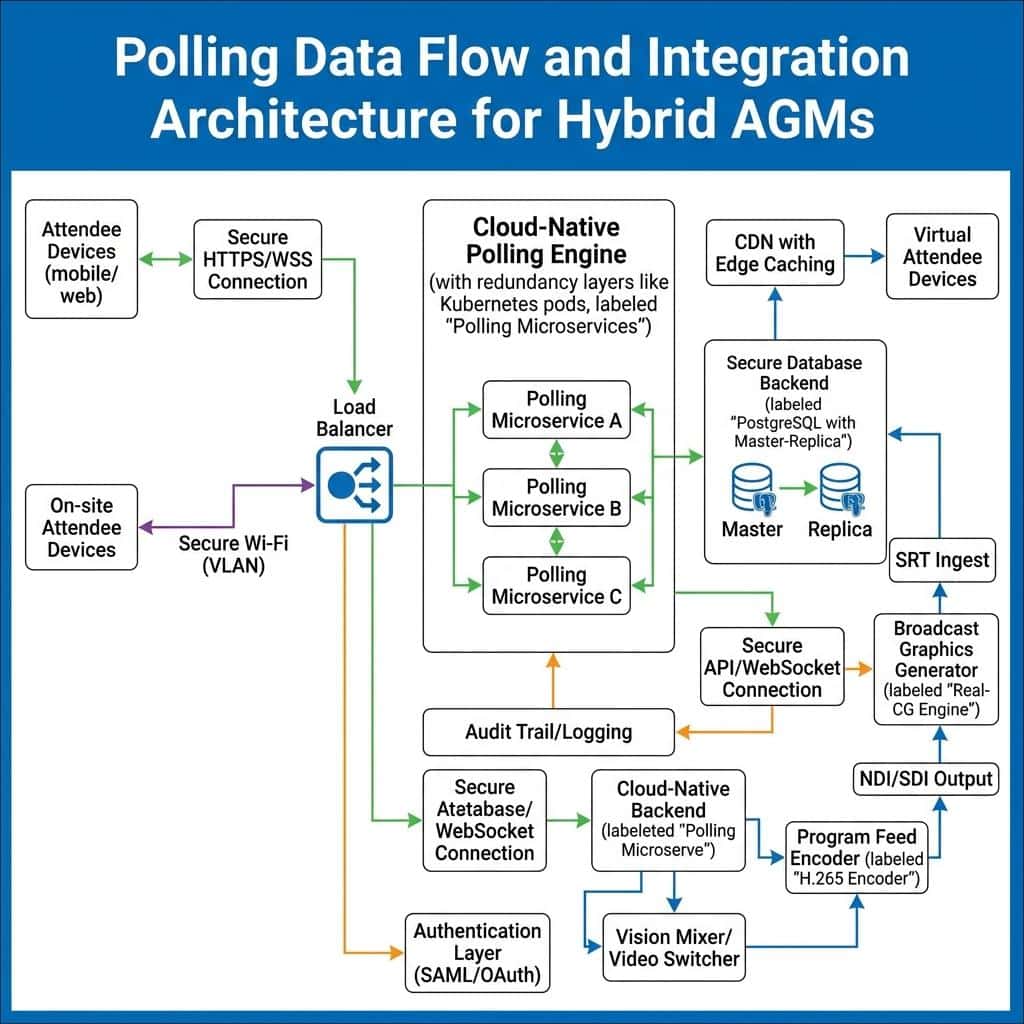
Building a custom polling infrastructure for enterprise-grade AGMs necessitates a resilient, scalable, and secure architecture capable of handling fluctuating loads and critical data. The foundation of such a system involves a multi-tiered approach, integrating real-time data capture, processing, and distribution within a low-latency streaming environment. At the core, a dedicated polling engine, either cloud-native or on-premise, acts as the central processing unit for all attendee interactions.
Data Ingestion and Processing: Attendee responses, whether from web-based interfaces or dedicated mobile applications, must be ingested rapidly and securely. This typically involves secure HTTPS/WSS (WebSocket Secure) connections, ensuring end-to-end encryption from the user device to the polling engine. Load balancing mechanisms are critical to distribute incoming requests efficiently, preventing bottlenecks during peak voting periods, especially for AGMs with thousands of participants. Data serialization formats like JSON (JavaScript Object Notation) or Protocol Buffers are commonly used for efficient data transmission, minimizing payload size and processing overhead. The polling engine must be designed for high availability, often employing redundant server instances across different availability zones to mitigate single points of failure. Database backends, such as PostgreSQL with master-replica configurations or NoSQL solutions like Cassandra for extreme scalability, store voting data with transactional integrity, ensuring every vote is accurately recorded and auditable.
Integration with Streaming Platforms: Seamless integration of polling results with the live video feed is paramount for real-time transparency. This involves a secure API (Application Programming Interface) connection between the polling engine and the live streaming graphics system. For example, a RESTful API or a WebSocket connection can push real-time voting tallies and question states to a broadcast graphics generator. This generator, typically a professional character generator (CG) or a real-time 3D graphics system, overlays the polling data onto the program feed. This feed is then encoded using H.264 or H.265 codecs and transmitted via protocols like Secure Reliable Transport (SRT) for ingest to the streaming platform or Content Delivery Network (CDN). SRT provides essential packet recovery and low-latency capabilities, crucial for maintaining synchronization between visual content and interactive data. For internal routing within the production environment, Network Device Interface (NDI) or SDI (Serial Digital Interface) remain standard for high-quality, low-latency video and audio transport to the graphics engine and video switcher.
Authentication and Authorization: Enterprise AGMs demand stringent security for voting. This is achieved through robust authentication mechanisms, often integrating with existing corporate identity management systems via SAML (Security Assertion Markup Language) or OAuth 2.0. Each attendee’s identity must be verified against the official shareholder or member register. Authorization rules ensure that only eligible participants can cast votes on specific resolutions. Multi-factor authentication (MFA), such as SMS tokens or authenticator apps, adds an extra layer of security, safeguarding against unauthorized access and fraudulent voting. A secure token-based approach, where a unique, time-limited token is issued upon successful authentication, can manage session integrity throughout the polling process.
Advanced Polling Feature Set for Governance
Beyond basic “yes/no” or multiple-choice questions, enterprise AGMs require sophisticated polling features:
- Weighted Voting: Crucial for AGMs where shareholders hold different numbers of shares. The system must accurately apply pre-defined weightings to each vote, aggregating results based on share capital rather than simply participant count. This requires careful data mapping and calculation within the polling engine.
- Quorum Tracking: Real-time monitoring of attendance and voting participation against regulatory quorum requirements is vital. The system should display the current quorum status, providing production teams and legal counsel with immediate visibility.
- Proxy Voting Integration: For hybrid events, systems must accommodate pre-submitted proxy votes alongside live votes, aggregating all results accurately. This involves secure data import and reconciliation processes prior to, and during, the live event.
- Dynamic Poll Creation and Management: The ability for designated administrators (e.g., the company secretary) to create, launch, close, and display results of polls in real-time during the live event is essential. This requires an intuitive yet secure content management interface for the polling engine.
Seamless Integration and Real-time Data Flow for Secure AGM Voting
The success of custom polling in an enterprise AGM hinges on its seamless integration into the broader hybrid event ecosystem. This involves not only the visual overlay of results but also the intricate backend synchronisation of multiple data streams, robust network infrastructure, and a carefully choreographed production workflow.
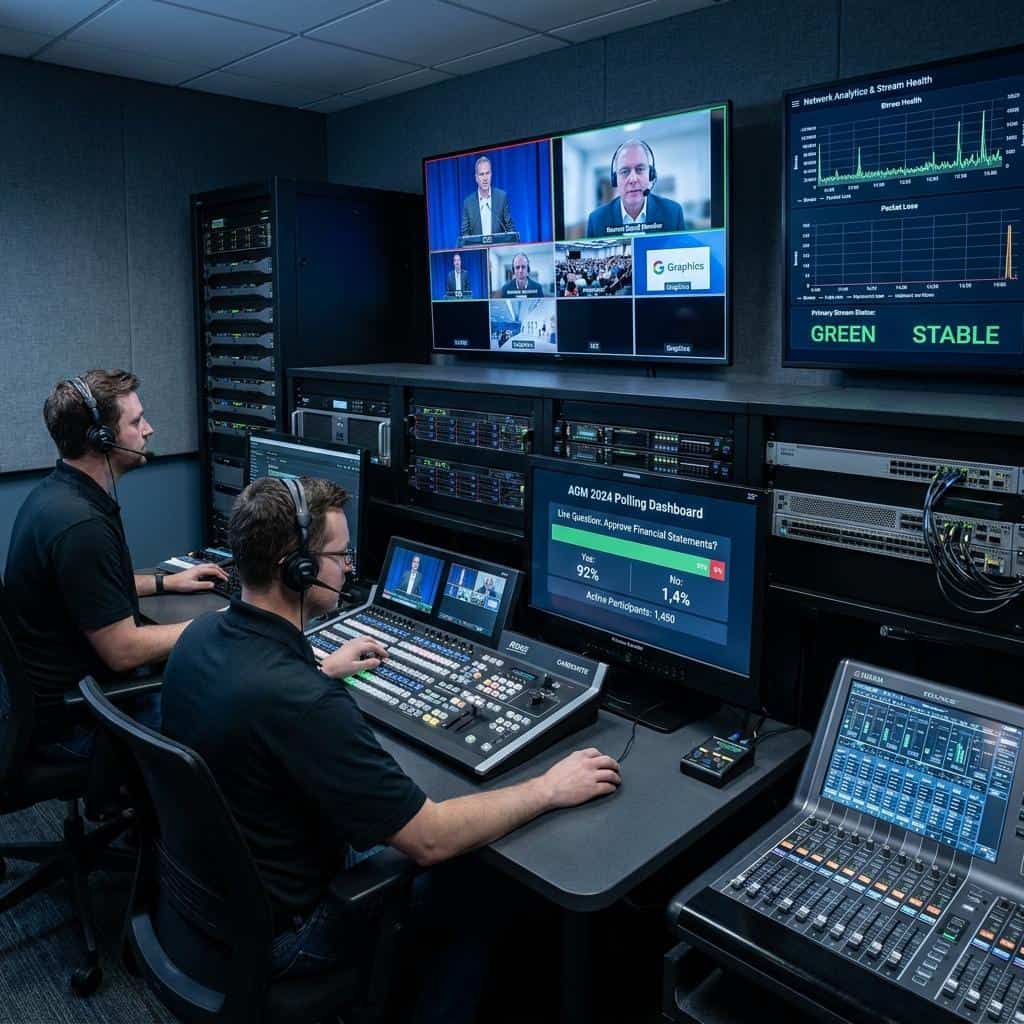
Hybrid Event Infrastructure Synergy: In a hybrid AGM, the technical environment must bridge the physical and virtual realms. On-site, multi-camera production setups capture the proceedings, with feeds routed through a vision mixer (e.g., Blackmagic ATEM, Grass Valley Kayak) and audio mixer (e.g., Yamaha QL, SSL Live). The program feed, often 1080p60 or 4K/UHD, is then encoded for various distribution paths. For virtual attendees, the encoded stream is pushed to a robust Content Delivery Network (CDN) with low-latency capabilities, ensuring minimal delay between the physical event and the virtual experience. Simultaneously, a dedicated data network, separate from the primary video network, manages all polling interactions. This segmentation is critical for maintaining Quality of Service (QoS) and isolating potential security risks. The polling application, accessible via a secure web portal or a dedicated native app, allows virtual attendees to participate in real-time. For on-site attendees, dedicated tablets or a secure Wi-Fi network with specific VLANs can provide access to the same polling interface.
Cloud-Based vs. On-Premise Solutions: The choice between a cloud-based or on-premise polling solution impacts scalability, security, and operational overhead. Cloud-based solutions (e.g., AWS Lambda, Google Cloud Functions for serverless polling logic, or managed Kubernetes clusters) offer unparalleled scalability, automatically adjusting resources to handle peak loads during voting, making them ideal for unpredictable attendance. They also benefit from the robust security infrastructure of major cloud providers, including DDoS mitigation and advanced threat detection. However, on-premise solutions provide complete control over data sovereignty and can be integrated more tightly with existing corporate data centers and security policies. For mission-critical AGMs, a hybrid cloud approach, leveraging cloud burst capabilities for polling and maintaining on-premise control for core data, can offer the best of both worlds, balancing flexibility with stringent security requirements.
Optimizing Network Infrastructure for Interactive Performance
Network infrastructure is the backbone of any interactive streaming event. For custom polling in an AGM, low latency and high reliability are non-negotiable.
- Dedicated Bandwidth: Ensure dedicated, redundant internet connections with ample upload and download bandwidth for both video streaming and interactive data. For professional-grade streaming at 1080p60, a minimum of 10-20 Mbps upload per stream is recommended, with additional capacity for polling data, especially during peak interaction.
- QoS Configuration: Implement Quality of Service (QoS) policies on network routers and switches to prioritize polling data packets and critical video streams. This prevents less critical network traffic from impacting interactive responsiveness or video quality.
- CDN Edge Caching: Utilizing a CDN with edge caching closer to the virtual audience minimizes latency for content delivery, which indirectly improves the perception of real-time polling integration. The polling application itself should ideally be served from the CDN’s edge locations to reduce response times.
- Network Redundancy: Implement failover mechanisms for all critical network paths, including primary and secondary internet service providers (ISPs), redundant routers, and switches. This ensures continuous operation even in the event of a network component failure.
Operational Resilience: Ensuring Security, Scalability, and Compliance
The successful execution of an enterprise AGM with custom polling is ultimately measured by its operational resilience. This encompasses not only technical uptime but also the ability to withstand cyber threats, scale gracefully, and adhere to rigorous compliance standards.
Comprehensive Security Framework: Security for AGM polling extends beyond mere encryption. A layered security approach is essential, starting with robust perimeter defenses like Web Application Firewalls (WAFs) and Intrusion Detection/Prevention Systems (IDPS). All data, both in transit and at rest, must be encrypted using industry-standard protocols (TLS 1.2/1.3 for transit, AES-256 for rest). Regular penetration testing and vulnerability assessments are critical to identify and remediate potential weaknesses. Access controls to the polling platform’s backend must follow the principle of least privilege, with stringent auditing of all administrative actions. Furthermore, protection against common web vulnerabilities, such as SQL injection, cross-site scripting (XSS), and cross-site request forgery (CSRF), must be embedded in the application’s development lifecycle and continuously monitored. For high-stakes AGMs, real-time security monitoring via Security Information and Event Management (SIEM) systems can provide immediate alerts for anomalous activity.
Scalability Planning and Load Testing: Enterprise AGMs can experience significant spikes in participant interaction, particularly during voting segments. The polling infrastructure must be designed to scale both horizontally (adding more instances of servers/containers) and vertically (increasing resources for existing instances). Rigorous load testing, simulating peak attendee numbers and voting patterns, is indispensable. This helps identify bottlenecks in database performance, application server capacity, and network bandwidth before the live event. Auto-scaling groups in cloud environments or container orchestration platforms like Kubernetes are instrumental in managing dynamic resource allocation, ensuring that system performance remains stable under stress. Benchmarking against expected maximum attendance, with a significant buffer, is a standard practice to guarantee reliability.
Regulatory Compliance and Auditability: AGMs are governed by strict corporate law and regulatory frameworks (e.g., company acts, stock exchange rules, GDPR, CCPA). The custom polling system must be designed with full auditability in mind. This means every vote, every interaction, and every system event must be logged with immutable timestamps. These audit logs are crucial for verifying vote counts, investigating disputes, and demonstrating compliance to regulatory bodies. Data retention policies must align with legal requirements, and data privacy by design must be a core principle, especially when handling personal identifiable information (PII) of shareholders. Secure archiving of all polling data and audit trails for mandated periods is a non-negotiable requirement.
Redundancy and Failover Strategies
To minimize the risk of disruption during a live AGM, robust redundancy and failover strategies are essential:
- Active-Active Architecture: Deploying the polling application and database in an active-active configuration across multiple data centers or cloud regions ensures that if one location fails, traffic can immediately be rerouted to another without interruption.
- Geographic Redundancy: For global enterprises, deploying infrastructure in geographically diverse locations protects against regional outages and provides lower latency for a distributed audience.
- Automated Failover: Implement automated health checks and failover mechanisms at every layer of the infrastructure, from network switches and load balancers to application servers and databases. DNS (Domain Name System) failover, for example, can automatically redirect users to a healthy IP address in the event of an outage.
- Comprehensive Monitoring and Alerting: Deploy real-time monitoring tools for all system components, including CPU usage, memory, network latency, application response times, and database performance. Proactive alerting (via SMS, email, or paging systems) for any deviation from baseline performance allows technical teams to address issues before they impact the live event.
Strategic Implementation: Best Practices and Future-Proofing
Implementing custom polling for enterprise AGMs is a complex undertaking that benefits significantly from established best practices and a forward-thinking approach to technology adoption.
Pre-Event Preparation and Testing: Thorough end-to-end testing is paramount. This includes functional testing of all polling features, load testing to simulate peak attendance, and full-scale rehearsals with all stakeholders (legal, production, IT, company secretariat). Test scenarios should cover potential edge cases, such as network connectivity issues for attendees or unexpected voting patterns. A dedicated technical run-through, simulating the entire AGM workflow from presenter cues to poll launches and results display, is critical to iron out any operational kinks. This meticulous preparation minimizes the risk of live event failures and builds confidence among all involved parties.
Dedicated Technical Support and Management: During the live AGM, a specialized technical team must be on standby to manage the polling system. This includes a dedicated polling operator responsible for launching and closing polls, a data auditor to verify results in real-time, and IT support to address any attendee technical issues. Clear communication channels between the polling team, the production control room, and the legal/governance team are vital for swift decision-making and problem resolution. A pre-defined escalation matrix ensures that any issues are addressed by the appropriate personnel without delay.
Post-Event Analytics and Reporting: Beyond the live event, the custom polling system should provide comprehensive analytics and reporting capabilities. This includes detailed breakdowns of voting percentages, participation rates, and individual vote records (where legally permissible and auditable). These reports are essential for regulatory filings, internal governance reviews, and strategic planning for future AGMs. Data visualization tools can present complex voting data in an easily digestible format for board members and stakeholders. Furthermore, feedback mechanisms for attendees regarding the polling experience can inform future improvements to the platform.
Future-Proofing for Evolving Governance and Technology
The technological landscape for virtual and hybrid events is constantly evolving. Future-proofing custom polling solutions involves:
- API-First Design: An API-first approach ensures maximum flexibility for integrating with new enterprise platforms, virtual event environments, or emerging immersive technologies (e.g., metaverse-style AGMs).
- Modular Architecture: A modular design allows for independent updates and enhancements to specific components of the polling system without impacting the entire application. This facilitates agile development and faster adoption of new features.
- Emphasis on AI and Machine Learning: Exploring the use of AI for sentiment analysis of open-ended feedback during AGMs (while maintaining strict privacy controls) or for predicting potential quorum issues based on historical data can provide strategic insights.
- Enhanced Cybersecurity Posture: Continuous investment in advanced cybersecurity measures, including zero-trust architectures and proactive threat intelligence, is crucial to protect against increasingly sophisticated cyberattacks targeting high-profile corporate events.
In conclusion, custom polling features for enterprise-grade AGMs are no longer a luxury but a fundamental component of effective corporate governance in the hybrid era. The successful implementation demands a meticulous technical approach, encompassing robust architectural design, seamless integration with professional streaming workflows, unwavering commitment to security and scalability, and stringent adherence to regulatory compliance. By partnering with experts like Live Streaming Studio, enterprises can ensure their AGMs are not only technically flawless but also highly interactive, transparent, and fully compliant, reinforcing shareholder confidence and upholding the integrity of the corporate decision-making process.

Michael Koh is a production specialist and entrepreneur who founded Spring Forest Studio in 2017 to provide event and virtual production solutions in Singapore. He specialises in hybrid live streaming, XR (Extended Reality) virtual production, and studio systems integration, transitioning the business from traditional videography to advanced corporate broadcasting. Operating out of a dedicated facility at NordCom2 in Singapore, he leads a technical crew to deliver multi-camera webcasts, digital sets, and technical consultations for large-scale corporate events.