
In the evolving landscape of global enterprise, the ability of C-suite executives and key opinion leaders to communicate seamlessly and authoritatively from any location has transitioned from a convenience to a critical strategic imperative. The era of low-resolution webcams and suboptimal audio for high-stakes corporate broadcasts is unequivocally over. Modern B2B event streaming and hybrid production demand a sophisticated, technically robust solution: the premium remote executive broadcast kit. This article delves into the meticulous technical specifications, infrastructure requirements, and workflow considerations essential for deploying such systems, ensuring global leaders maintain a commanding, broadcast-quality presence in all virtual and hybrid engagements.
Core Components of an Enterprise-Grade Remote Executive Broadcast Kit
Establishing a premium remote studio for a global leader requires a holistic approach, integrating professional-grade video acquisition, pristine audio capture, and controlled lighting. Each component must meet rigorous technical standards to contribute to an uncompromised broadcast output.
Camera Systems: Elevating Visual Fidelity to Broadcast Standards
The visual cornerstone of any professional remote kit is the camera system. While prosumer DSLR/mirrorless cameras can provide shallow depth-of-field aesthetics, their long-term reliability, thermal performance, and native professional I/O often fall short for continuous enterprise operations. Instead, the focus shifts to dedicated professional video cameras or, increasingly, advanced PTZ (Pan-Tilt-Zoom) camera systems.
- Broadcast-Grade PTZ Cameras: Solutions like those from Panasonic, Sony, or BirdDog offer up to 4K/UHD resolution at 30p or even 60p, featuring large 1/2.5-inch or 1-inch CMOS sensors for superior low-light performance and dynamic range. Key specifications include optical zoom ratios of 20x to 30x, critical for framing flexibility without digital degradation. Output options must include both SDI (3G-SDI, 6G-SDI, or 12G-SDI for UHD) and network protocols such as NDI|HX (High Efficiency) or full NDI. SDI ensures robust, low-latency baseband video transmission over longer cable runs (up to 100 meters for 3G-SDI over RG6 coax), while NDI|HX provides IP-based video, audio, and control over a single Ethernet cable, simplifying remote deployments. For color accuracy, a high Color Rendering Index (CRI) for lighting is paramount, and cameras with advanced colorimetry features (e.g., V-Log, S-Log) allow for greater flexibility in post-production or live color grading.
- Fixed Lens Professional Cameras: For environments where a fixed, optimal shot is desired, compact professional camcorders (e.g., Sony PXW-Z90, Panasonic AG-CX10) offers excellent image quality, professional audio inputs (XLR), and robust build quality. These typically provide 4K acquisition and multiple output formats, including HDMI 2.0/2.1 and 3G-SDI.
Professional Audio Capture: The Foundation of Clear Communication
Poor audio quality is the quickest route to undermining executive authority. A premium remote kit prioritizes crystal-clear, intelligible speech, free from ambient noise and acoustic anomalies. This necessitates moving beyond built-in camera microphones or consumer-grade USB headsets.
- Microphone Selection:
- Lavalier Microphones: Discrepancy is key for executives. Professional omnidirectional or cardioid lavalier microphones (e.g., Sennheiser ME 2-II, Shure WL185) offer consistent audio levels despite head movements. Wireless lavalier systems (UHF or 2.4 GHz digital) provide freedom of movement, with crucial consideration for signal integrity and frequency coordination, especially in dense RF environments.
- Shotgun Microphones: For a more discreet, off-camera solution, a short shotgun microphone (e.g., Rode NTG2, Sennheiser MKE 600) mounted on a desktop stand or boom arm, positioned strategically out of frame, can provide excellent directional pickup, minimizing room reverberation.
- USB Condenser Microphones (Professional Grade): While often associated with consumer use, certain professional USB microphones (e.g., Shure MV7, Blue Yeti Pro) integrate high-quality capsules and ADCs, offering a direct, high-fidelity digital path to a host computer. These are suitable when minimal hardware footprint is desired, but careful acoustic treatment of the space remains critical.
- Audio Interface and Mixing: Regardless of microphone choice, a professional USB audio interface (e.g., Focusrite Scarlett, PreSonus AudioBox) or a compact digital mixer (e.g., Behringer Xenyx Q1202USB) is essential. These devices provide high-quality preamplifiers, phantom power for condenser microphones, and robust Analog-to-Digital Conversion (ADC) to deliver clean digital audio to the streaming encoder or computer. Features like gain control, EQ, and basic compression are vital for optimizing vocal clarity and preventing clipping.
- Acoustic Treatment: No microphone, however high-end, can fully compensate for a poor acoustic environment. Simple, effective treatments include heavy drapes, bookshelves, rugs, and strategically placed acoustic panels to reduce reverberation and echo, significantly enhancing speech intelligibility.
Lighting Design for Executive Presence: Shaping the Visual Narrative
Professional lighting transforms a mundane background into a visually engaging environment, enhancing an executive’s presence and perception of authority. A standard three-point lighting setup forms the foundation.
- Key Light: The primary light source, typically a softbox or panel LED (e.g., Aputure Amaran 100x, Godox SL60W) positioned slightly off-axis from the camera, illuminating the executive’s face. Adjustable color temperature (3200K-5600K) and high CRI (>95) are crucial for natural skin tones.
- Fill Light: A softer light, positioned opposite the key light, reduces harsh shadows created by the key light, ensuring balanced illumination. It should be less intense than the key light.
- Backlight/Hair Light: Placed behind and above the executive, separating them from the background, adding depth and dimension.
- Background Lighting: Ambient or accent lighting (e.g., LED strips, small practical lamps) can add visual interest to the background without distracting from the primary subject. Avoid harsh overhead lighting that creates unflattering shadows.
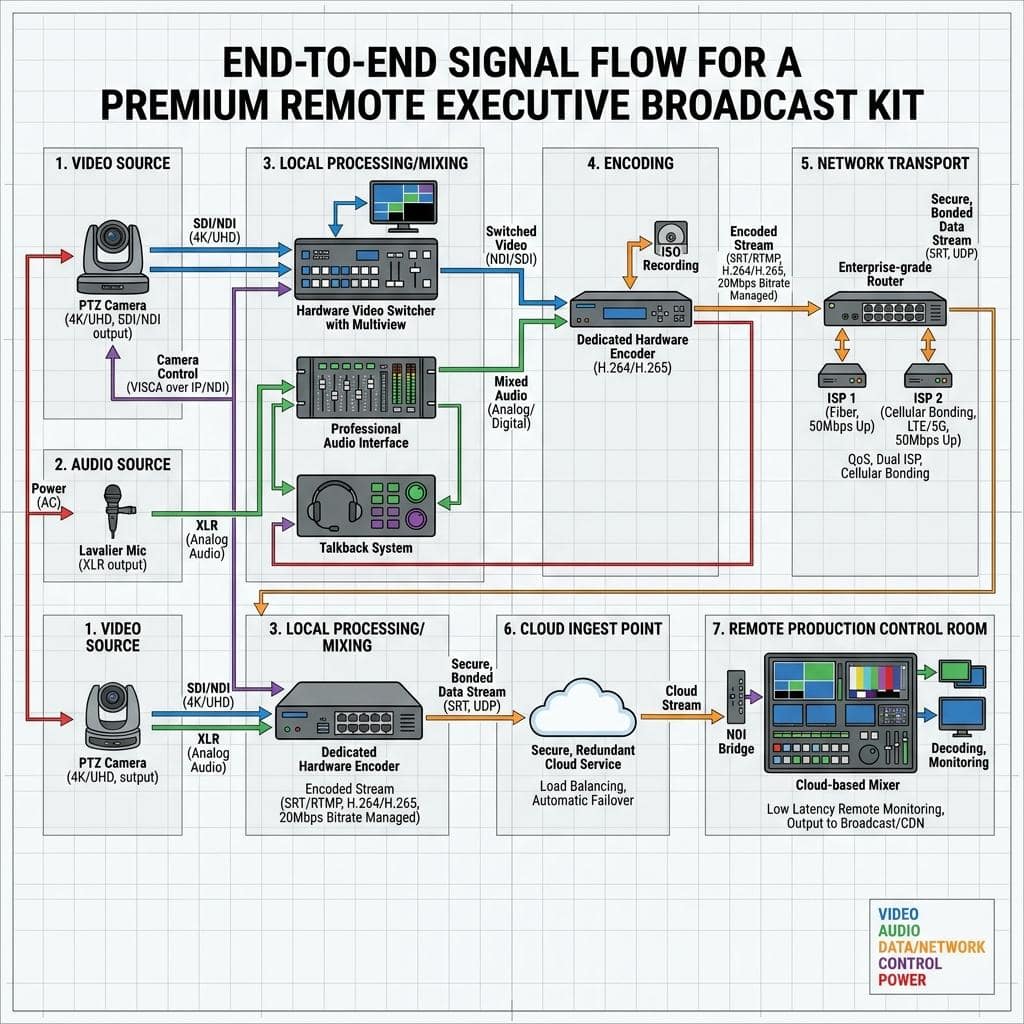
Signal Path, Encoding, and Transmission Protocols for Enterprise Streaming
Once video and audio are acquired, the next critical phase involves their processing, encoding, and reliable transmission to the remote production hub or content delivery network (CDN). This demands a robust signal chain and judicious protocol selection.
Video Signal Routing, Switching, and Monitoring: Ensuring Flawless Feeds
For multi-camera setups or when integrating presentation graphics, efficient signal management is paramount.
- Hardware Video Switchers: Compact production switchers (e.g., Blackmagic ATEM Mini Pro, Roland V-1HD) allow for seamless transitions between multiple camera angles, pre-rendered graphics, or computer inputs (for slides). These typically feature HDMI or SDI inputs and provide program and multiview outputs. Multiview monitoring is indispensable, allowing the executive or an on-site technician to see all camera feeds, program output, and audio levels simultaneously, enhancing confidence and control.
- IP-Based Video Routing (NDI): In setups leveraging NDI-enabled cameras and software, NDI allows for routing multiple video streams over a standard Gigabit Ethernet network. This eliminates the need for discrete video cables and offers significant flexibility, allowing any NDI source to be accessed by any NDI receiver on the network. NDI Bridge further facilitates secure, high-quality NDI transmission over WANs, enabling remote production teams to control and ingest NDI feeds from geographically dispersed executive studios.
- Talkback Systems: For professional remote direction, a dedicated talkback system (e.g., Clear-Com, RTS, or IP-based solutions via Dante or NDI) allows the executive to receive cues and and instructions from the remote production director without their audio being heard on the program feed.
Enterprise-Grade Encoding: Optimizing Quality, Efficiency, and Latency
Encoding transforms raw video and audio into a compressed digital stream suitable for transmission. For executive broadcasts, the goal is maximum quality with minimal latency and bandwidth efficiency.
- Codec Selection: H.264 (AVC) remains the ubiquitous standard for its wide compatibility and robust performance. For higher resolutions (4K/UHD) or when bandwidth is constrained, H.265 (HEVC) offers significantly improved compression efficiency (up to 50% bandwidth reduction for similar quality) but requires more processing power for encoding and decoding. Dedicated hardware encoders (e.g., Haivision Makito X, Teradek Cube/Bond series, AJA HELO Plus) are preferred over software encoders for their reliability, consistent performance, and lower processing overhead.
- Bitrate Management: Adaptive Bitrate Streaming (ABS) is a standard for professional delivery, but for a single executive feed, a constant bitrate (CBR) or constrained variable bitrate (CVBR) is often used for predictable quality. For 1080p30, typical bitrates range from 8-15 Mbps for excellent quality. For 4K/UHD 30p, bitrates of 25-50 Mbps are recommended, depending on the complexity of motion and desired fidelity. Key parameters like Group of Pictures (GOP) structure (e.g., I-frame every 1-2 seconds) and B-frame usage must be carefully configured to balance compression efficiency and latency.
- Latency Optimization: End-to-end latency for live interactive sessions should ideally be sub-200 milliseconds (ms). This involves minimizing delays at every stage: camera processing, encoding, network transport, and decoding. Hardware encoders, combined with low-latency protocols, are crucial.
Secure and Reliable Transport Protocols: Ensuring Global Reach
The choice of transmission protocol dictates the robustness and latency of the executive’s feed from their remote studio to the production control room.
- SRT (Secure Reliable Transport): Developed by Haivision, SRT is an open-source protocol specifically designed for high-performance, low-latency video transport over unpredictable public networks (WANs). It uses UDP for speed and implements sophisticated retransmission mechanisms (ARQ – Automatic Repeat reQuest) and forward error correction (FEC) to recover from packet loss, ensuring high reliability without excessive latency. SRT offers end-to-end encryption (AES 128/256) for security, making it ideal for sensitive corporate communications. SRT supports various modes: Caller, Listener, and Rendezvous, facilitating firewall traversal.
- RTMP/RTMPS (Real-Time Messaging Protocol): RTMP is a legacy TCP-based protocol widely adopted by CDNs and streaming platforms. While reliable, its TCP overhead can introduce higher latency, especially over long distances or lossy networks. RTMPS (secure RTMP over SSL/TLS) adds encryption. While still used for final distribution to CDNs, for the initial ingest from a remote executive studio to a production hub, SRT is generally preferred for its superior latency and error recovery capabilities over challenging network conditions.
- Bonding Solutions: For mission-critical scenarios or locations with unreliable single internet connections, cellular bonding devices (e.g., from LiveU, Teradek, TVU Networks) can aggregate multiple cellular modems and/or wired connections into a single, robust data pipe. These devices employ proprietary protocols with sophisticated FEC and load balancing to maintain a stable, high-bandwidth connection even under adverse network conditions, providing unparalleled redundancy.
Network Infrastructure and Redundancy for Uninterrupted Global Communication
The finest camera and encoder are rendered useless without a robust, resilient network foundation. For global executive communications, network infrastructure planning must prioritize bandwidth, quality of service (QoS), and failover strategies.
Bandwidth Management and Quality of Service (QoS): Prioritizing Mission-Critical Streams
Dedicated and optimized network resources are non-negotiable for enterprise-grade streaming.
- Dedicated Circuits and Symmetric Bandwidth: Ideally, the executive’s remote location should have access to a dedicated, enterprise-grade internet circuit with symmetric upload and download speeds. For 1080p streaming, a minimum sustained upload bandwidth of 20 Mbps is recommended; for 4K/UHD, this should scale to 50 Mbps or more, with ample overhead for network stability. Consumer-grade asymmetric connections (high download, low upload) are generally insufficient.
- QoS Configuration: Network administrators must implement QoS policies on local routers and enterprise firewalls to prioritize the outbound streaming traffic (e.g., SRT, RTMPS) over less critical network activities. This involves marking streaming packets with higher priority (e.g., DSCP values) to minimize jitter and packet loss, which are detrimental to video and audio quality.
- Local Network Optimization: A dedicated Gigabit Ethernet connection from the encoder to the internet router is essential. Wi-Fi, even Wi-Fi 6, introduces variability and potential interference that can compromise stream stability and should be avoided for primary transmission paths for executive broadcasts.
Redundancy and Failover Strategies: Mitigating Risk in Live Production
Live streaming from remote locations inherently carries risks. Comprehensive redundancy and failover planning are paramount to ensure business continuity.
- Dual ISP Connections: Implementing two independent Internet Service Providers (ISPs) with automatic failover capabilities (e.g., via a dual-WAN router) provides a primary layer of network redundancy.
- Cellular Bonding/Fallback: As mentioned, cellular bonding devices offer robust multi-network redundancy. For less critical but still important redundancy, a high-speed cellular modem (e.g., 5G hotspot) can serve as a manual or automated fallback for the wired connections.
- Local ISO Recording: Independently recording the pristine, high-quality camera and audio feeds (ISO recording) to a local SSD or NVR at the executive’s location serves as a crucial backup. In the event of a complete network outage or severe quality degradation, this recording can be retrieved and used for post-production or re-broadcast, ensuring no content is permanently lost.
- Cloud-Based Redundancy: Leveraging cloud ingest points and multi-CDN distribution strategies provides resilience further down the streaming chain, ensuring the executive’s content reaches its audience even if one cloud region or CDN experiences issues.
Cyber Security Considerations for Enterprise Streaming: Protecting Sensitive Communications
Enterprise streaming involves transmitting potentially sensitive corporate information. Robust security measures are non-negotiable.
- End-to-End Encryption: Utilize protocols like SRT with AES encryption or RTMPS (SSL/TLS) for all transmission paths. Encrypting local media storage and ensuring secure access controls are also vital.
- VPN Integration: For highly sensitive internal broadcasts, the remote executive kit can be configured to transmit its stream over a secure Virtual Private Network (VPN) connection to the enterprise network, further isolating it from the public internet.
- Firewall Configuration: Strict firewall rules should be in place, allowing only necessary ports and protocols for outbound streaming traffic while blocking all other ingress attempts. Regular security audits of all network devices and streaming infrastructure are essential.
Integration with Hybrid Event Ecosystems and Remote Production Workflows
The CEO’s home studio is not an isolated island; it must seamlessly integrate into larger hybrid event frameworks and sophisticated remote production workflows, allowing for global participation and professional oversight.
Seamless Integration with Virtual Meeting Platforms: Bridging the Gap
While a premium executive studio outputs broadcast-grade signals, it must often feed into widely used virtual meeting platforms (VMPs) like Microsoft Teams, Zoom, or Webex for internal meetings, town halls, or hybrid event components.
- Virtual Camera/Audio Interfaces: Professional capture cards (e.g., Elgato Cam Link, Blackmagic Web Presenter) can convert SDI or HDMI camera feeds into USB webcam signals, making them accessible to any VMP as a high-quality video input. Similarly, USB audio interfaces provide professional-grade microphone input to these platforms.
- NDI Tools Integration: For NDI-enabled studios, NewTek NDI Tools offers utilities like NDI Virtual Input, which allows any NDI stream on the local network to appear as a webcam and microphone input within VMPs, providing superior quality and flexibility compared to standard webcams.
- Dedicated VMP Hardware Endpoints: For permanent executive studios, integrating a dedicated VMP hardware endpoint (e.g., a Microsoft Teams Room system, Cisco Webex Desk Pro) can provide robust, enterprise-grade integration, offering advanced features like whiteboarding, digital signage integration, and simplified user experience, all while leveraging the high-quality camera and audio sources of the premium kit.
Remote Production Operations: Centralized Control and Monitoring
The true power of a CEO’s home studio is unleashed when it is part of a centrally managed remote production workflow. This involves control, monitoring, and communication back to the executive.
- Remote Camera Control: PTZ cameras supporting IP control (VISCA over IP, NDI) allow a technical director at a centralized production hub to remotely pan, tilt, zoom, and adjust camera settings (exposure, focus, white balance) in real-time. This eliminates the need for on-site camera operators, reducing logistical complexity and costs.
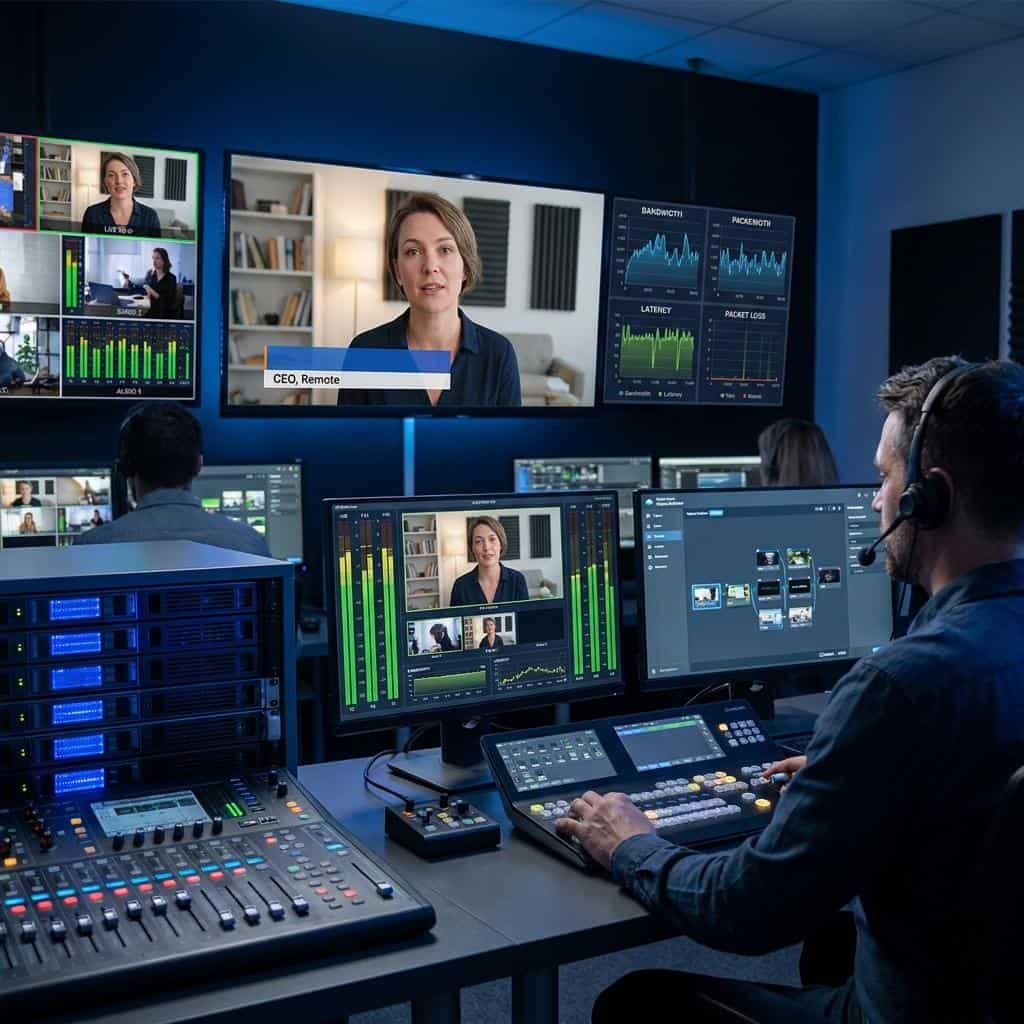
- Cloud-Based Mixing and Switching: Platforms like Grass Valley AMPP, TVU Producer, or LiveU Studio enable cloud-native video mixing and switching. Raw or encoded streams from the executive’s studio are ingested into the cloud, where they can be mixed with graphics, other remote feeds, and pre-recorded content by a remote technical team, before being distributed. This allows for global, collaborative production workflows.
- Return Feed and Multiview: Providing a low-latency return feed to the executive (e.g., via SRT decode or a dedicated web browser interface) allows them to see the program output or a multiview of other presenters, enhancing their engagement and responsiveness during live sessions.
Post-Production Readiness: ISO Recording and Metadata Management
Beyond live transmission, the content generated from executive studios often has significant post-production value.
- High-Quality ISO Recording: As mentioned, local ISO recording of each camera and audio channel in high-quality codecs (e.g., ProRes, DNxHD) is vital. This ensures a clean, uncompressed archive that can be used for later editing, creating highlight reels, or repurposing content without relying on the compressed live stream.
- Metadata and Timecode: Implementing consistent timecode synchronization across all recording devices and attaching relevant metadata (speaker name, topic, event title) simplifies asset management and accelerates post-production workflows.
The deployment of a premium remote executive broadcast kit is a strategic investment that pays dividends in brand reputation, communication efficacy, and global leadership presence. It signifies a commitment to excellence in every digital interaction, ensuring that even from a remote location, a global leader’s message is delivered with broadcast-grade quality, authority, and impact. By meticulously implementing these technical guidelines and leveraging advanced B2B streaming solutions, enterprises can empower their leaders to command any virtual stage with unparalleled confidence and professionalism.

Michael Koh is a production specialist and entrepreneur who founded Spring Forest Studio in 2017 to provide event and virtual production solutions in Singapore. He specialises in hybrid live streaming, XR (Extended Reality) virtual production, and studio systems integration, transitioning the business from traditional videography to advanced corporate broadcasting. Operating out of a dedicated facility at NordCom2 in Singapore, he leads a technical crew to deliver multi-camera webcasts, digital sets, and technical consultations for large-scale corporate events.