
 March 20, 2026 by Editor |
The Unseen Cost of Silence: Why Redundancy is Non-Negotiable for Enterprise Streaming
For a high-stakes enterprise live stream, there is no such thing as a minor glitch. Whether it is a CEO’s quarterly all-hands address, a global product launch, or a critical investor relations briefing, the expectation is broadcast-grade stability. The cost of downtime is not measured merely in lost revenue; it is a direct blow to brand integrity, shareholder confidence, and employee engagement. A single point of failure can cascade into a complete loss of transmission, turning a strategic communications opportunity into a public relations liability. In the world of professional B2B event production and hybrid experiences, redundancy is not an optional add-on or a luxury. It is a foundational requirement, an architectural philosophy that dictates every choice from camera selection to Content Delivery Network (CDN) strategy. Understanding and implementing multi-layered redundancy is what separates a professional broadcast from a risky gamble.
Deconstructing Single Points of Failure in the Production Chain
The journey of a live stream from a camera lens to a global audience is a complex chain of interconnected systems. Each link represents a potential point of failure. A comprehensive redundancy plan begins with a granular analysis of this chain, identifying and mitigating every vulnerability from the moment of capture through final processing.
Source and Ingest Resiliency
The point of origin is the most critical link. If the source signals, both audio and video, are compromised, no amount of downstream technology can recover them. True source resiliency involves parallel, independent signal paths. For a keynote speaker, this means having a primary and a backup microphone, perhaps a lavalier and a lectern mic, routed to separate channels on the audio mixer. For video, this means an A/B camera setup, where two cameras cover the same critical shot. In the event of a primary camera failure, the Technical Director (TD) can seamlessly cut to the backup. The signal transport from these sources to the production switcher also requires redundancy. While a single 12G-SDI (Serial Digital Interface) cable can carry a 4K/UHD signal, a secondary SDI run or a parallel NDI (Network Device Interface) stream over a separate network switch provides a vital fallback path. Ingest servers, responsible for converting these baseband signals into processable data, must be equipped with redundant capture cards and dual power supply units (PSUs) connected to independent power circuits.
Production Core: Switching and Processing
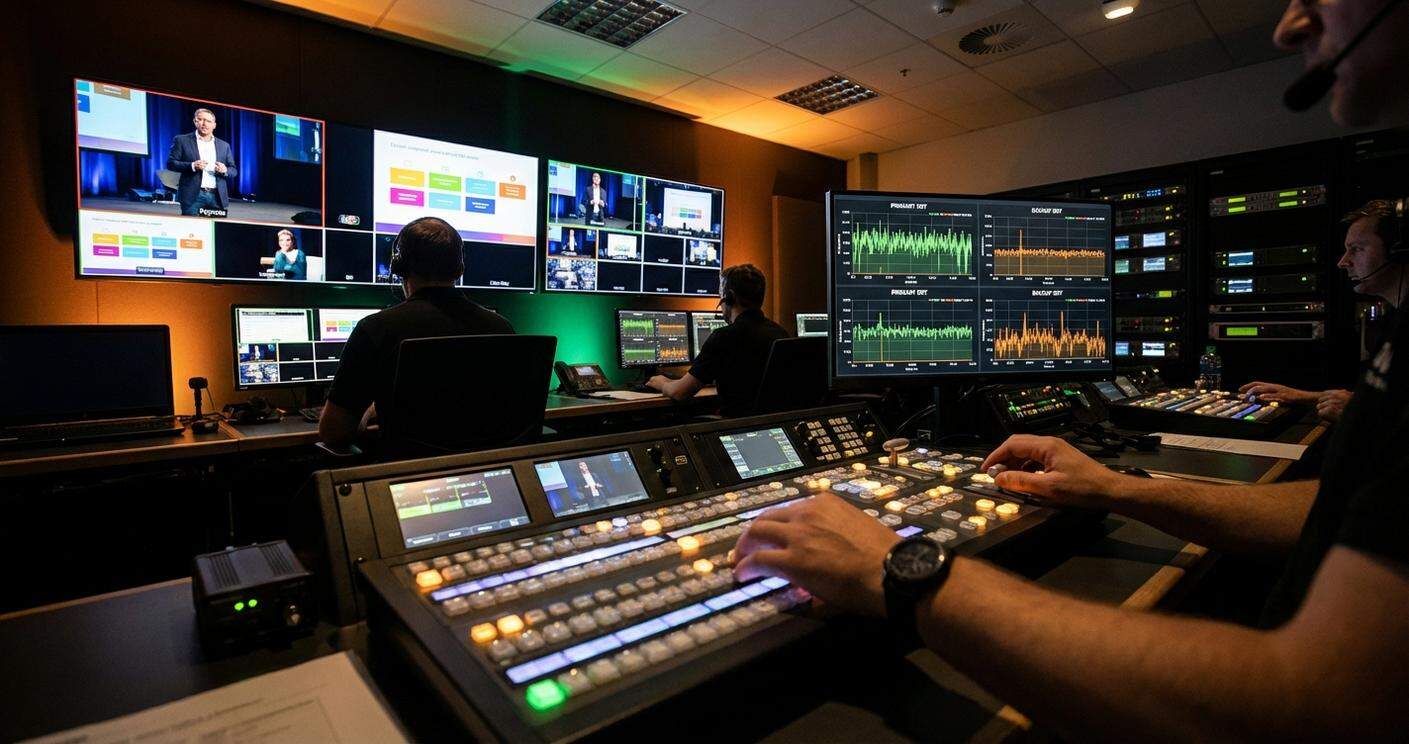
The production switcher is the heart of the live event. A failure here is catastrophic. Enterprise-grade hardware switchers, like those from Ross Video or Grass Valley, are designed with built-in redundancies, including dual PSUs and redundant crosspoint modules. The most robust setups employ a “hot spare” strategy: a second, identical production switcher running in parallel, mirroring the primary switcher’s state. In case of a catastrophic failure of the primary unit, a simple downstream router switch can instantly make the backup switcher the active program source. This failover can be executed in milliseconds, completely transparent to the viewing audience. For cloud-based production workflows, redundancy is often abstracted. The service provider manages infrastructure resilience across multiple availability zones. However, it is crucial to verify the provider’s Service Level Agreement (SLA) and understand their specific failover mechanisms and recovery time objectives.
Architecting Network and Encoding Redundancy
Once a clean program feed leaves the production switcher, it enters the most volatile segment of its journey: the network. From the local area network (LAN) to the public internet, connectivity is fraught with potential issues like packet loss, jitter, and complete outages. A professional streaming architecture anticipates these issues with multi-layered network and encoding redundancy.
The Critical Role of Path Diversity
Relying on a single internet connection is untenable for any serious enterprise stream. True path diversity means using multiple, completely independent internet service providers (ISPs), ideally with physically separate entry points into the venue. For example, a primary fiber connection can be paired with a secondary cable or dedicated microwave link. For ultimate mobility and resilience, bonded cellular technology is a key component. Systems from manufacturers like LiveU and TVU Networks bond multiple cellular connections (e.g., AT&T, Verizon, T-Mobile) with local Wi-Fi and Ethernet into a single, highly resilient data pipe. The technology can dynamically adjust the data flow across all available connections, mitigating the failure or degradation of any single link. This ensures a stable stream even from challenging remote locations without traditional connectivity.
Dual-Encoder Strategy and Protocol Selection
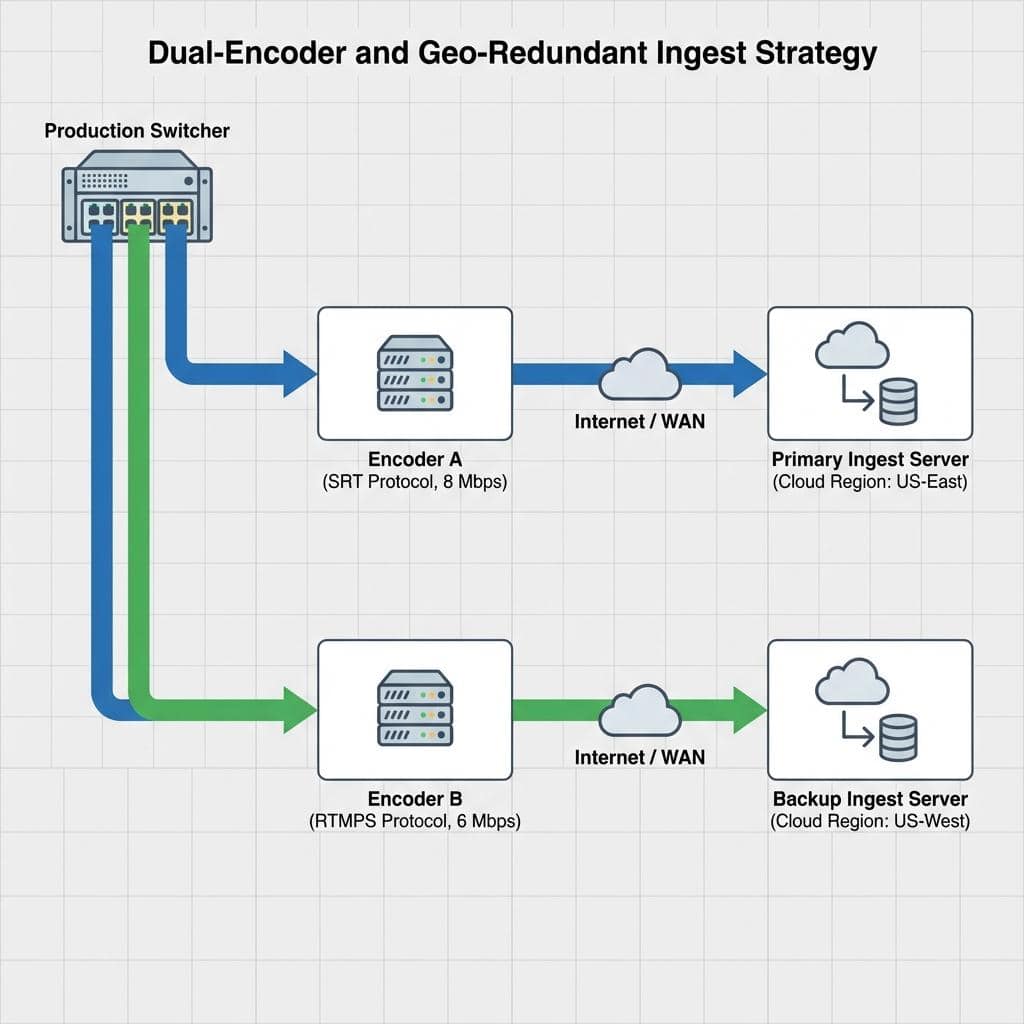
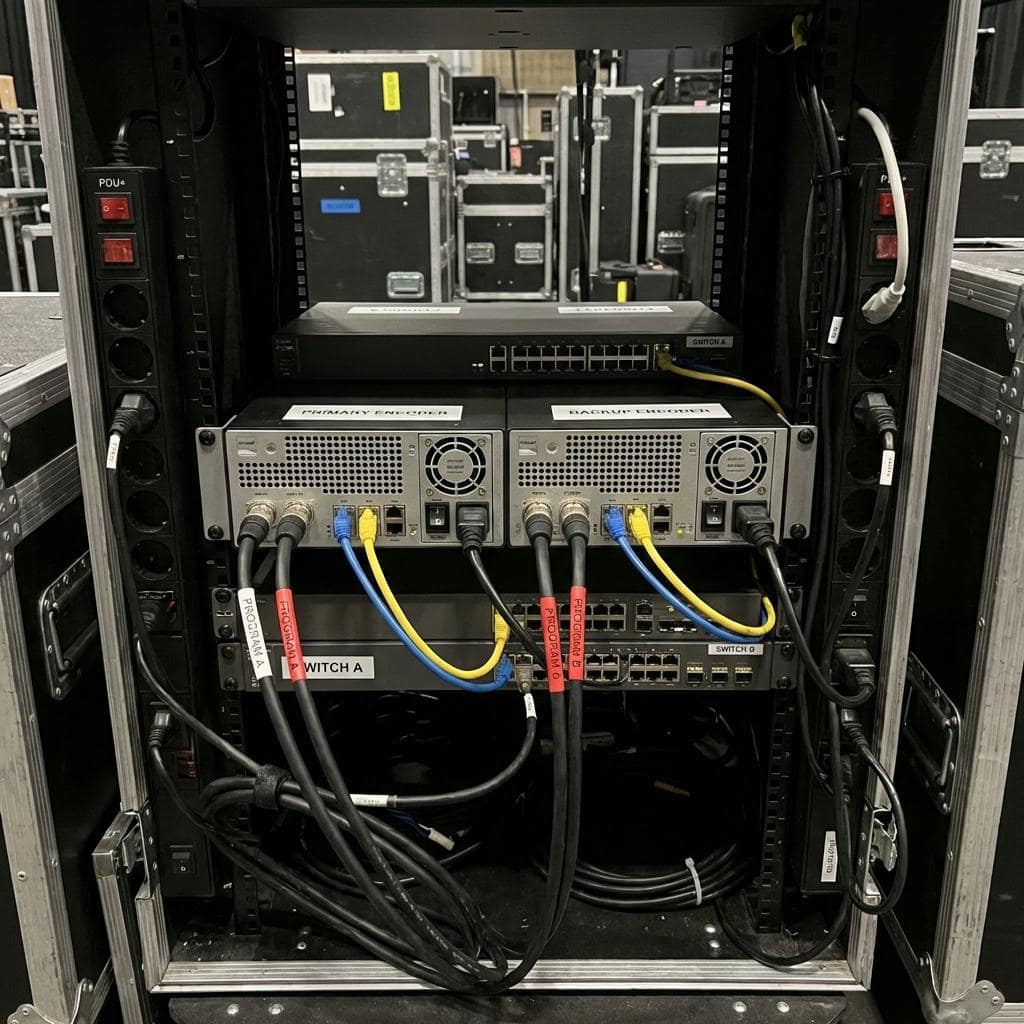
The encoder is the device or software that compresses the video and audio signal for transmission. A dual-encoder strategy is a non-negotiable standard for professional streams. The program feed from the switcher is split and sent to two independent encoders. These encoders should be configured for both hardware and network diversity.
- Primary Encoder: This unit might be configured to send a high-bitrate stream using the Secure Reliable Transport (SRT) protocol to the primary CDN ingest point. SRT is designed to handle packet loss and network instability, making it ideal for the primary contribution feed. A typical setting might be an 8 Mbps H.265 (HEVC) stream.
- Backup Encoder: The secondary unit could be configured to send a slightly lower bitrate stream, perhaps 6 Mbps H.264, using a different protocol like RTMPS (Real-Time Messaging Protocol Secure) to a geographically separate backup CDN ingest point. Using a different codec and protocol can sometimes mitigate rare, encoder-specific bugs or protocol-related network throttling.
The CDN or cloud streaming platform is then configured to automatically failover from the primary ingest to the backup ingest if the primary signal is lost or degrades below a predefined quality threshold. This hitless failover is invisible to the end viewer.
Cloud and CDN-Level Failover Architectures
The final layer of redundancy exists within the cloud infrastructure and the CDN responsible for global delivery. Even with a perfect on-site setup, a regional cloud outage or CDN performance issue can render a stream unwatchable for a segment of the audience. Enterprise-grade architectures plan for this with sophisticated cloud and multi-CDN strategies.
Geo-Redundant Ingest and Origin Shielding
A robust streaming platform offers geographically redundant ingest points. As part of the dual-encoder strategy, the primary SRT stream should be sent to one data center (e.g., US East) and the backup RTMPS stream to another (e.g., US West). This architecture ensures that a regional internet backbone issue or a data center-specific failure does not take the entire stream offline. The platform can seamlessly pull from the backup region. Furthermore, an Origin Shield is a critical component. It is a dedicated caching layer within the CDN that sits in front of the ingest server. All viewer requests are funneled to the shield, which then makes a single request to the origin. This protects the sensitive ingest servers from being overwhelmed by traffic and provides an additional layer of stability.
Multi-CDN Strategies for Global Reach
For mission-critical global events, relying on a single CDN can be a risk. A multi-CDN strategy involves using two or more CDN providers simultaneously, with a load-balancing service directing viewer traffic based on performance, geographic location, and availability. If one CDN experiences a performance issue in a specific region, traffic can be automatically rerouted to the other CDN, ensuring the best possible Quality of Experience (QoE) for every viewer, regardless of their location. This approach mitigates the risk of large-scale CDN outages that can impact even the biggest providers.
Operational and Human Redundancy
Technology is only half of the equation. The most resilient hardware can be defeated by human error or a lack of preparedness. The broadcast principle of “two is one, one is none” applies as much to personnel and procedures as it does to equipment.
Proactive Monitoring and Rehearsed Failover Drills
A professional production is an actively monitored one. The streaming engineer is not just watching the program feed; they are monitoring a bank of multiviewers displaying source signals, encoder outputs, and confidence feeds from the CDN. They are analyzing network telemetry data, watching for packet loss, jitter, and latency fluctuations. This proactive monitoring allows the team to identify a degrading component, like a failing SDI cable or a struggling network link, and switch to the backup *before* a catastrophic failure occurs. Critically, the entire failover process must be rehearsed. The team must conduct full failover drills, simulating an encoder failure, a network outage, and a camera failure to ensure that the switch to redundant systems is smooth, fast, and flawless.
The Human Element: Redundant Expertise
For any key role in a production, there must be a backup. A primary audio engineer (A1) should have an audio assistant (A2) who is fully capable of taking over the mix. The Technical Director operating the switcher should have a backup operator familiar with the show flow. This human redundancy ensures that an unforeseen issue with a key team member does not jeopardize the entire production. It also provides a second set of eyes and ears to catch potential problems, reinforcing the proactive monitoring philosophy.
Ultimately, building a resilient streaming architecture is about controlling variables in an inherently unpredictable environment. By systematically implementing redundancy at the source, production, network, cloud, and operational levels, enterprises can remove the element of chance. The investment in redundant systems and protocols is a direct investment in the success of the event and the preservation of brand reputation. For enterprise streams, where the stakes are highest, a single stream is no stream at all. A redundant, resilient architecture is the only professionally acceptable solution.