
 April 1, 2026 by Editor |
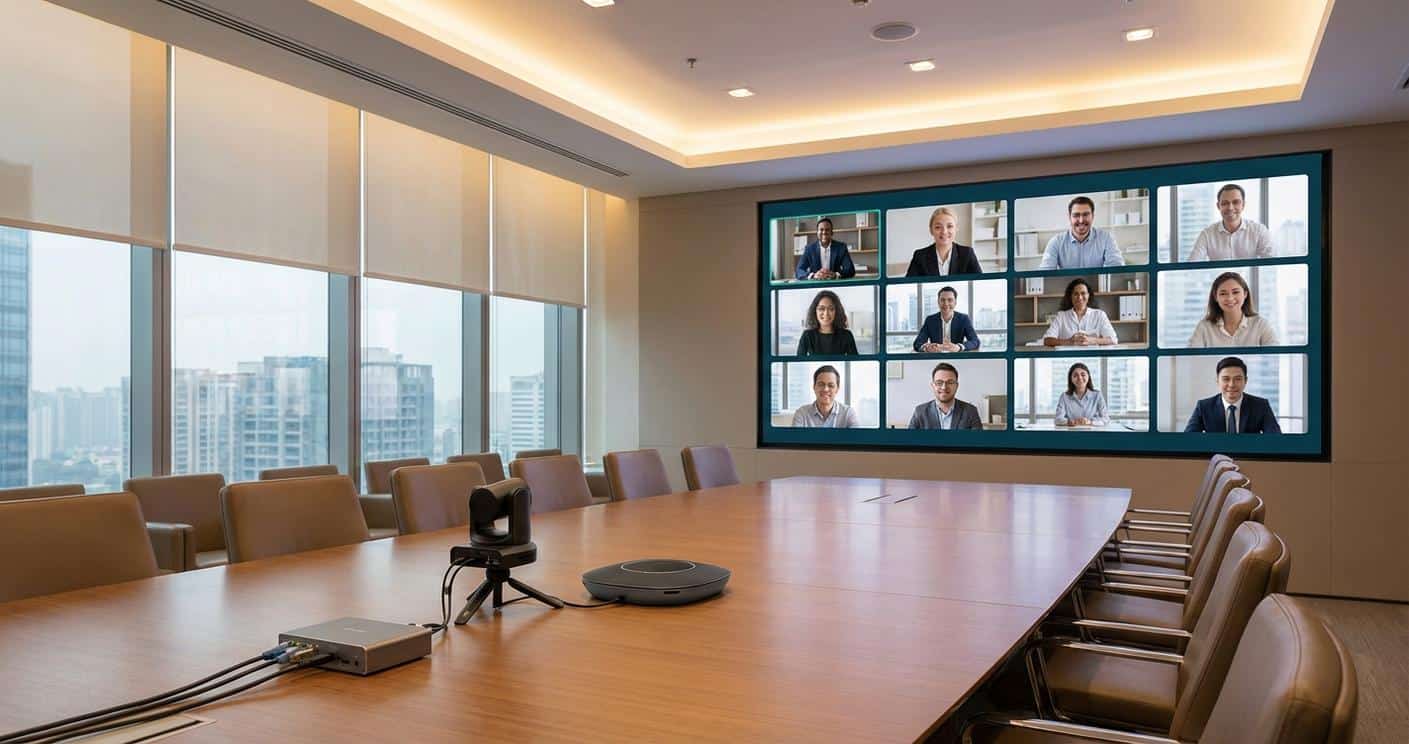
The imperative for environmental, social, and governance (ESG) compliance has fundamentally reshaped corporate strategy, extending to operational efficiency and carbon footprint reduction across all enterprise functions. For B2B organizations, traditional board meetings and executive gatherings, which often necessitate extensive air travel and energy consumption, represent a significant environmental impact. This article delves into how advanced B2B event streaming and hybrid production technologies, when meticulously engineered, provide a robust solution for significantly reducing a corporate carbon footprint through highly secure, low-latency virtual board meetings. We will explore the technical underpinnings, infrastructure requirements, and production methodologies that enable seamless, high-fidelity virtual interactions while adhering to stringent enterprise security and compliance standards. This is not about consumer-grade video conferencing; this is about broadcast-quality, enterprise-grade event production designed for mission-critical corporate communication.
The Environmental Imperative and Technical Demands of Virtual Boardrooms
The drive towards sustainable business practices places a spotlight on every aspect of corporate operations. Travel, particularly air travel for executive meetings, contributes substantially to an organization’s Scope 3 emissions. A single round-trip transatlantic flight for an executive can generate several metric tons of carbon dioxide equivalent (CO2e), a figure that multiplies rapidly across a global board of directors meeting periodically. Embracing virtual meeting technologies directly mitigates these emissions, alongside reducing associated costs for accommodation and local transport. However, the unique demands of a board meeting – confidentiality, clarity, and unwavering reliability – necessitate a technical infrastructure far exceeding standard videoconferencing tools.
Quantifying the Carbon Footprint of Traditional Executive Travel
Understanding the environmental benefit of virtualizing high-level corporate events begins with a quantitative assessment of traditional travel. For instance, a return flight from New York to London generates approximately 0.9 metric tons of CO2e per passenger. Multiply this by a board of fifteen members, meeting quarterly, and the annual carbon footprint from air travel alone can exceed 50 metric tons. This does not account for ground transportation, hotel stays, or the energy consumption of physical meeting venues. Sophisticated virtual and hybrid event solutions offer a direct pathway to eliminating or significantly reducing these emissions, aligning corporate operations with ambitious ESG targets.
The Non-Negotiable Requirements for Enterprise Virtual Meetings
For board meetings, the technical infrastructure must meet an exceptionally high bar for security, reliability, and audiovisual fidelity. Any compromise in these areas is unacceptable:
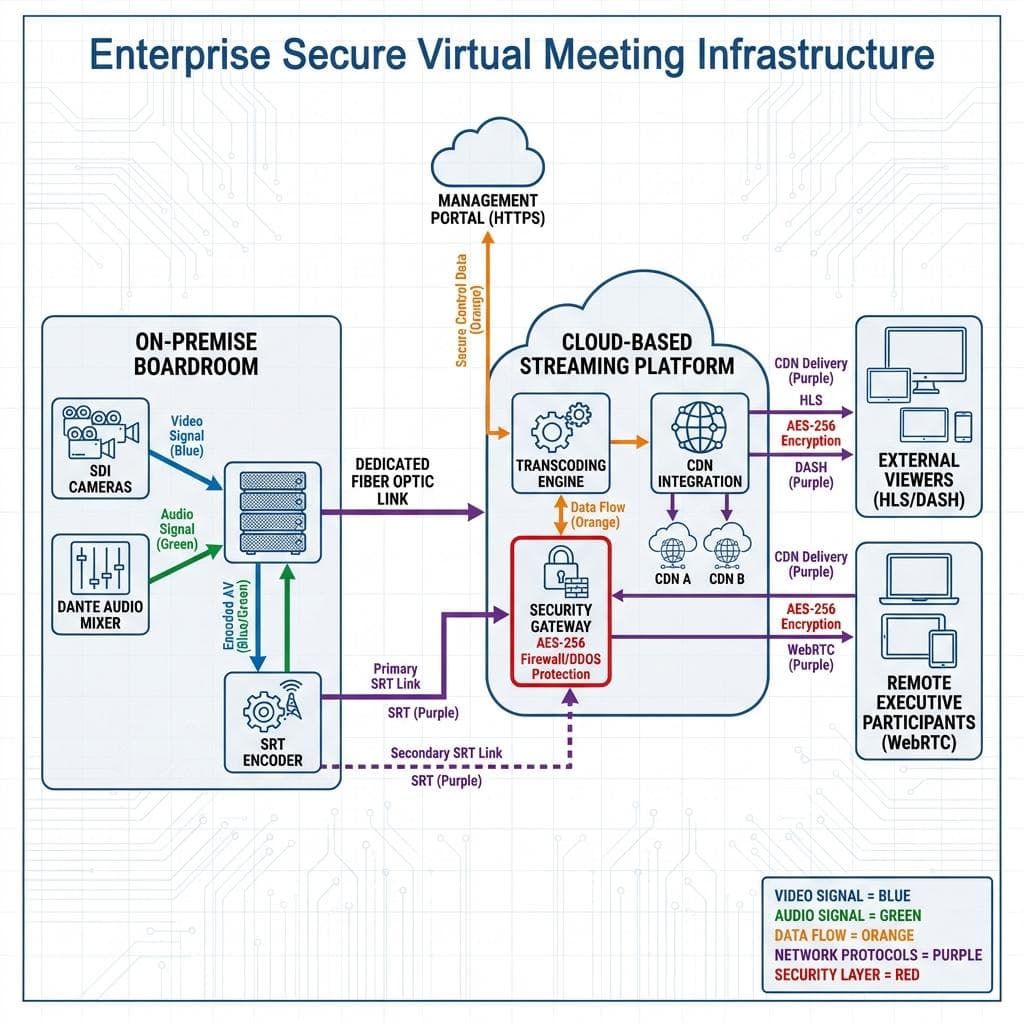
- Security and Confidentiality: All data, whether video, audio, or shared content, must be protected with enterprise-grade encryption. This includes AES-256 (Advanced Encryption Standard with a 256-bit key) for media streams and TLS 1.2/1.3 (Transport Layer Security) for control signals and metadata. End-to-end encryption for streaming protocols such as Secure Reliable Transport (SRT) and Real-Time Messaging Protocol Secure (RTMPS) is paramount. Secure authenticated access, often integrated with corporate Single Sign-On (SSO) systems, ensures only authorized personnel can join. Network segmentation via Virtual Local Area Networks (VLANs), stringent firewall rules, and robust Intrusion Detection Systems (IDS) are critical layers of defense.
- Reliability and Redundancy: Uptime guarantees are crucial for mission-critical events. This demands N+1 hardware redundancy for all primary processing units (encoders, switchers), geographically dispersed data centers for cloud-based components, and redundant network pathways (e.g., dual Internet Service Providers, ISP, with automatic failover). Active-standby configurations for software components ensure seamless transitions in case of failure.
- Audiovisual Fidelity: Board discussions require crystal-clear audio and video. This mandates support for 4K/UHD (Ultra High Definition) video resolutions, high dynamic range (HDR) color reproduction for accurate visual representation, and uncompressed or minimally compressed audio via protocols like Dante or AES67. Latency must be optimized to below 200 milliseconds (ms) for natural, interactive communication, preventing conversational overlap and delays.
- Compliance and Archiving: Adherence to regulatory frameworks such as GDPR (General Data Protection Regulation), CCPA (California Consumer Privacy Act), and ISO 27001 for information security is non-negotiable. Secure cloud storage with immutable logs for meeting recordings, coupled with granular access controls, ensures compliance. Video On Demand (VOD) accessibility must incorporate robust digital rights management (DRM) and audit trails.
Architecting Low-Latency, High-Fidelity Virtual Meeting Infrastructures
The foundation of a successful virtual board meeting lies in a meticulously designed technical architecture that prioritizes efficiency, quality, and security. This involves careful selection and configuration of streaming protocols, encoding standards, and network infrastructure.
Core Streaming Protocols and Encoding Standards
- SRT (Secure Reliable Transport): For high-stakes B2B contributions, SRT is often the protocol of choice due to its robust error correction mechanisms, retransmission capabilities, and built-in AES-256 encryption, all operating over the User Datagram Protocol (UDP). This makes SRT ideal for delivering low-latency, high-quality video streams over unpredictable internet connections, crucial for remote executive participation or linking geographically distant production sites. Its ability to dynamically adjust to network conditions ensures stable streams even under adverse circumstances.
- RTMP/RTMPS (Real-Time Messaging Protocol Secure): While SRT is preferred for contribution, RTMPS serves a critical role for broader compatibility with Content Delivery Networks (CDNs) and playback platforms. Being TCP-based, RTMPS typically introduces slightly higher latency but offers widespread ingestion support, making it suitable for distribution to a larger, less interactive audience or for feeding into established corporate streaming ecosystems.
- WebRTC (Web Real-Time Communication): For truly interactive, browser-based peer-to-peer or multipoint interactions within the virtual meeting platform, WebRTC provides ultra-low latency. Its direct browser integration eliminates the need for plugins, facilitating seamless real-time dialogue between participants.
- Video Encoding: Efficient and high-quality video encoding is fundamental. H.264 (AVC – Advanced Video Coding) remains a workhorse, offering excellent compatibility, while H.265 (HEVC – High Efficiency Video Coding) provides superior compression efficiency, delivering comparable quality at significantly lower bitrates. Encoder profiles like Main, High, or Main10 (for HDR) are selected based on desired quality and device compatibility. Bitrate ladder strategies, such as 2 Mbps for 720p, 6-8 Mbps for 1080p, and 15-20 Mbps for 4K streams, ensure adaptive bitrate (ABR) streaming can dynamically adjust quality based on viewer bandwidth, minimizing buffering.
- Audio Encoding: For clear voice reproduction, AAC-LC (Advanced Audio Coding – Low Complexity) is widely used for stereo program audio, offering good quality at efficient bitrates. For WebRTC-based voice communications, the Opus codec is optimized for speech, providing excellent clarity even at very low bitrates and varying network conditions.
Network Infrastructure and Signal Flow Optimization
A robust network infrastructure is the bedrock of reliable streaming. This typically involves:
- Dedicated Fiber Connectivity: A minimum of 1 Gbps (Gigabit per second) symmetric dedicated internet access is required, with 10 Gbps or higher connections highly recommended for multi-stream 4K production environments. This ensures sufficient bandwidth for simultaneous ingest, distribution, and monitoring feeds.
- QoS (Quality of Service): Implementing Differentiated Services Code Point (DSCP) marking for critical video and audio packets ensures that these streams receive priority over less time-sensitive network traffic. Strict priority queuing on network switches prevents packet loss and latency spikes for mission-critical data.
- Managed Switches and Routers: Enterprise-grade hardware from vendors like Cisco (e.g., Catalyst series) or Juniper (e.g., MX series) provides the necessary performance, granular traffic control, and redundancy features essential for professional streaming.
- Audio/Video Signal Chain: For professional camera connectivity and robust signal integrity over longer cable runs (up to 100 meters or more), SDI (Serial Digital Interface) is the industry standard. HDMI 2.1 is used for high-resolution displays within the control room or boardroom. NDI (Network Device Interface) provides an IP-based video transport solution within the Local Area Network (LAN) or Wide Area Network (WAN), with NDI|HX offering compressed IP streams from PTZ (Pan-Tilt-Zoom) cameras for efficiency. In advanced broadcast environments, SMPTE ST 2110 facilitates uncompressed IP video transport.
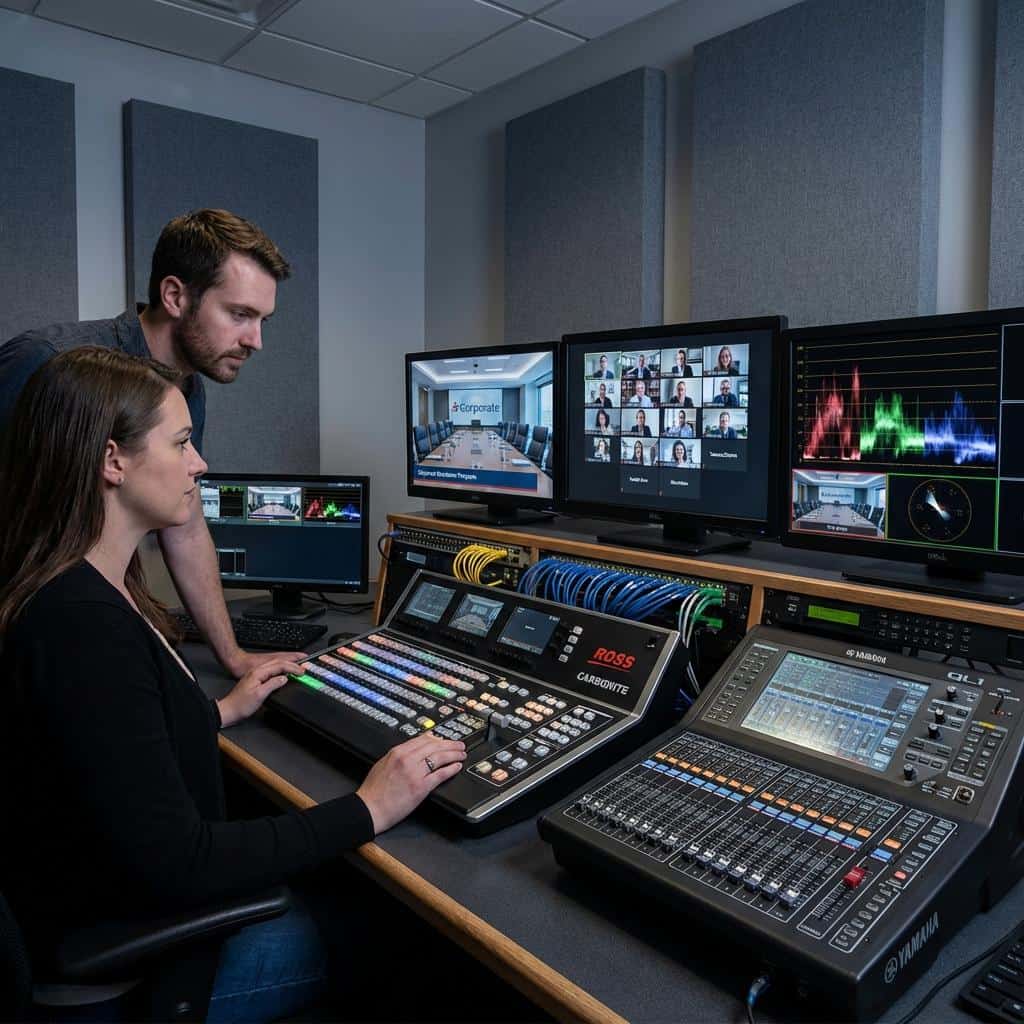
- Monitoring: Comprehensive monitoring is crucial. This includes multiview monitoring displays showing program output, preview feeds, and individual camera sources, augmented by waveform and vectorscope analysis for color and luminance accuracy, and real-time audio metering. Jitter buffers and packet loss concealment techniques are implemented to maintain smooth playback despite minor network fluctuations.
Hybrid Production Workflows for Seamless Integration and Reduced Travel
The optimal solution for many executive gatherings is a hybrid model, combining on-site participants with remote attendees. This demands sophisticated production workflows that integrate physical and virtual environments seamlessly.
Multi-Camera Production and Video Switching Architectures
Professional production values are essential for executive-level communications:
- Professional Video Switchers: Hardware-based production switchers (e.g., Grass Valley Kahuna, Sony XVS, AJA HELO, Blackmagic ATEM Constellation series) provide precise, sub-frame accurate control over video sources, enabling complex transitions, keying (chroma and luma), and Digital Video Effects (DVE). These switchers accept multiple SDI and occasionally HDMI 2.1 inputs, allowing for a dynamic presentation.
- Camera Systems: Broadcast-grade studio cameras (e.g., Sony HDC series, Panasonic AK series, Ikegami UHK series) are deployed for main presenters, offering superior image quality and control. High-end PTZ cameras (e.g., Panasonic AW-UE150, Sony BRC-X400) capture wide shots, audience reactions, and supplementary angles, often controlled remotely via VISCA over IP for discreet operation.
- Graphics Integration: Dynamic lower thirds, corporate branding, data overlays, and full-screen graphics are integrated via dedicated graphics engines (e.g., ChyronHego, Vizrt) or directly through advanced switcher capabilities. These elements are pre-rendered or real-time generated to maintain a polished, professional aesthetic.
Enterprise Platform Integration and Virtual Meeting Rooms
Bridging professional production with corporate communication platforms is key:
- API-Driven Control: Seamless integration between professional production switchers, encoders, and enterprise platforms like Microsoft Teams, Zoom, and Webex is achieved through their respective APIs. This allows a production team to control participant views, share specific program feeds as screen shares, manage breakout rooms, and facilitate Q&A sessions directly from the production control surface, enhancing efficiency and reducing manual errors.
- Secure Virtual Meeting Rooms: Dedicated, pre-configured virtual meeting rooms within these platforms are essential. These rooms feature enhanced security settings, including mandatory waiting rooms, strict participant admission controls, and granular permissions to prevent unauthorized access or disruptions.
- Audio Mixing and Talkback: Digital audio consoles (e.g., Yamaha CL/QL series, DiGiCo S-series) with extensive DSP capabilities are used for precise audio mixing, equalization, and dynamics processing. Mix-minus feeds are meticulously configured for each remote participant to eliminate echo and feedback. Professional intercom/talkback systems (e.g., Clear-Com HelixNet, Riedel Bolero) provide critical, low-latency communication channels for the entire production crew, both on-site and remote.
Distributed Production and Remote Contribution
Geographically dispersed production teams and remote executive contributors are supported by:
- Remote Encoder Units: High-performance hardware encoders, such as the Haivision Makito X series or AJA BRIDGE LIVE, are deployed at remote executive locations. These units ingest local audio/video and securely transmit low-latency SRT streams back to the main production facility or cloud-based platform, maintaining broadcast quality.
- Cloud-Based Production: Utilizing cloud-native platforms (e.g., Grabyo, Mux, AWS Media Services) for switching, mixing, and encoding allows distributed production teams to collaborate from various geographic locations. This virtualizes the control room, enabling global talent pools to contribute to a single, seamless production.
- Content Ingestion: Secure SFTP (SSH File Transfer Protocol) or cloud storage services facilitate the ingest of pre-recorded segments, graphics packages, and presenter slides, ensuring all media assets are available at the right time.
Scalability, Redundancy, and Compliance in Enterprise Virtual Events
To support high-stakes virtual board meetings, the infrastructure must be infinitely scalable, impervious to failure, and rigorously compliant with regulatory mandates.
Global Reach and Scalability via CDNs
Ensuring that global board members and stakeholders can access the meeting reliably requires a robust content delivery strategy:
- Tier 1 CDN Integration: Integration with top-tier CDNs such as Akamai, Limelight, or Cloudflare Stream is crucial for global content distribution. These networks leverage geographically distributed Points of Presence (PoPs) to cache content closer to end-users, reducing latency and network congestion, thereby ensuring reliable delivery to dispersed audiences worldwide.
- Origin Server Architectures: Robust origin servers, whether on-premise or cloud-hosted, must possess ample egress bandwidth and processing power to feed multiple CDNs simultaneously. These servers act as the primary source for the media streams before they are distributed globally.
- Load Balancing: Implementing DNS-based or hardware load balancers distributes incoming viewer requests across redundant origin servers and CDN entry points, preventing single points of failure and optimizing resource utilization during peak loads.
Ensuring Uninterrupted Operations: Redundancy and Failover Strategies
Downtime is not an option for board meetings. Therefore, redundancy is built into every layer:
- N+1 Redundancy: All critical components of the streaming pathway, including encoders, video switchers, network links, and power supplies, are configured with an active primary unit and a hot-standby secondary unit. This N+1 (N being the number of required operational units) configuration ensures that a single component failure does not disrupt the live stream.
- Geographic Redundancy: For cloud-based services and major data processing nodes, deploying redundant infrastructure across physically separate data centers mitigates the risk of regional outages, natural disasters, or major network failures affecting the entire operation.
- Automated Failover: Sophisticated, scripted or hardware-driven automatic failover mechanisms are implemented to detect a primary system failure and switch to standby systems within milliseconds, often imperceptibly to the end-user. This requires continuous health monitoring of all system components.
- Uninterruptible Power Supplies (UPS) and Generators: Ensuring power stability for all critical production and network equipment is paramount. Redundant UPS systems provide immediate backup power, while on-site generators offer extended power autonomy during utility outages.
Data Integrity, Security, and Regulatory Compliance
Beyond live delivery, the integrity and security of the meeting’s data are paramount:
- End-to-End Encryption: Mandating encryption at every stage of the workflow, from camera capture (if feasible and necessary via encrypted links) to ingest, transcoding, storage, and final audience delivery, creates a secure chain of custody for sensitive information.
- Access Control and Authentication: Multi-factor authentication (MFA) is standard for all administrative access. Role-based access control (RBAC) ensures that personnel only have privileges necessary for their specific tasks. Strict audit trails record all system access and changes, providing accountability and forensic capabilities.
- Data Retention Policies: Adherence to corporate and regulatory data retention requirements for meeting recordings and associated metadata is critical. This involves secure, long-term archiving solutions with defined deletion schedules.
- Security Audits and Penetration Testing: Regular third-party security assessments and penetration testing are conducted to proactively identify and rectify vulnerabilities in the streaming infrastructure, ensuring continuous improvement of the security posture.
The convergence of advanced live event streaming technologies with a corporate commitment to ESG principles offers a powerful pathway to sustainable business operations. By architecting technically robust, secure, and scalable virtual board meeting infrastructures, enterprises can significantly reduce their carbon footprint associated with executive travel while simultaneously enhancing meeting efficiency and global participation. From precision network engineering and broadcast-grade production workflows utilizing protocols like SRT and NDI, to comprehensive redundancy and stringent compliance frameworks, the technical expertise required is substantial. Live Streaming Studio stands as an experienced partner, providing the engineering acumen and production capabilities necessary to transform ESG objectives into tangible operational realities for the modern enterprise.