
In the contemporary landscape of global enterprise, the virtual town hall stands as a critical conduit for leadership communication, fostering employee engagement, and disseminating vital corporate directives. When orchestrating such pivotal events from a strategic hub like Singapore, the technical complexities of bridging vast geographical distances and disparate time zones become paramount. Live Streaming Studio specializes in architecting and deploying robust B2B event streaming solutions that surmount these challenges, ensuring seamless, high-fidelity delivery of your global town hall to every employee, irrespective of their locale.
The inherent challenge lies not merely in broadcasting a singular live feed, but in creating an immersive, interactive experience that respects diverse work schedules and technological infrastructures across continents. This requires a sophisticated synthesis of live production acumen, enterprise-grade streaming protocols, resilient network architectures, and intelligent content delivery strategies. Our approach transcends basic video conferencing, embracing broadcast-quality production methodologies tailored for the most demanding corporate environments.
Architecting the Asynchronous-Synchronous Hybrid Model for Global Reach
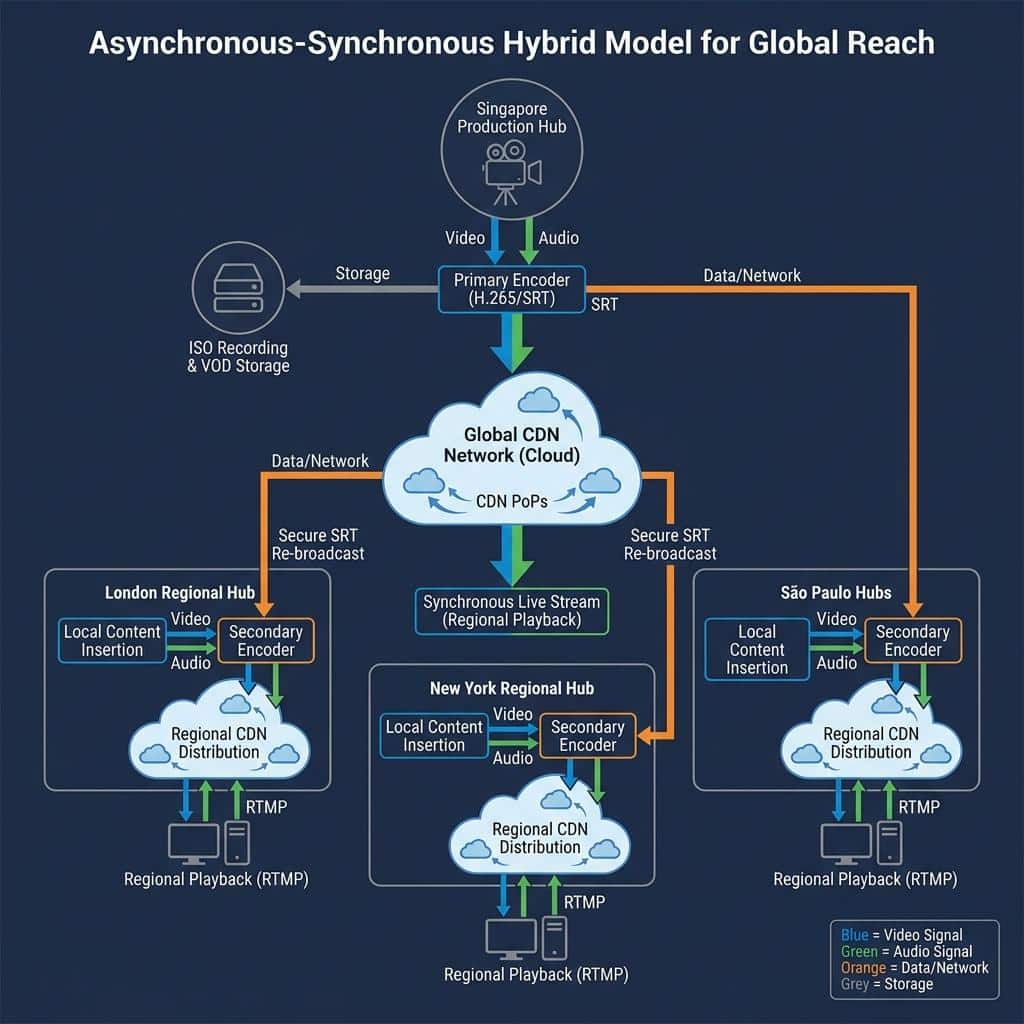
Overcoming the temporal chasm between Singapore and global audiences necessitates a nuanced hybrid model that intelligently combines synchronous live broadcasts with asynchronous, regionally optimized delivery. A single live stream originating from Singapore, while serving immediate APAC and potentially early EMEA audiences, will inevitably fall outside convenient viewing hours for North and South American participants. A truly global town hall embraces this reality, turning it into an opportunity for enhanced accessibility and engagement.
Leveraging Low-Latency Synchronous Feeds with Asynchronous Delivery
The core of this model involves a primary, high-definition live production from Singapore, typically leveraging SDI (Serial Digital Interface) or NDI (Network Device Interface) for internal signal routing within the production environment, ensuring minimal latency and pristine video quality. This program feed, often 1080p at 50/60 frames per second (fps) or even 4K/UHD (Ultra-High Definition) where bandwidth permits, is then encoded using enterprise-grade H.264 (AVC) or H.265 (HEVC) codecs. For the synchronous delivery, we utilize resilient streaming protocols such as RTMP (Real-Time Messaging Protocol) or its secure variant, RTMPS, for ingest into a robust Content Delivery Network (CDN) designed for B2B applications. However, for long-haul contributions or cross-continental studio links, the Secure Reliable Transport (SRT) protocol is indispensable. SRT, an open-source video transport protocol, offers superior error recovery mechanisms, end-to-end encryption, and dynamic latency adjustment, making it ideal for maintaining stream integrity over unpredictable internet paths, such as from Singapore to a European regional hub for localized re-broadcast.
Simultaneously, ISO (isolated) recordings of individual camera feeds and the program feed are captured at source, often in broadcast-quality formats like ProRes or DNxHD. These recordings are crucial for rapid post-production and the creation of time-shifted, localized versions. These pre-recorded segments can be strategically interleaved with live Q&A sessions or re-broadcast at optimal regional times, complete with localized language tracks or subtitles. The asynchronous element allows for on-demand access, providing global employees with the flexibility to engage with content at their convenience, without compromising the integrity or impact of the original message.
Regional Production Hubs and Localized Content Insertion
Singapore acts as the primary content origination point, but its output is strategically distributed to regional production hubs located in key time zones such as London, New York, or São Paulo. These hubs are equipped with compact, professional production setups capable of receiving the secure, high-quality SRT stream from Singapore. At these regional hubs, localized content elements, such as region-specific announcements, pre-recorded executive messages from local leadership, or live Q&A sessions with regional panels, can be seamlessly integrated into the main program feed. This requires advanced video switching systems (e.g., Ross Video, Blackmagic Design ATEM series) and audio mixing consoles (e.g., Yamaha QL/CL series, Behringer X32) that can handle multiple SDI/NDI inputs, perform clean cuts or dissolves, and ensure consistent audio levels. The output from these regional hubs is then streamed to local CDNs or enterprise video platforms, ensuring minimal latency and optimal viewing experience for their respective audiences. Talkback systems, often utilizing Dante or AES67 over IP, are critical for real-time communication between the Singapore master control and regional production teams, ensuring tight coordination.
Enterprise-Grade Streaming Protocols and Infrastructure
The foundation of a successful global town hall from Singapore rests upon a meticulously engineered streaming infrastructure. This involves selecting the right protocols, optimizing delivery networks, and employing advanced encoding techniques to guarantee fidelity and reach.
Secure Reliable Transport (SRT) for Ingest and Contribution
For the initial ingest and contribution from the Singapore studio to cloud-based encoders or regional hubs, SRT is the protocol of choice. Unlike traditional RTMP, which relies on TCP and can suffer from significant latency and packet loss over long distances, SRT builds upon UDP, incorporating advanced packet recovery mechanisms (ARQ – Automatic Repeat reQuest) and dynamic latency adjustment. This allows for low-latency, high-quality video transport even across transcontinental networks with varying conditions. Implementing SRT requires precise firewall configuration, often on specific UDP ports (e.g., 1234), and careful tuning of buffer sizes to balance latency and reliability. This is particularly crucial when Singapore is transmitting to destinations like the US West Coast, where round-trip times can exceed 200 milliseconds. SRT ensures that a 4K 60fps stream, typically requiring 30-50 Mbps, arrives intact and with minimal perceived delay.
Content Delivery Networks (CDNs) for Global Distribution and Edge Caching
Once the encoded stream leaves the primary production facility in Singapore, it enters a global CDN infrastructure. For enterprise applications, this typically involves a multi-CDN strategy or a premium CDN with extensive Points of Presence (PoPs) and robust peering agreements. A CDN’s global network ensures that video content is cached at edge servers geographically close to the end-users, drastically reducing latency and improving playback quality. Key CDN features for global town halls include advanced geo-load balancing, which intelligently directs viewers to the nearest and best-performing PoP, and sophisticated DDoS (Distributed Denial of Service) protection. Furthermore, enterprise CDNs often provide detailed analytics on viewership, geographical distribution, and quality of experience (QoE) metrics, which are vital for post-event analysis and future planning. Bandwidth management is critical here, with average viewer bitrates ranging from 2-8 Mbps for HD content, requiring the CDN to scale rapidly for tens of thousands of simultaneous viewers.
Advanced Encoding and Transcoding for Multi-Bitrate Adaptive Streaming
To cater to the diverse network conditions of a global audience, adaptive bitrate (ABR) streaming is essential. This involves encoding the source video into multiple renditions, each with different resolutions, bitrates, and perhaps even codecs. For instance, a 1080p source might be transcoded into 720p at 3 Mbps, 480p at 1.5 Mbps, and 360p at 750 kbps. H.264 remains a widely supported and efficient codec, but H.265 (HEVC) offers superior compression efficiency, delivering comparable quality at roughly half the bitrate, albeit requiring more processing power and newer decoder support. Cloud-based transcoding services (e.g., AWS Elemental MediaLive, Google Cloud Media CDN) provide the necessary scalability and processing power to handle multiple renditions in real-time. Perceptual encoding algorithms further optimize quality by dynamically allocating bits to areas of the frame where visual detail is most critical, ensuring a high-quality viewer experience even at lower bitrates. Audio encoding, typically AAC (Advanced Audio Coding) at 128-192 kbps, must also be optimized for clarity and synchronization with video.
Multi-Zone Production Workflows and Localized Engagement
Executing a global town hall from Singapore demands a highly coordinated, multi-zone production workflow that integrates diverse technical teams and accommodates localized audience needs.
Decentralized Control and Centralized Monitoring
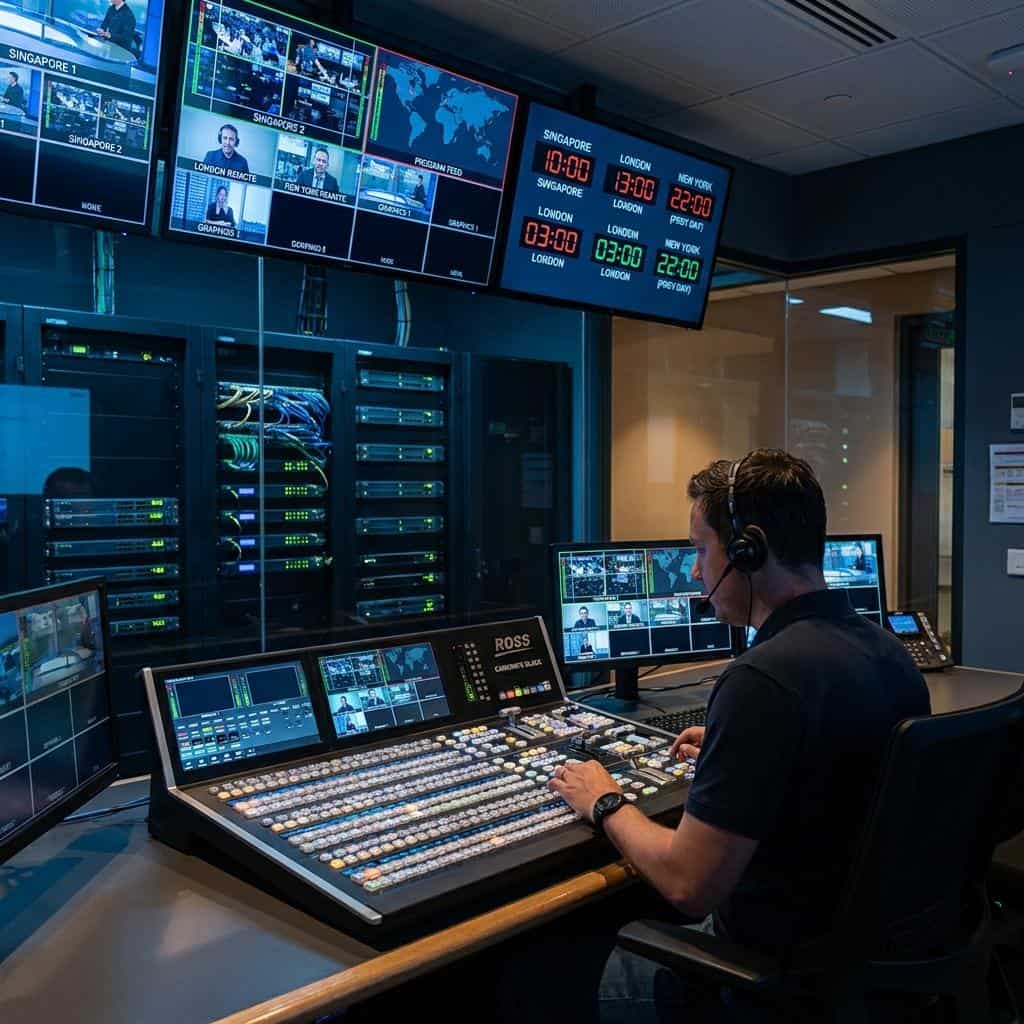
While the primary production originates from Singapore, control elements can be decentralized. A director or producer might be based in London, providing real-time instructions via a low-latency IP intercom system (e.g., Riedel Artist, Clear-Com FreeSpeak II) to camera operators and vision mixers in Singapore. This requires a robust, dedicated IP network with guaranteed QoS for intercom traffic. Centralized monitoring, however, remains paramount. A master control room (MCR) in Singapore, or a dedicated cloud-based monitoring platform, provides a comprehensive multiview display of all incoming feeds (SRT, NDI), program outputs, audio levels (VU meters, PPMs), network health indicators (packet loss, latency, jitter), and CDN performance metrics. This single pane of glass allows the technical team to proactively identify and troubleshoot issues before they impact the global audience. ISO recording, as mentioned, is crucial here for post-event analysis and recovery.
Multi-Language Audio Tracks and Real-time Subtitling Integration
For a truly inclusive global town hall, multi-language support is non-negotiable. This involves integrating professional interpreters either physically present in Singapore or connected remotely via dedicated audio links (e.g., NDI Audio, Dante Virtual Soundcard). Each interpreter provides a separate language feed, which is then multiplexed with the main program video stream as discrete audio tracks. Viewers can select their preferred language from a menu within the enterprise video player. Real-time subtitling, often powered by AI-driven speech-to-text engines combined with human review for accuracy, provides an additional layer of accessibility and comprehension. These captions conform to industry standards such as CEA-608/708 for broadcast closed captions and WebVTT for web delivery, ensuring compatibility across various platforms and devices. Precise timecode synchronization (SMPTE LTC or VITC) is essential for maintaining accurate alignment between video, audio, and subtitles across all renditions.
Network Architecture and Redundancy for Uninterrupted Global Events
The weakest link in any global streaming event is often the network. Our solutions prioritize bulletproof network architecture and comprehensive redundancy from Singapore to every corner of the globe.
Dedicated Fiber Optic and IP-MPLS Networks for Primary Feeds
For mission-critical primary feeds originating from Singapore, reliance on best-effort public internet is minimized. Instead, we leverage dedicated fiber optic connections and private IP-MPLS (Multi-Protocol Label Switching) networks where available. These provide guaranteed bandwidth, extremely low latency, and predictable performance, essential for the pristine transport of high-bitrate video. For instance, a dedicated 10 Gbps fiber link from the Singapore venue to a major data center for cloud ingest provides a robust foundation. IP-MPLS networks offer traffic engineering capabilities, allowing critical streaming data to be prioritized over other network traffic, thereby ensuring Quality of Service (QoS). Redundant network paths, often from different internet service providers (ISPs) and through diverse physical routes, are implemented to mitigate single points of failure, adhering to a “dark fiber” principle where possible.
5G/Cellular and Satellite Uplinks for Failover and Remote Contribution
Even with dedicated fiber, a comprehensive redundancy strategy is vital. 5G/cellular bonding devices (e.g., LiveU, TVU Networks) provide an excellent failover mechanism, aggregating multiple cellular connections to create a robust, resilient uplink. These can serve as a secondary path for the main program feed or as primary contribution for remote guests or field reporters joining the town hall from locations without robust wired infrastructure. For extremely remote or highly sensitive transmissions, satellite uplinks, while incurring higher latency, offer unparalleled reliability and bandwidth independence from terrestrial networks. A C-band or Ku-band satellite uplink from Singapore provides a completely diverse path, ensuring the event can continue even in the unlikely event of widespread terrestrial network outages. Automated failover systems are configured to seamlessly switch between primary fiber and secondary 5G/satellite paths without any interruption to the live stream.
Quality of Service (QoS) and Traffic Shaping for Mission-Critical Data
Within the local network infrastructure at the Singapore production venue, strict QoS policies are enforced. This involves prioritizing specific types of network traffic: video streams (SRT, NDI) and audio over IP (Dante, AES67) receive the highest priority, followed by intercom and control signals, and finally general internet traffic. Traffic shaping mechanisms limit the bandwidth consumption of non-essential services, preventing network congestion that could compromise the live stream. VLAN (Virtual Local Area Network) segmentation isolates different traffic types, enhancing security and performance. Robust network switches (e.g., Cisco Catalyst series, Arista Networks) capable of advanced QoS and low-latency forwarding are deployed. Constant network monitoring tools provide real-time visibility into bandwidth utilization, packet loss, and latency, allowing engineers to make immediate adjustments. This granular control is paramount for maintaining the integrity of multiple high-bitrate video and audio streams simultaneously.
Integration with Enterprise Collaboration Platforms and Analytics
A global town hall is more than just a broadcast; it is an interactive communication event. Seamless integration with enterprise platforms and detailed analytics are critical for maximizing engagement and understanding impact.
Deep Integration with Microsoft Teams, Zoom, and Webex for Hybrid Attendee Engagement
Modern global town halls often operate in a hybrid format, blending in-person attendees with a vast virtual audience. Our solutions facilitate deep, secure integration with leading enterprise collaboration platforms such as Microsoft Teams, Zoom, and Webex. This allows the high-quality, broadcast-grade program feed from Singapore to be ingested directly into these platforms, providing virtual attendees with a superior viewing experience than standard webcam feeds. Features like single sign-on (SSO), secure access controls, and interactive Q&A modules (e.g., Slido, Mentimeter) are integrated, allowing virtual participants to submit questions, participate in polls, and engage with content in real-time. For a hybrid setup, dedicated conference room systems equipped with professional PTZ (Pan-Tilt-Zoom) cameras, beamforming microphones, and echo cancellation technology ensure that remote participants can clearly see and hear in-room presenters and attendees, and vice-versa. Two-way video contribution for remote presenters via SRT or WebRTC is also seamlessly managed.
Post-Event Analytics and Performance Metrics
Understanding the impact and reach of a global town hall is as important as its flawless execution. Comprehensive post-event analytics provide granular data on viewership, engagement, and technical performance. Metrics include total unique viewers, peak concurrent viewers, average viewing duration, geographical distribution of viewers, device types, and network quality (buffering ratio, average bitrate delivered). Interactive engagement data, such as poll responses, Q&A participation rates, and chat activity, offers insights into audience comprehension and interest. Technical metrics like end-to-end latency, packet loss, and CDN edge server performance are crucial for optimizing future events. This data, often presented in customizable dashboards, informs strategic decisions, validates ROI, and allows for continuous improvement of enterprise streaming infrastructure and event production workflows.
Conclusion
Orchestrating a global town hall from Singapore, spanning diverse time zones and geographies, is an undertaking of significant technical complexity. It demands an expert understanding of broadcast-grade production, resilient streaming protocols like SRT, robust CDN architectures, and seamless integration with enterprise communication platforms. Live Streaming Studio provides the technical expertise and infrastructure to transform these challenges into opportunities for unparalleled global communication. Our commitment to precision, redundancy, and a high-quality viewer experience ensures that your message resonates clearly, powerfully, and consistently with every member of your global workforce, solidifying Singapore’s position as a nexus for international corporate communication.
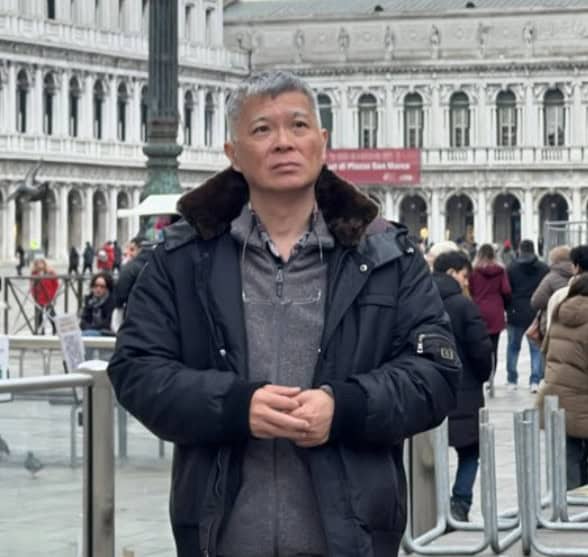
Michael Koh is a production specialist and entrepreneur who founded Spring Forest Studio in 2017 to provide event and virtual production solutions in Singapore. He specialises in hybrid live streaming, XR (Extended Reality) virtual production, and studio systems integration, transitioning the business from traditional videography to advanced corporate broadcasting. Operating out of a dedicated facility at NordCom2 in Singapore, he leads a technical crew to deliver multi-camera webcasts, digital sets, and technical consultations for large-scale corporate events.