 March 15, 2026 by Editor |
The transition to hybrid Annual General Meetings (AGMs) in Singapore, accelerated by amendments to the Companies Act, presents a formidable technical challenge for corporate event planners and their production partners. Successfully executing a hybrid AGM is not a simple exercise in webcasting; it is a mission-critical convergence of broadcast engineering, enterprise IT infrastructure, and legal compliance. The mandate is to provide virtual shareholders with rights and participation parity to their physical counterparts, a task that demands a robust, secure, and resilient technical architecture. This requires a deep understanding of signal flow, protocol selection, latency management, and redundancy strategies to ensure every vote is counted, every question is heard, and the integrity of the proceedings is maintained. For enterprises, the underlying production and streaming infrastructure is the bedrock upon which shareholder trust and legal validity are built.
Core Infrastructure: Architecting a Resilient Hybrid AGM Broadcast
The foundation of a successful hybrid AGM is a meticulously planned technical infrastructure that accounts for every component from the camera lens to the shareholder’s screen. This architecture must be designed for high availability and low latency, ensuring the seamless flow of video, audio, and interactive data between the physical venue and the virtual platform. It involves a multi-layered approach encompassing on-site acquisition, reliable contribution, and scalable cloud distribution.
Signal Acquisition and On-Site Production Core
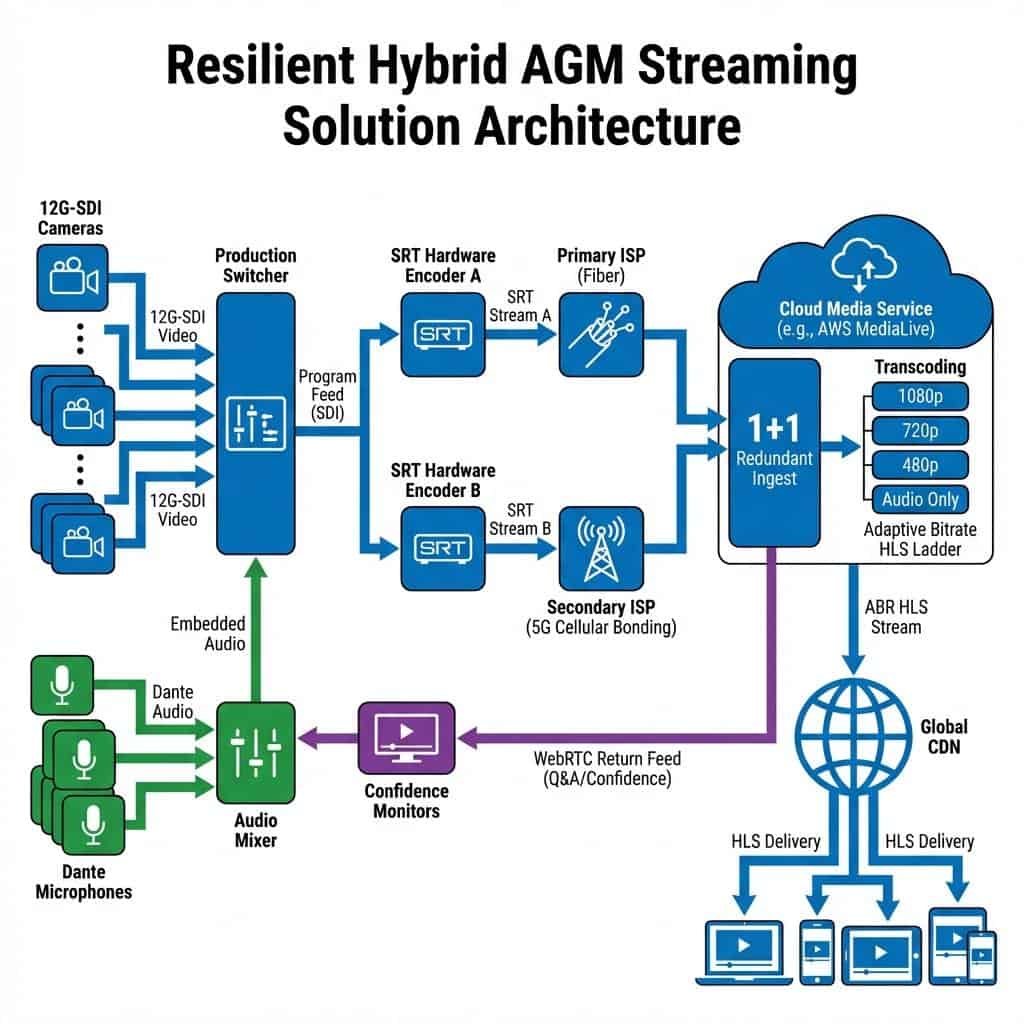
The production begins in the physical venue. High-quality signal acquisition is non-negotiable. A typical setup involves multiple cameras, such as broadcast-grade PTZ (Pan-Tilt-Zoom) cameras for wide shots and speaker close-ups, and manned studio cameras for dynamic coverage of the board of directors. These sources are captured in a native resolution, typically 1080p50 or increasingly 2160p (4K/UHD), to provide a clean, high-detail master feed. Video signals are transported over 6G or 12G-SDI (Serial Digital Interface) cabling to a central production hub. SDI is the industry standard for its reliability, low latency, and ability to carry video, multi-channel audio, and timecode in a single coaxial cable over long distances without significant degradation. At the heart of this hub is a production video switcher or vision mixer, such as a Blackmagic Design ATEM Constellation or a Ross Video Carbonite, which allows a technical director to cut between camera angles, integrate presentation slides, and insert lower-third graphics for speaker identification. Audio is equally critical. A Dante (Digital Audio Network Through Ethernet) network is often deployed, converting analog microphone signals from lecterns, lapels, and table mics into IP packets for flexible routing to a digital audio console like a Yamaha QL5. This ensures pristine audio quality, free from hum or interference, which is then embedded into the primary SDI program feed.
Encoding and Contribution: The First-Mile Challenge
Once the final program feed is produced, it must be encoded and transported to the cloud for distribution. This “first mile” is often the most vulnerable part of the streaming chain. We rely on professional hardware encoders, such as the Haivision Makito X4 or AWS Elemental Link, for this task. These devices convert the baseband SDI video signal into a compressed IP stream using codecs like H.264 (AVC) or H.265 (HEVC) for efficient bandwidth usage. For a high-quality 1080p50 stream, a constant bitrate of 6 to 8 Mbps is standard. The choice of transport protocol is critical. While RTMP (Real-Time Messaging Protocol) is still widely supported, its reliance on TCP makes it susceptible to packet loss and instability over public internet connections. For mission-critical events like AGMs, we strongly advocate for using Secure Reliable Transport (SRT). SRT is an open-source protocol that provides the reliability of TCP with the low latency of UDP, optimizing streaming performance over unpredictable networks by handling packet loss, jitter, and bandwidth fluctuations. This ensures the signal from the venue reaches the cloud ingest point with maximum integrity.
Cloud-Based Processing and Distribution
The SRT feed is sent to a cloud media service, such as AWS Elemental MediaLive or Wowza Streaming Cloud. This is where the stream is processed for mass distribution. The primary function here is transcoding, where the high-bitrate contribution feed is converted into a multi-bitrate HLS (HTTP Live Streaming) or DASH (Dynamic Adaptive Streaming over HTTP) ladder. This adaptive bitrate (ABR) ladder includes multiple renditions of the stream at different resolutions and bitrates (e.g., 1080p, 720p, 480p). This allows the video player on the shareholder’s device to automatically select the best possible quality based on their available bandwidth, preventing buffering. The packaged ABR stream is then pushed to a global Content Delivery Network (CDN), such as Amazon CloudFront or Akamai, which caches the video segments on servers around the world. This ensures that when a virtual shareholder in another country joins the AGM, they are served the video from a geographically close server, minimizing load times and ensuring a smooth playback experience.
Ensuring Equitable Participation: Synchronizing Physical and Virtual Experiences
The core legal requirement of a hybrid AGM is to provide virtual attendees with an equitable opportunity to participate. This translates into complex technical requirements for managing latency, integrating interactive features, and ensuring the security and accuracy of real-time voting. The goal is to bridge the gap between the physical and digital realms, creating a single, unified meeting environment where all shareholders have an equal voice.
Latency Management and Synchronization
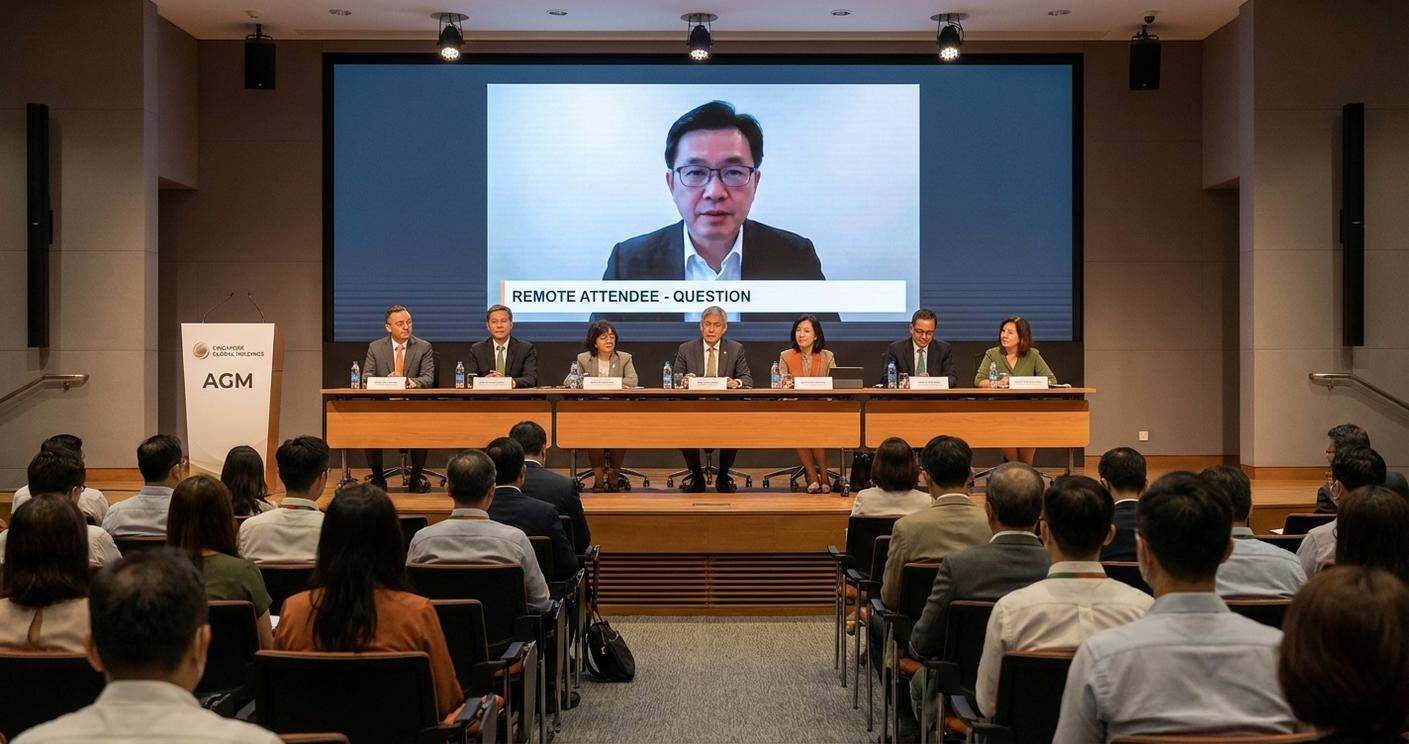
Glass-to-glass latency, the time it takes for an action in the venue to be seen by a virtual attendee, is a significant hurdle. Standard HLS/DASH delivery via a CDN can introduce 30 to 45 seconds of delay, which is unacceptable for real-time interaction like Q&A. To solve this, a dual-stream approach is often necessary. While the main high-quality video is delivered via HLS, interactive components are handled via a low-latency protocol like WebRTC (Web Real-Time Communication). When a virtual shareholder is approved to ask a question, their audio and video are transmitted back to the venue using WebRTC, which can achieve sub-500ms latency. This WebRTC return feed is ingested into the on-site production switcher, allowing the virtual participant to appear on screen and interact with the board in near real-time. The on-stage participants view this return feed on confidence monitors, enabling natural conversation. This requires careful audio management, including mix-minus audio feeds, to prevent feedback and echo between the venue’s PA system and the virtual participant’s audio.
Integrated Q&A and Polling Systems
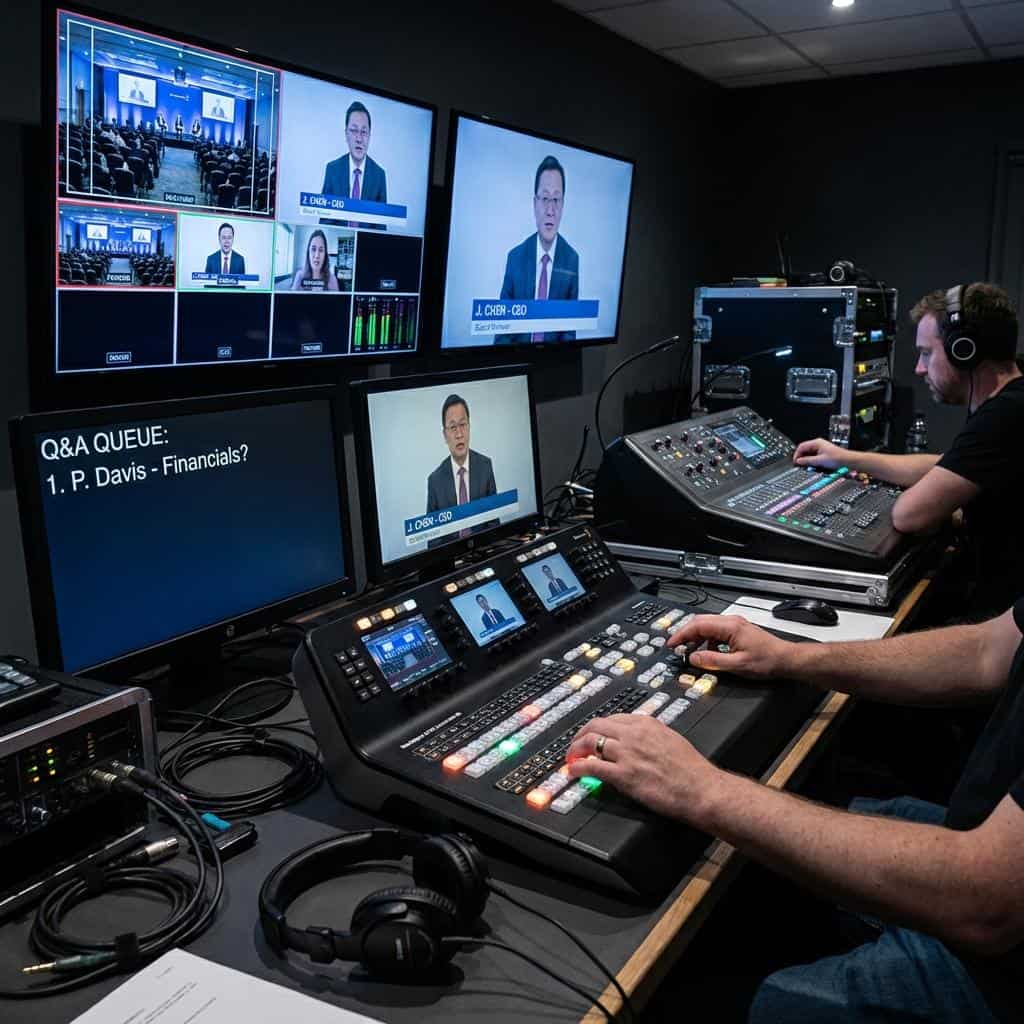
Managing shareholder questions and voting requires seamless integration between the streaming platform and specialized AGM service providers like Lumi or On24. The video stream is embedded into the provider’s platform, which handles user authentication, Q&A moderation, and secure polling. From a production standpoint, the workflow is a data-centric one. A dedicated Q&A moderator uses the platform’s backend to view and vet incoming questions from virtual attendees. Approved questions are then fed to the AGM chairperson, either on a private tablet or a dedicated monitor. This workflow must be tightly coordinated between the production team and the AGM service provider. The integration is typically handled via APIs, allowing the state of a poll (open, closed, results) to be triggered and displayed as graphical overlays within the video stream by the production switcher, ensuring both physical and virtual attendees see the same information simultaneously.
Secure Real-Time Voting Infrastructure
Voting is the most critical function of an AGM, and its technical implementation must be flawless and auditable. The streaming provider’s responsibility is to ensure the video and audio of the proceedings are delivered clearly and that the user experience within the voting platform is uninterrupted. The security of the voting process itself is handled by the specialized AGM platform, which employs multiple layers of security. This includes two-factor authentication for shareholder login, encryption of all data in transit (TLS 1.3) and at rest, and the generation of detailed audit logs for every vote cast. The infrastructure must be able to handle peak loads, such as when a poll is opened and thousands of shareholders attempt to vote simultaneously. This requires robust, auto-scaling server infrastructure and load balancing to prevent the system from becoming unresponsive, which could disenfranchise virtual voters and jeopardize the legal standing of the resolutions.
Redundancy and Security: Fortifying the AGM Broadcast
Given the legal and financial implications of an AGM, failure is not an option. A comprehensive redundancy plan and robust cybersecurity measures are essential to protect the stream from technical faults and malicious attacks. This involves building a resilient architecture with no single point of failure, from the on-site equipment to the final delivery platform.
Failover Strategies for Uninterrupted Streaming
A true professional-grade setup implements redundancy at every critical point. This starts with an N+1 hardware configuration on-site, including a backup production switcher and at least two hardware encoders. We employ a dual-path contribution strategy, sending two identical SRT streams from the venue to the cloud ingest points over diverse network paths. For example, the primary path might be a dedicated fiber internet line, while the secondary path could use a cellular bonding solution (combining multiple 4G/5G carriers) or a separate satellite link. In the cloud, the media service is configured to automatically failover to the secondary source if the primary feed is interrupted, with seamless switching that is imperceptible to the end-user. The CDN itself provides another layer of redundancy, as its distributed nature means that a failure of one edge server will not impact overall delivery. Power redundancy through Uninterruptible Power Supplies (UPS) and backup generators at the venue is also a mandatory part of the production plan.
Network Architecture and Cybersecurity
The on-site production network must be isolated and managed. All production equipment should be connected to a dedicated network switch with Quality of Service (QoS) policies implemented to prioritize streaming traffic over any other data. This network must be physically separate from the venue’s guest Wi-Fi to prevent interference and security risks. On the platform side, cybersecurity is paramount. Access to the AGM stream is controlled via token-based authentication. Each registered shareholder receives a unique, time-limited link. This is often implemented using JSON Web Tokens (JWT) which securely transmit identity information. The platform should also be protected by a Web Application Firewall (WAF) and DDoS (Distributed Denial of Service) mitigation services to prevent bad actors from overwhelming the system and disrupting the meeting. Geo-blocking can be implemented to restrict access to the stream to specific countries, adding another layer of security as required by corporate governance.
Ultimately, orchestrating a hybrid AGM that satisfies the rigorous legal standards of Singapore requires a specialized technical partner. It demands a holistic approach that blends broadcast production discipline with enterprise-grade network engineering and cybersecurity. By designing a resilient, secure, and equitable technical framework, companies can confidently engage with all their shareholders, regardless of their physical location, and uphold the highest standards of corporate governance in the new era of hybrid events.