Informal networking is one of the highest value components of any corporate conference, leadership summit, product launch, or internal town hall, yet it is also one of the hardest experiences to reproduce in a hybrid format. The scheduled keynote, panel discussion, and breakout session all map cleanly to a production plan, but the coffee break introduces a different engineering problem. Attendees want low-friction conversation, spontaneous introductions, and a sense of shared presence across physical and virtual environments. For the production team, that means designing a networking layer that is not merely a meeting link appended to the event agenda, but a purpose-built interaction environment with stable media transport, predictable latency, clear audio capture, and operational control.
In enterprise hybrid production, the coffee break becomes a small-scale distributed media system. The physical room may contain a sponsor lounge, café tables, or a hospitality area with display endpoints and directional microphones. The virtual audience may be participating from Microsoft Teams, Zoom, Webex, or a dedicated event platform. The production objective is to bridge those spaces without collapsing the social dynamic into a noisy group call. That requires disciplined use of streaming protocols such as RTMP, RTMPS, and SRT, a resilient network architecture, audio routing that preserves intelligibility, and a control workflow that allows stage managers, AV technicians, and producers to manage participation in real time. When done correctly, the hybrid coffee break improves attendee retention, sponsor value, and cross-functional networking outcomes across both onsite and remote populations.
Designing the Hybrid Coffee Break as a Production Environment
The most effective hybrid networking spaces are treated as active production zones, not passive lounge areas. The physical environment should be planned for visibility, acoustics, and signal access. A coffee break space that supports hybrid interaction usually benefits from a compact camera package, a dedicated confidence display, return audio, and a conversational audio mix that avoids the open-microphone chaos common in informal virtual gatherings. The technical plan should account for the number of concurrent remote participants, the expected sound pressure level from the room, and the interaction model, whether it is open networking, moderated introductions, or rotating small-group conversations.
Physical Layout and Sightline Engineering
A practical layout starts with camera placement that captures facial expressions and body language without forcing guests into a formal interview arrangement. A single remote-controlled PTZ camera can support a small networking zone, but for larger spaces, a two-camera configuration provides better coverage, one wide shot for environmental context and one tighter shot for active speakers. Switching between feeds can be handled by a hardware switcher, a software production platform, or a hybrid workflow using SDI ingest into a production engine and NDI, Network Device Interface, for internal IP distribution. For enterprise events, SDI remains a highly reliable baseband transport for primary camera paths, while NDI or NDI|HX can simplify rapid deployment in spaces where cabling logistics are constrained.
Displays should be positioned to support eye-line alignment between onsite attendees and remote participants. If remote guests are shown on a multiview or confidence monitor, the display needs to be high enough to capture gaze without creating neck strain. For sponsor or executive networking areas, a portrait display or a pair of landscape monitors can be used to present remote guests in gallery view while preserving enough screen real estate for moderation cues. The visual experience should feel intentional, not like a laptop placed on a side table.
Acoustic Control and Talkback Design
Audio quality determines whether the hybrid coffee break feels natural or fatiguing. Informal conversation is especially sensitive to echo, room noise, and inconsistent microphone gain. The room should use a combination of lavalier microphones, handheld microphones, or tabletop boundary microphones depending on the interaction format. A digital audio mixer with scene recall, automatic mix-minus routing, and acoustic echo cancellation, when needed, supports a controlled remote feed. Talkback systems are essential for producer coordination, especially when a host needs to cue onsite participants, manage rotations, or advise a remote facilitator without exposing operational chatter to the audience.
From an engineering perspective, the remote return feed should be managed with a clean program path and a separate communications path. Program audio can be sent to remote attendees with lightly processed speech, while intercom or IFB, interruptible foldback, is reserved for stage management. The difference matters. A room that blends all operational audio into a single feed creates noise, confusion, and reduced intelligibility. A well-architected audio matrix preserves source separation, allows submixing for different endpoints, and supports compliance with broadcast-style operational control.
Streaming Architecture for Interactive Networking
Hybrid coffee breaks often fail when the production architecture is borrowed from passive webcast design. A keynote can tolerate one-way delivery, but networking requires low-latency interaction, fast camera response, and audio paths that make conversation feel immediate. The choice of transport protocol, encoding profile, and platform integration strategy directly shapes the social experience.
Protocol Selection, Latency, and Transport Considerations
RTMP, Real-Time Messaging Protocol, remains common for contribution into streaming platforms and cloud encoders because of its broad compatibility, but it is not the strongest choice for conversational networking if used alone. RTMPS adds encryption, which is useful in enterprise environments where security policy requires TLS-based transport. SRT, Secure Reliable Transport, is often preferred for contribution across unpredictable networks because it uses packet loss recovery, encryption support, and configurable latency buffers. In a hybrid coffee break, SRT can be used to bring remote guest feeds or a secondary venue feed into the central production system with more resilience than a fragile public-internet path.
Latency targets should be set with the interaction model in mind. For meaningful conversation between onsite and remote participants, end-to-end latency should be kept as low as practical, with special attention to audio round-trip delay. A heavily buffered cloud workflow may still work for passive viewing, but it will degrade conversational pacing. Where possible, low-latency cloud ingest, local GPU encoding, and direct platform integration should be combined to reduce delay. If the event platform supports WebRTC-based interaction layers, that can improve conversational responsiveness for small-group networking rooms. When integrating enterprise collaboration platforms such as Teams, Zoom, or Webex, the production team should isolate the networking room as its own session or bridge it through a managed switching workflow to prevent uncontrolled participant audio spill.
Encoding Profiles and Resolution Strategy
For a coffee break environment, the technical goal is stable intelligibility and natural motion rather than cinematic production value. A 1080p workflow at 30 frames per second is often sufficient for conversation-focused networking, though 1080p60 may be justified if the room includes active movement or dynamic sponsor activations. H.264 remains the most interoperable codec across enterprise platforms, while H.265 can be efficient in constrained bandwidth scenarios if the entire workflow, including ingestion, processing, and endpoint playback, supports it. Bitrate should be selected based on network capacity and platform constraints, with enough headroom to avoid macroblocking during motion or when multiple speakers enter the frame. Constant bitrate, CBR, or capped variable bitrate, VBR, encoding is generally preferable in controlled live event pipelines because it simplifies capacity planning and quality assurance.
For dual-feed workflows, one stream can be optimized for the platform distribution layer, while a separate ISO recording, isolated source recording, is captured locally for post-event editing, sponsor clips, or highlight reels. ISO recording is especially useful in networking environments where spontaneous remarks may later be repurposed for recap content, provided participant permissions and legal release requirements are handled correctly. The technical workflow should maintain synchronization between program recording, isolated camera tracks, and any screen capture sources used for remote participant galleries or chat-based interaction displays.
Network Infrastructure and Signal Flow in Corporate Venues
The hybrid coffee break places unusual demands on local network design because the room often lives in a suboptimal patch of the venue, adjacent to ballroom partitions, catering operations, and high-density Wi-Fi traffic. Production teams need deterministic connectivity, not best-effort consumer-grade access. A dedicated managed switch stack, segregated VLANs, and prioritization of real-time media traffic are essential for maintaining quality of service, QoS. Where possible, wired connectivity should be used for cameras, production laptops, and encoder appliances. Wi-Fi should be reserved for participant devices and controlled fallback paths, not primary media transport.
Media Routing, Redundancy, and Failover
Signal flow should be mapped from source to destination before the event opens. Camera feeds may enter through SDI into a switcher or capture interface, then route to the encoder, recording system, and confidence monitors. Laptop inputs from remote hosts or presentation graphics may enter via HDMI 2.1 or USB-C capture devices, depending on the source. Audio may be derived from a digital console with direct outs or from a networked audio-over-IP system if the venue infrastructure supports it. The routing layer should be documented with input labels, IP assignments, audio channel maps, and backup paths.
Redundancy should be proportional to event criticality. For enterprise leadership events, a backup encoder, a spare network path, and a redundant power strategy are standard practice. Uninterruptible power supplies, UPS, on critical nodes protect against short outages, while dual internet uplinks or bonded connectivity can reduce the risk of a single WAN failure. In high-stakes environments, a parallel ingest path using SRT or RTMP to a secondary destination provides a practical failover posture. If the main platform becomes unavailable, the technical team can pivot remote participants to an alternate session link or a backup distribution channel with minimal interruption.
Onsite and Virtual Participant Synchronization
The production challenge is not simply connecting feeds, but creating conversational parity. Remote guests should not be relegated to passive observers while the onsite audience chats freely. A producer or moderator should manage a clear turn-taking model, using visible cues, name prompts, and structured pairings to prevent crosstalk. Multiview monitoring assists the operator in tracking active speakers, platform status, stream health, and remote participant readiness. A separate producer headset channel can also help coordinate live transitions without interrupting the networking flow.
When multiple breakout clusters are active, the architecture should support routing each cluster to its own virtual room or breakout session. This is where production control and event design intersect. The system may use a central program feed for opening and closing remarks, then move participants into smaller networking pods that are each managed through moderated sessions. That model is particularly effective for sales kickoffs, partner summits, and executive roundtables where informal exchange needs structure to remain productive.
Platform Integration, Moderation, and Operational Control
Integrating the coffee break into enterprise collaboration platforms requires careful moderation design. A virtual networking space in Teams, Zoom, or Webex should be configured with waiting rooms, participant permissions, host controls, and clear naming conventions. The technical producer should define who can unmute, who can share video, and whether chat is visible to all participants or only to hosts. These controls reduce operational noise and keep the session aligned with the event’s networking objective.
Moderation Workflow and Session Governance
The moderator role is central to a successful hybrid coffee break. The moderator should guide introductions, rotate speakers, and manage time while the technical director controls the video switcher, audio mixer, and platform bridge. In practice, the best sessions use a lightweight script with flexible timing, not rigid cues. The production team can pre-build a lower-third graphics package for names and roles, then use it sparingly to support recall without turning the environment into a formal interview set. If sponsor representatives are present, the moderation plan should ensure balanced visibility while preserving conversational authenticity.
Session governance also includes compliance and privacy management. Enterprise events frequently require participant consent for recording, retention policies for recorded media, and controls over whether chat or Q&A is exported. If the coffee break is intended as an informal networking space, the event team should clearly state whether the session is being recorded, whether recordings include attendee thumbnails or names, and how the media will be used afterward. These are operational requirements, not optional extras.
Cloud-Based Versus On-Premise Workflow Decisions
Cloud production offers scale and flexibility, especially when participants are geographically dispersed or when the event has multiple parallel networking sessions. Cloud switching, cloud graphics, and virtual guest management can reduce on-site footprint. However, cloud workflows also introduce internet dependency and potential latency variability. On-premise production, by contrast, provides tighter control over signal flow, lower transport uncertainty, and easier integration with physical venue infrastructure. For many enterprise events, a hybrid workflow is the strongest option, with local switching and encoding on site, plus cloud distribution and remote participant management in the backend.
A sensible decision framework considers audience size, session criticality, venue connectivity, and staffing model. Smaller executive networking sessions may work well with a compact on-site encoder and direct platform bridge. Large multi-room conferences, especially those with sponsored networking lounges or regional participation, often benefit from a distributed architecture in which local production nodes feed a central cloud orchestration layer. The architecture should always be validated with end-to-end testing, including audio echo checks, failover verification, bitrate stress tests, and remote participant join testing across the actual collaboration platform.
Production Best Practices for a High-Trust Networking Experience
The hybrid coffee break succeeds when technology disappears into the experience. Attendees should perceive a smooth conversational environment, not a complicated broadcast stack. Achieving that outcome requires disciplined engineering, rehearsal, and production management. The camera framing should be flattering but natural. Audio should be clear and consistently leveled. Graphics should be minimal and useful. Latency should be low enough to preserve the timing of back-and-forth dialogue. Above all, the workflow should be predictable for the operators and comfortable for the participants.
Implementation Checklist for Enterprise Event Teams
- Define the networking format, open mingle, moderated introductions, or themed breakout circles.
- Confirm the transport path, whether SDI to encoder, NDI within the LAN, or SRT contribution across networks.
- Establish a clean audio architecture with mix-minus, return feeds, and separate comms channels.
- Use a managed switch with VLAN segmentation and QoS for production traffic.
- Provision primary and backup encoders, plus redundant power and internet paths for critical events.
- Test platform integration with Teams, Zoom, Webex, or the selected event platform before call time.
- Capture ISO recordings for post-event editing and sponsor deliverables when permissions allow.
- Assign a dedicated moderator and a separate technical director to prevent role conflict.
- Validate latency, lip-sync, and multiview monitoring under live conditions.
- Document the full signal map, including camera, audio, graphics, and return paths.
For enterprise clients, the hybrid coffee break is not a soft feature. It is a strategic interaction layer that supports relationship-building, knowledge exchange, and sponsor engagement across distributed audiences. When it is engineered with broadcast discipline, robust network design, and platform-aware moderation, it creates the kind of informal contact that attendees remember long after the formal agenda ends. That outcome depends on the same fundamentals that drive any professional live event workflow, stable transport, clean audio, controlled switching, resilient infrastructure, and a production team that understands how to make hybrid participation feel immediate and human.
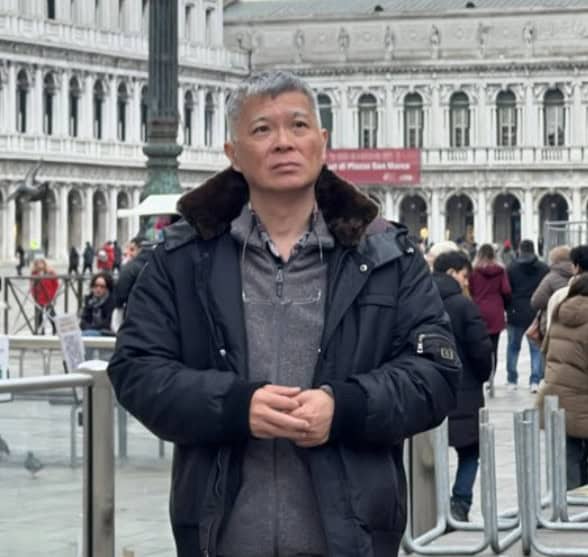
Michael Koh is a production specialist and entrepreneur who founded Spring Forest Studio in 2017 to provide event and virtual production solutions in Singapore. He specialises in hybrid live streaming, XR (Extended Reality) virtual production, and studio systems integration, transitioning the business from traditional videography to advanced corporate broadcasting. Operating out of a dedicated facility at NordCom2 in Singapore, he leads a technical crew to deliver multi-camera webcasts, digital sets, and technical consultations for large-scale corporate events.