
The Hybrid Manifesto: Designing One Production System for Two Audiences
Hybrid events have matured from a contingency model into a primary production format for enterprise communications, annual meetings, product launches, leadership forums, investor briefings, training sessions, and multi-site corporate town halls. The technical challenge is no longer whether an event can be streamed. The real standard is whether the on-site audience and the remote audience experience the same editorial intent, technical quality, timing discipline, and interaction fidelity. A successful hybrid production treats the venue, the streaming stack, and the collaboration platform as one integrated system, not as separate delivery channels.
For corporate event planners, AV professionals, production managers, and IT directors, the operational goal is consistency across signal acquisition, transport, encoding, switching, synchronization, and distribution. That means a properly engineered hybrid architecture must account for video format compatibility, audio intelligibility, network resiliency, latency control, and platform integration with Microsoft Teams, Zoom, Webex, or enterprise webinar environments. It also means the production design must support multi-camera coverage, live graphics, speaker confidence monitoring, talkback, ISO recording, and failover paths that can sustain the event if a single subsystem fails.
The hybrid manifesto is simple in principle and demanding in execution: the room and the stream must be designed together from the first technical plan. When that happens correctly, the audience boundary disappears, and the production behaves like a unified broadcast event with two consumption endpoints.
Signal Architecture for Hybrid Events
Every hybrid production starts with a signal flow map. The map defines how audio, video, intercom, control, and metadata move from capture devices to the program output, then into the distribution chain. In enterprise environments, this is normally built around a combination of SDI, HDMI 2.1 where appropriate, IP video, and managed audio routing. The choice between baseband and IP transport depends on venue scale, crew size, latency tolerance, and interoperability requirements.
Video acquisition and camera topology
For corporate hybrid events, a common production layout uses one master wide camera, one or more tight speaker cameras, and a presentation ingest path for slides or demonstrations. SDI remains the most robust baseband transport for professional cameras, routers, and switchers because it delivers long cable runs, locking connectors, and predictable latency. 3G-SDI supports 1080p at high frame rates, while 12G-SDI is widely used for 4K UHD workflows over a single coaxial path. HDMI 2.1 can support high bandwidth signals at the source, but it is less operationally resilient than SDI for long-distance venue distribution without conversion.
For scalable installations, IP video has become increasingly important. NDI, particularly NDI|HX in bandwidth constrained environments, allows camera feeds, graphics computers, and remote contribution sources to move over managed Ethernet infrastructure. SMPTE ST 2110 is the preferred uncompressed IP standard in higher-end broadcast style deployments, but it requires precise timing, network engineering, and PTP, the Precision Time Protocol, support. In most corporate event venues, NDI or NDI|HX offers a practical balance between flexibility and operational simplicity, while SDI remains the trusted backbone for critical camera and switcher paths.
Audio routing and intelligibility
In hybrid events, audio quality determines audience confidence more than video resolution does. A remote participant can tolerate a slightly softer image, but speech intelligibility must remain stable throughout the program. The audio chain should begin with proper microphone selection, then continue through gain staging, wireless coordination, digital mixing, dynamics processing, and program distribution. Common inputs include lavalier microphones, handheld microphones, goosenecks, podium feeds, and direct program audio from playback systems or remote presenters.
The mix strategy should separate the room mix from the stream mix whenever possible. The in-room mix supports the acoustics and reinforcement of the venue, while the stream mix is optimized for nearfield headphone and speaker listening. This often requires a dedicated broadcast mix with different compression, equalization, and ambience balance. For remote callers joining over Teams, Zoom, or Webex, the mix-minus feed prevents echo and feedback by removing the caller’s own return audio from the send path. When multiple remote participants are involved, a communications interface or hybrid conferencing bridge becomes essential.
Audio transport inside the venue can be handled with analog balanced lines, AES3, or networked audio platforms such as Dante or AES67. Dante is especially common in corporate production because it offers flexible patching, low latency, and straightforward integration with DSPs, mixing consoles, and stageboxes. For larger hybrid facilities, redundant network paths and separate VLANs for audio control and media transport improve reliability.
Synchronization and timing discipline
Hybrid events can suffer from lip sync errors, graphics timing drift, and delayed audience interaction when the signal chain lacks proper timing discipline. Frame syncs, genlock, and clock distribution remain important in larger systems, especially when multiple cameras, replay systems, and graphics engines must stay aligned. If the production uses IP video, PTP becomes central to synchronization. If it uses a traditional SDI router, house reference and frame synchronization should be confirmed on every incoming source that does not lock natively to the facility timing reference.
Encoding, Transport, and Latency Strategy
Once the production creates a clean program feed, the next challenge is moving it reliably to the audience platform. This is where encoding settings, transport protocol choice, and latency management define the viewer experience. The objective is to maintain stable picture quality, preserve audio sync, and keep interaction latency low enough for live Q and A, polling, and speaker handoff.
Codec selection and bitrate governance
H.264 remains the most widely supported codec for enterprise streaming because it delivers strong compatibility across browsers, conference platforms, and hardware decoders. H.265, also known as HEVC, can improve compression efficiency, especially for 4K UHD workflows, but it is not universally supported in corporate distribution environments and may complicate playback compatibility. The correct codec choice depends on the target platform, the audience devices, and the operational tolerance for encoding complexity.
Bitrate must be set according to resolution, frame rate, motion complexity, and transport conditions. A 1080p30 corporate stream often performs well in the 4 to 6 Mbps range using H.264, while 1080p60 may require 6 to 8 Mbps or more depending on content motion. For 4K UHD, bitrates rise significantly, and the network path plus platform support must be validated before deployment. Constant bitrate, CBR, is commonly used for predictable delivery, while variable bitrate, VBR, can be effective in some controlled distribution scenarios. For live enterprise events, conservative bitrate selection usually improves stability more than aggressive quality tuning does.
RTMP, RTMPS, and SRT in enterprise workflows
RTMP, the Real-Time Messaging Protocol, remains common as an ingest protocol because many platforms and encoders support it. RTMPS adds TLS encryption, which is valuable for secure transport to enterprise endpoints. However, RTMP is not designed for modern contribution resilience, and its TCP based behavior can become fragile on unstable networks.
SRT, Secure Reliable Transport, is increasingly used for contribution from remote locations, overflow rooms, and distributed production hubs because it handles packet loss more gracefully, supports encryption, and offers latency controls that are more suitable for live production. In practice, SRT is often preferred for sending remote camera feeds back to a central control room or for receiving speaker contributions from branch offices. For mission-critical corporate events, SRT contribution with a disciplined firewall policy and redundant internet access can outperform legacy transport methods under challenging network conditions.
Latency optimization
Hybrid events require a latency model that matches the interaction design. A keynote presentation with no live audience participation can tolerate higher latency than a board Q and A session or a moderated panel with remote speakers. Low latency is especially important when the remote audience is expected to vote, ask questions, or interact through a conferencing platform. The technical team should minimize processing delays introduced by encoders, decoders, switching, scaling, conferencing bridges, and CDN distribution layers.
Latency optimization begins with the camera path and ends with the platform path. Avoid unnecessary conversions between SDI and IP. Reduce multistage transcoding. Use a direct contribution path to the platform where possible. If the event is distributed via a webinar platform, understand that the platform’s internal buffering and transcoding behavior will add delay that cannot be eliminated completely. The engineering objective is to keep total end-to-end latency within the acceptable range for the event format, then design audience interaction around that constraint.
Production Control, Switching, and Redundancy
The control room is where hybrid events either feel seamless or fall apart. A disciplined production control architecture includes video switching, graphics playback, media servers, confidence monitoring, intercom, and records of every live source. The production team must see the same program the audience sees, while also monitoring source integrity and failover readiness.
Multi-camera switching and program design
Modern corporate shows benefit from a switching layout that supports both editorial flexibility and operational simplicity. A vision mixer or production switcher should handle camera sources, presentation ingest, remote feeds, lower thirds, stingers, and emergency backup sources. In a conference keynote, for example, the director may cut between a wide shot for context, a podium close-up for emphasis, a slide source for data points, and a remote guest window for panel participation. The switching strategy should be driven by content pacing and speaker behavior, not by the number of available cameras alone.
Multiview monitoring is indispensable. The technical director needs confidence monitoring for every input, program output, preview bus, audio meters, and return feed. If the remote platform accepts a separate confidence return, the team should verify that the speaker talent sees the correct presentation and layout before the event goes live. A dedicated preview environment reduces risk when remote contributors are joining from different locations and network conditions.
Failover and resilience planning
Redundancy is not optional for enterprise hybrid events. At minimum, critical systems should include backup laptops for slides, redundant internet connectivity, spare microphones, alternate camera sources, and a backup encoder path. For larger events, the resilience plan can extend to dual power circuits, UPS, bonded cellular or secondary WAN paths, and mirror ingest devices. If the primary streaming encoder fails, the production should be able to switch to the backup system without forcing the audience to reconnect.
Control systems should also be designed with operational separation. If remote conferencing is integrated into the show, isolate the conference bridge from the live program path wherever possible. That way, a problem in the remote contribution chain does not interrupt the main stream. The production team should rehearse failure scenarios, including internet loss, camera disconnection, media file corruption, and audio device failure. A true hybrid infrastructure is measured by how gracefully it recovers under stress.
Enterprise Integration, Security, and Venue Network Design
Corporate hybrid productions frequently operate inside restricted IT environments where security policies, firewall rules, and authentication controls must be respected. This makes coordination between production crews and enterprise IT teams critical. A successful deployment begins with a network plan that identifies required ports, transport protocols, VLAN segmentation, DHCP or static addressing, DNS behavior, and outbound stream destinations.
Venue network requirements
Managed switches, quality of service, QoS, and traffic segmentation are fundamental for stable performance. Production traffic should not share an unmanaged network with guest Wi-Fi, office traffic, or building systems. If NDI, Dante, streaming encoders, control surfaces, and conferencing bridges all operate on the same venue network, QoS policies and switch configuration must be validated before show day. For IP video systems, multicast handling, IGMP snooping, and bandwidth headroom must be reviewed carefully.
Wireless should be treated as support, not as the primary transport path, for critical live feeds. Even high quality enterprise Wi-Fi can be affected by contention, device density, and RF interference. Wired connectivity remains the default for encoders, switchers, and conferencing bridges in high stakes events.
Platform integration with Teams, Zoom, and Webex
Enterprise collaboration platforms are frequently used as the audience layer for hybrid meetings and town halls. Each platform has its own behavioral constraints regarding participant joining, screen sharing, audio routing, and ingest methods. In many cases, the most robust workflow is to send a dedicated program feed to the platform, while using a separate moderator channel for remote interaction. This keeps the audience clean and avoids contamination of the public feed with operational chatter.
For speaker contribution, a producer may invite presenters into Teams, Zoom, or Webex, then route them through a controlled return feed into the production switcher. Audio hygiene is essential. The remote participant should receive a stable confidence mix or a structured program return, depending on whether they are speaking or only listening. Proper camera framing, network testing, and local audio monitoring remain important even when the final audience sits in a conferencing environment.
Security and compliance considerations
Enterprise streaming must respect data handling, access control, and content governance requirements. RTMPS and SRT encryption support secure transport, but they do not replace organizational policy. Access to the encoder, streaming destination, cloud control panel, and recording archive should be restricted to authorized operators. If the event includes confidential financial, legal, or internal strategy content, the production team should coordinate with corporate security and legal stakeholders regarding retention, access logs, and recording distribution. ISO aligned operational processes, such as documented change control and incident response, improve trust and repeatability across repeated events.
Operational Best Practices for Seamless Hybrid Delivery
The strongest hybrid productions are built on repeatable procedures, not improvisation. Pre-production should include a full technical rehearsal, a show-flow document, signal path verification, and bandwidth testing from the actual venue. Encoding settings should be locked and tested, not changed live unless the team has already validated the consequences. Each critical device, camera, audio source, and network path should have a named owner and a fallback plan.
On-site and online audience alignment
The editorial experience for both audiences must be intentionally designed. On-site attendees need sightlines, room audio, and stage confidence. Online attendees need crisp camera cuts, intelligible program audio, and clean graphics that communicate the same key information without depending on the room environment. Interactive moments should be planned with platform latency in mind so the host knows when to wait for remote responses and when to continue with a prepared segment.
Production teams should also format graphics and lower thirds for dual consumption. Text must remain legible on small screens, while still supporting the physical room display environment. Camera shots should avoid excessive movement that hurts remote compression efficiency. Audio mixing should prioritize speech clarity, limiting unnecessary low-frequency buildup and reverberant spill that can degrade conferencing audio.
Finally, every hybrid event should end with a post-event technical review. This review should assess stream stability, audio performance, audience engagement timing, latency behavior, backup utilization, and platform-specific issues. The objective is to improve the operating model for the next event, not merely to archive the result.
Conclusion: Hybrid as a Broadcast Discipline
Hybrid production is not a compromise between live and virtual formats. It is a broadcast discipline that combines venue engineering, internet distribution, live switching, network architecture, and enterprise collaboration into a single delivery system. When the signal chain is designed around both audiences from the outset, the production gains clarity, stability, and editorial control. RTMP, RTMPS, and SRT each have roles in the architecture. SDI, NDI, Dante, and SMPTE aligned timing models each contribute to reliability. Teams, Zoom, and Webex can serve as effective interaction layers when integrated with proper routing, moderation, and latency planning.
For enterprise clients, the practical mandate is clear. Build for redundancy. Validate the network. Separate the room mix from the stream mix. Rehearse the show under real conditions. Protect the program with secure transport and disciplined control. That is how the on-site and online audiences become one coherent experience, delivered with the technical rigor expected in professional B2B event streaming.
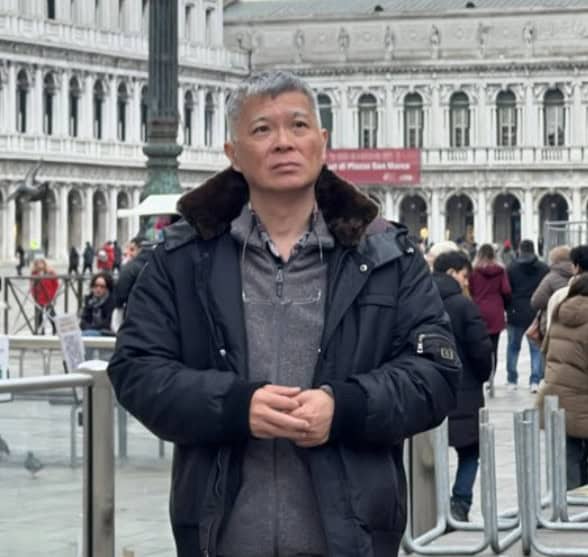
Michael Koh is a production specialist and entrepreneur who founded Spring Forest Studio in 2017 to provide event and virtual production solutions in Singapore. He specialises in hybrid live streaming, XR (Extended Reality) virtual production, and studio systems integration, transitioning the business from traditional videography to advanced corporate broadcasting. Operating out of a dedicated facility at NordCom2 in Singapore, he leads a technical crew to deliver multi-camera webcasts, digital sets, and technical consultations for large-scale corporate events.