
In Singapore’s dynamic corporate landscape, the transition to a hybrid workplace model has accelerated, mandating a profound re-evaluation of how enterprises facilitate internal and external communication. This evolution transcends simple video conferencing; it necessitates the integration of robust, enterprise-grade live video streaming solutions that seamlessly bridge the physical and virtual realms of B2B events and daily operations. The challenge lies not merely in deploying cameras and microphones, but in architecting a comprehensive streaming infrastructure capable of delivering broadcast-quality experiences, ensuring data security, optimizing network performance, and guaranteeing seamless scalability for diverse corporate needs. As the Live Streaming Studio Technical Team, our focus is on providing the advanced technical frameworks required for Singaporean enterprises to master this new normal, moving beyond consumer-grade solutions to professional, resilient hybrid event production.
Foundation of Hybrid Video Infrastructure in Singapore’s Enterprise Environment
The bedrock of a successful hybrid video strategy lies in a meticulously engineered infrastructure. For B2B events, especially those with high-stakes corporate communication, the underlying network, encoding protocols, and signal transport mechanisms must be absolutely dependable. Singapore’s advanced digital infrastructure provides a strong foundation, but specific optimizations are critical for live video. We are not discussing rudimentary webcam feeds, but rather a professional production ecosystem.
Network Architecture and Bandwidth Provisioning for Enterprise Streaming
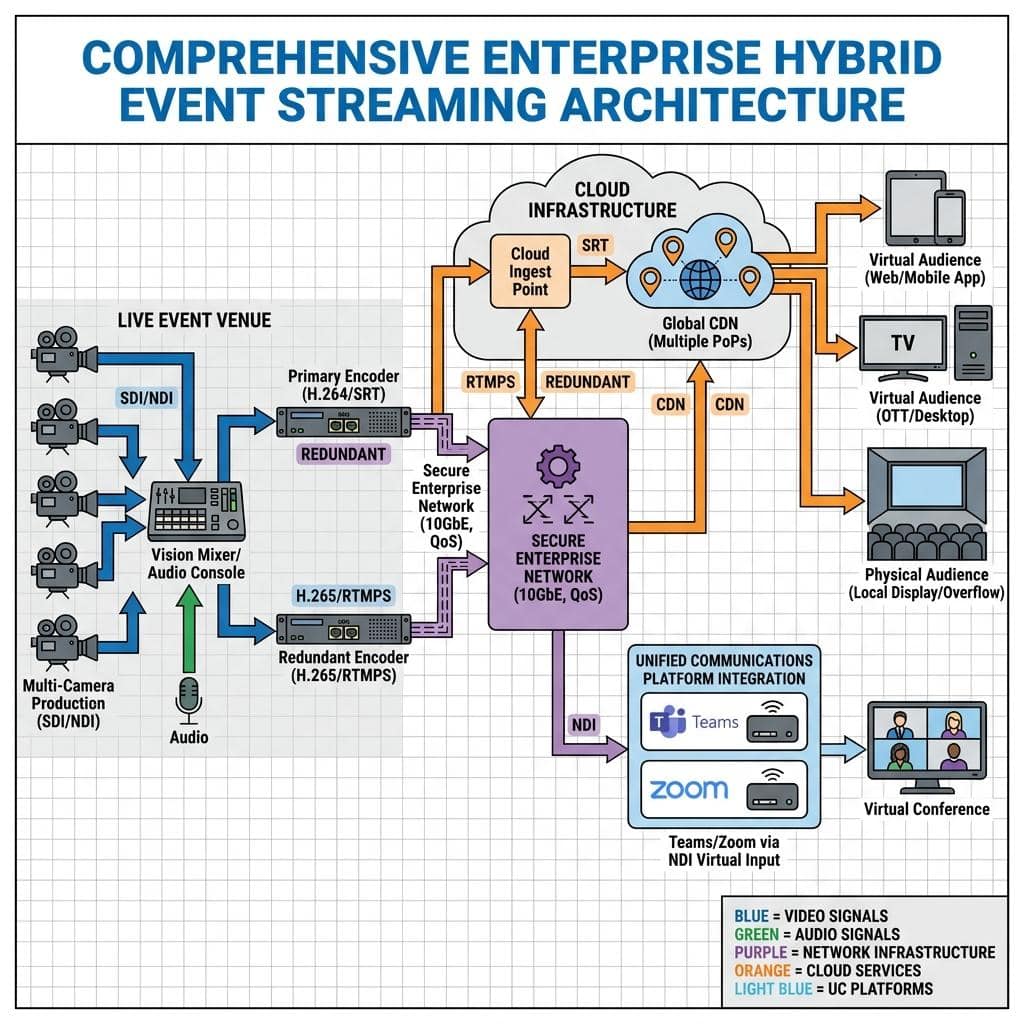
Deploying live video at an enterprise scale demands a network architecture designed for high-throughput, low-latency data transmission. Gigabit Ethernet backbones are the minimum requirement, with 10 Gigabit Ethernet (10GbE) often necessary for multi-camera 4K/UHD productions, especially when utilizing Network Device Interface (NDI) for internal IP video workflows. Critical considerations include Quality of Service (QoS) prioritization on switches and routers, ensuring that real-time video and audio packets receive preferential treatment over less time-sensitive data. Redundant network links, often through diverse Internet Service Providers (ISPs), are imperative to prevent single points of failure. For reaching geographically dispersed audiences, particularly across Asia-Pacific and beyond, integration with a high-performance Content Delivery Network (CDN) is non-negotiable. A CDN offloads delivery traffic from the origin server, distributes content geographically closer to end-users, and absorbs traffic spikes, thus mitigating buffering and latency for viewers in varied locations. Bandwidth calculations must account for aggregate ingest bitrates (e.g., 20-50 Mbps for a high-quality 1080p stream with redundant feeds) and egress bandwidth for internal distribution and contribution links.
Encoding Standards and Protocol Selection for Professional Output
The choice of encoding standards and transport protocols directly impacts video quality, latency, and interoperability. H.264 (AVC) remains the ubiquitous standard for broad compatibility across devices and platforms, offering an excellent balance of compression and quality. However, for higher resolutions or when bandwidth is constrained, H.265 (HEVC) provides superior compression efficiency, delivering comparable quality at approximately half the bitrate of H.264. This is particularly relevant for 4K/UHD content delivery. For streaming protocols, Real-Time Messaging Protocol (RTMP) and its secure counterpart RTMPS are still widely supported by social media platforms and many CDNs for ingest, providing a robust, albeit higher-latency, contribution method. For mission-critical B2B events requiring near real-time interaction and resilience over unreliable networks, Secure Reliable Transport (SRT) protocol is the preferred choice. SRT, an open-source protocol developed by Haivision, leverages UDP for speed while incorporating ARQ (Automatic Repeat reQuest) for packet loss recovery, encryption for security, and dynamic latency adjustment. This makes it ideal for live contribution feeds from remote locations in Singapore or international guest speakers. For in-venue IP video routing and contribution, NDI offers extremely low-latency, high-quality video, audio, and metadata transport over standard IP networks, making it a powerful tool for multi-camera production within the event space, especially NDI|HX for bandwidth-constrained environments.
Professional Live Production Workflows for Seamless Hybrid Events
Beyond the fundamental infrastructure, the actual production workflow for hybrid events demands broadcast-grade methodologies and equipment. This involves meticulous planning of multi-camera setups, precise audio engineering, and robust signal management to deliver a polished program feed to both the physical audience and the virtual participants.
Multi-Camera Acquisition and Signal Routing Architectures
A dynamic hybrid event necessitates multiple camera angles to capture presenters, audience reactions, and supplementary visuals. Professional production typically employs a minimum of three cameras: a wide shot, a medium shot, and a close-up, often utilizing Broadcast Grade PTZ (Pan-Tilt-Zoom) cameras for flexibility and operator efficiency, alongside manned cinema or ENG cameras for superior image quality. These cameras output signals via SDI (Serial Digital Interface) for robust, uncompressed video transmission over long cable runs, or increasingly, via NDI for IP-based workflows. An advanced vision mixer (e.g., Blackmagic ATEM Constellation, Ross Carbonite, Grass Valley K-Frame) is central to switching between these sources, applying transitions, and managing graphics. Audio signal flow is equally critical, moving from professional microphones (lapel, handheld, boundary mics) through a digital audio mixer (e.g., Yamaha QL series, Behringer X32, Dante-enabled systems) to ensure pristine sound quality. Audio channels are often routed via Dante or AES67 for network-based transport, synchronizing precisely with video signals. The final program feed, comprising mixed video and audio, is then routed for encoding and distribution.
Program Management, Monitoring, and Interactivity Integration
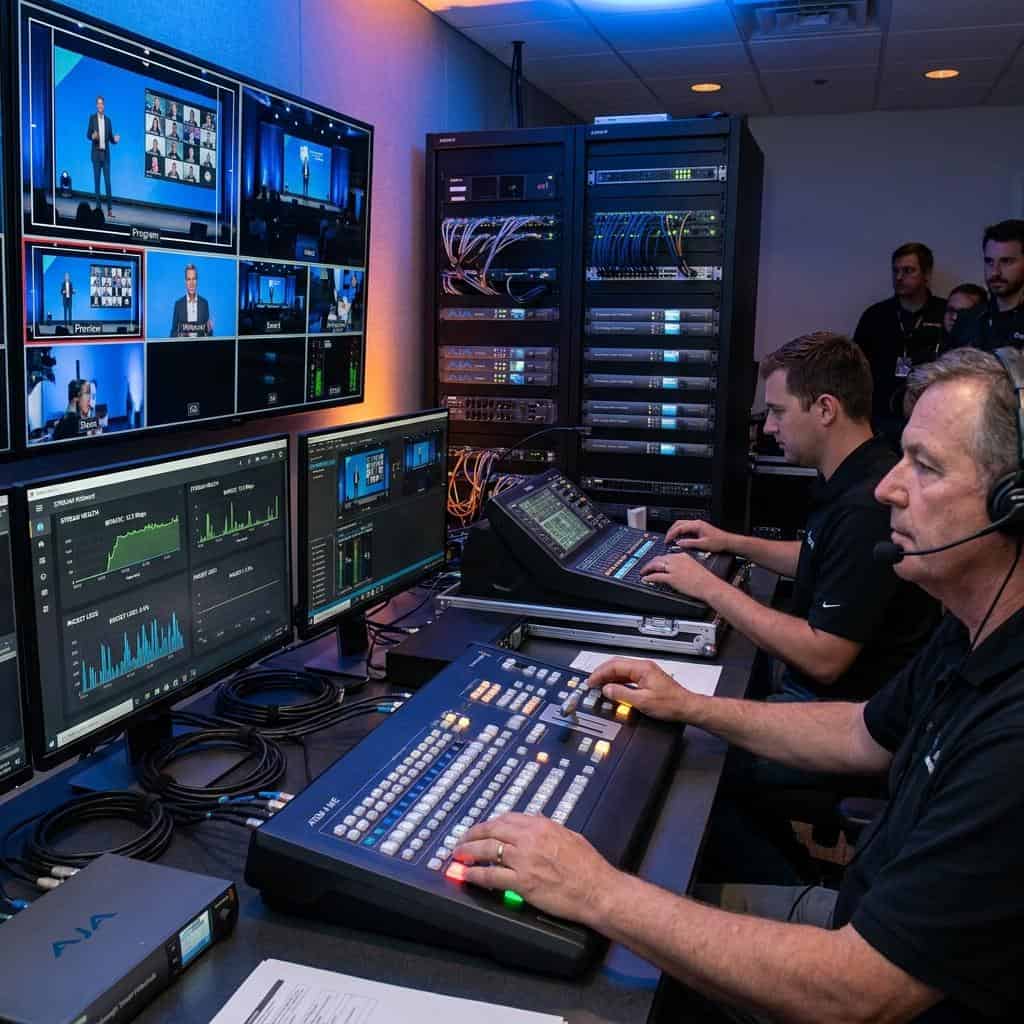
Effective program management in a hybrid environment requires sophisticated monitoring and communication systems. A technical director or vision mixer operator relies on multiview monitoring setups, displaying all camera inputs, program output, preview output, and graphics feeds simultaneously. Clear communication is maintained via talkback systems (e.g., Clear-Com, RTS Intercom) between the control room, camera operators, and stage managers. For virtual presenters or panellists, a dedicated virtual green room is essential, where technical checks can be performed and cues provided without disrupting the live program. Integrating interactive elements is crucial for engaging the virtual audience. This includes live Q&A platforms (e.g., Slido, Mentimeter) whose outputs can be dynamically overlaid onto the program feed, real-time polling, and interactive chat functionalities. These digital tools ensure that remote participants are not passive observers but active contributors, fostering a sense of inclusion identical to the in-person experience. Comprehensive ISO recording of individual camera feeds and the clean program output is standard practice for post-production editing, archiving, and potential on-demand distribution, often captured on SSD recorders with specific codecs like Apple ProRes or Avid DNxHR at resolutions up to 4K/UHD, maintaining high bitrates for maximum quality.
Enterprise Platform Integration and Scalability for Singapore’s Diverse Needs
The hybrid workplace in Singapore often revolves around established enterprise communication platforms. Seamlessly integrating professional live video production into these ecosystems is a key differentiator for high-quality B2B events. Furthermore, the ability to scale these solutions for local, regional, or global audiences is paramount.
Bridging Traditional AV with Unified Communications Platforms
While platforms like Microsoft Teams, Zoom, and Webex are ubiquitous for daily meetings, their native capabilities often fall short for broadcast-quality multi-camera events. The Live Streaming Studio Technical Team bridges this gap by integrating professional AV production into these platforms. This typically involves ingesting the high-fidelity program feed from our vision mixer into the UC platform as a virtual camera source. Techniques include using NDI Virtual Input for platforms that support it, or employing dedicated hardware ingest devices (e.g., Blackmagic Web Presenter, AJA U-TAP) that convert SDI or HDMI signals into a USB webcam-compatible feed. This approach ensures that the superior video and audio quality, multiple camera angles, professional graphics, and precisely mixed audio of a dedicated production are delivered directly to the attendees within their familiar UC environment. Advanced integration can also involve routing individual NDI feeds from our production suite into a Zoom Room or Teams Meeting for specialized interactive segments, maintaining a high level of control and quality.
Cloud-Based vs. On-Premise Streaming Solutions for Enterprise Resilience
Enterprises in Singapore face a critical decision regarding the hosting of their streaming infrastructure: fully cloud-based, entirely on-premise, or a hybrid model. Cloud-based solutions (e.g., AWS Elemental MediaLive, Azure Media Services, Vimeo Enterprise) offer unparalleled scalability, global reach, and reduced upfront hardware investment. They are ideal for events with unpredictable audience sizes and global distribution requirements, providing robust redundancy and failover mechanisms inherently. However, on-premise solutions offer maximum control over data security, compliance with stringent data residency requirements (critical in sectors like finance and government in Singapore), and often lower long-term operational costs for consistently high-volume internal streaming. A hybrid approach, leveraging on-premise encoders for ingest and primary processing, then distributing via cloud CDNs, often provides the best balance of control, security, and scalability. This flexibility allows enterprises to adapt their streaming strategy to specific event requirements, compliance mandates, and budget constraints, always prioritizing reliability and performance.
Ensuring Quality of Service, Redundancy, and Security in B2B Streaming
In the B2B sphere, a live stream failing or exhibiting poor quality is not merely inconvenient; it can inflict significant reputational damage and financial loss. Therefore, meticulous attention to Quality of Service (QoS), robust redundancy, and stringent cybersecurity measures are non-negotiable for enterprise-grade streaming.
Latency Optimization and Proactive Monitoring Strategies
Minimizing end-to-end latency is crucial for fostering real-time interaction in hybrid environments. While traditional RTMP streams typically incur 10-30 seconds of latency, protocols like SRT can reduce this to sub-second levels, enabling more natural Q&A sessions and audience engagement. Latency optimization involves selecting efficient encoders (e.g., NVIDIA NVENC, Intel Quick Sync Video for hardware acceleration), configuring appropriate buffer sizes, and optimizing network paths. Continuous, proactive monitoring is paramount. This includes real-time bitrate analysis, network congestion detection, and video quality assessment through tools like multiviewers, waveform monitors, and dedicated stream health dashboards. A dedicated technical director and streaming engineer constantly monitor these metrics, ready to implement contingency plans at the first sign of degradation, ensuring the program feed maintains consistent quality and stability.
Redundancy and Failover Architectures for Uninterrupted Delivery
Single points of failure are unacceptable in professional B2B streaming. Redundancy must be built into every layer of the production and delivery chain. This starts with dual, identically configured encoders running in parallel, fed by redundant video and audio signals. Should one encoder fail, the other seamlessly takes over. Network redundancy involves dual ISP connections, often from different physical entry points, and redundant switching and routing equipment configured for automatic failover via protocols like VRRP (Virtual Router Redundancy Protocol). Power redundancy is achieved through Uninterruptible Power Supplies (UPS) for short outages and backup generators for extended power loss, ensuring continuous operation of all critical hardware. For cloud-based distribution, geographic redundancy across multiple CDN points of presence (PoPs) guarantees that if one server cluster experiences issues, traffic is rerouted to another, ensuring continuous global availability and mitigating localized network issues that could affect Singaporean or international viewers. These failover strategies are rigorously tested through simulations to ensure swift and automatic transitions without audience interruption.
Cybersecurity Protocols for Enterprise Live Streams
The security of corporate communications delivered via live stream is paramount. B2B events often contain sensitive proprietary information, intellectual property, or confidential financial data. Robust cybersecurity measures must be integrated from source to screen. This includes encrypted streaming protocols such as RTMPS and SRT with AES-128 or AES-256 encryption. Access control mechanisms, including single sign-on (SSO) integration, token-based authentication, and geo-restriction, ensure that only authorized individuals can view the content. Digital Rights Management (DRM) technologies can be employed to prevent unauthorized downloading or redistribution of premium content. Regular vulnerability assessments and penetration testing of the streaming platform and infrastructure are crucial to identify and remediate potential security gaps. Furthermore, all streaming data, especially if processed or stored on cloud platforms, must adhere to relevant data privacy regulations, including Singapore’s Personal Data Protection Act (PDPA), emphasizing secure data handling and processing practices.
The hybrid workplace in Singapore is not a transient phase; it is the definitive future. Integrating live video into this new normal requires a sophisticated, technically robust approach that far exceeds conventional video conferencing. At Live Streaming Studio, our technical team possesses the profound expertise in broadcast standards (SMPTE, ISO), advanced streaming protocols, and intricate production workflows to empower Singaporean enterprises. From architecting resilient network infrastructures with QoS and redundant links, through multi-camera 4K/UHD production using SDI and NDI, to seamless integration with enterprise UC platforms and securing content with RTMPS/SRT encryption, we provide end-to-end solutions. Our commitment is to transform the technical complexities of hybrid event production into seamless, high-impact experiences, ensuring your corporate communications achieve unparalleled clarity, reach, and security. Engage with Live Streaming Studio to elevate your B2B event streaming capabilities, ensuring your enterprise thrives in Singapore’s evolving hybrid landscape.

Michael Koh is a production specialist and entrepreneur who founded Spring Forest Studio in 2017 to provide event and virtual production solutions in Singapore. He specialises in hybrid live streaming, XR (Extended Reality) virtual production, and studio systems integration, transitioning the business from traditional videography to advanced corporate broadcasting. Operating out of a dedicated facility at NordCom2 in Singapore, he leads a technical crew to deliver multi-camera webcasts, digital sets, and technical consultations for large-scale corporate events.