
The Managed AGM Checklist: 10 Essentials for Singaporean Corporate Secretaries
In the evolving landscape of corporate governance, the Annual General Meeting (AGM) stands as a cornerstone event that requires rigorous planning and execution. With the rise of hybrid event formats, Singaporean corporate secretaries are tasked with navigating complex streaming and production workflows to ensure seamless experiences for both physical and virtual attendees. This requires a comprehensive understanding of the latest B2B event streaming technologies and hybrid production solutions.
1. Infrastructure Design for Seamless Streaming
Establishing a robust infrastructure is pivotal for AGM success. Leveraging enterprise-grade streaming protocols like RTMP (Real-Time Messaging Protocol) and SRT (Secure Reliable Transport) ensures reliable and low-latency video delivery. Integration of NDI (Network Device Interface) for video over IP can facilitate efficient multi-camera setups and easy routing across networks.
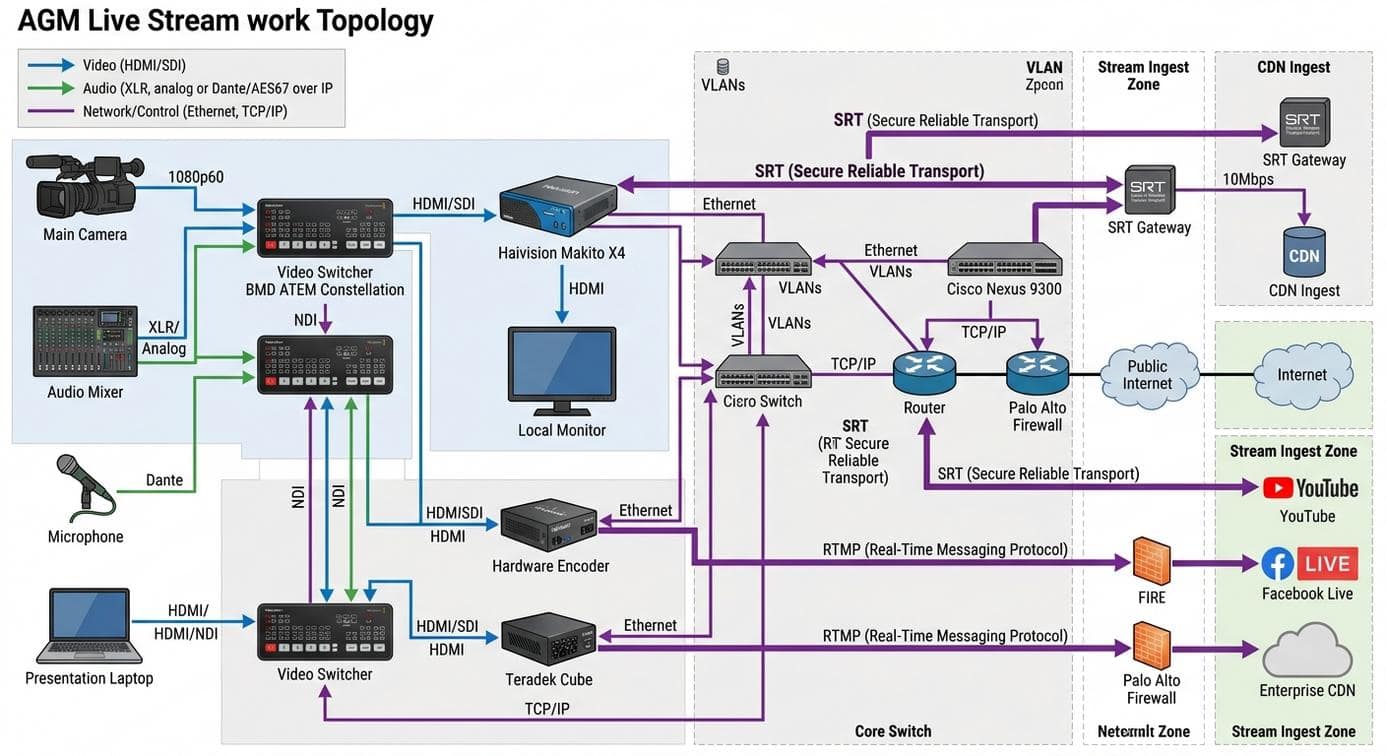
illustrates an optimal network setup utilizing these protocols.
Network and Bandwidth Considerations
AGMs demand high bandwidth to cater to multiple streams. A dedicated network with managed switches and Quality of Service (QoS) measures helps in prioritizing video data over other types of traffic, ensuring uninterrupted streaming.
2. Multi-Camera Production and Video Switching
Producing a dynamic and engaging AGM requires a sophisticated multi-camera setup. Utilizing SDI and HDMI 2.1 interfaces ensures 4K/UHD quality transmission. Video switchers should support ISO recording and provide multiview monitoring for effective control of live feeds.
Camera Setup and Configuration
Positioning PTZ (Pan-Tilt-Zoom) cameras strategically around the venue allows for flexible framing options and reduces the need for manual camera operations, enhancing the broadcast’s fluidity.
3. Audio Infrastructure: Mixing and Signal Flow
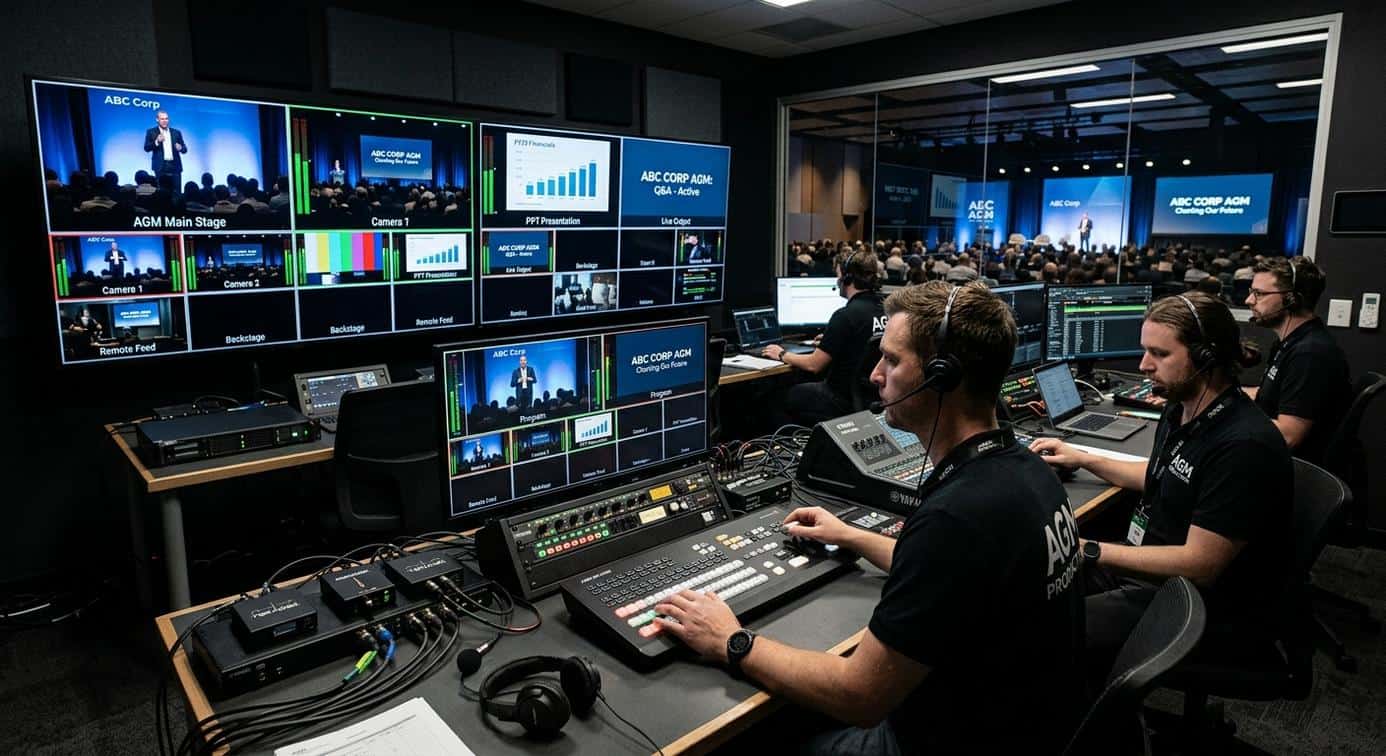
Sound quality is as critical as video quality. Implementing advanced audio mixing consoles with talkback systems ensures clear communication between technical teams. Proper audio signal flow using balanced XLR connections and digital audio mixers can prevent ground loop issues and maintain optimum sound fidelity.
Acoustic Treatments and Microphone Placement
Employing strategic acoustic treatments in the venue and correctly positioning directional microphones can significantly enhance sound capture quality, reducing ambient noise.
4. Hybrid Event Integration
AGMs increasingly require integration with platforms like Microsoft Teams, Zoom, or Webex for virtual participation. On-premise solutions such as local servers can be paired with cloud services to scale operations and provide redundant failover options.
Redundancy and Failover Strategies
To mitigate risks associated with technical failures, implementing redundancy across critical components, such as backup encoders and network paths, is essential for maintaining broadcast integrity.
5. Quality Assurance and Post-Event Analysis
Consistent quality assurance protocols should be in place before, during, and after the AGM. This includes real-time monitoring using latency-optimized encoders and bitrate management tools to deliver a flawless viewing experience. Post-event analysis involving metrics from video streams and participant feedback can guide future improvements.
By adhering to these 10 essentials, Singaporean corporate secretaries can adeptly manage AGMs with confidence, leveraging advanced B2B streaming technologies to deliver impactful and seamless events.
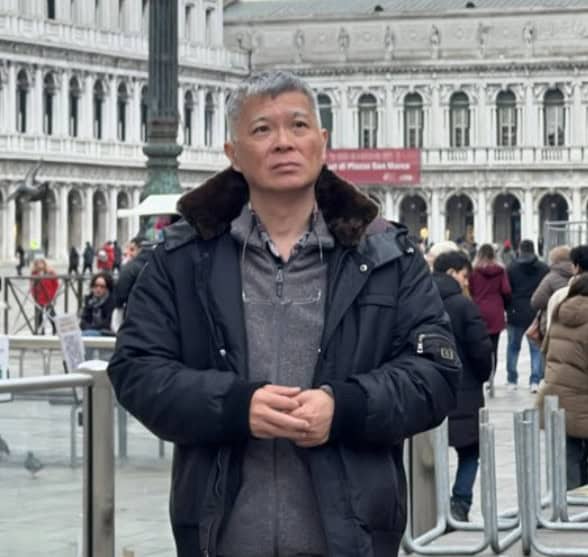
Michael Koh is a production specialist and entrepreneur who founded Spring Forest Studio in 2017 to provide event and virtual production solutions in Singapore. He specialises in hybrid live streaming, XR (Extended Reality) virtual production, and studio systems integration, transitioning the business from traditional videography to advanced corporate broadcasting. Operating out of a dedicated facility at NordCom2 in Singapore, he leads a technical crew to deliver multi-camera webcasts, digital sets, and technical consultations for large-scale corporate events.