
In the complex ecosystem of B2B event production, the decision between deploying an in-house, do-it-yourself (DIY) streaming solution and engaging a professional managed service provider is a pivotal one. For corporate event planners, AV professionals, and IT directors, the stakes are exceptionally high. Unlike consumer-grade streaming, enterprise live events demand absolute reliability, uncompromised fidelity, and seamless integration within existing corporate IT infrastructures. A DIY approach, while seemingly cost-effective initially, often succumbs to the intricate technical demands of professional multi-camera production, advanced encoding, robust network management, and stringent security protocols. The “Managed Stream Advantage” transcends mere technical support; it represents a holistic operational paradigm that mitigates risk, optimizes resource allocation, and guarantees broadcast-quality outcomes for critical corporate communications, hybrid conferences, and virtual summits. This article will dissect the fundamental technical distinctions, underscoring why a managed service model consistently outperforms self-managed solutions in the high-pressure environment of B2B live event streaming.
The Intricacies of Enterprise-Grade Live Production: Beyond Basic Encoding
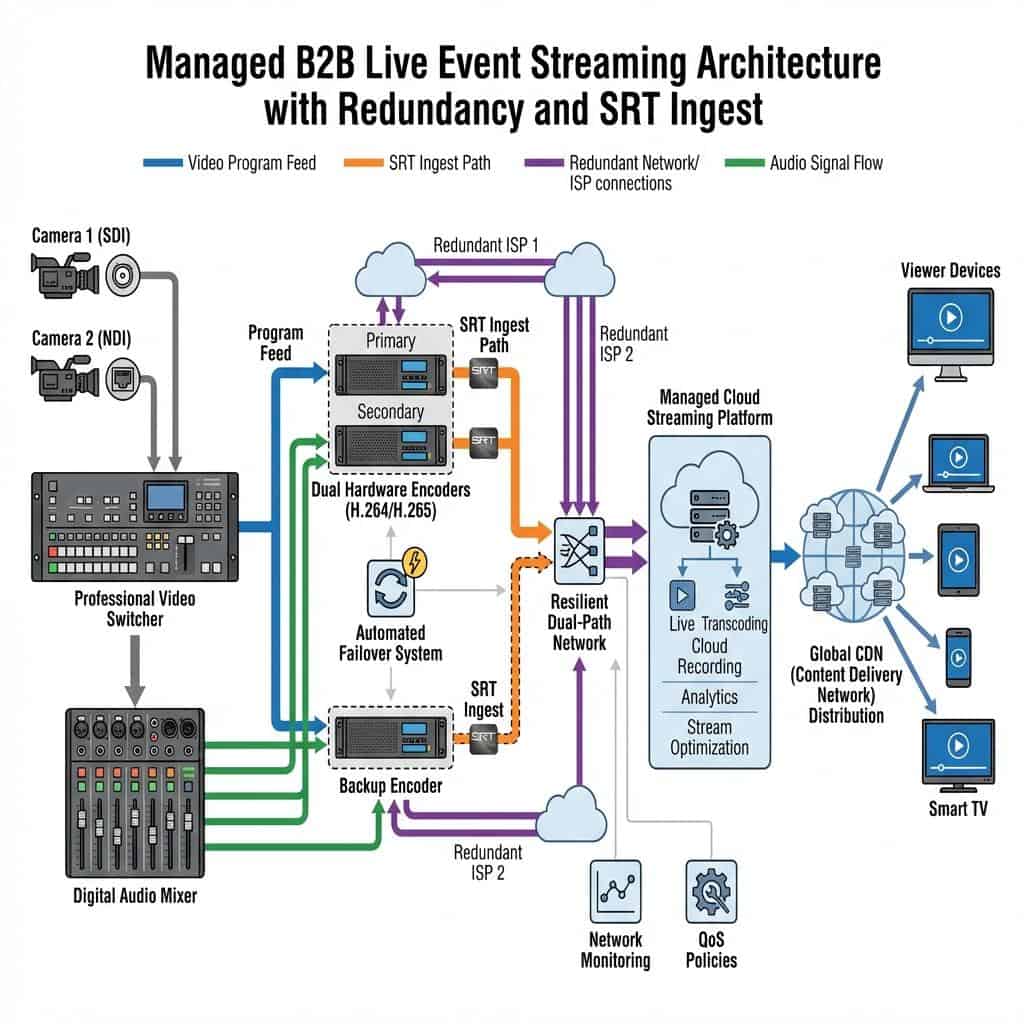
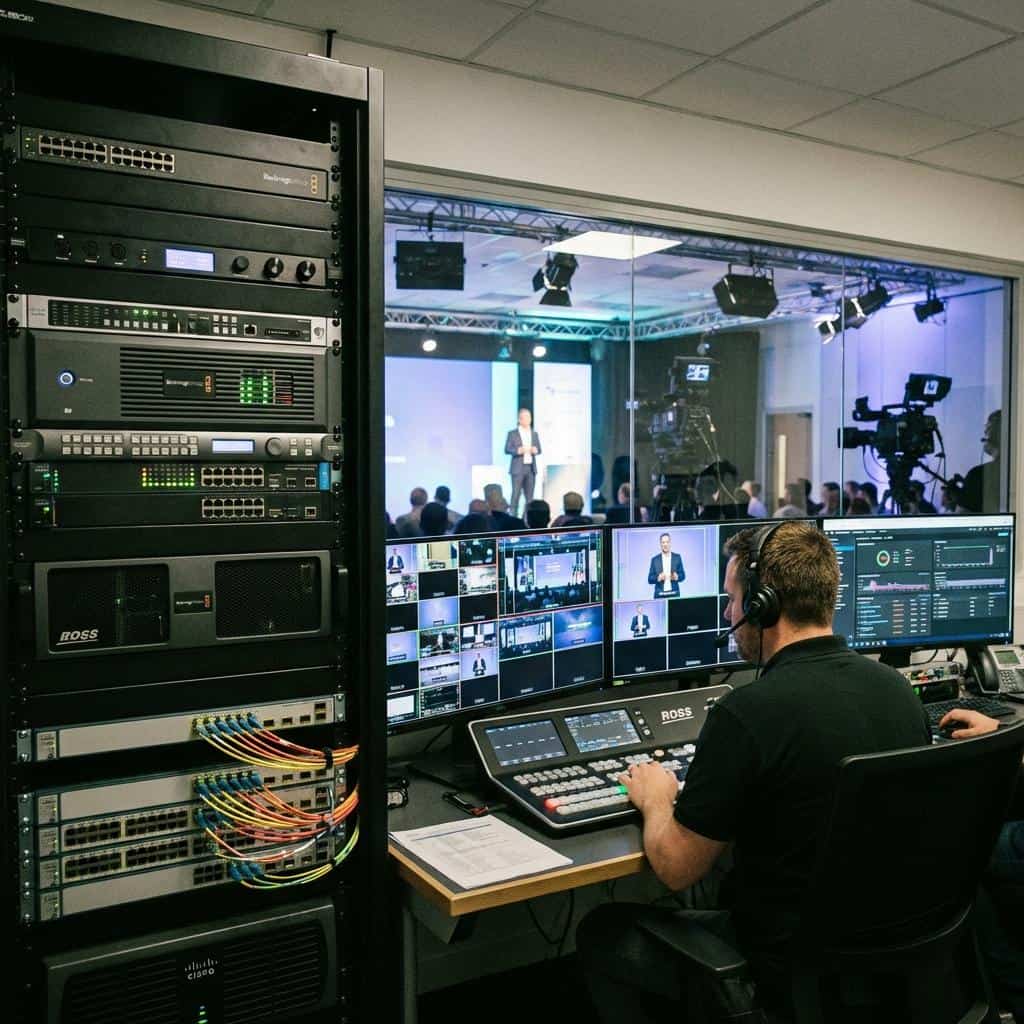
The foundation of any successful B2B live stream is a meticulously engineered production workflow. A DIY setup often underestimates the complexity inherent in capturing, processing, and distributing high-fidelity audio and video signals from multiple sources. Professional managed services deploy sophisticated multi-camera architectures, typically involving broadcast-grade cameras transmitting via Serial Digital Interface (SDI) or increasingly, Network Device Interface (NDI) for IP-based workflows. These signals are routed through professional video switchers, such as Blackmagic ATEM Television Studio or Ross Carbonite series, allowing for dynamic transitions, graphic overlays, and Picture-in-Picture (PiP) compositions. Audio signal flow is equally critical, managed by digital audio consoles (e.g., Yamaha QL series or Behringer X32) which ingest microphone feeds, program audio, and external playback sources, ensuring optimal gain staging, equalization, and dynamic range processing. Achieving precise audio-video synchronicity, often complicated by varying signal latencies across different equipment, is paramount for a professional presentation and requires specialized genlock capabilities and frame synchronizers.
Advanced Encoding, Transcoding, and Distribution Protocols
The choice and implementation of encoding technologies are fundamental. Professional managed services leverage dedicated hardware encoders (e.g., Elemental Live, Haivision Makito X series) capable of H.264 (Advanced Video Coding) and H.265 (High Efficiency Video Coding) at high profiles, ensuring optimal video quality at specified bitrates (e.g., 8-20 Mbps for 1080p Full HD, up to 50 Mbps for 4K/UHD). These encoders often support multiple output profiles simultaneously for adaptive bitrate streaming, catering to diverse viewer bandwidths. The transmission protocol stack is equally critical. While Real-Time Messaging Protocol (RTMP) and its secure variant, RTMPS, remain prevalent for ingest, the Secure Reliable Transport (SRT) protocol, developed by Haivision, has gained significant traction for its superior error recovery, low latency, and firewall traversal capabilities over unstable networks. Managed services often deploy SRT for contribution feeds from remote locations, ensuring robust signal integrity. For distribution, HTTP Live Streaming (HLS) and MPEG-DASH are preferred for their broad compatibility and adaptive bitrate delivery.
Integrated Audio-Visual Workflows and Synchronicity Challenges
A professional production environment demands a tightly integrated audio-visual workflow. This extends beyond simple input connections to encompass sophisticated signal routing architectures, talkback systems for crew communication (e.g., Clear-Com, RTS Intercom), and comprehensive multiview monitoring systems displaying program feeds, preview feeds, and individual camera outputs. Color grading and correction are often applied in real-time or post-production to ensure visual consistency across all sources. ISO recording, where each camera feed is recorded individually, is a standard practice for post-event editing and archive, providing immense flexibility that DIY setups rarely accommodate due to storage and processing constraints. The meticulous orchestration of these elements requires not just equipment, but deeply ingrained technical expertise in broadcast engineering and live production best practices.
Network Infrastructure and Resiliency: The Backbone of Reliable Streaming
The network infrastructure supporting a B2B live stream is its most critical vulnerability. A DIY approach often relies on standard enterprise network segments, which may lack the dedicated bandwidth, Quality of Service (QoS) prioritization, and redundancy necessary for mission-critical video transport. Managed services begin with a thorough network assessment, often establishing dedicated, high-throughput connections (e.g., 10 Gbps fiber links) independent of general corporate traffic. QoS policies are implemented to prioritize SRT or RTMP streams, minimizing jitter, packet loss, and latency across Wide Area Networks (WANs) and local networks.
Dedicated Bandwidth Provisioning and Quality of Service (QoS)
Professional live streaming demands guaranteed bandwidth. For multi-stream, high-resolution events, egress bandwidth requirements can easily exceed hundreds of megabits per second. Managed service providers provision dedicated symmetrical internet connections with explicit Service Level Agreements (SLAs) for uptime and performance. Beyond raw bandwidth, intelligent traffic shaping and QoS protocols ensure that video and audio packets receive preferential treatment over less time-sensitive data. This prevents congestion-induced artifacts such as macroblocking, frame drops, and audio desynchronization, which are common issues in unmanaged network environments.
Redundancy and Failover Strategies for Uninterrupted Delivery
An enterprise-grade live event simply cannot fail. Managed services integrate multiple layers of redundancy across the entire signal chain. This includes redundant internet connections (e.g., primary fiber with 5G cellular failover), redundant encoders, redundant power supplies for all critical equipment, and even redundant switching matrices. Automated failover mechanisms are implemented at key points, instantaneously switching to a backup system upon detection of a primary system failure. For instance, dual SRT ingest pathways from different network egress points can ensure continuity even if a primary path experiences an outage. This architectural robustness is a hallmark of professional broadcast engineering, providing peace of mind that a DIY setup rarely offers.
Global Content Delivery Networks (CDNs) and Latency Optimization
Effective global distribution requires the strategic utilization of Content Delivery Networks (CDNs). Managed services integrate with tier-1 CDNs (e.g., Akamai, Limelight, Cloudflare) that possess extensive global points of presence (PoPs). This ensures that viewers worldwide receive the stream from the nearest server, drastically reducing latency and improving playback quality. Furthermore, professional CDNs offer robust scaling capabilities, effortlessly accommodating sudden spikes in viewer numbers without degradation in service. Latency optimization is a continuous process, from low-latency encoding to optimized CDN configurations, ensuring an interactive and responsive viewing experience, critical for Q&A sessions or real-time polling.
Bridging Physical and Virtual: Hybrid Event Integration
Hybrid events, combining in-person and virtual audiences, introduce a unique set of technical challenges that demand specialized expertise. Seamless integration between the physical event space and virtual engagement platforms is paramount.
Seamless Integration with Enterprise Communication Platforms
Corporate clients often leverage existing enterprise communication platforms such as Microsoft Teams, Zoom, or Webex for internal meetings and virtual participants. Managed services excel at integrating professional program feeds from the physical event into these platforms, effectively bridging the gap between a broadcast-quality production and the familiar virtual meeting environment. This often involves specialized NDI converters or dedicated hardware interfaces to ingest the program feed and route participant audio/video back into the physical venue for Q&A panels. The complexity of managing multiple concurrent platforms, ensuring audio mix-minus feeds to prevent echo, and coordinating presenter handoffs far exceeds typical DIY capabilities.
Interactive Elements and Audience Engagement Technologies
Engaging virtual audiences requires more than just a video feed. Managed services incorporate sophisticated audience engagement technologies, including real-time Q&A moderation platforms, live polling, virtual breakout rooms, and dynamic graphic overlays for attendee recognition or sponsor branding. Integrating these elements seamlessly into a live production workflow, ensuring data synchronization and a cohesive user experience, requires specialized software integrations and operational expertise. From managing chat streams to dynamically displaying audience questions on screen, the technical orchestration is meticulous.
Data Security, Compliance, and Access Control
For enterprise clients, data security and compliance are non-negotiable. Managed streaming services implement stringent security protocols, including end-to-end encryption for all media streams (e.g., AES-256 encryption with SRT), secure viewer authentication, and content geo-blocking if required. Compliance with industry standards like GDPR, CCPA, and internal corporate IT policies is integrated into the service framework. This extends to secure content archiving, audit trails, and granular access control for sensitive corporate communications. A DIY setup often lacks the robust security architecture and expertise to meet these stringent corporate requirements, exposing the organization to significant data breach risks.
Operational Excellence and Technical Expertise: The Managed Service Differentiator
The true value of a managed streaming service lies not just in its technology stack, but in the highly specialized human capital and refined operational workflows it brings to bear. This is the ultimate differentiator from any DIY attempt.
Specialized Production Teams and Workflow Optimization
Managed services deploy expert production teams comprising video engineers, audio technicians, broadcast directors, graphic operators, and network specialists. Each member possesses deep domain knowledge and practical experience in high-pressure live environments. Their workflows are optimized through years of refinement, adhering to established Society of Motion Picture and Television Engineers (SMPTE) and ISO standards. This team handles everything from pre-event planning and site surveys, equipment setup, pre-show testing, live execution, to post-event breakdown and archiving. The meticulous coordination, problem-solving capabilities, and rapid response of such a team are simply unattainable with internal, often generalist, IT or AV staff.
Proactive Monitoring, Troubleshooting, and Post-Event Analytics
During a live event, proactive monitoring is continuous and multi-faceted. Managed services utilize advanced monitoring tools to track stream health, network performance, encoder status, viewer metrics, and CDN activity in real-time. This allows for immediate detection and rectification of any anomalies before they impact the audience. Post-event, detailed analytics provide invaluable insights into viewer engagement, geographical distribution, device usage, and content consumption patterns. These reports are crucial for assessing event ROI and informing future strategies. A DIY solution typically offers limited monitoring capabilities and often lacks the analytical depth to extract actionable intelligence from event data.
Scalability and Adaptability for Diverse Event Requirements
Corporate events vary dramatically in scale and complexity, from small internal webinars to large-scale hybrid conferences with thousands of concurrent viewers and multiple concurrent tracks. Managed services are built for inherent scalability, possessing the infrastructure, equipment inventory, and personnel to adapt to these diverse requirements. Whether it’s provisioning additional encoder capacity for 4K/UHD streams, expanding CDN resources for a global audience surge, or deploying extra camera operators for dynamic content capture, the managed service model offers unparalleled flexibility and elasticity. This ensures that technical capabilities never become a bottleneck, allowing event planners to focus on content and audience experience without being constrained by technical limitations.
Conclusion: Elevating B2B Events with Professional Managed Streaming Services
The decision to opt for a managed streaming service over a DIY solution for B2B live events is not merely a preference; it is a strategic imperative for organizations that prioritize professional execution, technical reliability, and brand integrity. The complexities of multi-camera production, advanced encoding and protocol management, resilient network infrastructure, secure hybrid integration, and expert operational oversight demand a level of specialized knowledge and resources that typical in-house teams cannot sustainably provide. By entrusting their critical live communications to a professional managed service provider, enterprises gain access to cutting-edge technology, battle-tested workflows, and seasoned technical teams. This partnership mitigates operational risks, ensures superior quality of experience for all stakeholders, and allows corporate clients to focus on their core objectives, confident that their message is delivered flawlessly, securely, and effectively. The Managed Stream Advantage is, unequivocally, the pathway to elevating B2B events from mere technical broadcasts to impactful, memorable experiences.

Michael Koh is a production specialist and entrepreneur who founded Spring Forest Studio in 2017 to provide event and virtual production solutions in Singapore. He specialises in hybrid live streaming, XR (Extended Reality) virtual production, and studio systems integration, transitioning the business from traditional videography to advanced corporate broadcasting. Operating out of a dedicated facility at NordCom2 in Singapore, he leads a technical crew to deliver multi-camera webcasts, digital sets, and technical consultations for large-scale corporate events.