
In Singapore’s dynamic business landscape, corporate events serve as critical platforms for communication, collaboration, and brand projection. From high-stakes annual general meetings (AGMs) and investor briefings to expansive product launches and internal town halls, the demand for flawless execution and expansive reach is paramount. As organizations increasingly embrace hybrid models, blending physical attendees with geographically dispersed virtual participants, the technical complexity of live event production has escalated exponentially. This intricate convergence of broadcast engineering, network infrastructure, and digital distribution necessitates a level of specialized expertise and advanced equipment that often surpasses the capabilities of in-house teams. For many forward-thinking Singaporean firms, the strategic decision to outsource their event production to a premium agency represents not merely a logistical convenience, but a critical technical imperative. This partnership ensures access to enterprise-grade solutions, robust infrastructure, and the deep technical acumen required to deliver superior, high-fidelity hybrid event experiences.
Navigating the Technical Labyrinth: Core Infrastructure and Protocol Challenges
The foundation of any successful B2B live streaming event lies in a meticulously designed and rigorously implemented technical infrastructure. This encompasses everything from the initial capture of high-quality audio and video signals to their secure and low-latency distribution across global networks. Internal IT departments, while highly proficient in corporate network management, often lack the specialized broadcast engineering knowledge required for multi-camera production, advanced signal processing, and real-time streaming protocol optimization. This technical gap frequently leads firms to seek external production partners.
Multi-Camera Acquisition and Signal Integrity
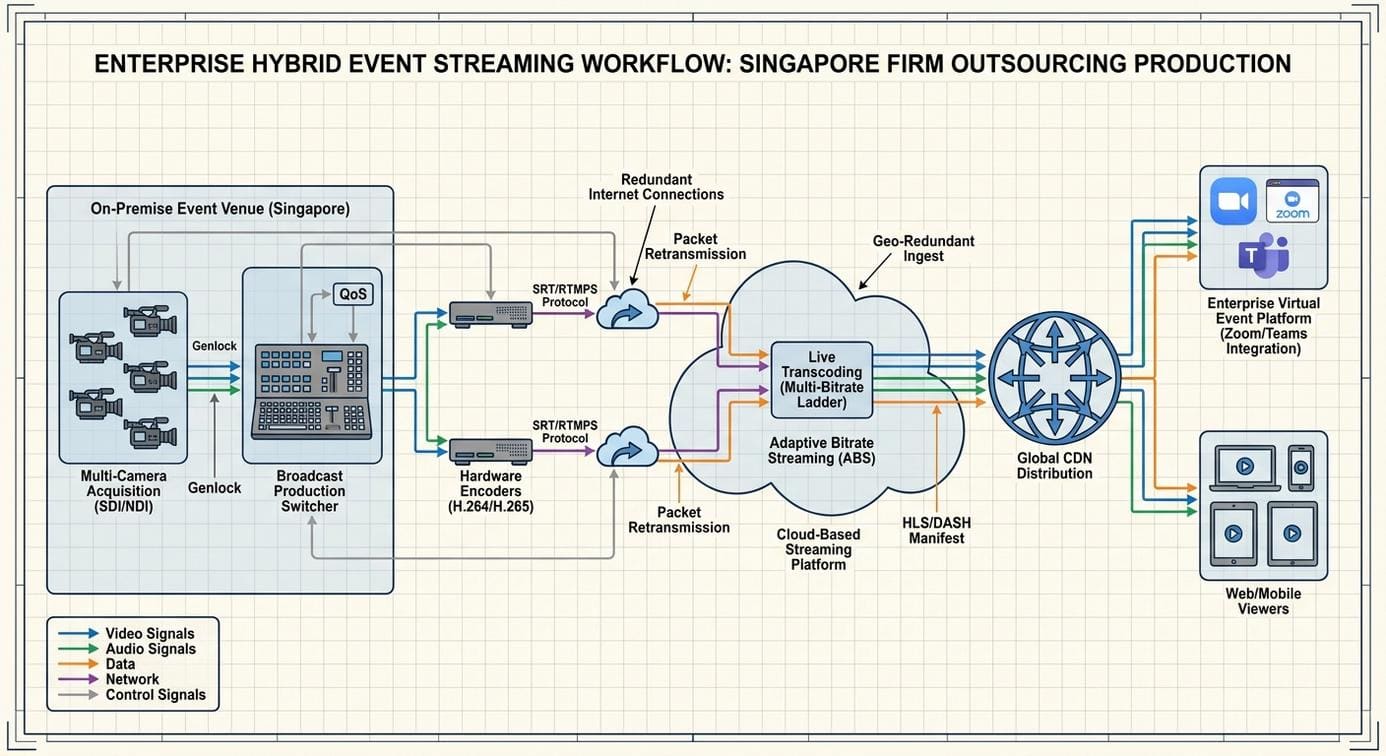
Professional multi-camera production is foundational for engaging corporate events, providing diverse perspectives and dynamic storytelling. This requires meticulous planning of camera positions, lens selection, and the establishment of robust signal paths. For critical B2B applications, SDI (Serial Digital Interface) remains the industry standard for uncompressed, high-bandwidth video transmission over coaxial cable, offering superior reliability and minimal latency over distances up to 100 meters, especially with 12G-SDI for 4K/UHD (Ultra High Definition) signals compliant with SMPTE ST 2082-1. Alternatively, IP-based solutions such as NDI (Network Device Interface) and NDI|HX are increasingly prevalent, enabling video, audio, and metadata transport over standard Ethernet networks. While NDI simplifies cabling and routing, its implementation demands a finely tuned, low-latency Gigabit Ethernet or 10 Gigabit Ethernet network with appropriate QoS (Quality of Service) configurations to prioritize video packets and prevent dropped frames. Regardless of the chosen transport, ensuring precise genlock (generator locking) across all cameras and video sources is crucial to prevent timing discrepancies, signal disruptions, and maintain a perfectly synchronized program feed, essential for professional-grade output and seamless transitions between video sources.
Encoding and Transcoding for Diverse Delivery
Once acquired, raw video signals must be efficiently encoded into a digital format suitable for streaming. H.264 (Advanced Video Coding, AVC) is a ubiquitous codec offering excellent compression ratios, while H.265 (High Efficiency Video Coding, HEVC) provides even greater efficiency, typically reducing bitrate requirements by 25-50% for equivalent quality, albeit demanding more processing power. For enterprise streaming, a multi-bitrate ladder is essential, generating multiple renditions (e.g., 1080p at 5 Mbps, 720p at 2.5 Mbps, 480p at 1 Mbps) to support Adaptive Bitrate Streaming (ABS). This allows client devices to dynamically switch between video qualities based on available bandwidth, ensuring an uninterrupted viewing experience. Transcoding, the process of converting an encoded stream into various formats and bitrates, is often performed in real-time in the cloud or by dedicated hardware encoders. Professional encoding hardware offers superior video quality, lower latency, and higher reliability compared to software-only solutions, critical for mission-critical B2B events. Output formats typically include HLS (HTTP Live Streaming) and MPEG-DASH (Dynamic Adaptive Streaming over HTTP), which use manifest files to manage segments of video and audio for efficient delivery.
Protocol Selection for Low Latency and Reliability
The choice of streaming protocol is a fundamental technical decision impacting latency, reliability, and compatibility. RTMP (Real-Time Messaging Protocol) and its secure variant RTMPS remain widely supported by legacy encoders and CDNs, offering relatively low latency, typically between 2-10 seconds. However, for applications demanding ultra-low latency, such as interactive virtual conferences or critical shareholder meetings, protocols like SRT (Secure Reliable Transport) are increasingly adopted. SRT, an open-source protocol developed by Haivision, leverages UDP (User Datagram Protocol) for high-speed transmission while adding advanced features like Forward Error Correction (FEC), packet retransmission capabilities, and dynamic latency adjustment to ensure stream integrity over unpredictable networks. This makes SRT particularly robust for contribution links over public internet connections where packet loss and jitter are common. For secure enterprise environments, encryption via AES-128 or AES-256 is often implemented at the protocol level. Understanding and deploying the optimal protocol stack requires deep expertise in network engineering and streaming architecture, a core competency of specialized production agencies.
Orchestrating the Hybrid Experience: Production Workflows and Integration
The hybrid event model, which seamlessly merges a physical audience experience with a virtual one, presents unique production challenges. Agencies excel at designing and executing complex workflows that cater to both environments, ensuring consistent quality and engagement across all participant touchpoints. This demands not only technical proficiency but also a strategic understanding of audience psychology in diverse settings.
Advanced Video Switching and Graphics Integration
At the heart of any professional multi-camera production is the video switcher, a sophisticated piece of hardware responsible for selecting and transitioning between various video sources in real-time. Broadcast-grade switchers, such as those from Ross Video (e.g., Carbonite series) or Blackmagic Design (e.g., ATEM Constellation), offer extensive capabilities including multi-layer keying (chroma key, luma key), DVEs (Digital Video Effects) for picture-in-picture and wipes, and sophisticated macro programming. These systems are integral for creating a polished program feed suitable for live broadcast and streaming. Equally critical is the seamless integration of real-time graphics for lower thirds, corporate branding, data visualizations, and presentations. Dedicated graphics engines, such as Vizrt or ChyronHego, can dynamically render complex animations and data-driven graphics, ensuring brand consistency and enhancing information delivery. Agencies employ skilled technical directors and graphics operators who understand signal flow, video standards (e.g., ITU-R BT.709 for HD, ITU-R BT.2020 for UHD), and the precise timing required for live production.
Immersive Audio Management and Intercom Systems
Often overlooked, professional audio is paramount for a premium event experience. This involves sophisticated audio acquisition using high-quality microphones (lapel, handheld, boundary), precise mixing on digital audio consoles (e.g., Yamaha Rivage, Avid S6L) capable of managing dozens of channels, and advanced signal processing (EQ, compression, noise gates) to achieve pristine sound quality. For hybrid events, separate audio mixes are often required: one for the in-room PA system, another for the live stream (optimized for web codecs), and sometimes a mix-minus for remote presenters to prevent feedback. Audio over IP networks, such as Dante or MADI (Multichannel Audio Digital Interface), simplifies cabling and provides flexible routing. Crucial for seamless production is a robust intercom system (e.g., Clear-Com FreeSpeak II, Riedel Bolero) allowing the production crew (camera operators, stage managers, technical directors, audio engineers) to communicate discreetly and effectively in real-time, coordinating complex cues and mitigating issues without disrupting the event flow. Redundant audio paths and failover strategies are always implemented to prevent catastrophic audio loss.
Seamless Platform Integration and Audience Engagement
For hybrid and virtual events, the integration with enterprise collaboration and streaming platforms is a key technical challenge. Professional production agencies possess the expertise to integrate live production feeds into platforms like Microsoft Teams, Zoom Webinar, Webex Events, or custom corporate virtual event platforms. This typically involves secure RTMP/SRT ingest endpoints, API (Application Programming Interface) driven control for features like participant management, and single sign-on (SSO) authentication for secure access. Advanced engagement features such as live Q&A modules with moderator control, real-time polling, and interactive chat functionality are integrated to foster audience participation. Furthermore, agencies can implement virtual networking lounges, breakout rooms, and gamification elements, all designed to replicate and enhance the in-person event experience for remote attendees. The technical architecture must support thousands of concurrent viewers, ensuring low-latency delivery and maintaining a high quality of service across diverse network conditions globally. This includes careful consideration of data security and privacy regulations (e.g., PDPA in Singapore, GDPR).
The Enterprise Network Backbone: Ensuring Scalability and Resilience
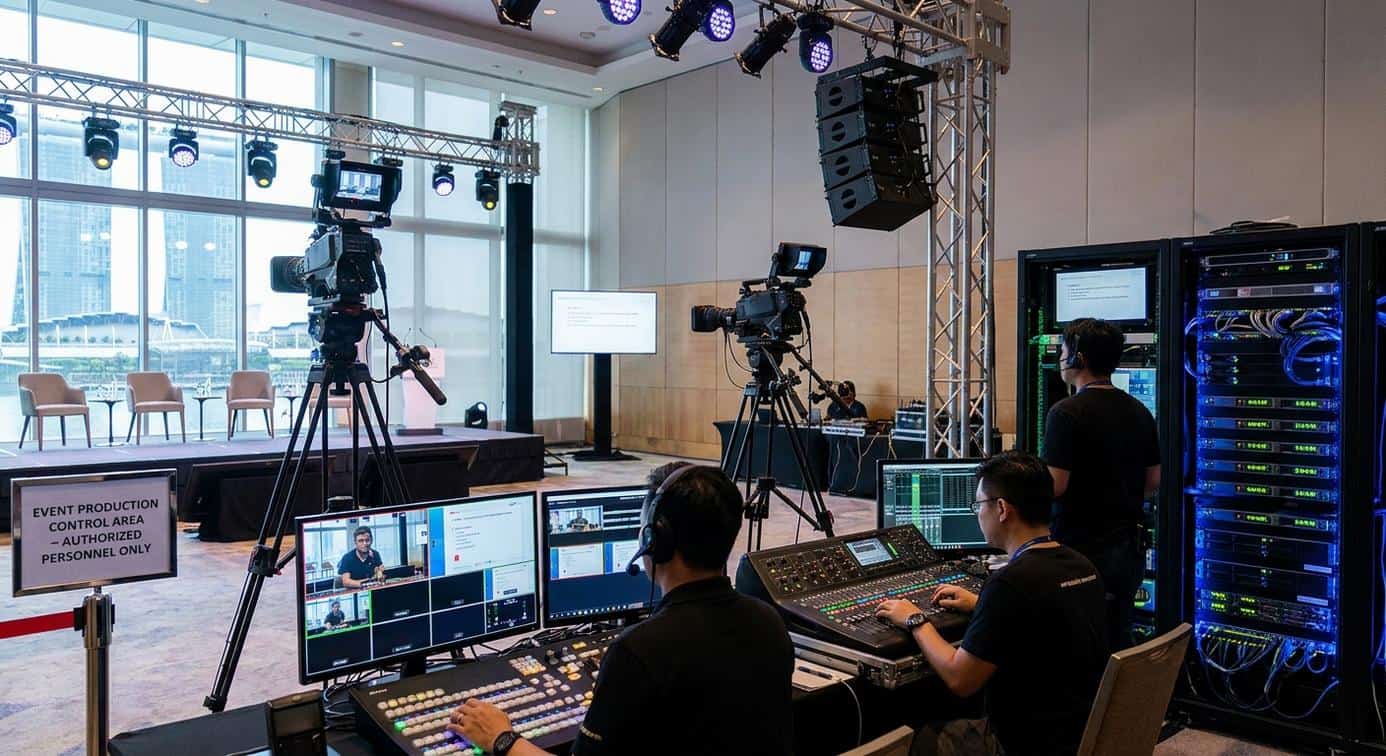
The network infrastructure forms the critical conduit for all live event streaming data. A robust, secure, and highly available network is non-negotiable for enterprise-grade B2B events. Outsourcing partners bring specialized network engineering expertise to design and manage these complex systems, mitigating risks associated with bandwidth saturation, latency, and single points of failure.
Dedicated Network Infrastructure and Bandwidth Management
Professional live streaming demands a dedicated and meticulously managed network infrastructure. This often involves establishing VLANs (Virtual Local Area Networks) to segment streaming traffic from general corporate network activity, preventing congestion and ensuring predictable performance. Critical is the implementation of QoS (Quality of Service) policies that prioritize real-time video and audio packets over less time-sensitive data, guaranteeing smooth playback and minimal latency. For large-scale events, symmetrical internet connections with significant upload and download bandwidth (e.g., 500 Mbps to 1 Gbps or higher) are essential. Redundant ISP links with automatic failover mechanisms, such as BGP (Border Gateway Protocol) routing, provide critical resilience against internet outages. Furthermore, leveraging a global CDN (Content Delivery Network) is paramount for distributing live streams efficiently to geographically dispersed audiences, reducing load on the origin server, improving delivery speeds, and mitigating DDoS (Distributed Denial of Service) attack risks. CDNs like Akamai, Cloudflare, or AWS CloudFront strategically cache content at edge locations closer to viewers, minimizing latency and maximizing scalability.
Cloud-Native vs. On-Premise Architectures
Enterprise streaming solutions can be deployed either predominantly on-premise, leveraging an organization’s existing data center infrastructure, or in a cloud-native architecture, utilizing public cloud platforms like AWS, Google Cloud, or Azure. On-premise deployments offer maximum control over data and security, potentially lower long-term costs for continuous high-volume streaming, and direct integration with local broadcast equipment. However, they require significant capital expenditure, ongoing maintenance, and internal expertise. Cloud-native solutions, conversely, offer unparalleled scalability on demand, global reach, and reduced upfront investment. They are ideal for burst capacity needed for infrequent large events and provide advanced services like AI-powered content analysis and automated transcription. Many modern B2B streaming solutions adopt a hybrid cloud approach, using on-premise infrastructure for primary production and ingest, while leveraging cloud services for transcoding, distribution, and archiving. Containerization technologies, such as Docker and Kubernetes, facilitate the deployment of scalable streaming microservices, ensuring efficient resource utilization and rapid deployment of production environments.
Redundancy, Failover, and Disaster Recovery Strategies
For mission-critical B2B events, a single point of failure is unacceptable. Premium production agencies implement multi-layered redundancy across all technical components. This includes N+1 redundancy for encoders (e.g., two encoders for a single stream, where one is active and one is hot standby), redundant video switchers, power supplies, network switches, and internet connections. Automatic failover mechanisms are configured to instantaneously switch to backup systems in the event of a primary component failure, often within milliseconds, preventing any noticeable disruption to the live stream. Beyond hardware, robust disaster recovery strategies are in place, including geo-redundant streaming ingest points and distribution paths across different data centers or cloud regions. This ensures that even in the rare event of a regional outage, the live stream can continue uninterrupted from an alternate location. Thorough testing of all failover scenarios is conducted pre-event to validate the resilience of the entire system. ISO recording of all camera feeds (ISO recording) provides an invaluable backup for post-production or forensic analysis in case of a primary program feed issue, upholding the highest standards of trustworthiness and reliability for enterprise clients.
Elevating Corporate Events Through Strategic Outsourcing
The complexities inherent in delivering professional-grade, high-fidelity B2B live and hybrid events in Singapore necessitate a strategic approach to production. The rapid evolution of streaming protocols, the sophistication of multi-camera workflows, and the stringent demands of enterprise network infrastructure combine to form a technical landscape that is both challenging and unforgiving. For Singaporean firms, attempting to manage these intricacies with limited in-house resources can lead to compromised quality, technical glitches, and ultimately, a diminished brand experience. A premium agency partnership offers a definitive solution, providing not only access to cutting-edge technology and broadcast-grade equipment, but critically, a team of seasoned production engineers, technical directors, and network specialists whose collective expertise ensures seamless execution. By outsourcing production, enterprises gain a robust, scalable, and resilient streaming infrastructure, allowing them to focus on their core business objectives while confidently delivering impactful, globally accessible corporate events. Live Streaming Studio stands as the authoritative partner, equipped with the technical prowess and operational excellence to transform any corporate vision into a flawlessly executed live and hybrid reality.
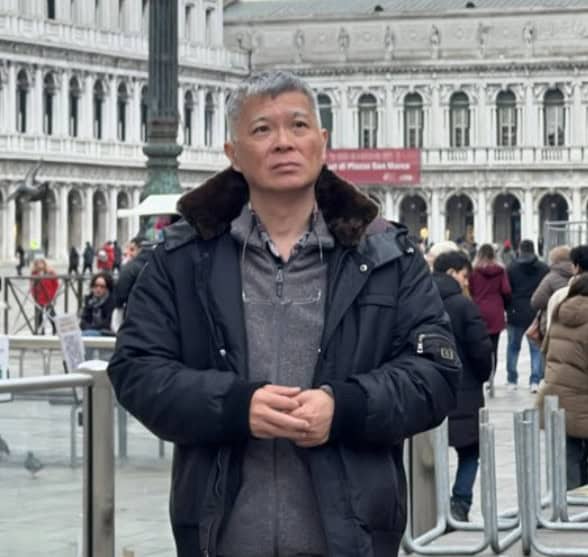
Michael Koh is a production specialist and entrepreneur who founded Spring Forest Studio in 2017 to provide event and virtual production solutions in Singapore. He specialises in hybrid live streaming, XR (Extended Reality) virtual production, and studio systems integration, transitioning the business from traditional videography to advanced corporate broadcasting. Operating out of a dedicated facility at NordCom2 in Singapore, he leads a technical crew to deliver multi-camera webcasts, digital sets, and technical consultations for large-scale corporate events.