
 March 30, 2026 by Editor |
The Audio-Visual Contract: Establishing a Baseline of Perceptual Trust
In any communication, a subconscious contract is formed between the speaker and the audience. In a digital town hall, this contract is not built on handshakes but on the flawless delivery of audio and video signals. Any technical failure, from poor image quality to distorted audio, represents a breach of this contract, eroding the perceived competence and trustworthiness of the leadership team. To engineer trust, we must first engineer a pristine signal path, beginning at the point of capture.
Beyond Resolution: The Importance of Sensor Size, Color Science, and Professional Optics
An executive communicating through a standard webcam is subconsciously sending a message of low investment and temporary importance. We must move beyond simple 1080p or 4K/UHD resolution as the sole metric of quality. Professional broadcast cameras, such as the Sony FX series or Blackmagic URSA Broadcast, utilize Super 35mm or full-frame sensors. These larger sensors provide a shallower depth of field, which naturally draws the viewer’s focus to the speaker and separates them from the background. This is not merely an aesthetic choice; it is a psychological tool that commands attention. Furthermore, the color science baked into these cameras delivers more accurate and pleasing skin tones, avoiding the artificial, sterile look of enterprise webcams. Coupling these sensors with high-quality cinema or broadcast lenses allows for precise control over the image, ensuring a professional, authoritative presentation that inspires confidence.
Illumination as Communication: Professional Lighting and its Subconscious Impact
Light is a powerful, non-verbal communication tool. A poorly lit executive appears obscured, untrustworthy, or even menacing. A properly implemented three-point lighting setup, the bedrock of professional video production, ensures the subject is clearly visible and presented in a positive manner. The key light provides the main illumination, the fill light softens shadows on the face, and the backlight (or hair light) creates separation from the background, adding depth and a professional finish. We must control the color temperature, typically balancing for 5600K (daylight) or 3200K (tungsten) to ensure skin tones are natural and consistent across all camera angles. Using high CRI (Color Rendering Index) LED panels ensures that colors are rendered accurately, which is critical for maintaining brand consistency and a professional image.
The Unforgivable Sin: Engineering Pristine Audio from Microphone to Encoder
While audiences may forgive minor video imperfections, poor audio is intolerable. Distorted, low-volume, or echo-filled audio forces the audience to strain to understand the message, creating frustration and immediately breaking engagement. Trust begins with clarity. The audio signal chain must be engineered with precision, starting with the microphone. A professional lavalier or boom microphone should be used instead of laptop or webcam mics. The signal must be managed through a digital audio console, where an audio engineer can apply equalization to improve clarity, compression to manage dynamic range, and noise gating to eliminate background distractions. Levels must be carefully gain-staged to peak around -12dBFS to -6dBFS on the digital scale, providing sufficient headroom and avoiding clipping. This clean audio signal is then embedded into the SDI (Serial Digital Interface) video feed or transported separately to the encoder, ensuring perfect lip-sync and broadcast-quality sound for every participant.
Engineering the Handshake: Latency, Synchronicity, and Remote Integration
A digital town hall is often a hybrid affair, with executives participating from multiple locations. The technical challenge is to make this geographical separation invisible to the audience. The “handshake” between on-premise and remote participants must be seamless, frame-accurate, and free of distracting latency. This requires a robust technical architecture built on modern streaming protocols and precise synchronization.
The War on Latency: SRT vs. RTMP for Contribution and Distribution
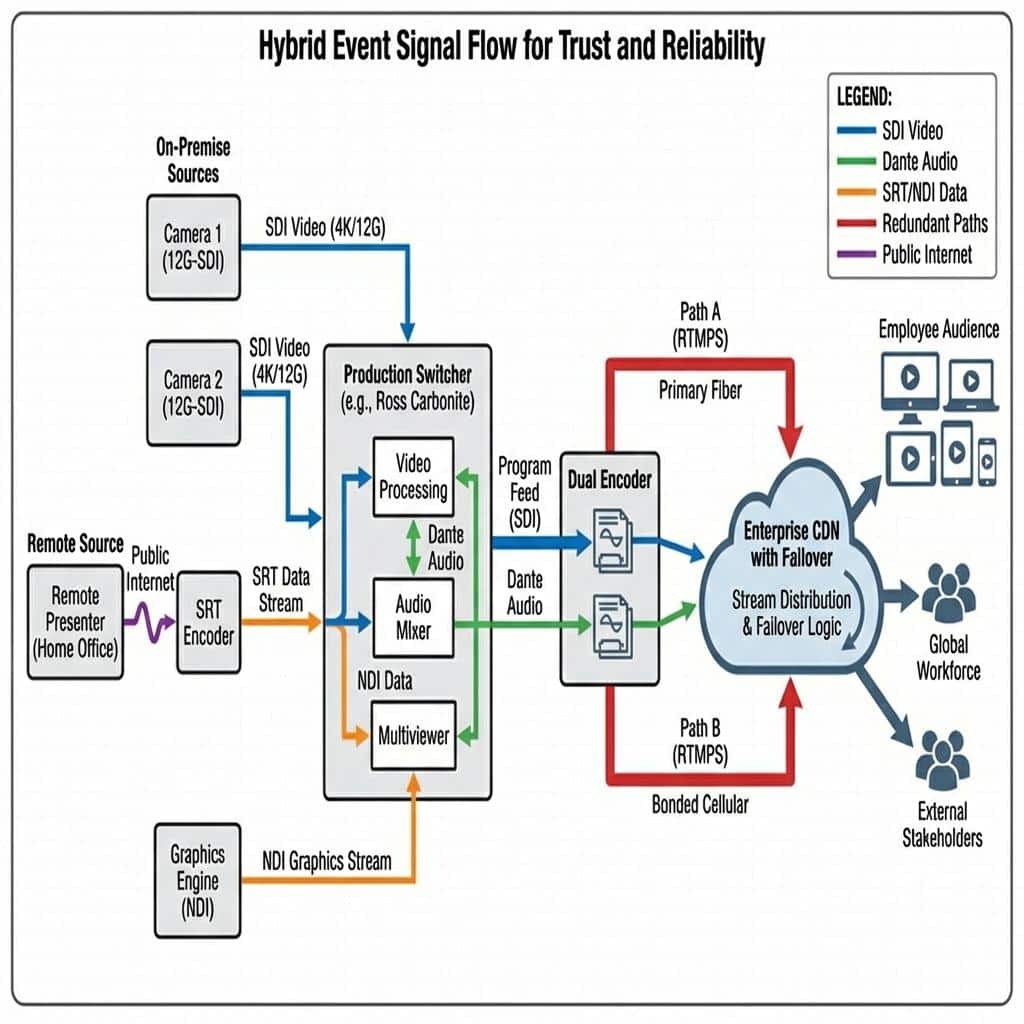
For years, RTMP (Real-Time Messaging Protocol) was the standard for streaming. However, it is a TCP-based protocol that does not handle network packet loss gracefully, leading to buffering and dropouts, especially over public internet connections. For professional contribution (sending a feed from a remote presenter to the main studio), RTMP is no longer the best tool. We now rely on SRT (Secure Reliable Transport). SRT is a UDP-based protocol that features advanced low-latency packet loss recovery, making it vastly superior for contribution over unpredictable networks. It can deliver a high-quality, stable feed with sub-second latency, which is critical for natural, two-way conversation between a CEO in a home office and a moderator in the main studio. While RTMP/RTMPS is still a common and reliable protocol for final distribution to the audience from the production encoder, SRT is the professional standard for contribution.
Achieving Frame-Accurate Synchronization in Hybrid Environments
When cutting between a camera in the studio and a remote presenter, any audio or video delay is immediately jarring. To solve this, all video sources must be synchronized to a common clock. In a physical studio, this is achieved using Genlock, where a master sync generator sends a timing signal to all cameras and the video switcher. In a hybrid environment, we extend this concept using PTP (Precision Time Protocol) over the network or by using encoders and decoders with adjustable buffers. An SRT feed from a remote presenter might have a 500ms latency. The on-premise SDI camera feeds have virtually no latency. To compensate, the studio’s primary video switcher or a dedicated processing frame must be capable of delaying the local camera and audio feeds to perfectly match the latency of the remote source, ensuring a seamless cut and perfect lip-sync every time.
Integrating Enterprise Platforms: Beyond the Screen Share
Often, a town hall requires integrating feeds from platforms like Microsoft Teams, Zoom, or Webex. A simple screen share of the platform’s gallery view is an amateur solution. For a professional broadcast, we must extract clean, isolated video feeds (ISO feeds) of each participant. This can be achieved using the NDI (Network Device Interface) output features of these platforms. An NDI feed can be received over the local network as a high-quality, low-latency video source directly into a compatible production switcher, such as a NewTek TriCaster or a Ross Ultrix system. This allows the technical director to switch to a full-screen view of a remote speaker, place them in a picture-in-picture graphic, or arrange them in a custom layout, providing the same production flexibility as if they were on a physical stage.
The Production Core: Signal Flow, Switching, and Real-Time Graphics
The heart of a professional digital town hall is the production control room, whether it’s a physical space or a cloud-based equivalent. This is where all audio and video sources converge to be mixed, switched, and graphically enhanced into a polished final program feed. This core infrastructure is what elevates a simple webcast into a compelling communication event.
Architecting the Signal Path: From SDI and NDI to the Master Program Feed
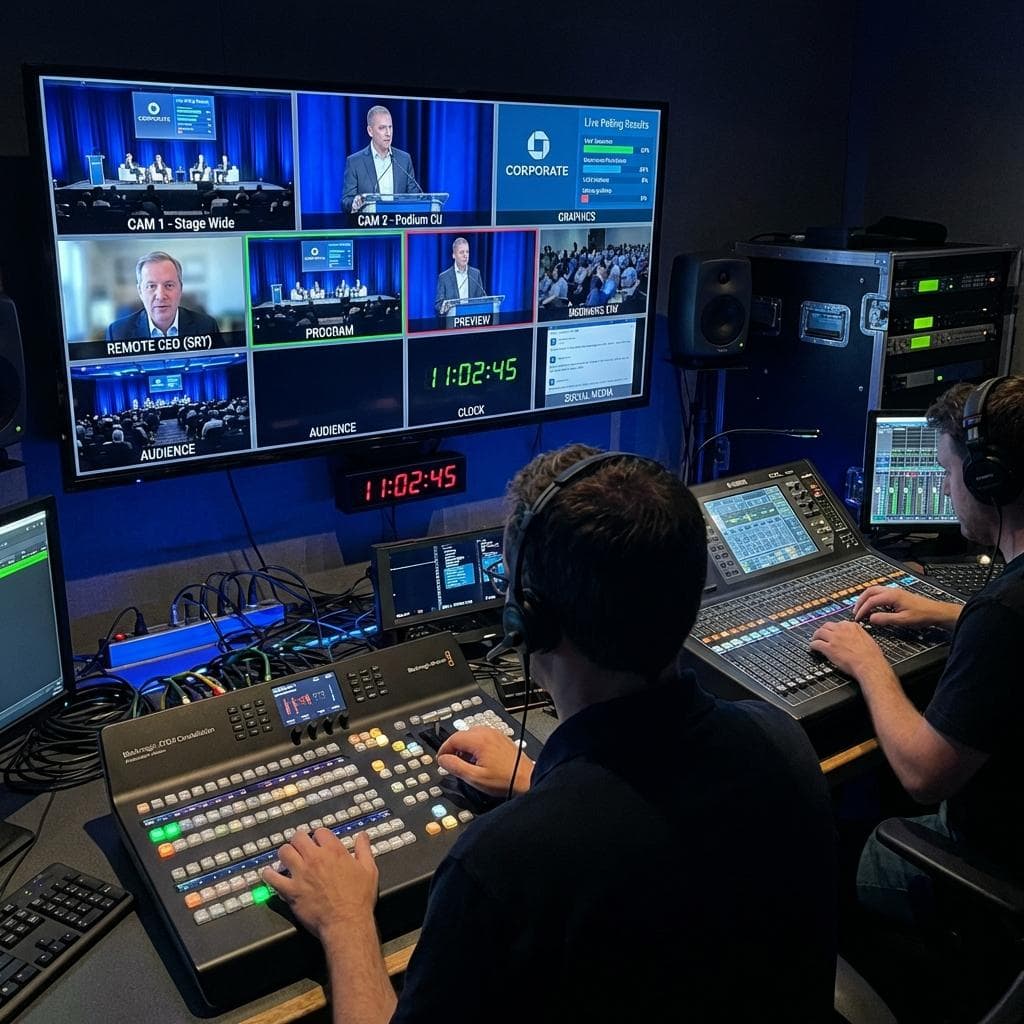
A robust production begins with a clear signal flow architecture. On-premise cameras connect to the production switcher via 12G-SDI for 4K workflows or 3G-SDI for HD, ensuring an uncompressed, high-fidelity signal. Remote NDI and SRT feeds are brought into the network and converted to SDI if necessary for integration with the switcher. All these sources are routed into a central video switcher, such as a Blackmagic ATEM Constellation or Grass Valley Kula. Here, the Technical Director (TD) can cut, mix, dissolve, and apply effects between sources in real-time. The final “program” output from the switcher is the master feed that is sent to the encoders for streaming.
Real-Time Data Visualization: The Role of Lower Thirds and Dynamic Graphics
Trust is built on clarity, and real-time graphics are essential for reinforcing key messages. A professional graphics engine, either integrated into the switcher or as a standalone system like Singular.live or Ross XPression, is used to overlay lower thirds to identify speakers, display key data points, and showcase branded animations. These are not PowerPoint slides; they are broadcast-quality graphics rendered in real-time and keyed over the program video. This level of polish signals a high degree of preparation and professionalism, which reinforces the authority and seriousness of the message being delivered.
ISO Recording and Multi-View Monitoring: The Director’s Toolkit
Professional production requires total control and a comprehensive post-event strategy. A crucial component is ISO recording, where an isolated, clean recording of every single camera and video source is made. This is invaluable for creating post-event highlight reels, correcting any errors, or re-editing the town hall for on-demand viewing. The director and TD manage all incoming sources via a multiview monitor, a large display that shows every camera angle, remote feed, graphics channel, and the final program and preview outputs. This comprehensive overview is essential for anticipating cues, making smooth transitions, and maintaining complete control over the broadcast, preventing the unexpected errors that can shatter viewer confidence.
The Unseen Backbone: Network Infrastructure, Security, and Redundancy
The most sophisticated production setup is worthless without a solid foundation of network infrastructure, security, and redundancy. This unseen backbone is the ultimate guardian of trust. A town hall that drops mid-stream or is insecurely delivered can cause significant damage to employee confidence and corporate reputation. Enterprise-grade delivery is non-negotiable.
Enterprise Network Considerations for Flawless Streaming
Professional streaming cannot share the same network resources as general office internet traffic. A dedicated, uncontended internet connection with sufficient upstream bandwidth (a minimum of 20-30 Mbps for a high-quality 1080p stream, and more for 4K or redundant streams) is mandatory. Network Quality of Service (QoS) policies should be implemented to prioritize streaming traffic (specifically SRT and RTMPS packets) over all other data, ensuring that a sudden surge in office web browsing does not impact the broadcast. The production network itself, which carries NDI and control data, should be physically or virtually segregated from the main corporate LAN to guarantee performance and security.
The A/B Path: Implementing True Redundancy and Failover
A single point of failure is unacceptable. True redundancy involves creating a completely parallel A/B signal path. This means using two separate video encoders, fed by two different power circuits, and sending streams out over two different internet connections (e.g., primary fiber and a cellular bonded backup). These two streams are sent to the primary and backup ingest points of a professional streaming platform that supports seamless failover. If the primary encoder, network connection, or ingest server fails, the platform automatically switches to the secondary stream with no interruption to the viewer. This is the ultimate insurance policy that guarantees the message will be delivered, reinforcing the perception of a well-prepared, resilient organization.
Securing the Message: Encryption from Glass to Glass
Digital town halls often contain sensitive internal information. Security is paramount. The stream must be encrypted at every stage. This starts with using RTMPS or SRT with AES-256 encryption for the connection from the encoder to the streaming platform. On the distribution side, the enterprise CDN (Content Delivery Network) must be configured with security measures such as token-based authentication, geo-restriction, and IP whitelisting to ensure that only authorized employees can view the stream. This end-to-end, or “glass-to-glass,” security model demonstrates a commitment to protecting internal communications, which is a cornerstone of employee trust.
Ultimately, the psychology of a digital town hall is inextricably linked to its technical execution. Every decision, from the choice of camera lens to the implementation of a failover strategy, sends a message to the audience. By investing in professional production infrastructure and workflows, organizations are not just buying equipment; they are engineering the very foundation of employee trust in a digital-first world. A flawless, secure, and engaging technical delivery transforms a simple broadcast into a powerful act of leadership.