
 March 12, 2026 by Editor |
The Technical Delta Between Engagement and Disengagement
In the modern enterprise, particularly within hybrid operational models, executive communications are the primary conduit for corporate culture, strategic alignment, and employee morale. An all-hands meeting or a quarterly stakeholder update is no longer a simple presentation; it is a mission-critical broadcast that directly impacts talent retention and investor confidence. The technical quality of this broadcast is not a luxury. It is a direct reflection of the organization’s competence, stability, and respect for its audience. A stream plagued by buffering, unintelligible audio, or unstable video signals communicates organizational chaos. Conversely, a professionally produced, high-availability stream signals strength and precision, reinforcing the executive message and fostering a sense of connection and trust. This is the foundation of the return on investment in professional production: mitigating the significant financial and cultural costs of disengagement and attrition by ensuring the technical integrity of leadership visibility. This analysis will deconstruct the specific production infrastructure, transport protocols, and control systems that separate a high-impact, retention-positive broadcast from a technically deficient one that actively undermines its own message.
Foundational Integrity: The Professional Signal Chain
The quality of any live stream is ultimately limited by the weakest link in its signal chain. The perceived value of an executive’s message is inextricably linked to the fidelity of its audio and video representation. Enterprise-grade production begins with the acquisition of pristine source signals, a process that is fundamentally different from consumer or “prosumer” level setups. Investing in the foundational layer of signal acquisition is the first and most critical step in building a reliable streaming architecture.
Beyond the USB Interface: Broadcast-Grade Video Acquisition
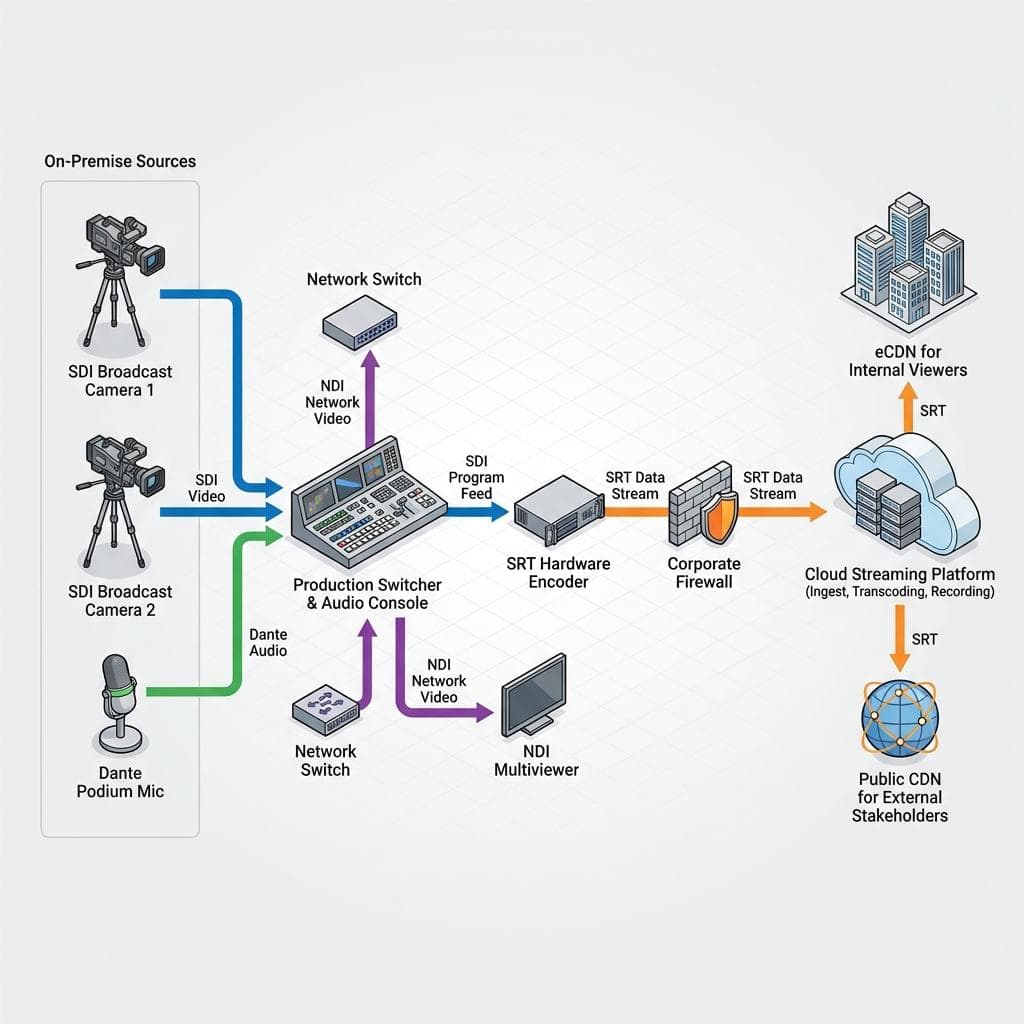
A professional video workflow begins with a broadcast-quality camera sensor and lens, but the integrity of the signal is maintained through the transport medium. While HDMI is ubiquitous in consumer electronics, its technical limitations make it unsuitable for mission-critical production. The non-locking connector is prone to accidental disconnection, and signal integrity degrades significantly over cable runs exceeding 15-20 feet. The professional standard is the Serial Digital Interface (SDI), a robust coaxial-based connection governed by standards set by the Society of Motion Picture and Television Engineers (SMPTE). SDI offers significant advantages: BNC locking connectors prevent accidental pullouts, and cable runs can extend 300 feet or more without signal degradation. For 4K/UHD (3840×2160) workflows, the 12G-SDI standard allows for uncompressed 4K60p video over a single cable, simplifying rigging and reducing potential points of failure. This adherence to broadcast standards ensures a stable, full-bandwidth video signal enters the production switcher, free from the artifacts and instability inherent in consumer-grade interfaces.
Audio Intelligibility as a Mission-Critical Priority
An audience will forgive mediocre video, but they will not tolerate poor audio. Unintelligible or distracting audio is the fastest way to cause viewer fatigue and message abandonment. Professional production treats audio with co-equal importance to video. This involves using high-quality microphones, such as wireless lavaliers for presenters and shotgun microphones on boom poles, to ensure optimal signal-to-noise ratio. The signal is then managed through a digital audio console, often utilizing Audio-over-IP (AoIP) protocols like Dante for routing audio signals over standard Ethernet networks. This allows for precise control over equalization, dynamics processing (compression, gating), and gain staging. For hybrid events with remote participants joining via platforms like Microsoft Teams or Webex, a “mix-minus” feed is essential. This is a custom audio mix sent to the remote contributors that contains the full program audio minus their own microphone signal, preventing distracting echo and feedback. This level of audio control is impossible with basic USB microphones and ensures that every word from every participant is delivered with clarity and authority.
Architecting for Resilience: The Network and Transport Layer
Once pristine audio and video signals are acquired, they must be transported reliably from the event space to the distribution platform. This transport layer is where many streaming initiatives fail, as they often rely on protocols and network configurations ill-suited for the unpredictable nature of the public internet. Building a resilient architecture involves selecting the right protocols and implementing strategic redundancy at every critical juncture.
The Contribution Protocol Debate: SRT vs. RTMP
For years, the Real-Time Messaging Protocol (RTMP) was the de facto standard for stream contribution. However, RTMP is a TCP-based protocol, and its method of handling network congestion can lead to dropped frames and increased latency, making it a poor choice for high-quality, low-latency contribution over public internet connections. The modern enterprise standard is Secure Reliable Transport (SRT). SRT is a UDP-based protocol that incorporates an intelligent packet-retransmission mechanism known as Automatic Repeat reQuest (ARQ). This allows it to recover from packet loss with minimal latency impact. Furthermore, SRT supports AES-128/256 bit encryption, securing sensitive executive communications from source to cloud. By leveraging SRT for the “first mile” transport from the on-premise encoder to the cloud ingest point, organizations can ensure a stable, secure, and low-latency contribution feed even over challenging network conditions.
On-Premise Flexibility with NDI and Fiber
Within a corporate campus or production facility, Network Device Interface (NDI) has emerged as a powerful protocol for routing high-quality, low-latency video over a standard Gigabit Ethernet LAN. NDI allows cameras, production switchers, graphics systems, and other devices to see and share video sources across the network, dramatically reducing the need for physical SDI cabling and routing. This provides immense flexibility in deploying sources and production systems throughout a building. For longer distances between buildings on a campus, dedicated fiber optic cable provides a high-bandwidth, interference-free backbone for transporting multiple uncompressed video signals, NDI traffic, and control data, creating a fully integrated production environment.
Building Redundancy: Path Diversity and Encoder Failover
For any mission-critical broadcast, a single point of failure is an unacceptable risk. A resilient architecture must include redundancy. A common and effective strategy is a dual-encoder setup. Two separate hardware encoders process the main program feed and deliver it to the cloud platform via two distinct network paths. This “path diversity” is achieved by using two different Internet Service Providers (ISPs), such as a primary fiber line and a secondary broadband or 5G cellular connection. Should the primary ISP experience an outage, the cloud streaming platform can seamlessly switch to the secondary encoder’s feed with no interruption to the end viewer. This level of hardware and network redundancy is a hallmark of professional streaming operations and provides the peace of mind required for high-stakes executive events.
The Production Core: Switching, Control, and Integration
The production core is where individual audio and video sources are synthesized into a polished, engaging, and coherent program. This is the human-crewed control layer that elevates a simple stream into a professional broadcast. It involves a combination of specialized hardware, software, and the technical expertise to operate it under the pressure of a live event.
The Production Switcher: Unifying Sources into a Cohesive Narrative
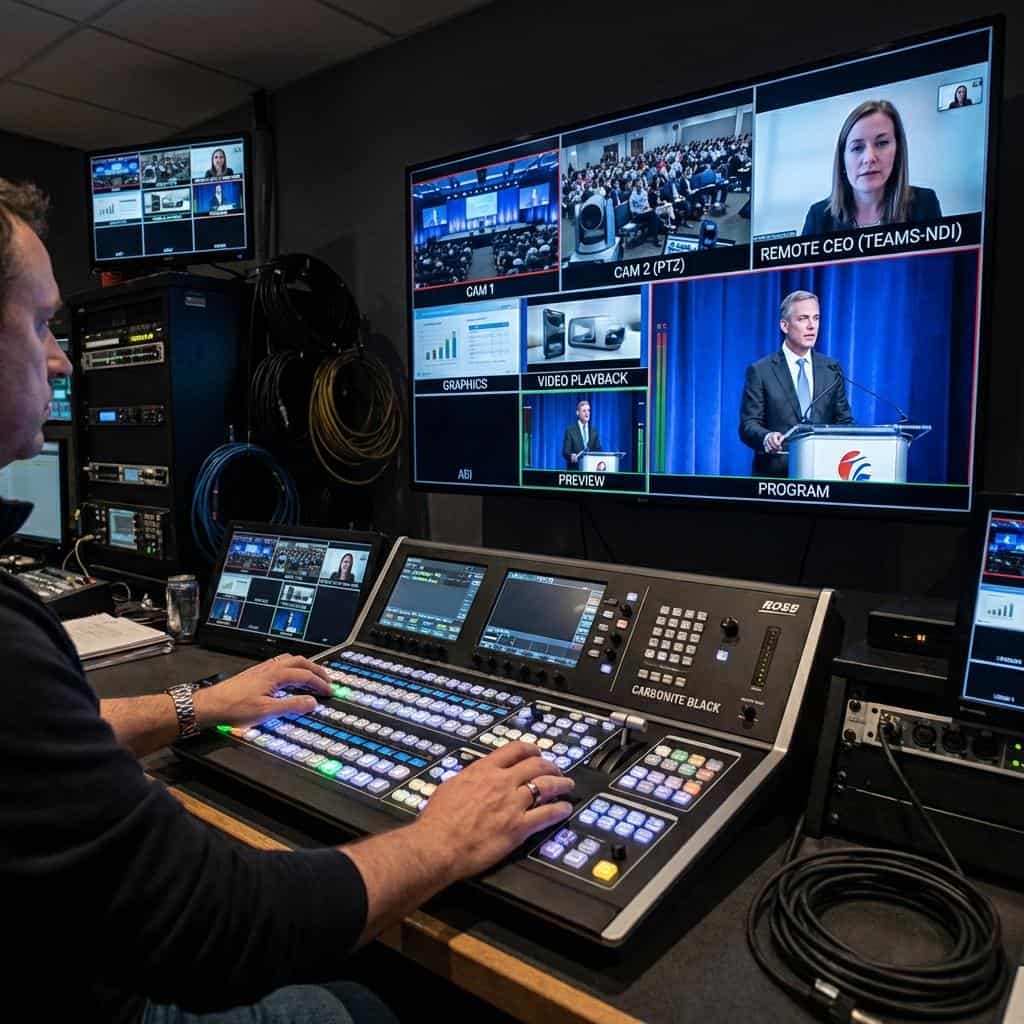
The heart of any multi-camera production is the production switcher, available as either a hardware control surface (from manufacturers like Ross Video or Blackmagic Design) or a software solution (like vMix or TriCaster). The switcher allows a Technical Director to cut, mix, and dissolve between camera angles, pre-recorded video playback, and graphic elements in real-time. A key feature is the Program/Preview bus architecture, which lets the director cue up the next shot on a preview monitor before taking it live to the program feed. Advanced functions like Digital Video Effects (DVEs) for picture-in-picture boxes and chroma keying for virtual sets are standard. Using a production switcher enables a dynamic, television-style presentation that keeps the audience engaged far more effectively than a static, single-camera view.
Integrating Remote Contributors Seamlessly
In a hybrid environment, seamlessly integrating remote executives is crucial. The goal is to make them appear as a natural part of the main program, not a low-quality afterthought. This is achieved by taking a direct, clean feed from the unified communications platform. Technologies like Microsoft Teams’ NDI output allow a production system to receive an isolated, high-quality video and audio feed of each remote participant. This NDI source is then ingested into the main production switcher and treated just like another on-site camera. It can be switched, color-corrected, and included in multi-view layouts, ensuring the remote executive’s presence is visually and audibly on par with those in the main studio.
The Importance of ISO Recording and Multiview Monitoring
Professional production workflows are designed for both live execution and post-event value. ISO recording refers to the practice of recording each camera feed as a separate, “isolated” video file. This is invaluable for creating high-quality archival edits, highlight reels, or correcting any switching errors that may have occurred live. Simultaneously, the production team relies on a multiview monitor. This is a large display that shows every single video source, preview and program outputs, audio level meters, and clock timers on one screen. The multiviewer provides the director and technical team with complete situational awareness, allowing them to anticipate cues, monitor signal integrity, and execute a flawless live broadcast.
Delivery and Measurement: Quantifying the ROI
The final stage in the professional production chain is delivering the stream to the audience and analyzing its performance. This is where the technical choices made upstream are validated through data, connecting production quality directly to viewer experience and providing the metrics needed to prove the ROI of the investment.
Enterprise CDN (eCDN) vs. Public Platforms
For internal all-hands meetings, broadcasting a high-bitrate stream to thousands of employees simultaneously can saturate a corporate WAN. An Enterprise Content Delivery Network (eCDN) solves this problem. An eCDN uses technologies like peer-to-peer sharing or on-premise caching nodes to efficiently distribute the video stream inside the corporate firewall. A single copy of the stream enters the network, and the eCDN manages its distribution internally, preventing network overload. This ensures a smooth playback experience for all employees, regardless of their office location, and is a critical piece of infrastructure for any large-scale internal broadcast.
Analyzing Quality of Service (QoS) and User Engagement Metrics
Professional streaming platforms provide a wealth of data far beyond a simple viewer count. Quality of Service (QoS) metrics are technical indicators of the viewer experience. These include the rebuffering ratio (the percentage of viewing time spent waiting for the video to load), video startup time, and bitrate stability. A low rebuffering ratio is a direct result of a resilient transport and delivery architecture. These QoS metrics can then be correlated with user engagement analytics, such as average view duration, drop-off points, and participation in polls or Q&A. The data consistently shows that streams with better QoS metrics have higher engagement. This creates a quantifiable link: investment in professional production infrastructure leads to better QoS, which leads to higher engagement and message retention, ultimately contributing to the ROI of improved employee alignment and reduced attrition.
Conclusion: Production as a Strategic Imperative
Moving executive visibility beyond a laptop webcam is not an aesthetic choice; it is a strategic business decision. The technical infrastructure that underpins a corporate broadcast—from the 12G-SDI signal chain and SRT transport protocol to the production switcher and eCDN delivery—is the framework that ensures an executive’s message is delivered with the clarity, stability, and authority it commands. Each component works in concert to eliminate technical distractions and focus the audience’s attention squarely on the strategic content. In an era where talent retention and stakeholder alignment are paramount, professional production is no longer a cost center. It is a direct investment in the human capital and cultural integrity of the enterprise, delivering a clear and measurable return through superior engagement and unwavering message fidelity.