
In the evolving landscape of global enterprise communication, the execution of B2B live events that span multiple continents and offices presents a unique set of technical challenges. For corporate event planners, AV professionals, and IT directors overseeing international conferences, product launches, or internal town halls, the seamless handover of live video and audio feeds between geographically dispersed production hubs is not merely an operational convenience; it is a critical determinant of event success. This advanced technical analysis from the Live Streaming Studio Technical Team dissects the intricate infrastructure, protocols, and workflows required to achieve zero-downtime transitions and maintain broadcast-grade quality when coordinating live feeds across global offices. Our expertise lies in engineering robust, enterprise-grade streaming solutions that overcome the inherent complexities of intercontinental signal transport, synchronization, and redundancy, ensuring that your hybrid event production maintains professional integrity from origin to destination.
The Core Technical Challenge: Ingesting and Synchronizing Distributed Feeds
The fundamental hurdle in coordinating live feeds between global offices is the precise ingest, transport, and synchronization of high-fidelity audio and video across disparate network infrastructures. This involves navigating significant geographical distances, variable bandwidth availability, and the inherent latency introduced by internet backbone traversal. A robust architecture must account for these variables, ensuring signal integrity and minimal delay from the point of capture to the ultimate mixing and distribution platform.
Understanding Latency and Bandwidth Requirements in Global Links
Intercontinental fiber optic networks, while robust, introduce unavoidable latency. For live interactive events, round-trip latency exceeding 200 milliseconds (ms) can severely impact presenter interaction and audience engagement. Furthermore, professional-grade video feeds demand substantial bandwidth. A single uncompressed 1080p60 signal can require upwards of 3 Gbps (gigabits per second) via SDI (Serial Digital Interface), while a 4K/UHD (Ultra High Definition) signal can exceed 12 Gbps. While compression reduces these requirements significantly, maintaining visual fidelity with H.264 (AVC) or H.265 (HEVC) encoding for contribution streams still necessitates dedicated bandwidth; typically, 20-50 Mbps (megabits per second) for a high-quality 1080p60 contribution feed, with bursts potentially higher for complex scenes. Network architects must provision for sufficient, stable bandwidth with minimal jitter and packet loss, often through dedicated MPLS (Multiprotocol Label Switching) circuits or intelligently routed VPN (Virtual Private Network) tunnels, rather than relying solely on best-effort public internet.
Protocol Selection for Intercontinental Transport: SRT vs. RTMP
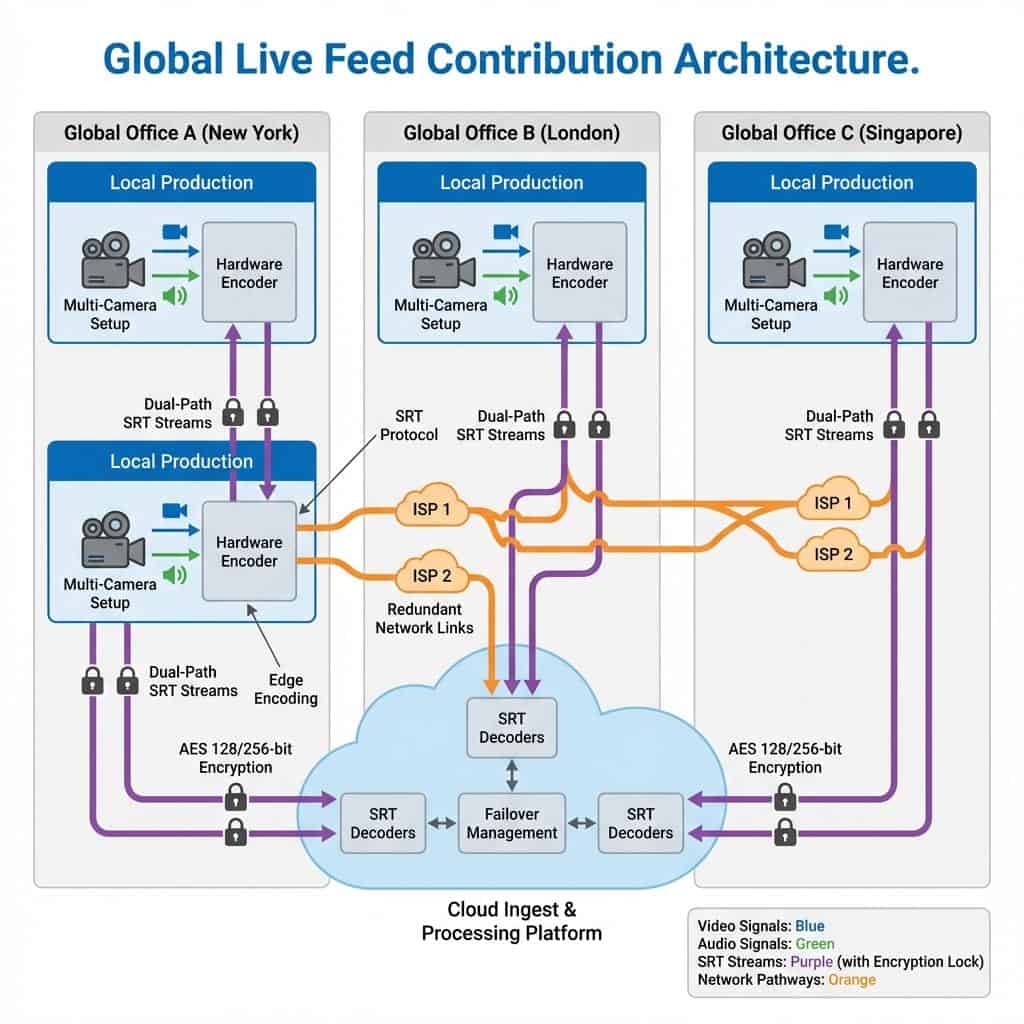
The choice of transport protocol is paramount for reliable global feed handover. While RTMP (Real-Time Messaging Protocol) has been an industry workhorse, its TCP-based nature often struggles with high latency and packet loss over long distances, leading to significant buffering and increased latency. For enterprise-grade global streaming, the Secure Reliable Transport (SRT) protocol has emerged as the superior solution. SRT, an open-source protocol leveraging UDP (User Datagram Protocol), incorporates advanced error correction, packet retransmission, and dynamic latency adjustment mechanisms to maintain stable, low-latency video delivery even across unpredictable internet connections. It encapsulates standard video codecs like H.264 or H.265 and audio codecs like AAC (Advanced Audio Coding), providing both security (AES 128/256-bit encryption) and reliability, making it ideal for point-to-point contribution links between global offices or to a centralized cloud ingest point. NDI (Network Device Interface), while excellent for local area network (LAN) production, is typically less suited for wide area network (WAN) transport without specialized bridging or encapsulation, due to its bandwidth intensity and multicast reliance.
Edge Encoding and Contribution Strategies
To minimize bandwidth requirements and optimize quality, live feeds from each global office must be professionally encoded at the source, or “edge.” This involves deploying dedicated hardware encoders, such as those from Haivision, Elemental, or Teradek, or robust software-based solutions running on high-performance compute platforms. These encoders take baseband video (SDI or HDMI 2.1) and audio signals, compress them efficiently using H.264 or H.265 at appropriate bitrates (e.g., 20-30 Mbps for 1080p, 50-70 Mbps for 4K), and encapsulate them into SRT streams. Multiple redundant encoders are often employed at each edge location to provide failover protection, with dual-path network egress strategies to diverse internet service providers (ISPs). Each contribution feed should also embed professional audio, typically AES67 (Audio-over-IP) or embedded within SDI, ensuring pristine sound quality for the main program mix. Comprehensive metadata, including timecode (e.g., SMPTE LTC – Linear Time Code), should be preserved and transported to facilitate precise synchronization at the master control room (MCR).
Mastering Signal Flow and Routing Architectures for Handover
Once feeds are reliably ingested and transported, the next critical phase involves the sophisticated routing, switching, and mixing necessary for a seamless handover. This demands a centralized or distributed production architecture capable of managing multiple concurrent inputs from disparate global sources, presenting them to a technical director, and integrating them into a cohesive program feed. The goal is to achieve visual and audio continuity, indistinguishable from a single-location production.
SDI/NDI Architectures for Local Production Hubs
Within each participating global office, the local production setup often relies on traditional baseband SDI or modern IP-based NDI for internal signal routing. SDI cabling (e.g., 3G-SDI for 1080p, 12G-SDI for 4K) provides robust, low-latency, uncompressed video transport within the local studio or event space. Multi-camera production setups typically feed into a professional video switcher (e.g., Ross Carbonite, Blackmagic ATEM, Grass Valley K-Frame) where local sources are selected, graphics are composited, and a local program feed is generated. For flexible, software-centric production, NDI|HX (High Efficiency) offers a lower-bandwidth, high-quality IP video solution that can traverse standard Gigabit Ethernet networks, enabling easy integration of multiple cameras, computers, and graphics generators without extensive cabling. A local production team then packages their segment, including specific audio mixes, and sends a single, clean program output via the aforementioned SRT encoder to the central control point.
IP-Based Video Routing and Switching Systems
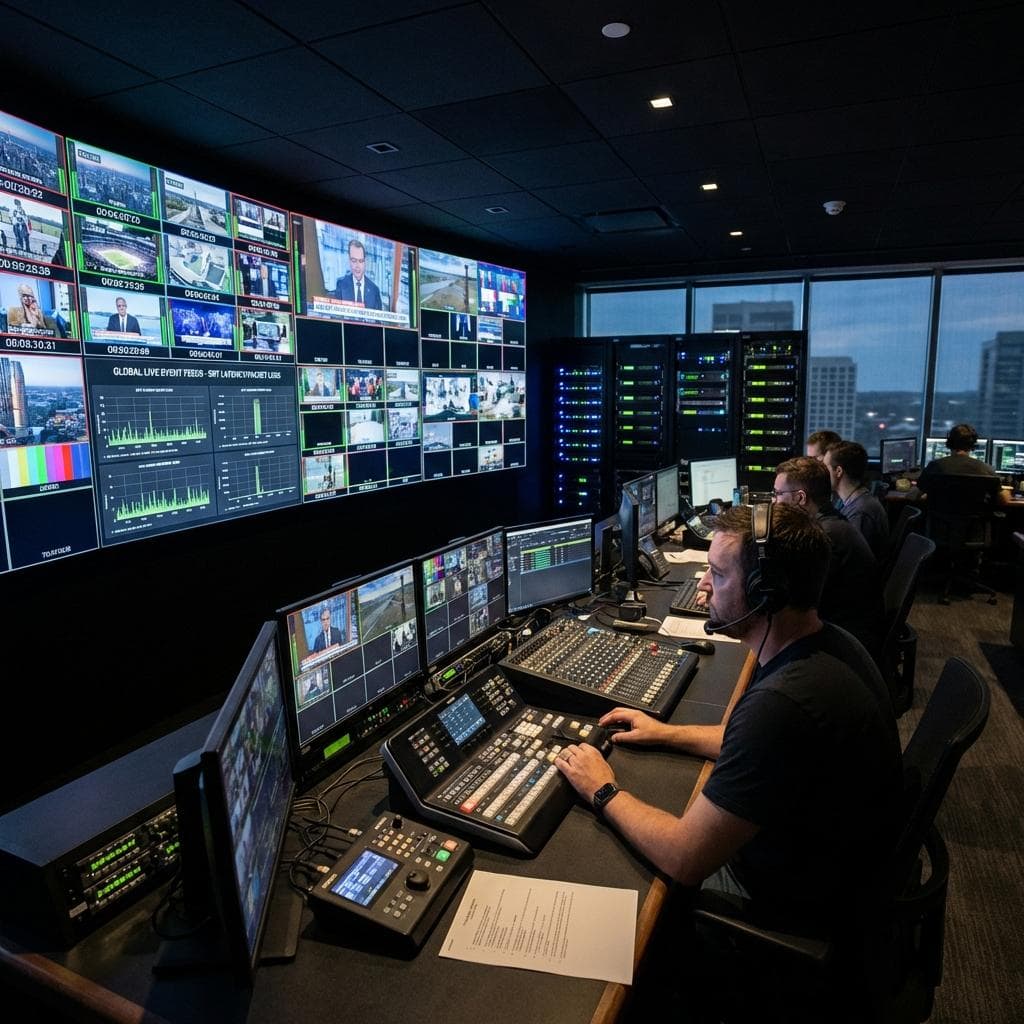
At the central control room (physical or cloud-based), the incoming SRT streams from global offices are decoded and often converted back to an internal production format, such as SDI or NDI, for integration into a master switching matrix. Enterprise-grade IP-based routing and switching systems, such as those from Evertz, Imagine Communications, or Riedel, are designed to manage hundreds of simultaneous video and audio paths. These systems allow for dynamic routing of any input to any output, providing the flexibility required to preview, program, and record multiple remote feeds. Advanced features include clean switching (frame-accurate transitions without glitches), embedded audio de-embedding and re-embedding, and support for ancillary data like timecode and Closed Captions (CC). The ability to instantly switch between live feeds from New York, London, and Singapore, for example, without any perceivable disruption, is the hallmark of a truly seamless handover, requiring precise timing and robust processing power.
Genlock and Timecode Synchronization Across Geographies
Achieving a seamless handover necessitates extremely tight synchronization, both visually (genlock) and for post-production and logging (timecode). While traditional genlock (synchronizing video raster scan lines) is primarily a local studio concern, its principles extend to maintaining phase coherence between incoming remote feeds. More critically, precise timecode synchronization is essential. SMPTE ST 2059 (PTP – Precision Time Protocol) or Network Time Protocol (NTP) can be used to synchronize network clocks across global production facilities. However, for video, timecode generators at each remote site should be synchronized to a master clock, and this timecode must be embedded in the outgoing SRT stream. At the central control room, sophisticated frame synchronizers with timecode alignment capabilities are used to adjust for minor phase differences and ensure that when a switch occurs between two different global sources, their associated audio and video are perfectly aligned, preventing jarring jumps or audio pops. ISO recording (isolated feeds) of all incoming global feeds, each with synchronized timecode, is a best practice for post-event editing and archive.
Redundancy, Failover, and Quality of Service (QoS) for Enterprise Reliability
In high-stakes B2B events, the concept of “seamless” extends beyond mere synchronization; it encompasses an absolute commitment to uninterrupted service. This necessitates comprehensive redundancy, sophisticated failover strategies, and stringent Quality of Service (QoS) implementation across the entire streaming infrastructure, from source capture to final distribution. Downtime or glitches are unacceptable and can severely damage brand reputation.
Dual-Path Ingest and Automated Failover Mechanisms
To mitigate the risk of network outages or encoder failures at any global location, implementing dual-path ingest is a non-negotiable best practice. Each remote office should transmit its live feed via two entirely independent network routes, ideally utilizing different ISPs and even diverse internet backbones. This could involve primary and secondary SRT streams sent from separate hardware encoders over distinct VPN tunnels or dedicated circuits. At the central ingest point, automated failover systems constantly monitor the health and quality of both primary and secondary streams. In the event of a degradation (e.g., high packet loss, stream freeze, or complete signal loss) on the primary path, the system must instantaneously and imperceptibly switch to the secondary, healthy stream. This can be achieved through broadcast-grade stream processors like Synamedia, Ateme, or dedicated cloud-based media services that offer origin redundancy and path diversity management, ensuring the program feed remains continuous.
Network Prioritization and Managed VPN Solutions
For enterprise environments, network infrastructure must be meticulously configured to prioritize live video traffic over less time-sensitive data. QoS policies, implemented on enterprise routers and switches (e.g., Cisco, Juniper), use DSCP (Differentiated Services Code Point) markings to tag video packets with high priority, ensuring they receive preferential treatment across the network. Furthermore, managed VPN solutions (e.g., site-to-site IPsec VPNs, SD-WAN – Software-Defined Wide Area Networking) provide secure, encrypted tunnels for global feed transport, often with built-in traffic shaping and QoS capabilities. These solutions offer greater control and predictability over network performance compared to relying solely on the public internet, crucial for maintaining consistent low latency and high bandwidth for professional video contribution. The careful segregation of streaming traffic onto dedicated VLANs (Virtual Local Area Networks) further isolates it from general corporate network congestion.
Distributed Monitoring and Alerting Systems
Proactive monitoring is critical for identifying and resolving potential issues before they impact the live event. A robust distributed monitoring system should continuously track key performance indicators (KPIs) across all global production sites and the central control room. This includes monitoring encoder health, stream bitrates, frame rates, latency, packet loss, network jitter, server CPU/GPU utilization, and storage performance. Tools like Prometheus, Grafana, Zabbix, or specialized video monitoring platforms from Telestream or Bridge Technologies provide real-time dashboards and generate automated alerts (SMS, email, Slack) to the Live Streaming Studio technical team upon detection of any deviation from predefined thresholds. This allows for immediate intervention, often leveraging remote access capabilities to diagnose and rectify problems at the source or switch to redundant paths without human intervention delays, ensuring optimal uptime and quality for enterprise clients.
Integration with Hybrid Event Platforms and Scalability Considerations
The contemporary B2B event often exists in a hybrid format, blending physical attendance with a significant virtual audience. The seamless handover of global feeds must therefore extend to frictionless integration with enterprise-grade virtual event platforms and possess the inherent scalability to accommodate fluctuating audience sizes and diverse distribution requirements.
Seamless Integration with Microsoft Teams, Zoom, Webex for Virtual Audiences
For hybrid events, the aggregated program feed from the central control room must be seamlessly ingested into platforms like Microsoft Teams Live Events, Zoom Webinars, or Cisco Webex Events. This integration typically occurs via RTMP or SRT ingest points provided by these platforms. The Live Streaming Studio ensures that the final, high-quality program feed—incorporating all global office contributions, graphics, and audio mix—is delivered to these platforms with appropriate encoding parameters (e.g., H.264, AAC, 2-5 Mbps for 1080p, depending on platform specifications). Furthermore, our solutions can facilitate bidirectional communication, allowing remote presenters from global offices to participate in Q&A sessions or panel discussions via these platforms, with their video and audio seamlessly brought back into the main production switcher for inclusion in the program feed. This requires careful management of audio mix-minus feeds to prevent echo and feedback loops (N-1 mix).
Cloud-Based Processing and Distribution for Scalability
Leveraging cloud-based media processing and Content Delivery Networks (CDNs) is crucial for global scalability and robust distribution. After the central production switcher generates the final program feed, it is often sent to a cloud ingest point (e.g., AWS MediaLive, Azure Media Services, Google Cloud Media CDN). Here, it can be transcoded into multiple adaptive bitrate (ABR) renditions (e.g., 1080p, 720p, 480p at various bitrates) using H.264 or H.265 encoding. This ensures optimal playback across diverse devices and network conditions for the virtual audience. CDNs like Akamai, Cloudflare, or Limelight Networks then distribute these renditions globally, caching content at edge locations closer to viewers, minimizing latency, and maximizing quality of experience (QoE). This cloud-centric approach allows for virtually unlimited scalability, effortlessly accommodating tens of thousands to hundreds of thousands of concurrent viewers worldwide without compromising performance or requiring massive on-premise infrastructure investments.
Enterprise Security Posture for Global Streaming Workflows
Security is paramount in B2B enterprise streaming. All aspects of the global feed handover—from edge encoding to cloud distribution—must adhere to stringent corporate security policies and compliance standards (e.g., ISO 27001, GDPR). This includes end-to-end encryption for all data in transit (SRT with AES encryption, TLS/SSL for HTTP-based delivery), robust authentication mechanisms for access to streaming infrastructure, and comprehensive access control lists (ACLs). Vulnerability assessments and penetration testing are routinely performed on all streaming components. Furthermore, digital rights management (DRM) can be implemented for on-demand content, and geo-blocking can restrict viewership to specific regions, ensuring content is delivered only to its intended audience. The Live Streaming Studio prioritizes a defense-in-depth approach, safeguarding sensitive corporate communications throughout the entire global streaming lifecycle.
Conclusion: Architecting Flawless Global Event Handover
The orchestration of seamless live feed handovers between global offices represents the pinnacle of technical expertise in B2B event streaming and hybrid production. It demands meticulous planning, an in-depth understanding of advanced streaming protocols like SRT, robust network infrastructure design, precise synchronization techniques, and comprehensive redundancy strategies. From optimizing intercontinental bandwidth and latency with intelligent protocol selection to deploying sophisticated IP-based routing and automated failover systems, every technical decision contributes to the overall success and professional integrity of your event. By leveraging cloud-native scalability and integrating seamlessly with enterprise platforms while maintaining an unwavering commitment to security and QoS, the Live Streaming Studio Technical Team provides the expertise and infrastructure necessary to transform complex global coordination into an effortless, broadcast-grade experience. Partner with us to ensure your next international B2B event is technically flawless, engaging your audience across any geographical divide with unparalleled clarity and reliability.

Michael Koh is a production specialist and entrepreneur who founded Spring Forest Studio in 2017 to provide event and virtual production solutions in Singapore. He specialises in hybrid live streaming, XR (Extended Reality) virtual production, and studio systems integration, transitioning the business from traditional videography to advanced corporate broadcasting. Operating out of a dedicated facility at NordCom2 in Singapore, he leads a technical crew to deliver multi-camera webcasts, digital sets, and technical consultations for large-scale corporate events.