
 March 27, 2026 by Editor |
Executing a virtual event for high-net-worth investors and key stakeholders demands a fundamentally different approach than a standard corporate webinar. This audience expects a seamless, secure, and exclusive experience that mirrors the premium nature of their engagement. Delivering this VIP virtual experience is not a matter of software choice; it is an engineering discipline. It requires a meticulously designed production and delivery infrastructure built on broadcast-grade principles to ensure absolute security, uncompromising quality of service, and flawless execution. For corporate event planners, IT directors, and production managers, understanding the underlying technical architecture is critical to safeguarding sensitive financial communications and upholding brand integrity.
This article provides a detailed technical analysis of the essential components required to tailor live streams for a high-net-worth audience. We will move beyond surface-level discussions and examine the specific protocols, hardware, and workflows that constitute a truly secure, high-fidelity virtual event. The focus is on building a resilient and protected ecosystem, from the camera lens to the investor’s screen, ensuring that the entire signal chain is robust, encrypted, and professionally managed. We will cover the core pillars of this architecture: the secure transport foundation, the broadcast-quality production workflow, and the bespoke delivery and engagement infrastructure.
Architecting the Secure Streaming Foundation
The bedrock of any VIP virtual event is a secure and resilient streaming architecture. Standard consumer-grade or prosumer solutions are inadequate for handling sensitive fiduciary content. The entire transport stream, from the point of origin to the endpoint, must be protected by multiple layers of security and supported by a robust network infrastructure designed for near-perfect uptime. This involves moving beyond legacy protocols and embracing a modern, security-first approach to content contribution and delivery.
Beyond RTMP: Embracing Secure Reliable Transport (SRT)
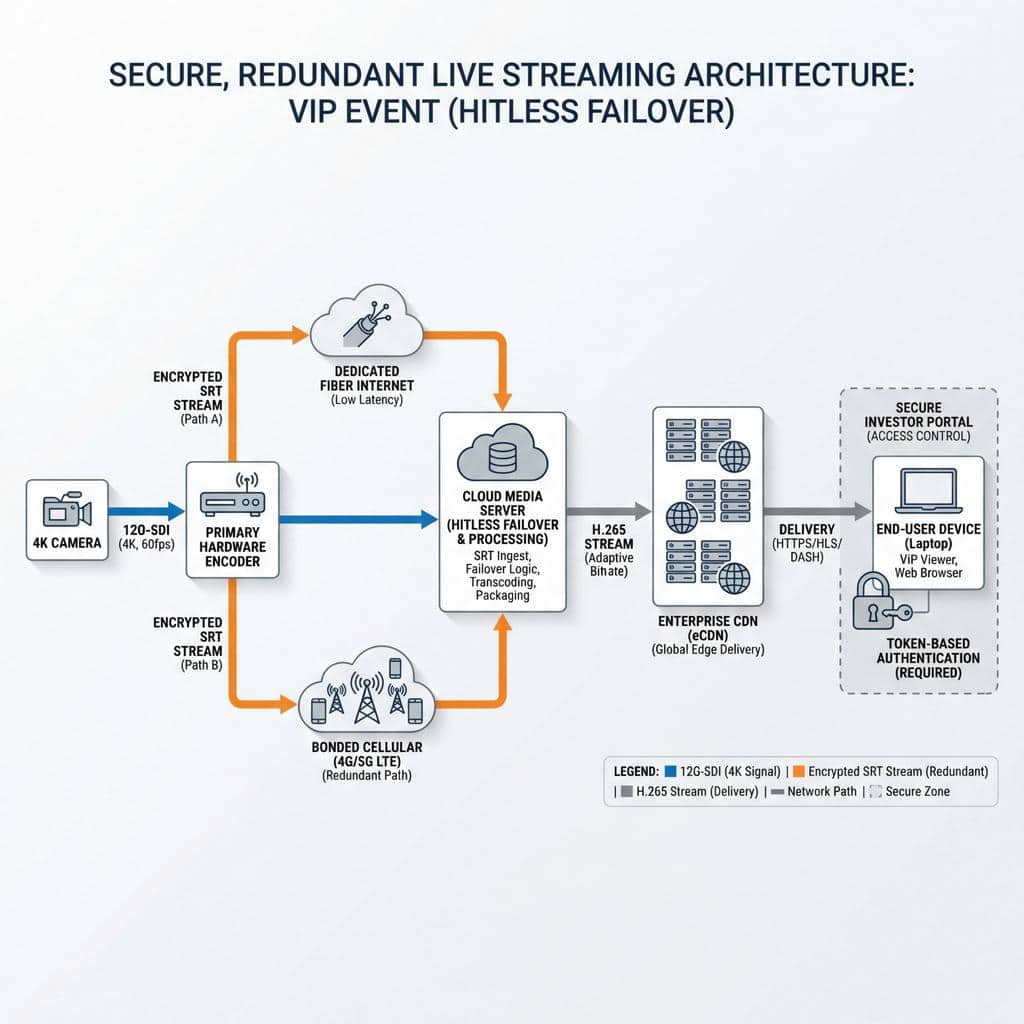
For decades, Real-Time Messaging Protocol (RTMP) was the standard for live stream contribution. However, its limitations in error correction and its declining support make it unsuitable for high-stakes broadcasts. The superior solution is Secure Reliable Transport (SRT), an open-source protocol specifically designed for high-performance streaming over unpredictable networks. SRT provides packet loss recovery through its advanced ARQ (Automatic Repeat reQuest) mechanism, which is critical for maintaining signal integrity over public internet connections. Most importantly, it mandates end-to-end AES-256 bit encryption, ensuring the content is completely secure in transit between the on-site encoder and the cloud media server. This native encryption makes it vastly superior to RTMPS, which only secures the session layer, not the payload itself.
Multi-Layered Access Control and Content Protection
Securing the transport protocol is only the first step. The next critical layer is controlling who can access the stream. A VIP event requires a granular access control system far beyond a simple password. This is achieved through token-based authentication, where each individual viewer is issued a unique, single-use token that grants access for a limited time. This prevents unauthorized sharing of access links. Further layers of security include IP whitelisting, which restricts access to a pre-approved list of IP addresses, and geo-fencing, which limits viewing to specific geographical regions. For maximum content protection against unauthorized recording, enterprise-grade Digital Rights Management (DRM) solutions can be integrated, providing hardware-level control over how the content is decrypted and displayed on the client device.
Network Redundancy and Contribution Path Diversity
For a high-net-worth investor event, there is zero tolerance for failure. Achieving 99.999% uptime requires a sophisticated approach to network connectivity. A primary contribution path should utilize a dedicated, uncontended fiber internet circuit. However, a secondary, completely independent path is essential for failover. This is often achieved using bonded cellular technology, which aggregates multiple cellular connections (from different carriers like Verizon, AT&T, and T-Mobile) into a single, high-bandwidth, and highly resilient stream. Professional-grade hardware encoders support hitless failover, where two identical SRT streams are sent over these diverse network paths. If the primary path experiences packet loss or a complete failure, the receiving media server instantly switches to the secondary path with no interruption to the final output stream.
Production Workflows for Broadcast-Quality Fiduciary Content
The visual and auditory experience for a VIP audience must be flawless. This requires adhering to professional broadcast production standards, not just IT or web conferencing norms. The goal is to produce a clean, clear, and engaging program that communicates authority and professionalism. This involves careful selection of equipment and a disciplined approach to managing the audio and video signal flow from acquisition to encoding.
Signal Acquisition and Routing: The Primacy of SDI
While HDMI is common in consumer and prosumer environments, the professional standard for live production is the Serial Digital Interface (SDI). For 4K/UHD productions, 12G-SDI provides a robust, locking connection capable of carrying an uncompressed 4K 60p video signal, embedded audio, and timecode over a single coaxial cable for up to 100 meters. This reliability is paramount in a live event setting. Within the production environment, Network Device Interface (NDI) offers a powerful IP-based alternative for signal routing. NDI allows high-quality, low-latency video and audio to be sent over a standard 1/10 Gigabit Ethernet network, providing immense flexibility for routing sources from cameras, graphics systems, and remote contributors to the primary production switcher.
Encoding Specifications for Uncompromising Visual Clarity
The quality of the final stream is determined by the encoding process. For 4K/UHD delivery, the H.265 (HEVC) codec is vastly more efficient than the older H.264 (AVC) standard, delivering superior quality at a lower bitrate. For a discerning audience likely viewing on large, high-resolution displays, a high-bitrate stream is essential. An Adaptive Bitrate (ABR) ladder should be configured, but with a top-tier profile delivering between 15 and 25 Mbps for a 3840×2160 resolution at 59.94 frames per second. This ensures that viewers with sufficient bandwidth receive a crystal-clear image free of compression artifacts. The encoder must be a professional hardware unit, not a software-based solution, to ensure dedicated processing power and stable performance over long durations.
Audio Integrity: From Microphone to Endpoint
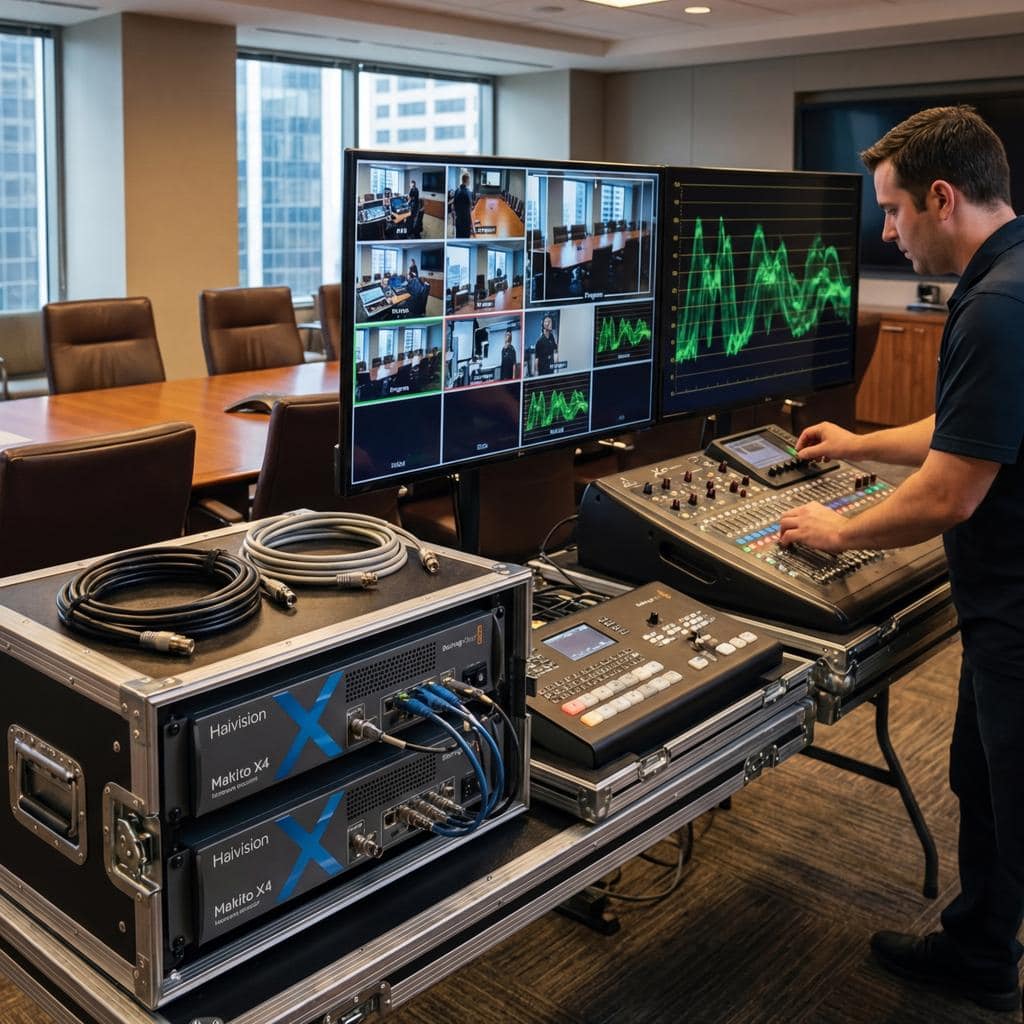
Audio is arguably more critical than video for conveying complex financial information. The audio chain must be pristine from start to finish. This begins with professional microphones connected via balanced XLR cables to a dedicated audio mixing console. The audio engineer’s role is to ensure dialogue is intelligible and free of noise, managing levels and equalization (EQ) for each speaker. The final program audio is then embedded into the SDI video signal and sent to the encoder. During encoding, audio should be compressed using a high-quality codec like AAC at a bitrate of at least 192 kbps, or preferably 320 kbps, to preserve the full frequency range and dynamic nuance of the presenters’ voices.
The Delivery and Engagement Infrastructure
The final stage of the signal chain involves delivering the stream to the end-user and providing secure, professional engagement tools. This last mile is just as critical as the contribution and production phases. Using public-facing video platforms is not an option; a bespoke and secure environment is required to complete the VIP experience.
Enterprise CDN vs. Public CDNs
While public Content Delivery Networks (CDNs) are built for scale, they may not offer the specific security features and granular control required for a private investor event. An Enterprise CDN (eCDN) or a premium-tier public CDN provides significant advantages. These services offer robust security features, including the token authentication and DRM integration discussed earlier. They also provide detailed, real-time analytics, allowing the production team to monitor Quality of Service (QoS) metrics for every single viewer, such as buffering ratios, received bitrate, and latency. This enables proactive troubleshooting and provides valuable post-event data on audience engagement.
Crafting the Bespoke Viewing Environment
The viewing experience should be presented within a custom, brand-aligned microsite or secure investor portal, not on a third-party platform. The video player itself should be a professional HTML5 player configured to meet specific security requirements. This includes disabling playback controls that allow for downloading, preventing right-click context menus, and using iframe embedding with strict domain restrictions to prevent the player from being used on unauthorized websites. This creates a locked-down viewing environment that reinforces the exclusivity and confidentiality of the content.
Integrating Secure, Moderated Interactivity
Interactivity, such as Q&A sessions, must be managed through a secure and moderated channel. The interactive module should be integrated directly into the secure viewing portal via an API. All questions submitted by investors should be routed to a moderation dashboard, where a communications manager can review, approve, and queue them to be answered by the presenters. This prevents inappropriate or off-topic questions from appearing publicly and maintains the professional decorum of the event. Polling and other engagement tools should follow the same secure, moderated workflow to ensure all interactions are controlled and on-brand.
In conclusion, tailoring a virtual experience for high-net-worth investors is a comprehensive technical endeavor. It requires a deep understanding of secure streaming protocols like SRT, broadcast-quality production workflows built on SDI and professional encoding, and a locked-down delivery infrastructure using enterprise-grade CDNs and bespoke viewing portals. By architecting a solution that prioritizes security, reliability, and quality at every stage of the signal chain, organizations can deliver a VIP virtual event that protects sensitive information and powerfully represents their brand.