
Why Standard Green Screens Are Reaching Their Limits in Enterprise Production
Premium brands have never treated visual presentation as decoration. In corporate live events, product launches, shareholder broadcasts, leadership town halls, and hybrid conferences, the visual system is part of the communication infrastructure. Standard green screen workflows, once acceptable for simple chroma key inserts, are increasingly failing to meet the demands of modern enterprise production. The issue is not merely aesthetic. It is technical, operational, and strategic. As event formats have become more immersive, camera movements more dynamic, and audience expectations more exacting, XR, or extended reality, has emerged as the preferred production method for brands that need precision, scalability, and visual authority.
In a live event environment, chroma key depends on stable illumination, careful subject separation, limited motion, controlled wardrobe, and clean edge extraction. These constraints are manageable in a small studio. They become fragile in a corporate keynote hall, an executive briefing center, or a hybrid event venue where lighting conditions, camera positions, talent movement, and networked contribution sources change continuously. XR production reduces reliance on keying by replacing the flat keyed background with a rendered environment, often displayed on LED volumes or large-format LED wall systems, synchronized with camera tracking and real-time rendering engines. The result is not only a more convincing image, but also a more robust production workflow for enterprise use.
For production managers, AV professionals, and IT directors, the shift toward XR is driven by measurable operational advantages. These include reduced keying artifacts, improved subject integration, more consistent camera results across wide shots and close-ups, and stronger visual control over branded environments. In a hybrid event, where in-room and remote audiences must receive the same program feed with minimal latency and predictable picture quality, XR can simplify the image pipeline and reduce the number of failure points created by poor spill suppression, uneven green coverage, and inconsistent talent blocking. For premium brands, that reliability is increasingly non-negotiable.
The Technical Problem with Green Screens in Live Corporate Events
Chroma Key Sensitivity and Lighting Complexity
Green screen production relies on separation between the foreground subject and the chroma background, with clean luminance and color contrast enabling the keyer to isolate the matte. In a live event scenario, that separation is hard to maintain. Corporate event stages often combine key lights, practical lighting, uplighting, presentation monitors, and audience wash. Each of these sources can contaminate the green surface or introduce color spill onto skin, hair, reflective fabrics, eyeglasses, and metallic accessories. Even with disciplined lighting design, the keyer can fail when the presenter moves outside the optimal lighting zone or when the camera exposure shifts under auto-iris or improperly controlled gain.
From an engineering perspective, the challenge is compounded by the need to support multiple camera angles, often with a robotic PTZ camera system, one or more pedestal cameras, and a handheld roaming camera for audience interaction. A green screen that keys well on one angle may break down on another because of perspective distortion, foreground overlap, or inconsistent spill mapping. In hybrid productions, these inconsistencies are amplified because the program feed is distributed to remote participants over RTMP, RTMPS, SRT, Secure Reliable Transport, or enterprise conferencing platforms such as Microsoft Teams, Zoom, and Webex. Compression artifacts introduced downstream can worsen key edges and reveal imperfections that were less visible in the live room.
Scaling Constraints in Multi-Camera and Multi-Format Workflows
Standard green screen also struggles when the production requires simultaneous deliverables. A single corporate event may need a 16:9 live stream, an ISO recording for archive, an executive highlight reel, speaker confidence monitors, and social cutdowns. Each output can have a different aspect ratio, framing requirement, and graphics treatment. Green screen compositing generally happens as a single image construct, which means every change in framing, camera resolution, or lens choice affects the key quality. In contrast, XR environments can be built as volumetric or perspective-correct virtual sets that preserve spatial relationships across cameras, making multicam switching less disruptive and more visually coherent.
When events require 4K/UHD capture at 2160p with 50 or 59.94 frames per second, the demands on keying, bandwidth, and processing rise sharply. The more pixels and motion detail in the image, the more visible any matte instability becomes. Standard chroma workflows are especially sensitive to hair detail, translucent materials, reflective surfaces, and fast camera motion, all common in premium corporate productions where presenters move naturally rather than standing rigidly in place. XR reduces dependence on pixel-perfect matte extraction and shifts complexity toward camera tracking, render synchronization, and signal integrity, which are easier to engineer deterministically.
How XR Production Works in a B2B Event Streaming Environment
LED Volumes, Camera Tracking, and Real-Time Render Engines
XR production combines physical and virtual elements into a single in-camera visual. Instead of keying talent over a green surface, the background is rendered in real time and displayed on LED walls or, in some formats, projected surfaces. Camera tracking systems feed positional data, pan, tilt, zoom, focus, and lens metadata into a render engine such as Unreal Engine or equivalent real-time graphics platforms. This allows the background perspective to shift correctly as the camera moves, preserving parallax and spatial realism. For live corporate events, this is critical because presenters often move between lecterns, product demo zones, and interview positions, while the audience expects a consistent, premium image.
The tracking system may use optical, mechanical, or hybrid measurement methods. Accuracy matters because even small tracking errors produce perspective drift, horizon mismatch, or object occlusion errors. In a broadcast-style XR setup, the render pipeline must remain frame-accurate relative to the camera feed. That requires genlock or at minimum tightly managed synchronization between source cameras, switchers, media servers, and rendering nodes. The goal is to avoid visual tearing, mismatch between foreground and background motion, and any latency that would make the environment feel disconnected from the camera movement.
Signal Flow and Media Infrastructure
A properly designed XR system integrates multiple signal domains. Camera feeds may originate in SDI, Serial Digital Interface, or HDMI 2.1 for shorter local runs, then be converted into SDI or ST 2110-based IP workflows depending on venue scale and equipment ecosystem. For larger enterprise productions, NDI, Network Device Interface, can support flexible IP routing inside a managed network, while SRT can carry contribution feeds across wide-area links with encryption and resilience against packet loss. The switcher, media server, render engine, audio console, and recording platforms all need deterministic routing and synchronized timing. Without that discipline, the result is a visually impressive but operationally unstable system.
Audio should be treated with broadcast rigor. The most elegant visual system fails if dialogue is muddy, mic gain is inconsistent, or latency between in-room reinforcement and program audio is not managed correctly. Corporate XR environments often integrate wireless lavalier microphones, handheld interview microphones, boundary mics for panel tables, and talkback systems for crew coordination. Audio mixing must support a clean program bus, discrete monitor feeds, and if necessary, an auxiliary mix for remote attendees with platform-specific loudness targets. In professional workflow terms, audio is not an afterthought. It is part of the production architecture.
Enterprise Streaming Standards, Protocols, and Reliability Requirements
Encoding, Bitrate Strategy, and Latency Control
For hybrid events, the output chain usually includes a live encoder, adaptive delivery logic, and platform-specific integration for corporate conferencing or managed CDN distribution. RTMP remains common for event ingestion, while RTMPS adds transport security. SRT is increasingly preferred for contribution links because it provides error correction, encryption, and better performance on less predictable networks. Encoding decisions should align with the audience delivery platform, target resolution, motion complexity, and network headroom. For many corporate events, H.264 remains the most interoperable codec, while H.265, also known as HEVC, may be selected where bandwidth efficiency matters and the playback environment is known to support it.
Latency targets depend on the use case. A low-latency executive Q and A with in-room and remote interaction may require a tighter end-to-end budget than a delayed broadcast-style webcast. The XR pipeline itself introduces additional processing, especially when rendering large LED surfaces and synchronizing multiple cameras. For that reason, engineering teams must define latency budgets for capture, rendering, switching, encoding, transport, and player buffering as separate stages rather than treating the stream as a single black box. This is how professional productions maintain confidence in live interaction, especially when presenters are speaking to both a room audience and remote stakeholders at the same time.
Redundancy, Monitoring, and Failover Design
Enterprise-grade streaming cannot depend on a single point of failure. The architecture should include dual encoders, redundant network paths, backup power through UPS systems, mirrored media storage where appropriate, and a clear failover plan for both visuals and audio. In a premium event, a failed network switch, a tracking loss, or an encoder crash cannot be treated as a minor inconvenience. These systems need monitoring through multiview layouts, waveform and vectorscope analysis, confidence monitoring, and health alerts from the network layer. Good operations teams build the production so that a fault degrades gracefully instead of collapsing the entire program.
Standards matter here. SMPTE, the Society of Motion Picture and Television Engineers, defines many of the timing, format, and interoperability expectations that professional workflows rely on. Where IP video is used, alignment with established standards and disciplined network engineering is essential. IT teams should isolate media VLANs, manage multicast where required, prioritize traffic using QoS, and verify that switches support the throughput, buffering, and clock synchronization demands of live media. For larger campuses or international hybrid events, the network design should include testing under realistic load, not just theoretical bandwidth calculations.
Production Design Advantages of XR for Premium Brands
Visual Consistency Across Executive, Product, and Investor Events
Premium brands want consistency. XR enables branded environments that can be reused across leadership broadcasts, product launches, analyst briefings, and internal town halls without rebuilding physical scenic elements every time. The virtual environment can be adjusted for different messaging goals while preserving a coherent design language. A company can present a polished keynote stage, a minimalist executive interview space, or a data-rich product showcase using the same underlying production architecture. That consistency is difficult to achieve with green screen, where every visual change depends on matching light, matte, and camera behavior in real time.
XR also supports more confident camera choreography. Because the background is rendered to match the lens and movement, operators can use wider shots, slower pushes, and more cinematic blocking without exposing the edge cases that often reveal chroma key imperfections. This is especially important when a brand wants a premium visual signature rather than a generic webcast look. The difference is visible in on-camera authority, presentation clarity, and audience perception of technical competence.
Practical Implementation in Hybrid Event Venues
In practical terms, a hybrid event venue needs defined signal zones, clear cable management, a controlled camera plan, and dedicated engineering space for media servers, switching, and monitoring. If the XR system uses large-format LED walls, content calibration must be verified before doors open, including color uniformity, refresh behavior, scan performance, and brightness balancing. The venue’s power and cooling design must support the additional load of displays, compute nodes, and tracking hardware. For multi-day events, thermal stability is not optional. Even small shifts in hardware temperature can affect fan behavior, processing stability, and long-run reliability.
The production team should also establish a workflow for content versioning and cueing. Live XR shows often combine pre-rendered motion graphics, lower thirds, sponsor assets, presentation slides, and real-time environmental scenes. These assets must be managed with broadcast discipline so that a last-minute change does not introduce incorrect aspect ratios, alpha handling issues, or color space mismatches. In a well-run corporate workflow, assets are tested in the final signal chain, not assumed to work because they were approved in desktop review.
When to Choose XR Over Green Screen, and How to Make the Transition
Decision Criteria for Enterprise Stakeholders
XR is not the right answer for every live event. Smaller internal webinars, simple one-camera talks, and low-budget training sessions may still be better served by a controlled green screen or a traditional physical set. The decision should be based on production value, camera count, presenter movement, content complexity, audience expectation, and the need for reusable branded environments. If the event requires premium visual continuity, wide-angle camera movement, polished multi-angle switching, and a level of environmental control that green screen cannot reliably provide, XR is the stronger choice.
Enterprise stakeholders should evaluate the full system cost, not just the visual outcome. XR demands more planning, more precise integration, and more technical coordination across video, audio, network, and rendering teams. However, it often reduces risk during live execution because the production is less dependent on perfect chroma conditions. In high-visibility scenarios such as investor days, global sales kickoffs, government briefings, or product reveals with simultaneous in-room and remote participation, that reduction in fragility is often worth the higher upfront complexity.
Implementation Guidelines for Corporate Production Teams
Before deployment, define the production objectives, camera plan, signal format, and delivery endpoints. Confirm whether the event will use SDI, NDI, or a hybrid transport model. Establish the encoding target, whether RTMP, RTMPS, SRT, or a platform-specific ingest path. Set the program feed resolution and frame rate early, then align the camera system, switcher, graphics engine, and recording workflow to that standard. If the production requires 4K/UHD, verify that every link in the chain, including capture cards, media servers, displays, and monitors, can sustain the required throughput without forced conversions.
Next, validate the venue infrastructure. Measure network capacity, isolate production traffic, and test failover paths. Confirm audio routing, monitor mixes, and talkback. Verify color management, exposure, and synchronization. Run full rehearsal conditions with actual presenters, real slide decks, and final graphics. This is where XR proves its value. Once the system is aligned, the production team can deliver a controlled, premium result that scales from the main stage to the remote audience without the fragility of a standard green screen workflow.
The shift away from standard green screens is not a trend driven by style alone. It is a response to the engineering realities of modern B2B live production. Premium brands need reliable image integration, repeatable execution, and a visual system that withstands the demands of hybrid delivery. XR meets that requirement by combining real-time rendering, synchronized camera tracking, broadcast-grade signal management, and enterprise network discipline into a production model built for serious corporate events. For organizations that treat live streaming as a strategic communications channel, XR is becoming the standard, not the exception.
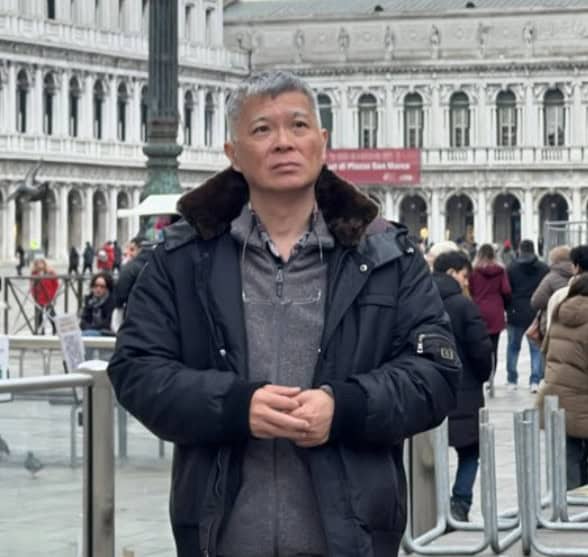
Michael Koh is a production specialist and entrepreneur who founded Spring Forest Studio in 2017 to provide event and virtual production solutions in Singapore. He specialises in hybrid live streaming, XR (Extended Reality) virtual production, and studio systems integration, transitioning the business from traditional videography to advanced corporate broadcasting. Operating out of a dedicated facility at NordCom2 in Singapore, he leads a technical crew to deliver multi-camera webcasts, digital sets, and technical consultations for large-scale corporate events.