 March 10, 2026 by Editor |
The Uncompromising Mandate for Transparency in Digital AGMs
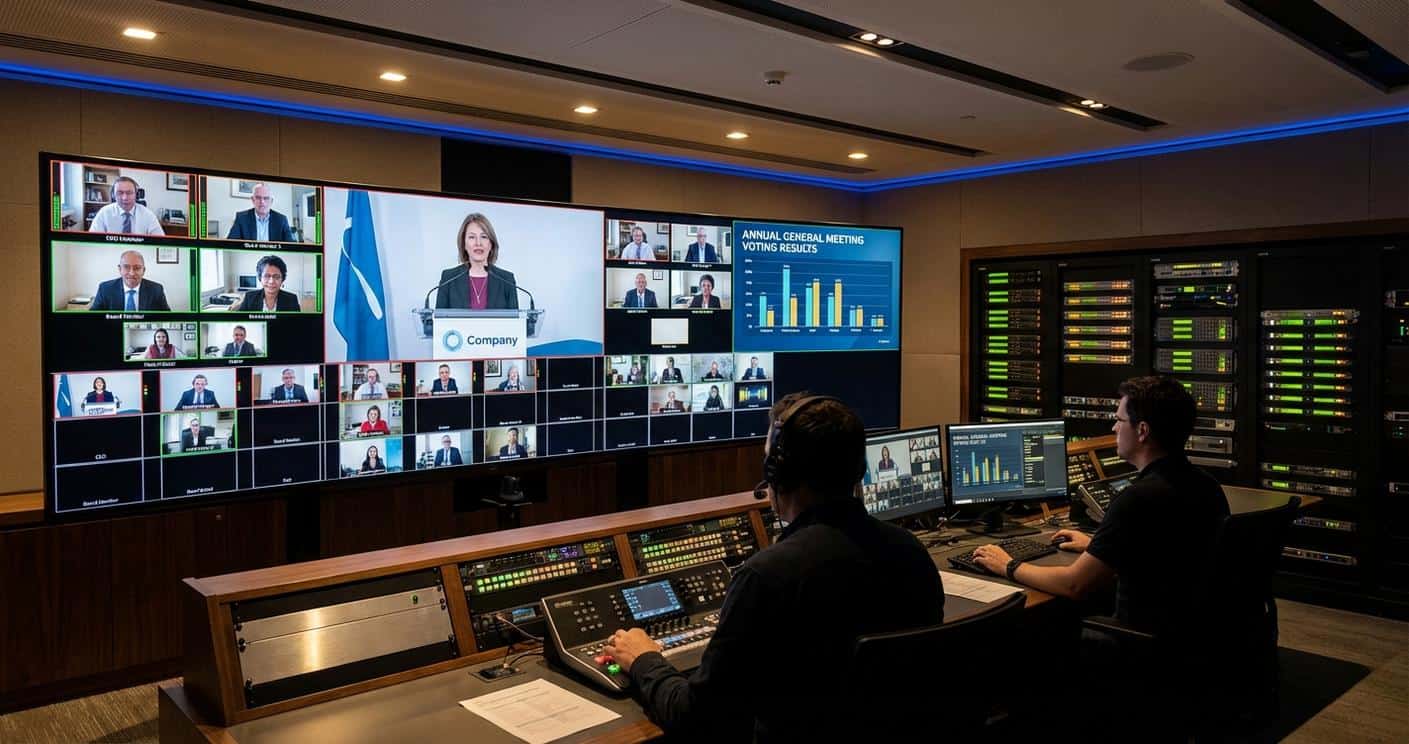
The transition to digital and hybrid Annual General Meetings (AGMs) is no longer a novelty; it is a fundamental component of modern corporate governance. For enterprise decision-makers, IT directors, and production managers, this shift presents a mission-critical challenge: how to replicate the procedural integrity and legal defensibility of an in-person vote within a distributed, digital ecosystem. The stakes are immense. A flawlessly executed AGM stream with a transparent voting process reinforces shareholder confidence, whereas a technical failure can lead to invalidated resolutions, legal challenges, and significant reputational damage. This is not a task for consumer-grade webinar platforms. It demands a broadcast-level production ethos, a deep understanding of network engineering, and a robust infrastructure designed for absolute reliability. The core objective is to create a single, verifiable source of truth that is simultaneously accessible to a global audience, secure from manipulation, and auditable for regulatory compliance. This requires a holistic approach that integrates high-availability streaming architecture with secure, API-driven voting platforms and meticulous production workflows.
Foundational Infrastructure: The Bedrock of Secure AGM Streaming
Before a single vote is cast, the underlying technical infrastructure must be architected for resilience and security. The entire process hinges on the uninterrupted, high-quality delivery of the primary program feed. Any compromise in this foundational layer undermines the credibility of the entire event. We approach this by engineering a multi-layered system where every critical component has a redundant counterpart.
Encoding and Protocol Selection for Mission-Critical Feeds
The initial stage of any professional stream is video encoding, and for AGMs, the choice of protocol is paramount. While Real-Time Messaging Protocol (RTMP) has been a workhorse, its reliance on TCP makes it vulnerable to packet loss over unstable networks. For high-stakes corporate governance, we exclusively recommend Secure Reliable Transport (SRT). SRT, an open-source protocol, provides the security of AES-128/256 encryption and excels at maintaining stream integrity over unpredictable public internet connections by using advanced error correction. For a primary 1080p60 program feed, we typically configure our hardware encoders, such as the Haivision Makito X4, to output an H.264 stream at 6 to 8 Mbps. For clients requiring 4K/UHD delivery for premium visual quality, we utilize H.265 (HEVC) encoding to maintain comparable quality at a similar bitrate, optimizing bandwidth consumption. The key is that SRT provides the robust pipe needed to transport this encoded video to the cloud or on-premise media server with measurable, low latency.
Redundancy and Failover Architecture
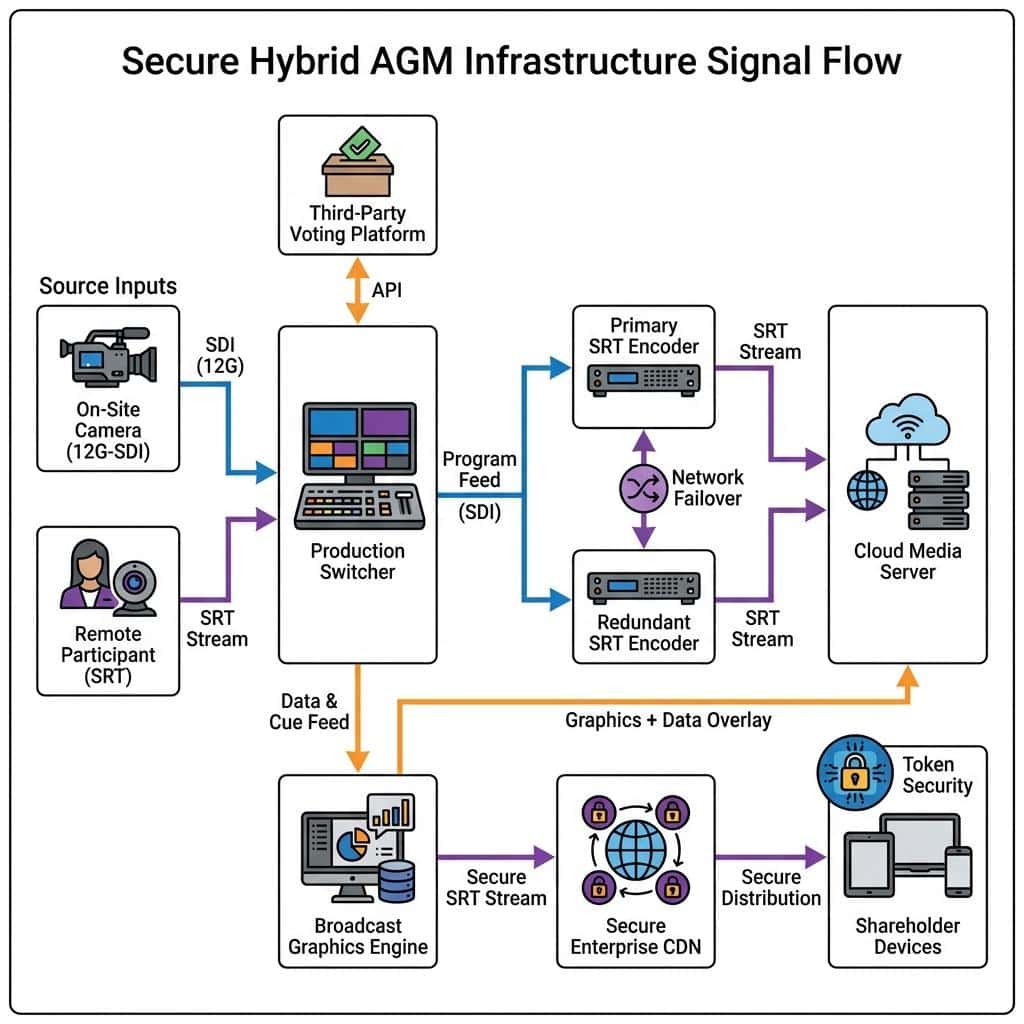
Single points of failure are unacceptable in the context of an AGM. Our standard deployment model is a 1+1 or N+1 redundancy for all critical path components. This begins with the encoders. We configure two identical hardware encoders, fed from the same SDI (Serial Digital Interface) program output from the video switcher. Each encoder runs on a separate power circuit and utilizes a different internet egress path. One path might be the primary fiber line, while the secondary path uses a bonded cellular solution (e.g., LiveU or Teradek Bond) or a secondary ISP. These two independent SRT streams are sent to the media server, which is configured for seamless source failover. If the primary encoder or its network path fails, the server automatically switches to the secondary stream with no perceptible interruption to the end viewer. This architecture ensures that a hardware failure or local network outage does not derail the meeting.
Secure Content Delivery Network (CDN) Integration
The final delivery mechanism must be as secure as the contribution path. We integrate with enterprise-grade CDNs that provide robust security features far beyond simple stream delivery. Access control is managed via token-based authentication, where the viewing portal validates a shareholder’s credentials and issues a time-limited, single-use token to access the video stream. This prevents unauthorized viewing or stream ripping. Furthermore, we implement geo-fencing to restrict access to specific countries or regions and can apply Digital Rights Management (DRM) for an additional layer of content protection. This secure CDN infrastructure is crucial for ensuring that only verified, eligible shareholders can view the proceedings and access the integrated voting platform.
Integrating Verifiable Voting Platforms into the Production Workflow
A successful digital AGM is not just a video stream; it is an interactive system where the video, audio, and voting mechanics are perfectly synchronized and transparently presented. This requires a tight integration between the live production environment and the specialized third-party voting platform (e.g., Lumi, Broadridge). This integration is achieved through a combination of meticulous signal flow management and API-driven data exchange.
Signal Flow for Hybrid AGMs: Merging Physical and Virtual Inputs
In a hybrid AGM, the production switcher is the heart of the operation. We build the signal flow around a professional broadcast switcher like a Blackmagic ATEM Constellation 8K or a Ross Carbonite Ultra. Physical inputs arrive via 12G-SDI from cameras capturing the boardroom and on-site presenters. Audio is managed on a separate digital network, typically using Dante, with all microphones and audio sources routed into a digital mixer (like a Yamaha QL5) before the final program mix is embedded into the SDI video feed. Remote contributors, such as board members joining from home, are brought into the workflow using SRT or NDI (Network Device Interface). Their return feeds are converted back to SDI for input into the switcher. This allows the Technical Director to switch seamlessly between on-site cameras, remote presenters, and presentation graphics, creating a polished and professional program feed that serves as the visual basis for the meeting.
API-Driven Graphics and Data Integration for Real-Time Results
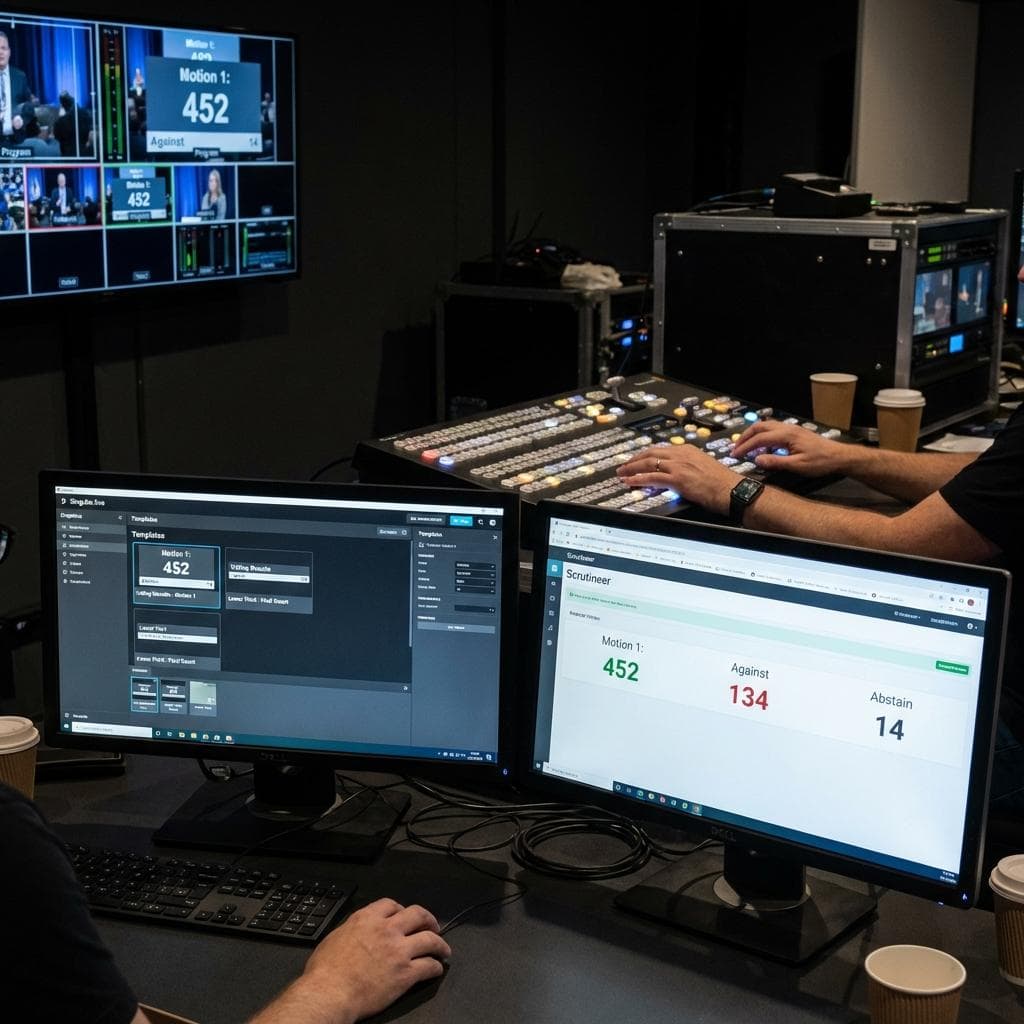
Transparency in voting is achieved by showing, not just telling. We leverage the Application Programming Interface (API) provided by the official voting platform to pull real-time data directly into our broadcast graphics system, such as Vizrt or Singular.live. When a motion is proposed, the exact text of the motion is pulled via API and displayed as a lower-third graphic. When voting is opened, a graphic confirms this status. Crucially, once the polling period closes and the scrutineer validates the results, the final tally (votes for, votes against, abstentions) is pushed from the voting platform’s API to our graphics engine. This data then populates a full-screen graphic that is immediately keyed into the program feed. This direct data link ensures that the results displayed to shareholders are the official, untampered results from the audited platform, eliminating the possibility of human error in transcription and building immense trust in the process.
Latency Management and Synchronization
For voting to be fair, every participant must receive the information at the same time. We obsessively manage latency throughout the entire signal chain. By using SRT for contribution and a WebRTC-based or low-latency HLS delivery via the CDN, we can achieve a glass-to-glass latency of under three seconds. This is critical. It ensures that when the chairperson announces, “Voting is now open,” the video, the audio, and the activation of the voting button on the shareholder’s device are nearly simultaneous. We further ensure synchronization by slaving all production equipment to a master clock using a Network Time Protocol (NTP) server. This guarantees that all recorded media, logs from the streaming server, and the voting platform’s transaction records share a common, accurate timestamp, which is essential for any potential post-event audit.
Production Best Practices for Legally Defensible Governance
Technology alone is insufficient. The human operational workflow is the final layer of assurance that guarantees a transparent and orderly digital AGM. Our production methodologies are designed around clear roles, secure communications, and comprehensive record-keeping to create a legally defensible audit trail.
The Role of the Technical Director and Scrutineer Integration
The control room operates with a strict separation of duties. The Technical Director (TD) is exclusively focused on cutting the show; switching cameras, rolling video playouts, and executing the run-of-show. A separate Graphics Operator is responsible for managing the data-driven voting graphics. This operator often has a direct line of communication or a shared screen view with the official, independent scrutineer. The scrutineer’s interface is fed into the control room’s multiview monitoring system, so the production team can see precisely what the auditor is seeing. The Graphics Operator only triggers the display of results after receiving explicit confirmation from the scrutineer that they have been verified. This human-in-the-loop workflow provides a critical check-and-balance to the automated API data feed.
Secure Communication Systems for Key Personnel
Clear, private communication is non-negotiable. The AGM chairperson, board members, the TD, the graphics operator, and the legal scrutineer must be connected via a secure, full-duplex talkback or intercom system, such as a Riedel Bolero wireless system. This allows the chairperson to be cued on procedural steps, for the TD to receive instructions without being heard by the public audience, and for the scrutineer to privately confirm the readiness of results before they are made public. This closed-loop communication system is essential for managing the meeting flow smoothly and reacting to any unforeseen technical or procedural issues in real-time without alarming shareholders.
ISO Recording and Archival for Comprehensive Audit Trails
The final pillar of a defensible digital AGM is a complete and unimpeachable record of the event. We implement a comprehensive recording strategy. In addition to the main program feed, we perform isolated (ISO) recordings of every single camera and remote presenter feed. We also record a clean feed (without graphics) and a dirty feed (with graphics). Most importantly, we capture a high-quality screen recording of the scrutineer’s official voting platform interface throughout the event. All of these assets are recorded with matching timecode locked to the master NTP clock. This creates a comprehensive archive that can be used to verify every second of the proceedings, cross-reference the video with the voting platform’s data logs, and provide an indisputable audit trail for regulatory bodies or legal review. This level of diligence, compliant with information security principles like those in ISO 27001, transforms the live stream from a simple broadcast into a secure, verifiable record of corporate governance in action.